Posts Tagged ‘Afghanistan’

US: Court Ruling Revokes Protection for Bagram Detainees

May 22, 2010

Foreigners Arrested Outside Afghanistan Can’t Challenge Detention in US Courts

Human Rights Watch, May 21, 2010

People arrested outside of Afghanistan and detained at Bagram should have the same rights as those held at Guantanamo. This misguided ruling leaves them with no legal remedy against indefinite and unlawful detention.

Andrea Prasow, senior counterterrorism counsel at Human Rights Watch

(Washington, DC) – A US federal appeals court ruling today that bars the courts from hearing the claims of detainees arrested outside of Afghanistan and brought to Bagram Air Base in Afghanistan leaves them without legal recourse against unlawful detention and other abuses, Human Rights Watch said today.

In April 2009, a federal district court ruled that three men held at Bagram who were arrested outside of Afghanistan had the right to challenge their detention in US federal court. Citing the Supreme Court’s historic 2008 ruling in Boumediene v. Bush, the court found that the three men were similarly situated to detainees at Guantanamo Bay. Today’s ruling, issued by the US Court of Appeals for the DC Circuit, reversed that decision, finding that because Afghanistan is “a theater of war,” detainees held at Bagram, regardless of where they were captured, have no constitutional right to challenge their detention in a US court.

“People arrested outside of Afghanistan and detained at Bagram should have the same rights as those held at Guantanamo,” said Andrea Prasow, senior counterterrorism counsel at Human Rights Watch. “This misguided ruling leaves them with no legal remedy against indefinite and unlawful detention.”

The three detainees in question – two Yemenis and a Tunisian – all claim they were captured outside of Afghanistan, far from any battlefield. Human Rights Watch has interviewed close relatives of one of the Yemenis, Amin al-Bakri. Al-Bakri’s father told Human Rights Watch that he had to hire a private detective to learn that his son, a gem trader and father of three, was picked up in late 2002 during a business trip to Thailand. He said he did not receive a letter from his son for a full year after his arrest.

The ruling will likely be appealed to the Supreme Court, although the court need not accept the case. The Supreme Court has rejected the DC Circuit’s reasoning in numerous other detainee cases, including Rasul v. Bush, Hamdan v. Rumsfeld, and Boumediene v. Bush, each time finding that the detainees had greater rights to judicial review than the DC Circuit had held.

In its ruling today, the court acknowledged that the review procedures available to the Bagram detainees “afford even less protection” than the procedures that were available at Guantanamo. Since Guantanamo detainees have been able to challenge their detention in court, the federal district courts have ordered the release of 35 detainees, while finding that the government was lawfully detaining only 13.

While holding that US courts do not have jurisdiction over Bagram, the appellate court rejected the government’s broader claim that all detainees held outside the United States and Guantanamo have no constitutional right of access to the courts.

Human Rights Watch expressed concern about the incentives created by the court’s ruling, noting that systematic and notorious detention abuses over the past decade have underscored the need for court scrutiny of detention of people apprehended outside of the United States.

“The appeals court holding means that people apprehended anywhere in the world can be whisked off to Bagram and hidden from court review,” Prasow said. “Just because the plane landed at Bagram instead of Guantanamo should not mean they can be held indefinitely without any court review.”

(Washington, DC, May 21, 2010) – A US federal appeals court ruling today that bars the courts from hearing the claims of detainees arrested outside of Afghanistan and brought to Bagram Air Base in Afghanistan leaves them without legal recourse against unlawful detention and other abuses, Human Rights Watch said today.

In April 2009, a federal district court ruled that three men held at Bagram who were arrested outside of Afghanistan had the right to challenge their detention in US federal court. Citing the Supreme Court’s historic 2008 ruling in Boumediene v. Bush, the court found that the three men were similarly situated to detainees at Guantanamo Bay. Today’s ruling, issued by the US Court of Appeals for the DC Circuit, reversed that decision, finding that because Afghanistan is “a theater of war,” detainees held at Bagram, regardless of where they were captured, have no constitutional right to challenge their detention in a US court.

“People arrested outside of Afghanistan and detained at Bagram should have the same rights as those held at Guantanamo,” said Andrea Prasow, senior counterterrorism counsel at Human Rights Watch. “This misguided ruling leaves them with no legal remedy against indefinite and unlawful detention.”

The three detainees in question – two Yemenis and a Tunisian – all claim they were captured outside of Afghanistan, far from any battlefield. Human Rights Watch has interviewed close relatives of one of the Yemenis, Amin al-Bakri. Al-Bakri’s father told Human Rights Watch that he had to hire a private detective to learn that his son, a gem trader and father of three, was picked up in late 2002 during a business trip to Thailand. He said he did not receive a letter from his son for a full year after his arrest.

The ruling will likely be appealed to the Supreme Court, although the court need not accept the case. The Supreme Court has rejected the DC Circuit’s reasoning in numerous other detainee cases, including Rasul v. Bush, Hamdan v. Rumsfeld, and Boumediene v. Bush, each time finding that the detainees had greater rights to judicial review than the DC Circuit had held.

In its ruling today, the court acknowledged that the review procedures available to the Bagram detainees “afford even less protection” than the procedures that were available at Guantanamo. Since Guantanamo detainees have been able to challenge their detention in court, the federal district courts have ordered the release of 35 detainees, while finding that the government was lawfully detaining only 13.

While holding that US courts do not have jurisdiction over Bagram, the appellate court rejected the government’s broader claim that all detainees held outside the United States and Guantanamo have no constitutional right of access to the courts.

Human Rights Watch expressed concern about the incentives created by the court’s ruling, noting that systematic and notorious detention abuses over the past decade have underscored the need for court scrutiny of detention of people apprehended outside of the United States.

“The appeals court holding means that people apprehended anywhere in the world can be whisked off to Bagram and hidden from court review,” Prasow said. “Just because the plane landed at Bagram instead of Guantanamo should not mean they can be held indefinitely without any court review.”

Seymour Hersh Says US Troops Executing Prisoners in Afghanistan

May 13, 2010

David Edwards, LewRockwell.com, May 13, 2010

The journalist who helped break the story that detainees at the Abu Ghraib prison in Iraq were being tortured by their US jailers told an audience at a journalism conference last month that American soldiers are now executing prisoners in Afghanistan.

New Yorker journalist Seymour Hersh also revealed that the Bush Administration had developed advanced plans for a military strike on Iran.

At the Global Investigative Journalism Conference in Geneva, Hersh criticized President Barack Obama, and alleged that US forces are engaged in “battlefield executions.”

Continues >>

Reuters: Civilian casualties rising in Afghanistan

May 13, 2010
Reuters,  May 12, 2010

* Ninety civilians killed in January to April period

* Deaths up from 2009 despite efforts to avoid killings

WASHINGTON, May 12 (Reuters) – The number of civilians killed by U.S. and NATO forces in Afghanistan has risen this year, despite efforts to limit fallout from the widening war against the Taliban, the Pentagon said on Wednesday.

Citing NATO statistics, the Pentagon said U.S. and NATO forces killed 90 civilians from January to April — a 76 percent rise from the 51 deaths in the same period of 2009.

The increase demonstrates the difficulty of shielding Afghans from violence as the United States pours thousands more troops into Afghanistan to challenge the Taliban, often in strongholds where insurgents hide among the population.

The U.S. military has made reducing civilian casualties an explicit goal of its revised Afghan strategy, given that popular support for NATO and Afghan forces is ultimately needed to isolate the Taliban and win the war.

President Barack Obama restated the goal on Wednesday, saying the United States was doing everything possible to avoid killing “somebody who’s not on the battlefield.” [ID:nN12185754]

“Our troops put themselves at risk, oftentimes, in order to reduce civilian casualties,” Obama told a joint news conference in Washington with visiting Afghan President Hamid Karzai.

“Oftentimes they’re holding fire, they’re hesitating, they’re being cautious about how they operate, even though it would be safer for them to go ahead and just take these locations out.”

Many of the deaths appeared to be related to several high-profile incidents, top among them an air strike in February that a NATO official said killed 23 civilians.

The NATO official, commenting on the numbers, stressed the increase in killings must be seen in the context of a larger U.S. fighting force that is directly engaging the Taliban in former strongholds.

The United Nations says foreign and Afghan troops killed 25 percent fewer civilians in 2009 than during the previous year. But civilian deaths rose overall because the number killed by insurgents climbed 40 percent. (Reporting by Phil Stewart; Editing by John O’Callaghan)

What I Learned In Afghanistan – About The United States

May 9, 2010

By Dana Visalli, Lew Rockwell.com, May 9, 2010

I was surprised on my recent trip to Afghanistan that I learned so much…about the United States. I was in Afghanistan for two weeks in March of this year, meeting with a large number of Afghans working in humanitarian endeavors – the principal of a girls’ school, the director of a school for street children, the Afghan Human Rights Commission, a group working on environmental issues. The one thing that all of these groups that we met with had in common was, they were penniless. They all survived on rather tenuous donations made by philanthropic foundations in Europe.

I had read that the United States had spent $300 billion dollars in Afghanistan since the invasion and occupation of that country ten years ago, so I naturally became curious where this tremendous quantity of money and resources had gone. Many Americans had said to me that we were in Afghanistan “to help Afghan women,” and yet we were told by the director of the Afghan Human Rights Commission, and we read in the recent UN report titled “Silence is Violence,” that the situation for women there was growing more violent and oppressive each year. So I decide to do some research.

95% of the $300 billion that the U.S. has spent on its Afghanistan operation since we invaded the country in 2001 has gone to our military operations there. Several reports indicate that it costs one million dollars to keep one American soldier in that country for one year. We will soon have 100,000 troops in Afghanistan, which will cost a neat $100 billion a year.

US soldiers in Afghanistan spend almost all of their time on one of our 300 bases in that country, so there is nothing they can do to help the Afghan people, whose physical infrastructure has been destroyed by the “30-year war” there, and who are themselves mostly jobless in a society in which there is almost no economy and no work.

Some effort is made to see that the remaining 5% of the $300 billion spent to date in Afghanistan does help Afghan society, but there is so much corruption and general lawlessness that the endeavor is largely futile. We were told by a female member of the Afghan parliament of one symbolic incident in which a container of medical equipment that was purchased in the US with US government funds for a clinic in Ghawr province, west of Kabul. It was shipped from the US, but by the time it arrived in Ghawr it was just an empty shell; all the equipment had been pilfered along the way.

Violence against women is increasing in Afghanistan at the present time, not decreasing. The Director of the Afghan Human Rights Commission told us of a recent case in which a ten-year-old girl was picked up by an Afghan Army commander in his military vehicle, taken to the nearby base and raped. He brought her back to her home semiconscious and bleeding, after conveying to her that if she told what had happened he would kill her entire family. The human rights commissioner ended the tale by saying to us the he could tell us “a thousand stories like this.” There has been a rapid rise in the number of self-immolations – women burning themselves to death – in Afghanistan in the past three years, to escape the violence that pervades many women’s lives – under the nine-year US occupation.

Armed conflict and insecurity, along with criminality and lawlessness, are on the rise in Afghanistan. In this respect, the country mirrors experience elsewhere which indicates a near universal co-relation between heightened conflict, insecurity, and violence against women.

Once one understands that the US military presence in Afghanistan is not actually helping the Afghan people, the question of the effectiveness or goodwill of other major US military interventions in recent history arises. In Vietnam, for example, the country had been a colony of France for the 80 years prior to WW II, at which point the Japanese invaded and took over. When the Japanese surrendered, the Vietnamese declared their independence, on September 2, 1945. In their preamble they directly quoted the US Declaration of Independence (“All men are created equal. They are endowed by their Creator with certain inalienable rights; among these are Life, Liberty, and the pursuit of Happiness….”).

The United States responded first by supporting the French in their efforts to recapture their lost colony, and when that failed, the US dropped 10 million tons of bombs on Vietnam – more than were dropped in all of World War II – sprayed 29 million gallons of the carcinogenic defoliant Agent Orange on the country, and dropped 400,000 tons of napalm, killing a total 3.4 million people. This is an appreciable level of savagery, and it would be reasonable to ask why the United States responded in this way to the Vietnamese simply declaring their inalienable rights.

There was a sideshow to the Vietnam war, and that is that the United States conducted massive bombing campaigns against Vietnam’s two western neighbors, Laos and Cambodia. From 1964 to 1973, the US dropped more than two million tons of ordnance over Laos in a operation consisting of 580,000 bombing missions – equal to a planeload of bombs every eight minutes, 24 hours a day, for nine years. This unprecedented, secret bombing campaign was conducted without authorization from the US Congress and without the knowledge of the American people.

The ten-year bombing exercise killed an estimated 1 million Laotians. Despite questions surrounding the legality of the bombings and the large toll of innocent lives that were taken, the US Undersecretary of State for Political Affairs at the time, Alexis Johnson, stated, “The Laos operation is something of which we can be proud as Americans. It has involved virtually no American casualties. What we are getting for our money there . . . is, I think, to use the old phrase, very cost effective.”

One Laotian female refugee recalled the years of bombing in this way: “Our lives became like those of animals desperately trying to escape their hunters . . . Human beings, whose parents brought them into the world and carefully raised them with overflowing love despite so many difficulties, these human beings would die from a single blast as explosions burst, lying still without moving again at all. And who then thinks of the blood, flesh, sweat and strength of their parents, and who will have charity and pity for them? In reality, whatever happens, it is only the innocent who suffer.”

In Cambodia, the United States was concerned that the North Vietnamese might have established a military base in the country. In response, The US dropped three million tons of ordnance in 230,000 sorties on 113,000 sites between 1964 and 1975. 10% of this bombing was indiscriminate, with 3,580 of the sites listed as having “unknown” targets and another 8000 sites having no target listed at all. About a million Cambodians were killed (there was no one counting), and the destruction to society wrought by the indiscriminate, long-term destruction is widely thought to have given rise to the Khmer Rouge, who proceeded, in their hatred for all things Western, to kill another 2 million people.

Four days after Vietnam declared its independence on September 2, 1945, “Southern Korea” also declared independence (on September 6), with a primary goal of reuniting the country – which had been split into north and south by the United States only seven months before. Two days later, on September 8, 1945, the US military arrived with the first of 72,000 troops, dissolved the newly formed South Korean government, and flew in their own chosen leader, Syngman Rhee, who had spent the previous 40 years in Washington D.C. There was considerable opposition to the US control of the country, so much that 250,000 and 500,000 people were killed between 1945 and 1950 resisting the American occupation, before the actual Korean War even started.

The Korean War, like Vietnam, Laos, Cambodia, Iraq, and Afghanistan, was an asymmetrical war, in which the highly industrialized and mechanized US pulverized the comparatively primitive North Korean nation. One third of the population of North Korea was killed in the war, a total of three million people (along with one million Chinese and 58,000 Americans). Every city, every sizable town, every factory, every bridge, every road in North Korea was destroyed. General Curtis LeMay remarked at one point that the US had “turned every city into rubble,” and now was returning to “turn the rubble into dust.” A British reporter described one of the thousands of obliterated villages as “a low, wide mound of violet ashes.” General William Dean, who was captured after the battle of Taejon in July 1950 and taken to the North, later said that most of the towns and villages he saw were just “rubble or snowy open spaces.”

More napalm was dropped on Korea than on Vietnam, 600,000 tons compared to 400,000 tons in Vietnam. One report notes that, “By late August, 1950, B-29 formations were dropping 800 tons a day on the North. Much of it was pure napalm. Vietnam veteran Brian Wilson asks in this regard, “What it is like to pulverize ancient cultures into small pebbles, and not feel anything?”

In Iraq, Saddam Hussein came to power through a U.S.- CIA engineered coup in 1966 that overthrew the socialist government and installed Saddam’s Baath Party. Later conflict with Saddam let to the first and second Gulf Wars, and to thirteen years of severe U.S.-imposed economic sanctions on Iraq between the two wars, which taken together completely obliterated the Iraqi economy. An estimated one million people were killed in the two Gulf wars, and the United Nations estimates that the economic sanctions, in combination with the destruction of the social and economic infrastructure in the First Gulf War, killed another million Iraqis. Today both the economy and the political structure of Iraq are in ruins.

This trail of blood, tears and death smeared across the pages of recent history is the reason that Martin Luther King said in his famous Vietnam Speech that the United States is “the greatest purveyor of violence in the world today.” Vietnam veteran Mike Hastie expanded the observation when he said in April of this year (2010) that, “The United States Government is a nonstop killing machine. The worst experience I had in Vietnam was experiencing the absolute truth of Martin Luther King’s statement. America is in absolute psychiatric denial of its genocidal maniacal nature.”

A further issue is that “war destroys the earth.” Not only does, as President Dwight D. Eisenhower said in 1960, “Every rocket fired signify a theft from those who hunger and are not fed, those who are cold and are not clothed,” but every rocket that is fired reduces the life-sustaining capacity of the biosphere. In an ultimate sense it could be argued that those who wage war and those who pay for and support war, in reality bear some hidden hatred for life and some hidden desire to put and end to it.

What are our options? The short answer is, grow up. Grow up into the inherent depth of your own existence. After all, you are a “child of the universe, no less than the trees and stars, you have a right be here.” There is no viable, universally inscribed law that compels you to do as you are told to do by the multitude of dysfunctional and destructive authority figures that would demand your compliance, if you acquiesce.

“If we led our lives according to the ways intended by nature,” wrote French author La Boétie in his book The Politics of Obedience,” we should be intuitively obedient to our parents; later we should adopt reason as our guide and become slaves to nobody.” La Boétie wrote this in the year 1552, but people today remain slaves to external authority. “Our problem,” said historian Howard Zinn, “is not civil disobedience; our problem is civil obedience. Our problem is that people all over the world have obeyed the dictates of the leaders of their government and have gone to war, and millions have been killed because of this obedience. Our problem is that people are obedient all over the world in the face of poverty and starvation and stupidity, and war, and cruelty.”

Do you want to spend your life paying for the death of people (executed by the US military) that you would probably have loved if you have met them? Do you want to spend your life paying for the arsenal of hydrogen bombs that could very well destroy most of the life on the planet? If not, if you want another kind of life, then as author James Howard Kunstler often suggests, ‘You will have to make other arrangements.” You will have to arrange to live according to your own deepest ethical standards, rather than living in fear of the nefarious authority figures that currently demand your obedience and threaten to punish you if you do not obey their demands on your one precious chance at life.

“We must know how the first ruler came by his authority.” ~ John Locke

“How does it become a man to behave toward this American government today? I answer that he cannot without disgrace be associated with it.” ~ Henry David Thoreau

Dana Visalli [dana@methownet.com] is an ecologist, botanist and organic farmer living in Twisp, Washington.

Copyright © 2010 Dana Visalli

America’s War Disease

May 8, 2010
Truthdig.com,  May 7, 2010
U.S. soldier in Afghanistan
Flickr / U.S. Army
Sgt. 1st Class Phillip Wire stands atop Ghar Mountain at Kabul Military Training Center in Afghanistan in February 2008.

By Bill Boyarsky

The Afghanistan war, along with Iraq, has become a chronic illness that America has learned to ignore.

News of the sick economy, natural and human-made disasters and momentary sensations like the Tiger Woods sex scandal flashes across cable news screens and the Internet, leaving hardly any space for the war. Financially strapped news organizations employ few of the talented war correspondents who could bring the conflicts to the public’s attention, as an earlier generation of journalists did with Vietnam. At home, the anti-war movement is barely covered. In late March, neither Afghanistan nor Iraq made the top 10 stories on cable, network television or online news, and they finished in seventh place among newspapers.

As a result, peace candidates such as Southern California’s Marcy Winograd find it difficult to break through the news media clutter to reach the public. And the nation is denied a debate on an Afghanistan war that has lasted eight years.

Winograd is a Democratic anti-war insurgent challenging Rep. Jane Harman, who supports President Obama’s war policy and voted for the resolution authorizing the Iraq war. They are competing in a district that has long reflected middle-class views. It reaches from Los Angeles suburbs through beach cities and inland cities. Harman represented the district from 1993 to 1998, when she ran for governor and lost, and was elected to the seat again in 2000. Her personal wealth and campaign contributions make it a tough race for a challenger like Winograd.

Winograd ran against Harman in 2006 and lost by a big margin. She says she lost badly because she entered the race too late. This time, she started early. There’s much that separates them in politics, policies and personality. Most important, if Winograd were to upset Harmon or even come close, it would be a sure sign of Democratic discontent with the president’s stand on Afghanistan.

Winograd told me she would have voted for Rep. Dennis Kucinich’s resolution forcing Obama to withdraw troops within 30 days of passage of the Kucinich measure.

“We should start bringing our troops home and ending the air war,” she said. She added that she would have conditioned her vote on a provision that the nation also “invest resources in … bringing peace and prosperity” to Afghanistan. “We have a commitment to invest in the country and not to simply say we are done, period,” she said.

Harman, chair of the Homeland Security Subcommittee on Intelligence, voted against the resolution, although she had previously opposed Obama’s decision to increase the number of troops in Afghanistan. “Like Mr. Kucinich, I want the United States out of Afghanistan at the earliest reasonable date,” she said during the debate on his resolution. “But accelerating the Obama administration’s carefully calibrated timetable could take grievous risks with our national security.”

The Kucinich resolution provided a rare debate on the war. It was defeated 356 to 65 on March 11, as expected. But, as Julian E. Barnes observed in his story in The Los Angeles Times, “antiwar lawmakers welcomed the debate as a chance to express pent-up frustration with the continued buildup in Afghanistan, and to express their view that the original mission of U.S. forces, defeating Al Qaeda, had been lost.”

We Americans are ready for such a debate. And there is plenty of discontent around the country. A Quinnipiac University poll in April showed only 49 percent of those surveyed approved of Obama’s handling of the war, while 39 percent disapproved. A CNN/Opinion Research survey found that 48 percent favored the war and 49 percent opposed it.

“Our country is deeply polarized,” Winograd said in an interview with the Tehran Times. “I wish our president had immediately used his victory, his political capital, to fight for transformative change, a transition from a permanent war economy to a new green economy,” she told the Iranian newspaper. “In the end, one man can’t make change all by himself; there needs to be a movement on the streets.”

Winograd also disagrees with the administration and the Jewish establishment on Israel. She told the Tehran Times, “I am a non-Zionist Jew who believes in equality and dignity for all in the Middle East. I hope my candidacy and convictions will give courage and strength to others who dare to question.”

In my interview with her, she said, “I’m not a Zionist. I am a realist, though. I support two states, [or] one state, whatever incarnation will put an end to the misery and suffering on both sides.”

We need a public debate on these issues, and Winograd is forcing one, at least in her corner of California. Scattered peace candidates are doing the same in other parts of the country.

Search them out. Give them a hand—or a few dollars. Bug the news media for attention. Guilt-trip the media bosses. Nag the reporters. It has worked for the tea party. Why not try it for a good cause? Otherwise, the United States will continue to be mired in this fruitless war.

Will Obama Say Yes to Afghan Peace Talks?

May 8, 2010

Robert Naiman, The Huffington Post, May 7, 2010

Afghan President Hamid Karzai is coming to Washington next week to meet with President Obama. Afghan government officials have said that their top priority for these talks is to get President Obama to agree that the U.S. will fully back efforts of the Afghan government to reconcile with senior leaders of the Afghan Taliban insurgency in order to end the war.

On the merits, saying yes to the Afghan government’s request for US support for peace talks would seem like a no-brainer.

Continues >>

War propaganda from Afghanistan

April 29, 2010
By Glenn Greenwal, Salon.com, April 27, 2010

AP
In this April 26, photo, U.S. Army Lt. David Cummings, of Raleigh, N.C., talks on the radio with his platoon while patrolling areas in Kandahar.

The New York Times yesterday excitedly declared that the imminent Battle of Kandahar “has become the make-or-break offensive of the eight-and-half-year [Afghanistan] war” and is “the pivotal test of President Obama’s Afghanistan strategy.”  As Atrios suggests, there never is any such thing as “make-or-break” because we never leave no matter how completely our war and occupation efforts fail.  That’s what led to the countless Friedman Units of the Iraq War:  the endless proclamations that The Next Six Months will be Decisive, only to be repeated at the end of the six-month period of failure as though the prior one never happened.

Just consider what’s being said now about how the Kandahar offensive is the “make-or-break” battle of the war and the “pivotal test” for Obama’s war strategy by comparing it to what was said a mere two months ago about the now clearly failing assault on Marjah:

Times of London, February 13, 2010:

Allied troops launched a major offensive into Afghanistan’s most violent province last night, in a key part of President Obama’s push to seize control of the Taleban’s last big stronghold. . . . If it fails, many analysts believe that the war will be lost.

The Independent declared on February 9, 2010, that General McChrystal wants the Marjah offensive to “be one of the most significant in the country since the fall of the Taliban in 2001” and, of Obama’s war strategy, said that “Marjah looks like being its first major — and possibly decisive — test.”  The BBC quoted a NATO official who proclaimed that Marjah “was ‘probably the definitive operation’ of the counter-insurgency strategy” and “this operation could potentially define the tipping point, the crucial momentum aspect in the counter-insurgency.”  Time helpfully informed us that “U.S. officials believe it will mark a turning point in the war.”

Now that that “make-or-break decisive test” has failed (or, at best, has produced very muddled outcomes), did the Government and media follow through and declare the war effort broken and the strategy a failure?  No; they just pretend it never happened and declare the next, latest, glorious Battle the real “make-or-break decisive test” — until that one fails and the next one is portrayed that way, in an endless tidal wave of war propaganda intended to justify our staying for as long as we want, no matter how pointless and counter-productive it is.

* * * * *

Speaking of war propaganda, today is a very proud day for the U.S.:  the military commission ordered by Eric Holder begins for Omar Khadr, a Canadian-born, Afghanistan-residing detainee encaged at Guantanamo for seven years — since he was 15 years old — on “war crimes” and “terrorism” charges that he was involved in a firefight with American military forces who, revealingly enough, were using a former Soviet military base as their outpost.  Khadr was wounded in the battle, imprisoned at Bagram, then at Guantanamo, claims he was severely tortured into falsely confessing, and made worldwide news when a video of him weeping, begging for medical help, and crying for his mother during an interrogation was released.  Apparently, if the U.S. Army invades a foreign country, anyone who fights against that invading force — including a 15-year-old boy — is a “war criminal” and a “Terrorist,” even the Worst of The Worst, which is, of course, all that we’re currently holding at Guantanamo.  Now that’s some robust propaganda.

US military escalates its dirty war in Afghanistan

April 27, 2010
By James Cogan, wsws.org,  27 April 2010

The New York Times reported Sunday that American special forces units are operating in and around the Afghan city of Kandahar, assassinating or capturing alleged leaders and militants of the Taliban resistance ahead of the major US-NATO offensive scheduled for June.

Suggestive of the sinister and murderous character of such operations, the Times noted that the “opening salvos of the offensive are being carried out in the shadows”. It reported that “elite” units had been “picking up or picking off insurgent leaders” for the past several weeks.

Continues >>

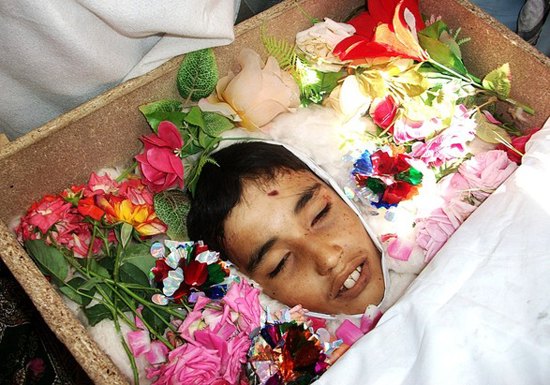
Officials: NATO forces kill four Afghan school students The Education Ministry said in a statement that the four dead were students, aged 11 to 17.

April 22, 2010

Uruknet.info, April 20, 2010

Deutsche Presse-Agentur

20killed_by_nato_khost_apr20_10.jpg
The body of a child lies in a coffin decorated with flowers in Khost province on April 20, 2010. Four children were killed April 19 in crossfire between foreign soldiers and insurgents in eastern Afghanistan, the education ministry said on April 20. (Photo: Getty Images)

April 20, 2010 – DPA

Kabul – Afghan officials said Tuesday that NATO forces shot dead four Afghan school students, but NATO said those killed were Taliban militants and their associates.

The incident happened around three kilometres south of Khost city, the capital of the south-eastern province of Khost, on Monday night, Mubarez Mohammad Zadran, a spokesman for the provincial governor, told the German Press Agency dpa.

Continues >>

Ninety-Four Percent of Kandaharis Want Peace Talks, Not War

April 20, 2010
By Gareth Porter, Axis of Logic, April 19, 2010
Inter Press Service

An opinion survey of Afghanistan’s Kandahar province funded by the U.S. Army has revealed that 94 percent of respondents support negotiating with the Taliban over military confrontation with the insurgent group and 85 percent regard the Taliban as “our Afghan brothers”.

The survey, conducted by a private U.S. contractor last December, covered Kandahar City and other districts in the province into which Gen. Stanley A. McChrystal is planning to introduce more troops in the biggest operation of the entire war. Those districts include Arghandab, Zhari, rural Kandahar and Panjwayi.

Afghan interviewers conducted the survey only in areas which were not under Taliban control.

Continues >>