Anti-Muslim racism leveled at Sami Al-Arian

August 13, 2008

Nicole Colson looks the government’s latest outrage against Dr. Sami Al-Arian, who has spent over five years in prison despite never having been convicted of a crime.

AN OVERZEALOUS federal prosecutor is proving that anti-Muslim racism is at the heart of the ongoing prosecution of Dr. Sami Al-Arian.

What you can do

On August 13, activists in Los Angeles are planning a “Free Dr. Sami Al-Arian” protest and vigil at 5 p.m. at the downtown Federal Building, 300 North Los Angeles St. Sponsors include Al-Awda, the American Friends Service Committee, the American-Arab Anti-Discrimination Committee, the International Socialist Organization and many others. Call 323-691-5283 for information.

Visit the Free Sami Al-Arian Web site to get regular updates about his case and learn more about what you can do to protest his continued imprisonment.

You can send donations to help the Al-Arian family defray the costs of more than five years of legal defense to: Liberty Defense Fund, P.O. Box 1211, 24525 E. Welches Road, Welches, OR 97067.

The documentary film USA v. Al-Arian can be viewed on the Internet at the LinkTV Web site.

Al-Arian is a former University of South Florida professor who has been imprisoned for the past five and a half years–despite never being convicted of a single crime–after the government accused him of using an Islamic think tank and a Muslim school and charity as a cover for raising funds to finance “terrorism.”

Though the Bush administration claimed that prosecuting Al-Arian was an essential part of the “war on terror” here at home, after a six-month trial that the government spent more than $50 million on, a Florida jury in 2006 refused to find Al-Arian guilty of a single count.

Facing the prospect of a lengthy retrial and further separation from his family, however, Al-Arian agreed to plead guilty to a single count of the least-serious charge against him in exchange for what was supposed to be a minor additional sentence and voluntary deportation.

Instead, Gordon Kromberg, the assistant U.S. attorney for the eastern district of Virginia, had Al-Arian moved to that state to try to force his testimony in an investigation of the International Institute of Islamic Thought (IIIT)–in defiance of an agreement with Florida prosecutors, recorded in court transcripts, that Al-Arian would be exempt from future testimony.

Sami Al-Arian continues to languish in prison after more than five years (usavsalarian.com)Sami Al-Arian continues to languish in prison after more than five years (usavsalarian.com)

Kromberg’s demand for Al-Arian’s testimony is a legal Catch 22. If he refuses to testify, say his lawyers and family, he faces continued contempt charges–but if he were to testify, it is likely that prosecutors would simply charge him with “perjury” and continue his imprisonment.

Al-Arian has so far continued to refuse to testify, leading Kromberg to file first civil, and now criminal, contempt charges against him—and extending his prison sentence well beyond his original release date. Criminal contempt is one of the few crimes that does not carry a set maximum sentence, meaning that if he is brought to trial and found guilty, and continues to refuse to testify, Al-Arian could conceivably be kept in prison indefinitely.

– – – – – – – – – – – – – – – –

KROMBERG’S BEHAVIOR during his involvement in the Al-Arian case has been reprehensible. At one point, he objected to defense attorney requests not to have Dr. Al-Arian moved during the Muslim religious holidays of Ramadan, reportedly saying that “If [Muslims] can kill each other during Ramadan, they can appear before the grand jury, all they can’t do is eat before sunset. I believe Mr. Al-Arian’s request is part of the attempted Islamization of the American Justice System.”

On August 8, at the most recent pre-trial hearing in the criminal contempt case, Judge Leonie Brinkema postponed the upcoming trial until a separate appeal by Al-Arian’s lawyers could be ruled on by the U.S. Supreme Court. In her ruling, Brinkema questioned whether prosecutors have been overzealous in filing additional charges against Al-Arian.

At the hearing Kromberg again showed off a vicious streak of anti-Muslim racism and sexism. As the Tampa Bay Coalition for Peace and Justice, which has mobilized support for Dr. Al-Arian, noted in a statement:

After Judge Brinkema ordered that Dr. Al-Arian be released on bail under the custodianship of his eldest daughter, Kromberg abruptly objected, claiming that, as an Muslim woman, Dr. Al-Arian’s daughter would be too weak and submissive to oppose any potential attempt by Dr. Al-Arian to flee, saying that “in this particular [Arab-Islamic] culture, she would not be able to stop him from leaving.”

Though Judge Brinkema struck down Kromberg’s objection, noting that it was “insulting,” Dr. Al-Arian still may not be released on bail–since the Bureau of Immigration and Customs Enforcement (ICE) has, in the past, taken custody of Al-Arian pursuant to a deportation order. Rather than actually deport Al-Arian, however, ICE seems willing to hold him in custody until federal prosecutors can drag him back into court.

Incredibly, Kromberg also attempted to play the victim during the latest hearing, complaining in court that Sen. Mike Gravel (D-Alaska) has called for activists to picket him in order to put pressure on him to free Dr. Al-Arian.

“Call him a racist in signs if you see him,” Gravel reportedly told a crowd in Washington, D.C., regarding Kromberg. “Call him an injustice. Call him whatever you want to call him, but in his face all the time.”

While Al-Arian’s lawyers and family have made it clear that they do not encourage people to target Kromberg or his family–and have publicly repudiated Gravel’s comments—it should be noted that that, due to being painted as a “terrorist,” Dr. Al-Arian and his family have faced continuous harassment by extremist Web sites, not to mention conservative media pundits like Bill O’Reilly. In addition, during his more than five years in prison, Dr. Al-Arian has been the victim of a campaign of abuse: from racist verbal and physical assaults, to punishing restrictions on visits with his family and phone calls, even to his attorneys.

As daughter Laila Al-Arian said in an interview in April,

After spending more than five years in 10 different prisons across the United States, and despite a six-month trial with 80 witnesses, including 21 from Israel, 12 average Americans stood firm and refused to convict innocent people of any count of over 100 charges leveled at them by the most powerful government in history.

No wonder people have been asking, “Where is justice?” Justice can’t be served when people are targeted because of their beliefs and politics…Justice can’t be served when those who are supposed to administer it abuse it in order to exact revenge. Justice can’t be served when employing fear mongering and fear tactics by exploiting a national tragedy to silence the voices of a vulnerable and weak minority in our society.

Muslims demand independent Kashmir as Indian police kill 13

August 13, 2008

Tension rises as thousands gather for funeral of separatist leader

By Andrew Buncombe, Asia Correspondent
The Independent, Wednesday, 13 August 2008

An Indian policeman is hit by an object thrown by a protester in Srinagar yesterday

Reuters

An Indian policeman is hit by an object thrown by a protester in Srinagar yesterday

Indian Kashmir has been convulsed by the biggest pro-independence rallies for two decades, with tensions between Muslims and Hindus spilling over into violence that has so far claimed 13 lives and left more than 100 people injured.

The deaths were a result of Indian police and troops firing on Muslim protesters who were defying a curfew imposed by the authorities following the killing of a high-profile separatist leader. In some of the worst violence in the region in recent years, there were at least a dozen shooting incidents as large numbers of Muslims ignored the curfew and took to the streets.

In Srinagar last night up to 10,000 people defied the curfew to bury the separatist leader, Sheikh Abdul Aziz, whose body had been taken to the city’s main mosque.

Mr Aziz, a senior figure within the All Parties Hurriyat Conference, a coalition of more than two dozen moderate religious and social groups campaigning for independence for Kashmir, was killed on Monday along with four other people when police fired into a crowd of Muslims protesting against what they said was a Hindu blockade of the road linking the Kashmir Valley to the rest of India. The protesters, up to 100,000 strong, were trying to march to the Pakistan-controlled part of Kashmir when the shootings took place.

The deaths are the latest violent twist in a summer of increasing tension in Kashmir that was initially sparked by a row over land being donated to a Hindu shrine. In June, faced by protests from Muslims, the state government reversed the decision it had taken to donate 99 acres of land to the Shri Amarnath shrine, a site of pilgrimage that draws thousands of Hindus a year from across India. In turn, the decision to reverse the donation angered Hindus in the state. Since then, tensions between the two communities have worsened, amid evidence that local politicians have sought to use the row to further their own interests.

As a result, not only have there been the largest demonstrations for independence in the past 20 years, but trade between the Muslim-majority Kashmir valley and the Hindu-dominated region around the city of Jammu, has been drastically curtailed. Muslims say the government is behind a blockade of a 185-mile link road that is leaving many communities low on food and medicine. They also complain that hundreds of truckloads of Kashmiri fruit are going to waste because they cannot be delivered and are rotting in the heat. The situation is so bad that producers are now demanding to be allowed to export their crops across the border to Pakistan.

“The first thing is that the whole event is very undesirable in terms of both the domestic situation in Jammu and Kashmir and its linkage with the larger bilateral peace process [between India and Pakistan],” C Uday Bhaskar, a strategic analyst, told Reuters. “I think this will have a bad impact and considering that Pakistan is going through bad turmoil now, the overall impact on the peace process will not be very positive.”

Indian-administered Kashmir has long been a flashpoint for religious violence and an estimated 68,000 people have been killed in the past two decades as a multitude of militant groups have fought either for independence or a merger with Pakistan. But in the past couple of years a fragile peace had descended upon the state, to the extent that Indian authorities had begun once again to promote Kashmir as a tourist destination

After Sheikh Aziz was killed in Chehel, about 30 miles from the border between the two portions of Kashmir, the Indian authorities imposed the curfew.

At the burial last night of Mr Aziz and the four other people killed with him, Mirwaiz Umar Farooq, chairman of Hurriyat and the most powerful separatist leader in Kashmir, told a huge crowd of mourners: “Sheikh Aziz’s death is big loss to the Kashmir nation, we will take his mission to its logical end.” Another leader of the organisation, Syed Ali Shah Geelani, also attended the funeral, defying both the curfew and house arrest.

As the crowd chanted for independence, Mr Farooq added: “Our struggle for complete independence from India will continue. No power on earth can deter us from achieving this.”

Continued . . .

See also:

Guardian: 14 protesters shot dead in Kashmir

The London Times: Kashmir under curfew after 19 deaths

Mikhail Gorbachev: We had no choice

August 13, 2008

Leaders in the Caucasus must stop flexing military muscle and develop the grounds for lasting peace

The past week’s events in South Ossetia are bound to shock and pain anyone. Already, thousands of people have died, tens of thousands have been turned into refugees, and towns and villages lie in ruins. Nothing can justify this loss of life and destruction. It is a warning to all.

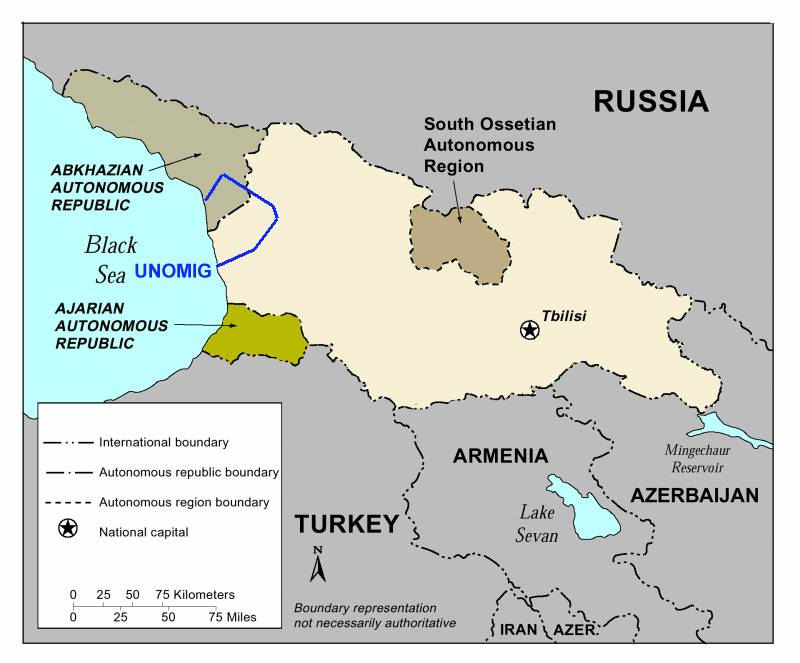
The roots of this tragedy lie in the decision of Georgia’s separatist leaders in 1991 to abolish South Ossetian autonomy. Each time successive Georgian leaders tried to impose their will by force – both in South Ossetia and in Abkhazia, where the issues of autonomy are similar – it only made the situation worse.

Nevertheless, it was still possible to find a political solution. Clearly, the only way to solve the South Ossetian problem on that basis is through peaceful means. The Georgian leadership flouted this key principle.

What happened on the night of August 7 is beyond comprehension. The Georgian military attacked the South Ossetian capital of Tskhinvali with multiple rocket launchers designed to devastate large areas. Russia had to respond. To accuse it of aggression against “small, defenceless Georgia” is not just hypocritical but shows a lack of humanity.

The Georgian leadership could do this only with the perceived support and encouragement of a much more powerful force. Georgian armed forces were trained by hundreds of US instructors, and its sophisticated military equipment was bought in a number of countries. This, coupled with the promise of Nato membership, emboldened Georgian leaders.

Now that the military assault has been routed, both the Georgian government and its supporters should rethink their position. When the problems of South Ossetia and Abkhazia first flared up, I proposed that they be settled through a federation that would grant broad autonomy to the two republics. This idea was dismissed, particularly by the Georgians. Attitudes gradually shifted, but after last week it will be much more difficult to strike a deal even on such a basis.

Small nations of the Caucasus do have a history of living together. It has been demonstrated that a lasting peace is possible, that tolerance and cooperation can create conditions for normal life and development. Nothing is more important. The region’s political leaders need to realise this. Instead of flexing military muscle, they should devote their efforts to building the groundwork for durable peace.

Over the past few days, some western nations have taken positions, particularly in the UN security council, that have been far from balanced. As a result, the security council was not able to act effectively from the very start of this conflict. By declaring the Caucasus, a region that is thousands of miles from the American continent, a sphere of its “national interest”, the US made a serious blunder. Of course, peace in the Caucasus is in everyone’s interest. But it is simply common sense to recognise that Russia is rooted there by common geography and centuries of history. Russia is not seeking territorial expansion, but it has legitimate interests in this region.

The international community’s long-term aim could be to create a sub-regional system of security and cooperation that would make any provocation, and the very possibility of crises such as this one, impossible. Building this type of system would be challenging and could only be accomplished with the cooperation of the region’s countries themselves. Nations outside the region could perhaps help, too – but only if they take a fair and objective stance. A lesson from recent events is that geopolitical games are dangerous anywhere, not just in the Caucasus.

· Mikhail Gorbachev was the last president of the Soviet Union; he was awarded the Nobel peace prize in 1990

© Washington Post

Israel: Don’t Destroy Homes

August 12, 2008

Collective Punishment Violates International Law

Human Rights Watch

Jerusalem, August 10, 2008 – The Israeli government should reject plans to resume the demolition or confiscation of the homes of alleged terrorists, Human Rights Watch said today. These measures would violate international legal prohibitions against collective punishment, as they affect the owners or inhabitants of the homes who have no involvement in terrorism.

" Punishing people for the crimes of others is no solution to terrorism. Israel should focus on bringing to justice those who actually plan or carry out attacks. "
Sarah Leah Whitson, Middle East director at Human Rights Watch
Contribute

Also Available in

arabic

The call follows an order issued on August 6, 2008, by Israeli Defense Minister Ehud Barak to demolish the home of Alaa Abu Dhein, a 26-year-old Palestinian who killed eight people during a gun attack on a Jewish seminary in Jerusalem in March. The house concerned does not belong to Abu Dhein but is occupied and owned by his relatives. Barak’s order marks the resumption of demolitions of homes after a three-year lull and comes in the wake of two separate attacks in which Palestinian men used bulldozers to attack people in July on the streets of Jerusalem.

“The assault on Mercaz Harav seminary and the more recent bulldozer attacks were appalling, but Israel shouldn’t respond by trampling on basic rights,” said Sarah Leah Whitson, Middle East director at Human Rights Watch. “The house demolition measures would violate international law because they punish people who are not even accused, let alone convicted, of a crime.”

Israel had abandoned the policy of house demolitions in 2005, when a panel of its own military experts rejected it, after concluding the policy was ineffective for tackling terrorism and possibly counterproductive. But there have been mounting calls by senior government officials, including Prime Minister Ehud Olmert, to resume the practice after the bulldozer attacks, which killed three people and wounded scores more. There is no evidence that the men involved in either attack had ties to militant groups.

Article 53 of the Fourth Geneva Convention, which governs military occupations, forbids the demolition of houses in the Occupied Palestinian Territories except where “absolutely necessary” for military operations. In addition, such demolitions punish family members and others living in the building solely for residing in the same home as an alleged terrorist. Under Israel’s policy, the fact that the owner of the building is neither the alleged terrorist nor related to him does not protect him from demolition of his property. Therefore such demolitions violate article 33 of the Fourth Geneva Convention, which prohibits punishing someone for an offense that he or she had not personally committed, and forbids collective penalties.

Continued . . .

Russia Georgia War – Washington Risks Nuclear War by Miscalculation

August 12, 2008

By F William Engdahl | The Market Oracle, August 11, 2008

The dramatic military attack by the military of the Republic of Georgia on South Ossetia in the last days has brought the world one major step closer to the ultimate horror of the Cold War era—a thermonuclear war between Russia and the United States—by miscalculation. What is playing out in the Caucasus is being reported in US media in an alarmingly misleading light, making Moscow appear the lone aggressor. The question is whether George W. Bush and Dick Cheney are encouraging the unstable Georgian President, Mikhail Saakashvili in order to force the next US President to back the NATO military agenda of the Bush Doctrine. This time Washington may have badly misjudged the possibilities, as it did in Iraq , but this time with possible nuclear consequences.

The underlying issue, as I stressed in my July 11 piece in this space, Georgien, Washington, Moskau: Atomarer geopolitischer Machtpoker , is the fact that since the dissolution of the Warsaw Pact in 1991 one after another former member as well as former states of the USSR have been coaxed and in many cases bribed with false promises by Washington into joining the counter organization, NATO.

Rather than initiate discussions after the 1991 dissolution of the Warsaw Pact about a systematic dissolution of NATO, Washington has systematically converted NATO into what can only be called the military vehicle of an American global imperial rule, linked by a network of military bases from Kosovo to Poland to Turkey to Iraq and Afghanistan . In 1999, former Warsaw Pact members Hungary , Poland and the Czech Republic joined NATO. Bulgaria , Estonia , Latvia , Lithuania , Romania , and Slovakia followed suit in March 2004. Now Washington is putting immense pressure on the EU members of NATO, especially Germany and France , that they vote in December to admit Georgia and Ukraine .

The roots of the conflict

The specific conflict between Georgia and South Ossetia and Abkhazia has its roots in the following. First, the Southern Ossetes , who until 1990 formed an autonomous region of the Georgian Soviet republic, seek to unite in one state with their co-ethnics in North Ossetia , an autonomous republic of the Russian Soviet republic and now the Russian Federation . There is an historically grounded Ossete fear of violent Georgian nationalism and the experience of Georgian hatred of ethnic minorities under then Georgian leader Zviad Gamsakhurdia, which the Ossetes see again under Georgian President, Mikhel Saakashvili. Saakashvili was brought to power with US financing and US covert regime change activities in December 2003 in what was called the Rose Revolution. Now the thorns of that rose are causing blood to spill.

Abkhazia and South Ossetia—the first a traditional Black Sea resort area, the second an impoverished, sparsely populated region that borders Russia to the north—each has its own language, culture, history. When the Soviet Union collapsed, both regions sought to separate themselves from Georgia in bloody conflicts – South Ossetia in 1990-1, Abkhazia in 1992-4.

In December 1990 Georgia under Gamsakhurdia sent troops into South Ossetia after the region declared its own sovereignty. This Georgian move was defeated by Soviet Interior Ministry troops. Then Georgia declared abolition of the South Ossete autonomous region and its incorporation into Georgia proper. Both wars ended with cease-fires that were negotiated by Russia and policed by peacekeeping forces under the aegis of the recently established Commonwealth of Independent States. The situation hardened into “frozen conflicts,” like that over Cyprus . By late 2005, Georgia signed an agreement that it would not use force, and the Abkhaz would allow the gradual return of 200,000-plus ethnic Georgians who had fled the violence. But the agreement collapsed in early 2006, when Saakashvili sent troops to retake the Kodori Valley in Abkhazia. Since then Saakashvili has been escalating preparations for military action.

Critical is Russia ‘s support for the Southern Ossetes . Russia is unwilling to see Georgia join NATO. In addition, the Ossetes are the oldest Russian allies in the Caucasus who have provided troops to the Russian army in many wars. Russia does not wish to abandon them and the Abkhaz, and fuel yet more ethnic unrest among their compatriots in the Russian North Caucasus . In a November 2006 referendum, 99 percent of South Ossetians voted for independence from Georgia , at a time when most of them had long held Russian passports. This enabled Russian President Medvedev to justify his military’s counter-attack of Georgia on Friday as an effort to “protect the lives and dignity of Russian citizens, wherever they may be.”

For Russia , Ossetia has been an important strategic base near the Turkish and Iranian frontiers since the days of the czars. Georgia is also an important transit country for oil being pumped from the Caspian Sea to the Turkish port of Ceyhan and a potential base for Washington efforts to encircle Tehran .

As far as the Georgians are concerned, South Ossetia and Abkhazia are simply part of their national territory, to be recovered at all costs. Promises by NATO leaders to bring Georgia into the alliance, and ostentatious declarations of support from Washington , have emboldened Saakashvili to launch his military offensive against the two provinces, South Ossetia and Abkhazia. Saakashvili and likely, Dick Cheney’s office in Washington appear to have miscalculated very badly. Russia has made it clear that it has no intention of ceding its support for South Ossetia or Abkhazia.

Continued . . .

GEORGIA: Where the Cold War Never Ended

August 12, 2008

Analysis by Zoltán Dujisin

PRAGUE, Aug 11 (IPS) – As war breaks out in Georgia, the geopolitical struggle between the U.S. and Russia becomes more violent and closer to Russia’s border than ever.

The conflict started after Georgian troops tried to take control of the Georgian breakaway region of South Ossetia, which had been de facto independent and protected by Russian peacekeeping forces since 1992.

Russia has responded by launching an extensive military operation in South Ossetia, repelling Georgian forces from regional capital Tskhinvali, 100 km northwest of the Georgian capital Tbilisi, and advancing into Georgian territory.

Mikheil Saakashvili, President of the 4.6 million Caucasus country, claims the Russian “invasion” was premeditated.

Abkhazia, another breakaway region in Western Georgia that proclaimed independence in the same year, has also become entangled in the conflict by taking Russia’s side.

Sporadic clashes between Georgian and separatist soldiers were not rare, but hostilities never reached the current extent.

The Georgian move apparently took Western leaders, who had warned against attempting a military solution, by surprise.

Ivan Sukhov, a journalist specialised in the region told Radio Free Europe on Friday that Saakashvili had taken “a position that is awkward for the West, since Georgia has consistently positioned itself as a principled opponent of military action. Even if the Georgian actions were provoked by the South Ossetians, this is a serious political mistake.”

Georgia seemed determined to expose Russia’s involvement in Abkhazia and South Ossetia and present the conflict as one between Western democracy and Eastern authoritarianism, possibly hoping to obtain a more decisive Western intervention in the conflict.

The attempt to revive cold war rhetoric was palpable in Saakashvili’s parallels of Georgia’s situation with the 1956 Hungarian and 1968 Czechoslovak interventions by the Soviet Union.

One possible goal of the Georgian leadership’s military intervention was to internationalise the conflict so as to change the format of the present Russian-dominated peacekeeping mission, and facilitate the regions’ peaceful or forcible reintegration.

Many have seen in Georgia’s rash decision the first consequence of Kosovo’s unilateral independence from Serbia last February.

The move has encouraged the separatist claims of the South Ossetian and Abkhaz leaderships, and Georgia’s renewed determination to fully regain its territorial sovereignty.

The leaders of the separatist regions trust that after Kosovo’s independence, the consent of the sovereign state is no longer necessary if a greater power can guarantee its security.

Moreover they have deployed similar arguments to those applied in Kosovo: a past of ethnic-driven war which left thousands of civilians dead and countless displaced on both sides.

Unhappy with the U.S.-promoted Kosovo independence, Moscow had promised an adequate response to the latest violation in international law, and its first step came with the institutionalisation of ties with Georgia’s two breakaway regions in March.

Unlike the West in Kosovo, Russia can claim the conflict in its southern regions directly affects its own security, and above all, that of a population of which 80 percent hold Russian passports.

Russian claims of arbitrary killings of up to 1,600 civilians by Georgian forces have not been independently verified, although a few Western journalists have started to take interest in testimonies by Ossetian refugees allegedly witness to human rights abuses by Georgian troops.

If the claims were to be at least partially verified and Russia was to show self-restraint and restore order, its ambition of a role as a legitimate world power and a regional pacifier could gain credibility.

Besides Kosovo, Russia was irritated by Washington’s enthusiastic promotion of North Atlantic Treaty Organisation (NATO) membership for two of Russia’s neighbours, Ukraine and Georgia, as well as U.S. plans to build a missile defence system in Eastern Europe which it claims will alter the balance of forces in Europe.

Georgia’s NATO bid was presented by the U.S. and Georgia’s former communist Eastern European allies as a chance to expand the area of freedom and democracy and to limit the expansion of Moscow’s authoritarian tendencies in Russia’s near abroad.

Many elites in the post-communist countries tend to believe that Russia is inherently inclined towards authoritarianism and expansionism and that the Soviet Union was just another expression of this impulse.

But the Western European member states, aware that Georgia’s commitment to liberal democracy was dubious and territorial tensions on the rise, decided to postpone the discussion on Georgia’s membership of NATO.

Many have noted an increase in Saakashvili’s authoritarian tendencies over the last year, with the arrest of opposition activists and the abuse of state resources by merely citing the “Russian threat”.

The U.S. has also been openly providing military support and training to the Georgian army while often encouraging Georgia to see itself as a crusader for democracy in the midst of authoritarianism. But as a member of NATO, a young and nationalistic state like Georgia could have drawn the entire alliance into a direct military confrontation with Russia.

Musharraf locked in battle to avoid impeachment as allies turn away

August 12, 2008

Pakistan President ‘unfit’ to rule, declares regional assembly

By Andrew Buncombe and Omar Waraich in Islamabad
The London Independent, Tuesday, 12 August 2008

Supporters of Pakistan's largest Islamic party Jamaat-e-Islami in Islamabad yesterday burn an effigy of President Pervez Musharraf

Reuters

Supporters of Pakistan’s largest Islamic party Jamaat-e-Islami in Islamabad yesterday burn an effigy of President Pervez Musharraf

Change font size: A | A | A

Pakistan’s government is finalising a “charge-sheet” against Pervez Musharraf as battle lines are drawn in the bitter struggle over the President’s future.

Several allies of Mr Musharraf began to distance themselves from him, saying he should stand down for the good of the country, but the former general again insisted he would fight the impeachment charges being prepared by his opponents. Meanwhile, the process to oust Mr Musharraf gathered additional pace as a crucial regional assembly overwhelmingly passed a vote of no confidence against him, saying he was “unfit” to rule.

Aftab Sherpao, a formerinterior minister in Mr Musharraf’s government and leader of a small regional party, said he was considering joining those seeking to force out the President. “[Mr Musharraf] is going to fight these charges on a moral ground to try to disprove them… But when it comes to the numbers, I think he’s lost it,” he said.

The coalition government led by the Pakistan People’s Party (PPP) of the late Benazir Bhutto and the former prime minister Nawaz Sharif’s Pakistan Muslim League-N (PML-N) had been expected to table their allegations against Mr Musharraf at a session of the parliament yesterday evening. But a coalition spokesman said the process was taking longer than expected because the charge sheet and its supporting documents was running to “100 hundred pages”.

Government officials have said the charges against Mr Musharraf will focus on eight key points, including violating the constitution, damaging the economy and the sacking of senior members of the judiciary. The head of the PPP, Ms Bhutto’s husband Asif Ali Zardari, upped the stakes over the weekend when he said Mr Musharraf could also be investigated for corruption.

Continued . . .

Mourners killed as Indian soldiers fire into Kashmiri funeral crowd

August 12, 2008

Indian security forces today fired into a crowd that had gathered for the funeral of a prominent Kashmiri separatist leader who was shot dead yesterday, killing three people.

The shootings, on the second day forces had fired into the crowd, came amid rising violence in Indian Kashmir, India’s only Muslim majority state.

The violence has seen many parts of the region, including the winter capital, Srinagar, put under curfew.

The roots of the crisis lie in a tug of war between the state’s Hindus and Muslims over 100 acres of land.

Tensions escalated after a blockade of the highway by Hindu groups cut off the mountainous Kashmir region, where Muslims predominate, from the plains of Jammu, where Hindus are the majority.

As a result, traders in Kashmir have been trying to sell their goods in neighbouring Pakistan.

Kashmiri separatists called on protesters to continue their march to Muzaffarabad, in Pakistani Kashmir, today.

Yesterday, Sheik Abdul Aziz, a senior figure in the separtist Hurriyat Conference, was killed along with four other people as they attempted to cross the disputed border with Pakistan. More than 150 were injured.

“Sheikh Aziz’s death is big loss to the Kashmir nation … we will take his mission to its logical end,” Mirwaiz Umar Farooq, the chairman of Hurriyat, told Indian television.

Violence began when the state government handed over 100 acres of land for pilgrimage facilities to be built at a popular Hindu shrine at Amarnath, in the Himalayas, in May.

The land dispute has deeply divided Indian Kashmir, and this week has seen some of the region’s worst religious rioting.

Spiralling violence has shattered the relative peace of the past four years in Indian Kashmir, which is also known as Jammu and Kashmir.

The state could still face a violent insurgency, but tensions had eased after India and Pakistan agreed to a peace process in 2004.

See BBC latest: : at least 11 protesters shot dead

US lighting Mideast powder keg?

August 12, 2008

Press TV, Mon, 11 Aug 2008 13:58:40 GMT

USS Theodor Roosevelt

Three more US warships are reportedly heading towards the Persian Gulf amid ongoing tension in the region.

DEBKAfiles– an Israeli web site with alleged close links with the regime’s military and intelligence sources– claimed that the USS Theodore Roosevelt, the USS Ronald Reagan and the USS Iwo Jima are sailing towards the Persian Gulf to reinforce the US strike forces deployed to the region.

The report said the expedition could be linked to a conflict between Russia and Georgia over the breakaway region of South Ossetia.

Citing military experts, the web site reported that through sending more strike forces to the Persian Gulf, the US is tightening its grip on oil resources in the Persian Gulf, after Russia extended its control over Caspian oil resources.

The report added that the US fleet could also support Israeli forces in case of any attack on Iran over the country’s nuclear activities.

According to the Israeli web site the expedition can also be considered as a sign of preparations by the US and its allies to impose partial naval blockade on Iran outside the framework of the UN Security Council, and to keep the Hormuz Striate open in case of a conflict.

Israel has been calling on the US to take a hard line in dealing with Iran’s nuclear issue. The pressure by hawkish Israeli politicians, however, has met with a cold response by many US military and political figures, who see the outcome of any military attack on Iran disastrous.

SB/DA

War in the Caucasus: Towards a Broader Russia-US Military Confrontation?

August 11, 2008
Global Research, August 10, 2008

During the night of August 7, coinciding with the opening ceremony of the Beijing Olympics, Georgia’s president Saakashvili ordered an all-out military attack on Tskhinvali, the capital of South Ossetia.

The aerial bombardments and ground attacks were largely directed against civilian targets including residential areas, hospitals and the university. The provincial capital Tskhinvali was destroyed. The attacks resulted in some 1500 civilian deaths, according to both Russian and Western sources. “The air and artillery bombardment left the provincial capital without water, food, electricity and gas. Horrified civilians crawled out of the basements into the streets as fighting eased, looking for supplies.” (AP, August 9, 2008). According to reports, some 34,000 people from South Ossetia have fled to Russia. (Deseret Morning News, Salt Lake City, August 10, 2008)

The importance and timing of this military operation must be carefully analyzed. It has far-reaching implications.

Georgia is an outpost of US and NATO forces, on the immediate border of the Russian Federation and within proximity of the Middle East Central Asian war theater. South Ossetia is also at the crossroads of strategic oil and gas pipeline routes.

Georgia does not act militarily without the assent of Washington. The Georgian head of State is a US proxy and Georgia is a de facto US protectorate.

Who is behind this military agenda? What interests are being served? What is the purpose of the military operation.

There is evidence that the attacks were carefully coordinated by the US military and NATO.

Moscow has accused NATO of “encouraging Georgia”. Russia’s Foreign Minister Sergey Lavrov underscored the destabilizing impacts of “foreign” military aid to Georgia: .

“It all confirms our numerous warnings addressed to the international community that it is necessary to pay attention to massive arms purchasing by Georgia during several years. Now we see how these arms and Georgian special troops who had been trained by foreign specialists are used,” he said.(Moscow accuses NATO of having “encouraged Georgia” to attack South Ossetia, Russia Today, August 9, 2008)

Moscow’s envoy to NATO, Dmitry Rogozin, sent an official note to the representatives of all NATO member countries:

“Russia has already begun consultations with the ambassadors of the NATO countries and consultations with NATO military representatives will be held tomorrow,” Rogozin said. “We will caution them against continuing to further support of Saakashvili.”

“It is an undisguised aggression accompanied by a mass propaganda war,” he said.

(See Moscow accuses NATO of having “encouraged Georgia” to attack South Ossetia, Russia Today, August 9, 2008)

According to Rogozin, Georgia had initially planned to:

“start military action against Abkhazia, however, ‘the Abkhaz fortified region turned out to be unassailable for Georgian armed formations, therefore a different tactic was chosen aimed against South Ossetia’, which is more accessible territorially. The envoy has no doubts that Mikheil Saakashvili had agreed his actions with “sponsors”, “those with whom he is negotiating Georgia’s accession to NATO “. (RIA Novosti, August 8, 2008)

Contrary to what was conveyed by Western media reports, the attacks were anticipated by Moscow. The attacks were timed to coincide with the opening of the Olympics, largely with a view to avoiding frontpage media coverage of the Georgian military operation.

On August 7, Russian forces were in an advanced state readiness. The counterattack was swiftly carried out.

Russian paratroopers were sent in from Russia’s Ivanovo, Moscow and Pskov airborne divisions. Tanks, armored vehicles and several thousand ground troops have been deployed. Russian air strikes have largely targeted military facilities inside Georgia including the Gori military base.

The Georgian military attack was repealed with a massive show of strength on the part of the Russian military.

In this image made from television, Russian military vehicles are seen moving towards the capital of South Ossetia, Tskhinvali, on Friday, Aug. 8, 2008. (AP / APTN)

Act of Provocation?

US-NATO military and intelligence planners invariably examine various “scenarios” of a proposed military operation– i.e. in this case, a limited Georgian attack largely directed against civilian targets, with a view to inflicting civilian casualties.

The examination of scenarios is a routine practice. With limited military capabilities, a Georgian victory and occupation of Tskhinvali, was an impossibility from the outset. And this was known and understood to US-NATO military planners.

A humanitarian disaster rather than a military victory was an integral part of the scenario. The objective was to destroy the provincial capital, while also inflicting a significant loss of human life.

If the objective were to restore Georgian political control over the provincial government, the operation would have been undertaken in a very different fashion, with Special Forces occupying key public buildings, communications networks and provincial institutions, rather than waging an all out bombing raid on residential areas, hospitals, not to mention Tskhinvali’s University.


Tskhinvali’s University before the bombing

The Russian response was entirely predictable.

Georgia was “encouraged” by NATO and the US. Both Washington and NATO headquarters in Brussels were acutely aware of what would happen in the case of a Russian counterattack.

The question is: was this a deliberate provocation intended to trigger a Russian military response and suck the Russians into a broader military confrontation with Georgia (and allied forces) which could potentially escalate into an all out war?

Georgia has the third largest contingent of coalition forces in Iraq after the US and the UK, with some 2000 troops. According to reports, Georgian troops in Iraq are now being repatriated in US military planes, to fight Russian forces. (See Debka.com, August 10, 2008)

This US decision to repatriate Georgian servicemen suggests that Washington is intent upon an escalation of the conflict, where Georgian troops are to be used as cannon fodder against a massive deployment of Russian forces.

US-NATO and Israel Involved in the Planning of the Attacks

In mid-July, Georgian and U.S. troops held a joint military exercise entitled “Immediate Response” involving respectively 1,200 US and 800 Georgian troops.

The announcement by the Georgian Ministry of Defense on July 12 stated that they US and Georgian troops were to “train for three weeks at the Vaziani military base” near the Georgian capital, Tbilisi. (AP, July 15, 2008). These exercises, which were completed barely a week before the August 7 attacks, were an obvious dress rehearsal of a military operation, which, in all likelihood, had been planned in close cooperation with the Pentagon.

The war on Southern Ossetia was not meant to be won, leading to the restoration of Georgian sovereignty over South Ossetia. It was intended to destabilize the region while also triggering a US-NATO confrontation with Russia.

On July 12, coinciding with the outset of the Georgia-US war games, the Russian Defense Ministry started its own military maneuvers in the North Caucasus region. The usual disclaimer by both Tblisi and Moscow: the military exercises have “nothing to do” with the situation in South Ossetia. (Ibid)

Let us be under no illusions. This is not a civil war. The attacks are an integral part of the broader Middle East Central Asian war, including US-NATO-Israeli war preparations in relation to Iran.

The Role of Israeli Military Advisers

While NATO and US military advisers did not partake in the military operation per se, they were actively involved in the planning and logistics of the attacks. According to Israeli sources (Debka.com, August 8, 2008), the ground assault on August 7-8, using tanks and artillery was “aided by Israeli military advisers”. Israel also supplied Georgia with Hermes-450 and Skylark unmanned aerial vehicles, which were used in the weeks leading up to the August 7 attacks.

Georgia has also acquired, according to a report in Rezonansi (August 6, in Georgian, BBC translation) “some powerful weapons through the upgrade of Su-25 planes and artillery systems in Israel”. According to Haaretz (August 10, 2008), Israelis are active in military manufacturing and security consulting in Georgia.

Russian forces are now directly fighting a NATO-US trained Georgian army integrated by US and Israeli advisers. And Russian warplanes have attacked the military jet factory on the outskirts of Tbilisi, which produces the upgraded Su-25 fighter jet, with technical support from Israel. (CTV.ca, August 10, 2008)

When viewed in the broader context of the Middle East war, the crisis in Southern Ossetia could lead to escalation, including a direct confrontation between Russian and NATO forces. If this were to occur, we would be facing the most serious crisis in US-Russian relations since the Cuban Missile crisis in October 1962.

Continued . . .