WikiLeaks exposé: Israel tried to coordinate Gaza war with Abbas

November 30, 2010

In diplomatic cable documenting 2009 meeting, Defense Minister Barak says Egypt, PA refuse to take over Gaza in case of Hamas defeat.

Barak Ravid, Haaretz, Nov 28, 2010

Israel tried to coordinate the Gaza war with the Palestinian Authority, classified diplomatic cables released by WikiLeaks said on Sunday, adding that both the PA and Egypt refused to take control of the Hamas-ruled coastal enclave.

Ehud Barak and Mahmoud Abbas AP 1.7.2008 Ehud Barak, right, and Mahmoud Abbas speaking during the 23rd congress of the Socialist International in Greece, July 1, 2008.
Photo by: AP

The whistle-blowing website obtained some 250,000 diplomatic cables between the U.S. and its allies, which Washington had urged the site not to publish.

In a June 2009 meeting between Defense Minister Ehud Barak and a U.S. congressional delegation, Barak claimed that the Israeli government “had consulted with Egypt and Fatah prior to Operation Cast Lead, asking if they were willing to assume control of Gaza once Israel defeated Hamas.”

“Not surprisingly,” Barak said in the meeting, Israel “received negative answers from both.”

While similar reports of such attempts to link the PA and Egypt to Israel’s war with Hamas had already surfaced in the past, the cable released by WikiLeaks on Sunday represents the first documented proof of such a move.

In the document, Barak also expressed his feeling that “the Palestinian Authority is weak and lacks self-confidence, and that Gen. Dayton’s training helps bolster confidence.”

The meeting which the cable documents took place just days before U.S. President Barack Obama’s Cairo speech, and a few weeks after Prime Minister Benjamin Netanyahu’s first visit to the United States, a visit which revealed the deep differences between Obama and himself.

The cable also refers to what Barak describes as the debate within the Israeli cabinet in regards to a “development of a response to President Obama’s upcoming speech in Cairo.”

Yemeni President Pledged to Help US Cover Up Attacks

November 29, 2010

Saleh Promised to Take Credit for Attacks Carried Out by US Military

by Jason Ditz, Antiwar.com, November 28, 2010

It is no secret that the US military has been launching attacks against targets inside Yemen for awhile now, but the depth of those attacks has been deliberately covered up by the US government, with the aid of Yemeni President Ali Abdullah Saleh.

The revelation, in one of the new WikiLeaks diplomatic cables, reports that Saleh had agreed to claim that bombings against targets in the country were all Yemeni air strikes, and not American ones. This puts in question just how many of the putative Yemeni bombing strikes this year were really American ones.

Saleh was said to have expressed concerns about the number of civilians killed in the December 24 strike, which his government claimed credit for but which was carried out by the US. General Petraeus was said to have denied the reports of civilian deaths and the cable called Saleh uninformed.

Yet the Yemeni government continued to probe the attack and months after the cable they were forced to publicly apologize when it was revealed the attack had killed only two al-Qaeda members and 42 civilians.

Egypt: Elections Marred as Opposition Barred from Polls

November 29, 2010

Violence, Arrests and Fraud Allegations Widespread

Human Rights Watch, November 29, 2010
2010_Egypt_Elections.jpg

Riot police form a line as opposition members and supporters gather to support their candidates for the upcoming elections.

© 2010 Reuters

The authorities promised that Egyptian civil society could monitor the elections without the need for international observers. Unfortunately the repeated exclusion of opposition representatives and independent monitors from polling stations, along with reports of violence and fraud suggest that citizens were not able to partake in free elections.

Joe Stork, deputy director of Human Rights Watch’s Middle East division

(Cairo) – Elections to Egypt’s People’s Assembly on November 28, 2010, were marred by reports that opposition supporters were barred from polling stations and subjected to violence, Human Rights Watch said today. There were reports of numerous irregularities including arrests and harassment of journalists, denial of access for opposition candidate representatives to 30 polling stations visited by Human Rights Watch across the country and widespread allegations of voter fraud.

“The authorities promised that Egyptian civil society could monitor the elections without the need for international observers,” said Joe Stork, deputy director of Human Rights Watch’s Middle East division. “Unfortunately the repeated exclusion of opposition representatives and independent monitors from polling stations, along with reports of violence and fraud suggest that citizens were not able to partake in free elections.”

Continues >>

New WikiLeaks documents expose US foreign policy conspiracies

November 29, 2010
By David Walsh, wsws.org, 29 November 2010

The batch of 250,000 US classified documents released by WikiLeaks to several news outlets, some of whose content was made public Sunday, sheds new light on the sordid nature of American imperialist intrigue and conspiracy around the globe.

The WSWS will analyze the documents more thoroughly in a subsequent article, but “highlights” published by the Guardian and the New York Times are revealing.

The leaked material consists of classified cables from US embassies, some dispatched as recently as early 2010. The cables, most of which date from 2007-2010, contain US officials’ comments on foreign governments and leaders and speculation about the activities and maneuvers of the latter, as well as details about American foreign policy operations.

In a revelation that should surprise no one, the US State Department and American diplomacy in general turn out to be a vast nest of spies.

The Guardian explains that the WikiLeaks documents “reveal how the US uses its embassies as part of a global espionage network, with diplomats tasked to obtain not just information from the people they meet, but personal details, such as frequent flyer numbers, credit card details and even DNA material.

Continues >>

Egypt’s discredited elections blighted by shadow of police violence

November 28, 2010

As Egypt goes to the polls today, allegations are multiplying of political torture and killings by a security service beyond the control of the courts

Jack Shenker in Alexandria, The Observer, Nov 28, 2010

An Egyptian woman holds up portrait of a Egyptian protesters hold up images of Khaled Said, who was found dead in Alexandria in June after posting an internet video apparently showing illicit police activity. Photograph: Khaled Desouki/AFP/Getty Images
The Mahmoudia canal wends its way through some of Alexandria’s poorest quarters before eventually reaching the middle-class suburb of Somoha, where elegant blocks of flats abut the water’s edge and a rickety old footbridge connects one bank to the other.

It was here that 19-year-old Ahmed Shaaban’s body was found floating among the reeds, battered and bruised. The police say he drowned himself deliberately, though it is difficult to see how – the channel is so shallow it barely reaches one’s knees. A few days later, Shaaban’s uncle stood in front of a local journalist’s video camera and addressed Egypt‘s leader, Hosni Mubarak, directly. “You are at war with your own people,” he said softly. “Your gang is running loose killing citizens, and all you care about is the presidential chair.”

Something is rotten at the heart of Alexandria, one of the great metropolises of the ancient world and Egypt’s modern gateway to the Mediterranean. The country goes to the polls today to elect a new parliament in a ballot widely condemned by human rights groups as being blatantly rigged in favour of Mubarak’s ruling NDP party, and which has been marred by violent clashes on the street between government security services and opposition supporters.

Continues >>

Pakistan: Repeal Blasphemy Laws

November 28, 2010

Legal Discrimination  Emboldens Extremists

Human Rights Watch, November 23, 2010
2010_Pakistan_Bibi.jpg

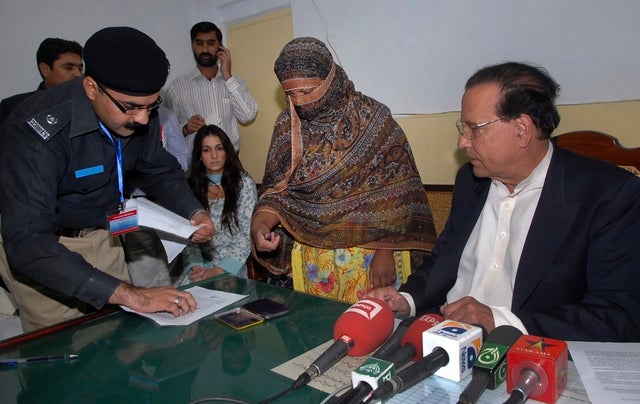
A police official takes the thumb print of Aasia Bibi, a Pakistani Christian woman who has been sentenced to death for blasphemy, on an affidavit stating her innocence after she was visited by the Governor of the Punjab Province Salman Taseer (R) at the central jail in Sheikhupura, Punjab Province, on November 20, 2010.

© 2010 Reuters

The Punjab provincial government is either in denial about threats to minorities or is following a policy of willful discrimination. Provincial law enforcement authorities need to put aside their prejudices and protect religious minorities who are clearly in serious danger from both the Taliban and sectarian militant groups historically supported by the state.

Ali Dayan Hasan, senior South Asia researcher at Human Rights Watch.

(New York) – Pakistan’s government should immediately introduce legislation to repeal the country’s blasphemy law and other discriminatory legislation, Human Rights Watch said today. The government should also take legal action against Islamist militant groups responsible for threats and violence against minorities and other vulnerable groups, Human Rights Watch said.

While international and Pakistani human rights groups have long called for the repeal of the blasphemy law, it has come under renewed scrutiny in recent weeks as a consequence of a death sentence imposed on November 8, 2010, on Aasia Bibi, an illiterate farmhand from Sheikhupura district in Punjab province. She was charged under the blasphemy law after a June 2009 altercation with fellow farm workers who refused to drink water she had touched, contending it was unclean because she was a Christian. She is the first woman in Pakistan’s history to be sentenced to death for blasphemy, though others have been charged and given lesser sentences.

Continues >>

Robert Fisk: Oceans of blood and profits for the mongers of war

November 28, 2010
Robert Fisk, The Independent, Nov 27, 2010

As casualties continue to mount in Afghanistan, so does the cost of war after nine years PA 

As casualties continue to mount in Afghanistan, so does the cost of war after nine years

Since there are now three conflicts in the greater Middle East; Afghanistan, Iraq, Israel/”Palestine” and maybe another Lebanese war in the offing, it might be a good idea to take a look at the cost of war. 

Not the human cost – 80 lives a day in Iraq, unknown numbers in Afghanistan, one a day in Israel/”Palestine” (for now) – but the financial one. I’m still obsessed by the Saudi claim for its money back after Saddam Hussein invaded Kuwait in 1990. Hadn’t Saudi Arabia, King Fahd reminded Saddam, financed his eight-year war against Iran to the tune of $25,734,469,885.80? For the custodian of the two holy places, Mecca and Medina, to have shelled out $25bn for Saddam to slaughter his fellow Muslims was pretty generous – although asking for that extra 80 cents was surely a bit greedy.

But then again, talking of rapacity, the Arabs spent $84bn underwriting the Anglo-American operation against Saddam in 1990-91 – three times what Fahd gave to Saddam for the Iran war – and the Saudi share alone came to $27.5bn. In all, the Arabs sustained a loss of $620bn because of the 1990 Iraqi invasion of Kuwait – almost all of which was paid over to the United States and its allies. Washington was complaining in August 1991 that Saudi Arabia and Kuwait still owed $7.5bn. Western wars in the Middle East, it seemed, could be fought for profit as well as victory. Maybe Iraq could have brought us more treasure if it hadn’t ended in disaster. At least it would help to have paid for America’s constant infusion of cash to Israel’s disastrous wars.

Continues >>

Video: Frost over the World – Ilan Pappe

November 28, 2010

Israeli historian Ilan Pappe speaks

AlJazeera.net, November 27, 2010

The Israeli historian talks about the possibility of a one-state solution in the Middle East peace process. Plus, Mark Regev, Binyamin Netanyahu’s spokesman, talks about settlement building in the West Bank and the stalled Middle East peace negotiations. And actress Samantha Bond talks about playing Miss Moneypenny in the James Bond films and working alongside her husband in her new play, ‘An Ideal Husband’.

Paul C. Roberts: The Stench of American Hypocrisy, Part 2

November 27, 2010

By Paul Craig Roberts, Foreign Policy Journal, Nov 23, 2010

In a recent column, “The Stench of American Hypocrisy,” I noted that US public officials and media are on their high horse about the rule of law in Burma while the rule of law collapses unremarked in the US. Americans enjoy beating up other peoples for American sins. Indeed, hypocrisy has become the defining characteristic of the United States.

Hypocrisy in America is now so commonplace it is no longer noticed. Consider the pro-football star Michael Vick. In a recent game Vick scored 6 touchdowns, totally dominating the playing field. His performance brought new heights of adulation, causing National Public Radio to wonder if the sports public shouldn’t retain a tougher attitude toward a dog torturer who spent 1.5 years in prison for holding dog fights.

I certainly do not approve of mistreating animals. But where is the outrage over the US government’s torture of people? How can the government put a person in jail for torturing dogs but turn a blind eye to members of the government who tortured people?

Under both US and international law, torture of humans is a crime, but the federal judiciary turns a blind eye and even allows false confessions extracted by torture to be used in courts or military tribunals to send tortured people to more years in prison based on nothing but their coerced self-incrimination.

Continues >>

Robert Fisk: The man who dares to take on Egypt’s brutal regime

November 27, 2010

Despite beatings and corruption, Ayman Nour still hopes for change. Ahead of new polls, our man meets him

Robert Fisk, The Independent, Nov 25, 2010

Ayman Nour will continue the fight for democracy despite being beaten in jail
AFP/GETTY IMAGES

Ayman Nour will continue the fight for democracy despite being beaten in jail

Ayman Nour touches his sideburns, just a shade grey beneath his black hair: not bad for a 45-year old, but not up to the standard of the absolutely uncompromisingly jet black hair of 82-year-old Egyptian President Hosni Moubarak, whose job – in theory at least – Dr Nour would like.

Mind you, being Mr Moubarak’s rival is not for amateurs. It’s cost Dr Nour more than four years in prison and here he is, on the eve of Egyptian parliamentary elections, sitting in Beirut – rather than Cairo – to express his disdain for the ‘moderate’, ‘pro-Western’ regime of America’s favourite Middle Eastern dictator (alongside King Abdullah of Jordan, King Abdullah of Saudi Arabia, Bouteflika of Algeria, Ben Ali of Tunis, King Hassan of Morocco and the rest). So long live President Hosni Moubarak.

But how long? Dr Nour’s Ghad party – Ghad means ‘tomorrow’, which may never come – is not taking part in this weekend’s parliamentary elections which will, he feels sure, be as rigged as every election in Egypt since the early years of President Anwar Sadat. “I believe that what you are about to witness at the weekend is part tragedy, part comedy, a black comedy,” he says. “You want to go to Cairo on Saturday, Robert? You might just go there for fun.”

Continues >>