Stuart Littlewood, urknet.info, Jan 29, 2011
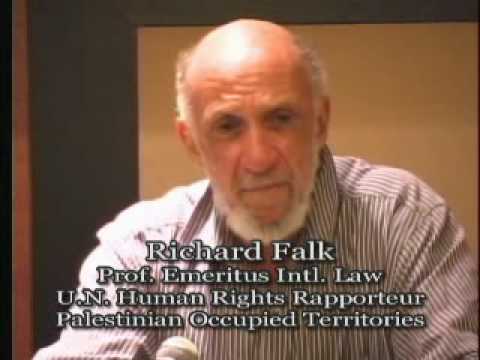 |
| Mention Richard Falk and you think of an honourable man who cares deeply about injustice, particularly the trampled rights of Palestinians under the evil jackboot.
Mention Susan Rice, US Ambassador to the United Nations, and what comes to mind? The BBC reported in December 2008: “During her stint in the Clinton White House, she was described as ‘brilliant’ but also ‘authoritarian’ and ‘brash’. According to the New York Times, she acknowledges ‘a certain impatience at times’.” She is also said to be “unwilling to consider opinions that differ from her own”. Ambassador Rice has just demanded that Falk, the UN Human Rights Council’s special rapporteur in the Palestinian territories, step down from his UN position. “In my view, Mr. Falk’s latest commentary [an entry in his blog about the media and 9/11] is so noxious that it should finally be plain to all that he should no longer continue in his position on behalf of the UN.” Falk’s crime was saying that the US administration’s reluctance to address the awkward gaps and contradictions identified by several scholars in the official explanations of 9/11, only fuels suspicions of a conspiracy. And he suggested that “what may be more distressing than the apparent cover up is the eerie silence of the mainstream media, unwilling to acknowledge the well-evidenced doubts about the official version of the events: an al Qaeda operation with no foreknowledge by government officials”. |
 The Obama Administration, which is still holding on to hopes that Mubarak can crush the protests and retain power, is now starting to come to grips with the


 trespassing law to uphold a higher law and save life. “In this case, no inherent danger was present, and so I find you guilty.”

 Email
Email Printer friendly

 Peace and Justice Post