Archive for the ‘war’ Category

“After Hiroshima And Nagasaki, There Was Fallujah.”

April 17, 2010

By William Blum, ZNet, April 17, 2010

William Blum’s ZSpace Page

When did it begin, all this “We take your [call/problem/question] very seriously”? With answering-machine hell? As you wait endlessly, the company or government agency assures you that they take seriously whatever reason you’re calling. What a kind and thoughtful world we live in.

The BBC reported last month that doctors in the Iraqi city of Fallujah are reporting a high level of birth defects, with some blaming weapons used by the United States during its fierce onslaughts of 2004 and subsequently, which left much of the city in ruins. “It was like an earthquake,” a local engineer who was running for a national assembly seat told the Washington Post in 2005. “After Hiroshima and Nagasaki, there was Fallujah.” Now, the level of heart defects among newborn babies is said to be 13 times higher than in Europe.

Contyinues >>

Obama’s Record On Guantanamo Just As Shoddy As Bush’s

April 16, 2010

By Lt. Col. Barry Wingard,  The Public Record, April 14, 2010

During his 2008 campaign, President Obama promised the country “change we can believe in.” Yet, more than a year into his administration, he has delivered “more of the same” on issues pertaining to Guantanamo Bay. The island prison is still open, detainees still await trials, and officials have recommended the worst of George W. Bush’s policies — indefinite detention.

Continues >>

Contractor Deaths Accelerating in Afghanistan as They Outnumber Soldiers

April 15, 2010
by T. Christian Miller, ProPublica – April 14, 2010

In this photograph taken  Jan. 31, 2007, Afghan men are trained by U.S. military contractors  during a exercise in the southern town of Qalat, the capital of Zabul  province. A new government report shows the number of contractor deaths  in Afghanistan has increased in recent months. (Shah Marai/AFP/Getty  Images)
In this photograph taken Jan. 31, 2007, Afghan men are trained by U.S. military contractors during a exercise in the southern town of Qalat, the capital of Zabul province. A new government report shows the number of contractor deaths in Afghanistan has increased in recent months. (Shah Marai/AFP/Getty Images)

A recent Congressional Research Service analysis [1] obtained by ProPublica looked at the number of civilian contractors killed in Afghanistan in recent months. It’s not pretty.

Of the 289 civilians killed since the war began more than eight years ago, 100 have died in just the last six months. That’s a reflection of both growing violence and the importance of the civilians flooding into the country along with troops in response to President Obama’s decision to boost the American presence in Afghanistan.

The latest U.S. Department of Defense numbers show there are actually more civilian contractors on the ground in Afghanistan than there are soldiers. The Pentagon reported [2] 107,292 U.S.-hired civilian workers in Afghanistan as of February 2010, when there were about 78,000 soldiers. This is apparently the first time that contractors have exceeded soldiers by such a large margin.

Using civilian contractors to haul food, prepare meals and act as bodyguards has kept the Pentagon’s official casualty figures lower than they would have been in past conflicts, where contractors were not as heavily used.

Contractor casualties are, by and large, invisible to the public, disguising the full human cost of the wars in Iraq and Afghanistan. They are not reported in totals given by the government. If they were, the death toll in Afghanistan would have surpassed 1,000 — 848 soldiers, 289 civilian contractors — from 2001 to 2009, a milestone that has gone entirely unmarked.

The number of contractor dead are released only through the Labor Department, which keeps count as part of an insurance program for contractors known as the Defense Base Act. And these numbers, agency officials have admitted and our reporting has shown, undercount fatalities. As David Isenberg [3] pointed out in the Huffington Post recently, a new database designed, in part, to track contractor deaths is still not being used to do so.

Staff researcher Lisa Schwartz contributed to this report.

US Troops See ‘Expanded Role’ in Pakistan

April 14, 2010

Pentagon Pushes for $10 Million ‘Pool’ for Funding

by Jason Ditz, Antiwar.com,  April 13, 2010

Despite an official prohibition at taking any part in Pakistan’s assorted military offensives, the US Special Forces in the nation have continued to expand the definition of “training operations” until now they are overseeing the combat in several areas.

The training mission was originally supposed to be so limited that they weren’t supposed to even train troops directly, they were supposed to train Pakistani trainers who would pass the information along to the paramilitary forces in FATA. Even this was controversial at the time.

But now, the US troops are taking part in “hold and build” operations in FATA, coordinating the operations of the various Pakistani military and civilian authorities in the region.

The Pentagon is now said to be seeking the creation of a $10 million pool for the “trainers” in the nation, to be used for discretionary “hearts and minds” spending, likely mostly on humanitarian aid projects.

But US troops are already showing up in some odd places considering their extremely limited mission. In February three US soldiers were killed in a bombing in the Swat Valley, when the troops were attending a school opening in the area. These photo-op visits are likely to become more and more common as the US presence in the nation grows.

War Crimes in Iraq and Afghanistan

April 14, 2010
Robert Dreyfuss, The Nation, April 13, 2010

War crimes, massacres, and, as Al Jazeera properly calls it, “collateral murder,” are all part of the US involvement in Iraq and Afghanistan since 2001.

The release last week of the Wikileaks video, thirty-eight grisly minutes long, of US airmen casually slaughtering a dozen Iraqis in 2007 — including two Reuters newsmen — puts it into focus not because it shows us something we didn’t know, but because we can watch it unfold in real time. Real people, flesh and blood, gunned down from above in a hellish rain of fire.

The events in Iraq, nearly three years old, were repeated this week in Afghanistan, when trigger-happy US soldiers slaughtered five Afghans cruising along on a huge, comfortable civilian bus near Kandahar.

Continues >>

Radical Historian George Barnsby 1919–2010

April 13, 2010

By Nasir Khan

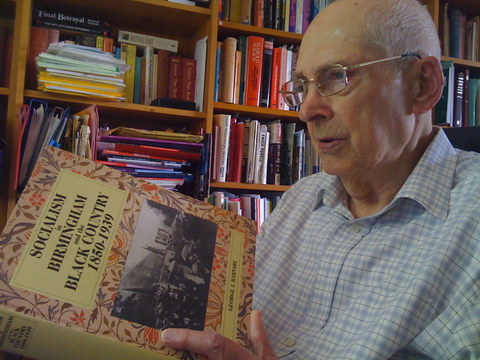
Dr George Barnsby

Dr George Barnsby, who died on April 11 at the age of 91 in Wolverhampton, was a leading radical activist and historian of the working class movement in the Black Country. Born in London in a working class family, his father died when he was only three years old. Now his mother had the sole responsibility to take care of her two infant sons in dire circumstances. The vicissitudes of his early life made George aware that the ‘station in life’ of many people was determined by their social and economic status. He certainly was not born with a silver spoon in his mouth.

He left school at 15 and did some ordinary jobs. He showed little interest in politics at that time. However, around the age of eighteen he became a reader of Daily Worker. It was the period when Nazism had emerged as the dominant voice of militarism and in many countries in Europe and the United States fascist parties emerged. Their model was the German Nazi party and their hero Adolf Hitler. When the Second World War started the young George was called up in 1939. At that time, he was 20 years old. When he went to fight for his ‘king and country’ his worldly possessions were two suits and a bicycle. He recalls in his ‘Subversive – One Third of the Autobiography of a Communist’ that for obvious reasons some people had more interest in ‘our country’ than he did!

He was sent to Burma. He experienced there inhumanity of the war and destruction caused by the Japanese. His contact with India and Indians subject to the imperial Raj gave him a broad political insight and awareness of the role of colonialism and imperialism. The Bengal Famine of 1943-44 occurred under the British rule. It is estimated that around 3 million Indians died from starvation and malnutrition. The Bengal government reacted to the disaster with little efficiency, and refused to stop the flow of rice from Bengal. George was an eye-witness to the apathy of the British rulers towards their subjects. There was no shortage of food in the British quarters either. There are still some hard questions about the role and knowledge of the British Prime Minster Winston Churchill into the affair. For instance, when the Secretary of State for India, Leo Amery, and Lord Wavell requested him an urgent release of food stocks for India, Churchill responded with a telegram to Wavell asking, if food was so scarce, ‘why Gandhi hadn’t died yet.’

The end of the Second World War saw the defeat of fascism and militarism in Germany and Japan. But no such harm came to the Spanish fascism under Franco. The Soviet Union and its Red Army in the Great Patriotic War had borne the brunt of the war on the Eastern Front. With the Allied victory, the army conscripts returned to their homes. In 1946, George was demobbed, receiving a gratuity of about £100. This sum he used to get further education. First, he matriculated from Regent Street Polytechnic before he went to the London School of Economics where he obtained a B.Sc. Honours degree there. From Birmingham University he gained an M.A. degree by writing ‘Social Conditions in the Black Country’ and then from the same university he earned a Ph.D. degree on his thesis ‘Working Class Movement in the Black Country 1750 to 1868′. His studies and committment to revolutionary Socialism that wanted to serve the interests of the working class had taken the central stage in his life. He was to struggle for these objectives for the rest of his life.

When he came to Wolverhampton in 1954, he became the secretary of the local Communist Party. This was the period when the Cold war was in full swing and in the United States anti-Communist crusade of McCarthyism had become the new credo of the Cold War allies in the West. In Britain, Communists were looked upon as traitors; they were spied upon and their telephones tapped. Obviously, George like other Communists was also regarded as subversive and he had to confront what came his way.

The range of his social, academic and political activities in the Black Country extends over vast areas. He wrote a number of histories and pamphlets on Socialism, Birmingham, Wolverhampton, Housing and the Radicals in the Black Country.

One major area of communal activity was around Bilston College of Further Education. Some teachers of the College and governors realised that many working-class people were excluded from formal institutional education who formed unqualified work force with little basic skills. Among the excluded were a disproportionate number of people from ethnic minority communities, mainly Afro-Caribbean and Asian. George was an active educator and a leading voice in the new approach to uplifting the working class people and providing them with education that met their needs. This progressive approach in a multicultural and multi-ethnic society was to counterbalance the legacy of Enoch Powell and his followers.

When American President George W. Bush and his close ally, Prime Minister Tony Blair, started their genocidal war of aggression against Iraq and the subsequent destruction of Iraq and Iraqis, George steadfastly opposed the imperial war. For him, the Anglo-American war in Iraq was a crime against humanity, a genocide, and its central figures the war criminals who need to be brought to justice. He focused on Bush and Blair and their allies, writing extensively on their policies on his website and informed the populace of the realities of the cover-up of their crimes and their incessant lies.

George Barnsby is survived by his wife Esme and two sons, William and Robert.

Iraq War Vet: “We Were Told to Just Shoot People, and the Officers Would Take Care of Us”

April 11, 2010

by: Dahr Jamail, t r u t h o u t | Report,   April 7, 2010

photo
(Image: Lance Page / t r u t h o u t; Adapted: The U.S. Army, K. OS, whiteblot)

On Monday, April 5, Wikileaks.org posted video footage from Iraq, taken from a US military Apache helicopter in July 2007 as soldiers aboard it killed 12 people and wounded two children. The dead included two employees of the Reuters news agency: photographer Namir Noor-Eldeen and driver Saeed Chmagh.

The US military confirmed the authenticity of the video.

The footage clearly shows an unprovoked slaughter, and is shocking to watch whilst listening to the casual conversation of the soldiers in the background.

Continues >>

Behind the Afghan Fraud

April 11, 2010

By Conn Hallinan Foreign Policy In Focus, April 8, 2010

Conn Hallinan

All frauds have a purpose, mostly to relieve the unwary of their wealth, though occasionally to launch some foreign adventure. The 1965 Tonkin Gulf hoax that escalated the Vietnam War comes to mind.

So, what was the design behind “Operation Moshtarak,” or the “Battle of Marjah,” in Afghanistan’s Helmand Province, the largest U.S. and NATO military operation in Afghanistan since the 2003 invasion?

Marjah was billed as a “fortress,” a “city of 80,000” and the Taliban’s “stronghold,” packed with as many as 1,000 “hard-core fighters.” But as Gareth Porter of the Inter Press Service revealed, Marjah isn’t even a city, but a district of scattered villages. As the days went by — and civilian deaths passed military casualties — the number of “hard-core fighters” declined. In the end, the “battle” turned into a skirmish. “Hardly a single gun was captured by NATO forces,” tribal elder and former police chief Abdul Rahman Jan told Time.

Dealing with Drugs

Marjah was also billed as the linchpin of the militants’ logistical and opium-smuggling network, and the area indeed has significant poppy cultivation. But according to Julian Mercille of University College Dublin, an expert on U.S. foreign policy, the Taliban get only 4 percent of the trade. Local farmers reap about 21 percent of the $3.4 billion yearly commerce, according to Mercille, while 75 percent of the trade is captured by government officials, the police, local and regional brokers, and traffickers. In short, our allies get the lion’s share of profits from the drug trade.

In any case, the word “linchpin” soon dropped off the radar screen. It soon became obvious that Operation Moshtarak would not touch the drug trade because it would alienate local farmers, thus sabotaging the goal of winning the “hearts and minds” of residents.

In some ways, the most interesting part of the Marjah operation was a gathering that took place shortly after the “fighting” was over. President Barack Obama called a meeting March 12 in the White House to ask his senior staff and advisors if the “success” of Moshtarak would allow the United States to open negotiations with the Taliban. According to Porter, Secretary of State Hillary Clinton and Defense Secretary Robert Gates opposed talks until after a similar operation, aimed at Kandahar, is completed this summer.

The Kandahar offensive is being pumped up as a “blow at the Taliban’s heartland” and the “fulcrum” of the Afghan war. Kandahar is where the Taliban got its start and, at 600,000, is Afghanistan’s second-largest city. Whether a military operation will have any more impact than the attack on Marjah is highly unlikely. As in Marjah, the Taliban will simply decamp to another area of the country or blend in with the local population.

However, the White House gathering suggests that the administration may be searching for a way out before the 2012 elections. With the economic crisis at home continuing, and the bill for the war passing $200 billion, Afghanistan is looking more and more like a long tunnel with no light at the end.

Certainly our allies seem to have concluded that the Americans are on an exit path.

Talking with the Taliban

The Hamid Karzai government and the United Nations have opened talks with some of the Taliban and Gulbuddin Hekmatyar’s Islamic Party. Pakistan —correctly concluding it was being cut out of the peace talks — swept up 14 senior Taliban officials,  including the organization’s number-two man, Mullah Abdul Ghani Baradar.

The Pakistanis claim they’re simply aiding the U.S. war effort. But the former head of the UN mission to Afghanistan, Kai Eide, bitterly denounced the arrests as nothing more than effort to derail the ongoing negotiations.

If Islamabad has a say, the Taliban will have a presence in whatever peace agreement emerges, a fact that has distressed India. Not only is it likely that India will lose much of its influence with the Karzai government — and see more than a billion dollars in aid spent for naught — but its traditional enemy, Pakistan, will almost certainly regain much of its former influence with Kabul.

The push by the United States to find a political solution is partly driven by the rapidly eroding NATO presence. The Canadians are sticking by their pledge to be out by 2011, and when the Netherlands tried to raise the possibility of Dutch troops remaining, the Dutch elected a new government. The British Labor Party, behind in the polls but catching up to the Tories, wants to rid itself of the Afghan albatross before upcoming elections.

The United States is also discovering that the Afghanis play a mean game of chess.

Geopolitical Chessboard

The Obama administration recently demanded that the Karzai government reinstate an independent electoral commission and end corruption — in particular, by dumping the president’s larcenous half-brother Ahmed Wali Karzai, who runs Kandahar like a feudal fiefdom. Karzai responded by flying off to Tehran to embrace the Iranian President Mahmoud Ahmadinejad and meet with Iran’s supreme leader, Ayatollah Ali Khamenei. Given that the United States is trying to isolate Iran in the region, Karzai’s Iran visit wasn’t a happy moment for those on the Potomac.

Yet Iran has influence over the Northern Alliance, which will need persuading to accept the Taliban into a coalition. Rather than isolating Iran, Karzai has made it central to the peace agreement that the United States and NATO want.

For the past five years, the United States has been wooing India as a bulwark against China. But because Washington needs Islamabad to broker a peace, the Americans agreed to send it F-16 fighter-bombers, helicopter gun ships, and reconnaissance drones.  A better-armed Pakistan, however, hardly goes down well in New Delhi, particularly because the Indians see their former influence in Kabul on the wane.

As a result, India promptly went off and met with the Russians. Ever sympathetic, Moscow offered New Delhi a bargain-basement price on an aircraft carrier and threw in a passel of MIG-29s. That dealt a blow to another aim of U.S. diplomacy: keeping Russia out of South Asia.

The same week as Pakistan’s foreign minister was in Washington asking for a laundry list of goodies in exchange for “helping out” in Afghanistan, Karzai jetted off to Beijing to talk about aid and investments. So much for the plan to keep China out of Central Asia.

This is beginning to look like checker-players in Washington versus the chess masters in Kabul.

Finessing Withdrawal

There seems to be a developing consensus, both inside and outside Afghanistan, that the war must wind down. If this consensus becomes firmer, then the Karzai government’s upcoming peace jirga, set for late April or early May, takes on greater importance.

While Washington appears to be divided over how, when, and with whom to negotiate, “withdrawing” doesn’t mean that the United States won’t leave bases behind or end its efforts to penetrate Central Asia. The White House recently announced an agreement with Kyrgyzstan to set up a U.S. “counter-terrorism center” near the Chinese border.

The danger at this juncture is seeing the outcome as a zero-sum game: If Pakistan gains, India loses; if the United States withdraws, the Taliban win; if Iran is helpful it will encourage nuclear proliferation.

Ultimately, Afghans must decide the future of Afghanistan. What they want and how they get it isn’t the business of Washington, Brussels, New Delhi, Tehran, or Islamabad. The current war, the latest endeavor in the “graveyard of empires,” has claimed far more Afghan lives than those of the invaders. As U.S. Afghan commander Stanley McChrystal told The New York Times, “We have shot an astounding number of people.”

Indeed, we have.

Conn Hallinan is a columnist for Foreign Policy In Focus.

The Perplexed Puppet Jerks on His Strings: Karzai Calls US Troops Invaders

April 9, 2010

by Tom Turnipseed, CommonDreams.org, April 9, 2010

Afghan President Hamid Karzai, a former consultant for UNOCAL oil company was installed by the US as the President of Afghanistan after our invasion and occupation of that country. Now he complains that US and NATO troops are invaders of Afghanistan and this is drawing a furious reaction from the Obama administration and the mainstream media. His outburst deserves a closer look at what led up to this furor in Afghanistan as Karzai turns on his US puppeteer.

Continues

Drone Wars, Without Any Rules

March 24, 2010

Dan Froomkin, The Huffington Post, March 24, 2010

The CIA’s extensive use of unmanned drones to kill alleged terrorists in Pakistan and elsewhere is arguably against international law and raises the possibility that top U.S. officials will someday be tried at the Hague for war crimes, a law professor told a congressional oversight panel on Tuesday.

Despite the rapidly increasing use of drones in warfare and anti-terrorism — and the legal and ethical issues their use raises — the U.S. government has never publicly advanced a legal justification for sending its drones on targeted killing runs overseas; up until Tuesday, Congress hadn’t even held a single hearing into the question.

Kenneth Anderson, an American University law professor, told the panel he believes there is legal justification for the U.S.’s use of drones, not just by the military but by the CIA, under the doctrine of self-defense.

But, he said, government lawyers “have not settled on what the rationales are, and I believe that at some point that ill serves an administration which is embracing this. Now, maybe the answer is: This is really terrible and illegal and anybody that does it should go off to the Hague. But if that’s the case, then we should not be having the president saying that this is the greatest thing since whatever. That seems like a bad idea.”

As HuffPost reported last week, the ACLU has filed a freedom of information lawsuit demanding that the government disclose the legal basis for its use of unmanned drones to conduct targeted killings overseas, as well as the ground rules regarding when, where and against whom drone strikes can be authorized, and the number of civilian casualties they have caused. The initial response from the government was that some public legal justification was, indeed, forthcoming.

But many questions about drones aren’t just unresolved, they’ve never even been asked. Rep. John F. Tierney (D-Mass.), chairman of the House oversight committee’s national security subcommittee, mentioned some of them in his opening statement:

[I]f the United States uses unmanned weapons systems, does that require an official declaration of war or an authorization for the use of force?Do the Geneva Conventions — written in 1949 — govern the prosecution of an unmanned war?

Who is considered a lawful combatant in unmanned war — the Air Force pilot flying a Predator from thousands of miles away in Nevada, or the civilian contractor servicing it in on an airstrip in Afghanistan?

Then there are questions about the civilian casualty rate; about how the U.S. maintains superiority in drone warfare; what happens when the bad guys get hold of them; and how do you defend against them.

Rep. Bill Foster (D-Ill.) raised the concern that drones might make some of the Pentagon’s big-ticket purchases look less wise.

“What I’m worried about is, we’re at some point going to be asked to defend Taiwan, you know, with a set of aircraft carriers, and all of sudden, 10,000 Chinese-manufactured mass-produced drones will be coming at us,” Foster said. “And it’ll be game over. ”

And just wait until they start thinking for themselves.

“If trends in computer science and robotics engineering continue, it is conceivable that autonomous systems could soon be developed that are capable of making life and death decisions without direct human intervention,” said John Edward Jackson, professor of unmanned systems at the U.S. Naval War College.

“Would a self-conscious and willful machine choose its own ends, and even be considered a person with rights?” asked Edward Barrett, director of research for the Stockdale Center, the U.S. Naval Academy’s ethics and military policy think tank.

The troubling questions and scenarios were coming from a panel that was, nevertheless, largely pro-drone — to the consternation of a handful of protesters in the audience.

The panel’s head cheerleader was Michael S. Fagan, who chairs the Advocacy Committee for the Association for Unmanned Vehicle Systems International.

Fagan said there is “much more” that drones can do to protect the nation. He urged the Federal Aviation Administration to allow drone-makers access to more airspace and spoke of “other useful applications of unmanned technology” such as “civil unrest”.

Peter W. Singer, director of the 21st Century Defense Initiative at the Brookings Institution, noted the the U.S. government isn’t the only one using drones. American border vigilantes have used them, as did Hezbollah during Israel’s 2006 invasion of Lebanon, and, most recently, a gang of thieves in Taiwan.

Barrett, the ethicist, worried that drones make war too easy. “Favorable alterations to pre-war proportionality calculations,” he said, could “reduce the rigor with which non-violent alternatives are pursued, and thus encourage unnecessary — and therefore unjust — wars,” he said.

He also said the homeland could be at risk if, on the battlefield, there’s “no one for the enemy to shoot at.” He explained: “You don’t want to go just to unmanned, or they’re coming here.”

Several clear distinctions emerged between the military’s use of drones and the CIA’s. One of those distinctions is that we know almost nothing about what the CIA is really doing, and how. “We do know about the military’s use of these systems, and they’ve shown… exceptional respect for the laws of war,” said Singer. “My concern is with the CIA strikes.”

Instead of trained military strategists, it’s intelligence analysts planning air-war campaigns, and CIA lawyers deciding on when to launch;. Or maybe it’s not even the CIA itself, but its contractors. Who knows?

Are there any limits? How many civilian casualties have there been? Does what they’re doing even make sense?

“We may be sucking ourselves into a game of whack-a-mole,” Singer said. “Are we unwittingly aiding their recruiting?”

© 2010 Huffington Post

Dan Froomkin is Washington Bureau Chief for the Huffington Post. Previously, he wrote the White House Watch column for the Washington Post’s website.