| Al Jazeera, Feb 14, 2009 | |||
At least 25 people have been killed in a missile attack by an unmanned US drone in a tribal district of Pakistan, Pakistani officials have told Al Jazeera. The raid destroyed a house in the northwestern town of Ladha, a base for Baitullah Mehsud, a Pakistani Taliban leader accused of plotting the 2007 assassination of Benazir Bhutto, a former prime minister of Pakistan, an official said. “Around 50 to 60 mujahideen [fighters] have been living [at the site of the attack] for about a week. All of them were Uzbeks,” a Taliban official said. Pakistan intelligence agents are investigating the attack on the house in the South Waziristan region on Saturday. Taliban fighters sealed off the site of the attack, preventing people from getting access, residents said. Pakistan angered The US has launched more than 30 missile attacks on Pakistani soil in recent months, ostensibly against al-Qaeda and Taliban-linked fighters. More than 220 people were killed in the raids, according to a tally of reports from Pakistani intelligence agents, district government officials and residents. Pakistan has been angered by the attacks, saying that innocent civilians have been killed and that Pakistani sovereignty has been infringed. Barack Obama, the US president, said this week that he has no doubt that Taliban and al-Qaeda-linked fighters are based in Pakistan’s tribal region and the US wants the support of Islamabad in tackling the armed groups. |
Archive for the ‘Pakistan’ Category

Indian Army chief terms surgical strikes feasible
February 9, 2009| The News, Feb 9, 2009 |
 |
|
|
 News Desk NEW DELHI: Indian Army chief General Deepak Kapoor on Sunday said the option of surgical strikes against ‘the terror infrastructure’ in Pakistan was “very much feasible” militarily. “Surgical strikes are definitely feasible but whether you wish to take that decision or not is a separate issue,” he said when asked by PTI whether such strikes were feasible. “Definitely, yes. Whether you would like to look at doing it (carrying out such strikes) by air or artillery or by another means or physically there,” he said in reply to questions. Asked if the Indian armed forces were ready for such strikes if the political leadership gave the go-ahead, Kapoor said: “We are an army which has been involved in operations in Kashmir and the Northern Command on a perpetual basis and on an ongoing basis.” During the wide-ranging interview, the Indian Army chief also sought to dispel the impression that there was no clarity about the nuclear command when Prime Minister Manmohan Singh was hospitalised for heart surgery last month. Also, Indian ruling Congress party chief Sonia Gandhi warned Pakistan against aiding terrorists, saying those supporting terror elements should not mistake India’s patience as its weakness. Addressing the Congress Convention here, Sonia Gandhi said India will give those supporting terror a befitting reply. ‘’We have resolved to fight terrorism till the end, those supporting terror elements from across the border will be given a befitting reply,” Sonia added. She said Mumbai and Assam attacks had been a painful reminder of the problem the country was facing. |
Now or Never!! Pakistan must change its position on the “war on terror”.
February 7, 2009| By Talha Mujaddidi in Pakistan. Exclusive to Axis of Logic Feb 7, 2009, 13:57 |
  |
A change in Pakistan’s relationship with the U.S. war on terror is required immediately.
Pakistan is amidst the worst political turmoil of its history. Things were not this bad at the turn of the millennium but after 9/11, its political future took a sharp, bleak downturn. When the U.S. started its “war on terror” in Afghanistan, it might have enjoyed support of many countries and their leaders but it did not enjoy support of the majority of the people of Pakistan. In addition, Pakistan’s Pukhtoon population and vast majority of Afghan population considered and still considers Afghanistan an occupied country. They had the same view when Soviet Russia was occupying Afghanistan, a land considered to be a graveyard for super powers.
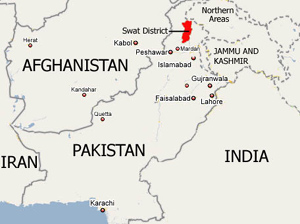
The Valley of Swat and the TTP
 |
|
A map of Pakistan and the surrounding region highlighting Swat District |
Pakistan’s current “catch 22” is in Swat, a valley in Northern part of Pakistan’s NWFP (North West Frontier Province). Swat was once Pakistan’ stop tourist destination, before its current and continuing chaos. The founder of the nation, Quaid-e-Azam Mohammad Ali Jinnah, called it “the Switzerland of Pakistan”. Winston Churchill was also fond of the valley in his early days in British India. In 2003 a new militant group emerged in Pakistan. This was Tehrik-e-Taliban (TTP). It was headed by Abdullah Mehsud, a former prisoner of the Guantanamo Bay Prison. Surprisingly he was cleared by U.S. authorities and sent back to Pakistan. He organized and started TTP which should not be confused with the Taliban in Afghanistan. This is a big common misconception in Pakistan and the rest of the world. It’s a pity that Pakistani and western journalists are confusing the Taliban with the Tehrik-e-Taliban (TTP) in their reporting and news articles.
The Taliban in Afghanistan have nothing against Pakistan and have never killed or threatened Pakistani people or Pakistani state. On the other hand, the TTP has done both. The TTP is a group based on Takfiri ideology (a Muslim who believes that all other Muslims even orthodox are not true Muslims and they are just collaborators of infidels and deserve to be attacked and killed). All Muslim scholars are unanimous in declaring Takfiris ‘heretics of Islam’.
The Hashshashin Sect
History provides us an example that sheds light on the Takfiris. When the Crusaders began to attack the Muslim world in the 11th century, a group of heretic Muslims emerged that started creating havoc amongst the Muslims by declaring war on their fellow Muslims. The group was the Hashshashin sect (the word assassin came from Hashshashin). Hashshashins were Muslims who had become heretics believing that other Muslims are Kafir (infidels) and had to be killed by any means necessary. Their doctrine was known as Fedayeen (a person ready to sacrifice his life for a mission). They should not be confused with today’s Mujaideen (Muslims committed to an armed struggle). While the Muslim armies were fighting the Crusaders, these Hashshashins also declared war on Muslims! Such internecine fighting is not unusual in other ethnic groups and religions. Similar fundamentalist sects who fought against their own can also be found in the histories of Christianity and Judiasm. Because of the Hashashin sect, Muslims had to fight with two brutal armies simultaneously during the time of the Crusades.
Often the Hashshashins fought alongside the Christian Crusaders against the Muslim armies. They assassinated Muslim scholars, political leaders, and civilians ruthlessly. This is the ideology that TTP is following in Pakistan. In 2004, under pressure from U.S.., former President Musharraf started a military operation in Pakistan’s tribal areas to remove TTP from those areas. At that time things were more stable in Swat. But they were about to get worse.
Need for a strong, central government in Pakistan
Swat, like the rest of Pakistan has always suffered from lack of a strong central government and a rule of law. According to Amnesty International Pakistan’s civil, district and Supreme courts suffer from massive corruption. According to Asian Journal of Political Science August 2007, report,
“Pakistan is generally included in most discussions of ‘failing states’ that pose the maximum danger to global security, with the rise of Islamic militancy being the most commonly cited reason for the ‘failure’. However, Islamic militancy is a result of impending state failure, not a cause of it.
“The state’s inability, caused by decades of systemic corruption, to provide any appreciable level of public goods or services, broadly defined, is responsible for the de-legitimization of the state and its inability to maintain law and order in the cities or suppress Islamist insurgents in the rest of the country.”
There has been a succession of corrupt Pakistani governments in the past. With nothing to offer to the Pakistani population these corrupt governments looked up to U.S., Britain, Saudi Arabia, and other countries in order to consolidate their position in power. They plundered the national wealth and placed Pakistan in debt by taking new loans from World Bank, IMF and other imperial financial institutions. Corrupt governments and weak parliaments were responsible for breakdown of institutions in Pakistan resulting in corruption, nepotism and rising lawlessness.
Emergence of Sufi Mohammad
The failure of civil law and order and the failure of enforcement have been the direct cause of the rise of local militants who controlled and operated their parallel Islamic courts in Swat. Sufi Mohammad was one such militant who started a movement to impose Islamic laws in Swat and other areas. His movement is not new. It first became known in 1989. In 1995 he started mass protests against the government. The government of Benazir Bhutto at that time negotiated with him and the matter was swept under the carpet.
Sufi Mohammad emerged again when U.S. attacked Afghanistan on October 7, 2001. He and his followers went to Afghanistan to fight U.S. invasion, most of his followers were killed there. Sufi Mohammad was captured and then sent back to Pakistan where he was imprisoned. He remained in Pakistani prison until April 2008, when he agreed to denounce “terrorist acts”, militancy, give up arms and come into agreement with Pakistan government.
Maulvi Fazalullah (also known as Radio Maulvi) is the current leader in charge of militants in Swat. He is son-in-law of Sufi Mohammad. Maulvi Fazalullah, unlike Sufi Mohammad, has not at all renounced violence or the armed struggle. Also note that followers of Fazalullah and TTP (Takfiri) are two separate groups. With the failure of law and order in Swat, many who lived outside the laws of Central Government, took refuge in Swat since civil law and enforcement has been virtually absent from the area.
When the Pakistan army started military operations against TTP in Tribal areas of Pakistan, Fazalullah and his militants began to attack police stations and to challenge the central government. Many civilians were killed. Members of the local population are often threatened, schools (especially girls’ schools) are closed down, teachers are killed, local politicians are attacked along with NGO workers and other acts of violence are taking place.
The judicial system in Swat
Swat was a princely state during British Rule in India. After the creation of Pakistan people of Swat used to follow the Islamic Shariah Laws to manage their day to day affairs. This means that all cases from criminal to civil to child custody were all managed by laws under Islamic Shariah Laws. After 1970 the Government of Pakistan took Swat under the District administration system just like the other parts of Pakistan. This meant that from that point on all Shariah courts would be replaced by civil courts, district courts. Pakistan is still following British laws that were incorporated under British India Act of 1935. The Pakistan government is still following a lot of obsolete rules and regulations of Act of 1935. The people of Swat agreed to accept the change but the problem with civil courts is that they take a longtime to come to any conclusion. They are susceptible to bribery and corruption because of the presence of unnecessary red tape and the handling of cases takes longtime. Plus the fact that there is a shortage of lawyers who are unwilling to work for lowly paid government jobs instead of more lucrative work in private practice.
Swat rejects Fazalullah
This system continued until Sufi Mohammad started his movement of re-introduction of Shariah courts. The local public wanted Shariah courts. As long as Sufi Mohammad was leading the movement it was non-violent. The people of Swat supported Sufi Mohammad. However, Fazalullah is now acting like a local war-lord. The people of Swat do not support violence at all and they are not supporting Fazalullah. The problem is that he has around 4000 men who are well trained and well armed and they have terrorized the local population. The local police, already understaffed and under budgeted, have been faced with massive desertions. The police does not have sophisticated weapons and gear comparable to that of Maulvi Fazalullah’s militants. The local police are no match for Fazalullah’s professional combatants.
Swat is different from Tribal Areas of Pakistan. Tribal areas are purely Pukhtoon and their daily lives are managed under tribal codes and laws. Mainstream schooling is very limited, whereas in Swat mainstream schooling was widespread. Swat, the most popular tourist destination in Pakistan once thrived with economic activity, local shops, small hotels and vintage shops. This resulted in better economic level compared to Tribal areas. Another thing to remember is that Tribal Areas have their traditional customs where all men consider carrying weapons a part of traditional manhood. In Swat this was not the case.
In the past, Swat progressed just like any other city in Pakistan and weapons were not to be found in every household. If Maulvi Fazalullah had appeared in Tribal Areas he would not have been able to terrorize the local population because there, the people are armed. Even though there is a great deal of anger throughout Pakistan over U.S. drone attacks, that anger will not cause the people of Swat to support Fazalullah. They see him as someone who is taking advantage of the U.S.. invasion and as one who is responsible for ruthless killings and the destruction of their local economy.
The government tried to bring Fazallullah under control through dialogue but to no avail. Fazalullah started his FM radio transmission that earned him the name of Radio Mullah. Notice the similarities between actions of Fazalullah and Hashshashins. There is no doubt that the restoration of law and order in Swat is a must through military intervention by the central government of Pakistan. There is no point with having a dialogue with Fazalullah, who has repeatedly backtracked from “peace talks” initiated by the central government. But this is an internal matter and is not the responsibility of foreign governments like the United States.
Who is providing arms to Fazalullah?
The situation in Swat has worsened in the last two years. With rising tensions between Pakistan and India, Pakistan moved some of its troops from Swat and tribal areas to eastern border with India; this provided a window of opportunity for Fazalullah to foment more anarchy in Swat. One important question is, “Who is the source of the weapons and supplies that are used by Fazalluah and TTP? In my view, the weapons are coming from Afghanistan where India operates 19 consulates. These are nothing more or less than operation centers of RAW (Research and Analysis Wing). RAW is India’s equivalent of CIA.
NDS is Afghanistan’s intelligence agency created by U.S. military after they setup Karzai government. The head of NDS is Amrullah Saleh, the thirty-six-year-old director of Karzai’s spy agency. Saleh became the world’s youngest intelligence chief in 2004, at age 32. Since 2005, NDS has emerged as a major source of strategic instability in the region. Saleh, explaining his action in Pakistan, says that “Insurgency is like grass, you cut the upper part but after sometime it will grow back, you poison the soil [Pakistan] where that grass is and it will die forever.”
Another problem for Pakistan is that the current government of Afghanistan is composed of Northern Alliance Warlords (NAW) who are supported by the U.S.. government. The NAW are extremely hostile towards Pakistan and very close to India. Historically, they have been mostly based in minority ethnic groups of Afghanistan like Tajik, Uzbek, Hazara (Shia by faith), and other groups. Pakistan has always supported majority ethnic group Pukhtoon, since Pakistan has huge Pukhtoon population. Taliban of Afghanistan was also Pukhtoon. During Taliban’s rule, India, Iran or Russia had no access into Afghanistan.
The India Factor
India’s intelligence bureau (IB) has always been responsible for internal intelligence gathering. The IB formed the “Research and Analysis Wing” known as RAW in 1968 for conducting external intelligence, comparable to the CIA. Recently, under RAW, India, in cooperation with the CIA, has begun to move some ground troops into Afghanistan.
According to Asian Tribune report of September 2008, India has 14 consulates in Afghanistan from which RAW is operating. In Wakhan, Badakshan province, RAW is operating a madarssah, where clerics from India are brainwashing local Afghans, Uzbeks and Tajiks. Their students are then infiltrated into Pakistan where they readily carry out suicide missions and other operations. The report further states:
“Mullah Omar (leader of the real Taliban) had never shown interest in establishing any links with Pakistani Taliban (TTP) and had warned Nek Muhammad (a militant who agreed to make peace deal with Pakistan government before he was killed in a U.S. drone attack) not to operate under the brand name of Taliban. It is being questioned as to why Baitullah, Fazlullah and their spokesmen desperately wanted by Pakistan security forces have escaped the hawkeye of U.S., particularly after they have been seen giving detailed interviews to media and using their cell phones? ISI [Pakistan’s intelligence service] had once given six figure coordinates of Baitullah and yet no Hellfire missile was fired on his hideout by CIA.”
It is very surprising that the CIA has not been able to kill Baitullah Mehsud, head of TTP or Fazalullah, when they have no problem hitting civilians with its drone-fired hellfire missiles.
Cambodia-Vietnam Analogy
When U.S. was fighting against the Vietcong in Vietnam, the U.S. military falsely claimed that support for the Vietcong was coming from Cambodia and President Lyndon Johnson, a Democrat, started air strikes in Cambodia. At the time, the military government of Cambodia was just a U.S. puppet regime. That U.S. bombing killed one million people Cambodian people. What was the result? Cambodia was torn into civil war and brutal suffering took place under Pol Pot. The same thing could happen in Pakistan. They are triangulating the U.S.. war in Afghanistan with India and Pakistan. One of their convoluted methods is to use India’s RAW in Afghanistan which leads to the indirect attacks in Pakistan by RAW’s madarssah students in Afghanistan. The Pakistani government’s stance on the “War on terror” is as never before at a tangent with the public opinion.
The government of Pakistan must act now to avert catastrophe
The Pakistan government must take the following steps immediately if complete destabilization and catastrophe is to be averted. If the Pakistan government does not take these steps, it must be removed and an interim government must be set up to carry out these steps.
- Pakistan must pass a bill in the parliament that authorizes the Pakistan Air Force to retaliate against deadly U.S. drone attacks. Pakistan has asked the U.S. government and military leadership repeatedly to stop drone attacks into Pakistan but to no avail.
- Pakistan must ask the U.S. to pack up its military bases and get them out off Pakistani soil, since there was no open agreement for these air bases between Pakistan government and U.S.. in the first place.
- After 9/11 military ruler Pervez Musharraf became dictator of Pakistan. All agreements were made between him and the U.S.. government. These agreements with the U.S. must be made public and cancelled. New agreements must be made with the U.S.. which ensures Pakistan’s territorial sovereignty.
- Pakistan must ask NATO and the U.S. military to make sure that Afghanistan’s soil is not used by India to create proxy war against Pakistan. Pakistan must declare neutrality in War in Afghanistan, Pakistan can’t continue to be supporting Afghan Government that is working against the interests of Pakistan.
- Pakistan must stop giving NATO and the U.S.. access to move arms and supplies through Pakistan. If the U.S. continues to send drones to kill civilians in Pakistan under the Obama regime, it will only fuel more militancy in Pakistan. Pakistan must stop the NATO/U.S. supply route.
Of course all this is easier said than done. The U.S.. knows it need not worry about any of this or similar course of action being taken by the current Pakistani government. The U.S.. is completely involved with Pakistani leadership, especially with the President and the Army Chief. What is not reported in the U.S.. media is that U.S.. Ambassador to Pakistan, Ann Patterson, meets with Pakistani leaders and even opposition leaders as often as she can. In one week in January 2009 she met with Pakistani President thrice. But will she say a word to stop the pointless, deadly U.S. drone attacks inside Pakistan by the U.S.. military?
Obama’s “War on Terror”
On December 26, 2008, immediately after he was inaugurated, President Obama ordered his first drone missile attack in sovereign Pakistan, killing 16 civilians. Obama should realize that the escalating “War on Terror” inside Pakistan is totally counterproductive. U.S. must realize that there is no option but to bring the Taliban into the political process in Afghanistan. Hamid Karzai, NATO commanders, and British government have all expressed similar views. Pakistan, on the other hand, must distance itself from the U.S. “war on terror” as it is creating havoc inside Pakistan and has no basis in fact, worldwide. It is also important to note that the Pakistan army is also not in best of moods since they are not particularly in tune with the government and have no desire to fight their own countrymen.
If the government does not address the situation, mounting public pressure can result in wide spread social unrest, protests, strikes, and even violent agitation? The situation in Pakistan’s tribal areas and Swat is moving from bad to worse. Even if the situation in Swat or Tribal Areas were to improve, trouble is likely to start in some other part of NWFP or Baluchistan province of Pakistan. The point is that Pakistan is facing tough challenges from TTP, Maulvi Fazalullah and other militants, and current U.S. policy of carrots and sticks for Pakistan is only making it worse. The U.S. must deal with people of Pakistan in a civil manner and respect their territorial integrity and national sovereignty rather than making back-room deals with the corrupt President and Prime Minister. Their refusal to do so raises questions about whether they really want to see Pakistan united in peace or a destabilized Pakistan that serves their imperial agenda. The spokesman for the Pakistan Army spokesman has said that crushing militancy will take a longtime as it’s very difficult to distinguish militants from local residents. Moreover, the continuing illegal U.S.. attacks are fostering support by local populations for disparate militant groups who already live their lives within those populations.
Democracy does not work the same way in Pakistan as it is reported to be working in the U.S. or Europe. With 35% literacy rate, it cannot be the same kind of democracy as in EU or North America. The U.S. belligerent support to corrupt democratic leaders of Pakistan will only undermine what is already a weak democracy in Pakistan. Weak democratic institutions give rise to militancy, extremism, and parallel institutions. Continuous U.S. and British support to corrupt Pakistani rulers will only result in more hatred for Pakistani state, Pakistani rulers, and in turn, the United States.
Conclusion
Finally, the news coverage of the Swat region is very limited, and no one exactly knows how many people have been killed. According to a rough estimate by Center for Research and Security Studies, since 9/11 Pakistan has lost at least 12,000 people as a result of the U.S. war on terror. Some were blown up in suicide bombings, some were killed by U.S. drone attacks, some of the dead were Pakistani army soldiers, some police officers, and a lot of them were women and children. This is nothing compared to the death count of Afghanistan, Palestine and Iraq but it is enough to push Pakistan on the brink of disaster. A policy shift by the Pakistan government toward foreign intervention is the need of the hour.
The current carnage in Swat has resulted in killing of many civilians, security personal and militants. The exact number of people killed is not known. The local economy has collapsed and people are making mass exodus from the valley. How long the military operation will continue is unknown. Pakistan must make drastic changes in its foreign policy in Afghanistan and its policy on the U.S. “war on terror”. Otherwise, we the people of Pakistan will suffer more.
Talha Mujaddidi is a writer/analyst and Axis of Logic correspondent, living in Pakistan. He can be contacted at: talhamujaddidi@gmail.com
Obama airstrikes kill 22 in Pakistan
January 25, 2009President Obama ‘orders Pakistan drone attacks’
January 24, 2009
INDIA/PAKISTAN: Kashmir Jittery Over Prospect of War
January 20, 2009
By Athar Parvaiz | Inter Press Service

SRINAGAR, Jan 19 (IPS) – As war clouds hover over India and Pakistan, anxiety levels have risen in Kashmir, often described as the bone of contention between the South Asian neighbours
Bellicose posturing by the two countries, following the Nov. 26-29 terror strikes in Mumbai, has, according to analysts here, the potential of spiralling into yet another one of a series of wars fought over the territory by the two countries, created in 1947 following the decolonisation of the sub-continent.
”War between India and Pakistan appears to be a possibility given the course the two countries have taken,” Mohammad Sayeed Malik, a well-known, Srinagar-based political commentator told IPS. “If not checked, it may reach a point of no return and actual war would be impossible to avoid.”
The Mumbai attacks, which left 180 people dead, rudely interrupted the ‘composite dialogue,’ begun in February 2004 after the nuclear-armed neighbours restored diplomatic ties – downgraded in reaction to a similar armed attack on India’s parliament in December 2001.
Accusing Pakistan-based militant groups, Lashkar-e-Toiba (LeT) and the Jaish-e-Mohammed (JeM), for staging the attack on Indian parliament, India massed troops along the border in the largest military mobilisation since the two countries went to war in 1971.
The LeT, set up to fight Indian rule in Kashmir, has now been implicated in the Mumbai attacks as well by India and by United States officials and analysts who have also linked it to Pakistan’s shadowy Inter-Services Intelligence.
In the aftermath of the 2001 attack, war between the neighbours was avoided by intense diplomatic activity led by the United States. But it took until February 2004 before the composite dialogue process – a serious effort aimed at confidence building, normalisation of bilateral relations and dispute resolution – could be put into place.
The peace process brought better diplomatic, trade and people-to-people contact across the 298-km, fenced and fortified Line of Control (LoC) that divides Indian Kashmir from the Pakistan-administered part of the territory and has served for decades as the de facto international border.
Most significantly, for people living along the LoC, the peace talks brought about a cessation of the constant exchange of artillery fire by the Indian and Pakistani armies across the border. Scores of civilians have been reported killed, maimed or displaced by the destructive exchanges.
“After the ceasefire, we had been living in a comfortable manner without any fear, but now we might again have go through the traumatic times before the ceasefire,” Rustum Gelani, a resident of the border town of Tangdar, told IPS over telephone.
Reports from the other towns near the LoC such as Uri and Poonch suggested that people were close to panic. “We would appeal the two countries to maintain the ceasefire,” said Abdul Gafoor, a resident of Poonch.
People living along the road leading to LoC in Tangdar, Uri and Poonch have reported seeing deployment of troops and equipment for several days now. “More military and machines are being stockpiled on the LoC… it looks like war is brewing up,” said Neik Mohammed, a resident.
Army officials have downplayed the activity as part of routine exercises, normally conducted at this time of the year. But one defence source said the moves were ”precautionary measures as our neighbour Pakistan is mobilising troops on its side of the border”.
Malik said that should war break out between India and Pakistan, Kashmiris would be the worst sufferers; socially, economically and politically. “It would wash away all the gains of the five-year-old peace process. The positive mood in the aftermath of the peaceful elections in Kashmir may vanish into thin air,” he said.
“During and after Gen. [Pervez] Musharraf’s rule, Pakistan had made quite a lot of progress in disengaging itself from active involvement in Kashmir… a war could reverse it,” Malik added.
Civil society and NGOs have been busy urging India and Pakistan to work towards de-escalating tension and peace-building. “We call upon India and Pakistan to sign the convention and treaty to ban production, stockpiling and use of cluster munitions and landmines,” said ActionAid’s Arjimand Talib, a peace activist.
”A war would seriously dent efforts at poverty eradication in the region and shift focus from development to further militarisation,” Talib added.
“After India felt that international pressure had started working on Pakistan, it has helped bring down tension levels. This should have been enough, but since India’s elections are just round the corner, one can’t be sure that the war hysteria will come down,” said Malik.
Tapan Bose, secretary general of the Pakistan India People’s Forum for Peace and Democracy (PIPFPD), told IPS that public anger projected in the media carried the danger of precipitating war, forgetting that ordinary people would suffer the consequences most.
“We have been so overwhelmed by the war jingoism of the media and sections of the state and upper middle class [because they were hit by the Mumbai attacks] that we forget what the peace process means for thousands of ordinary people,” Bose said. ”Who speaks for them?”
Hassan Gardezi: Pakistan Today
January 8, 2009Radical political activist Hassan Gardezi
By Nasir Khan, January 8, 2009
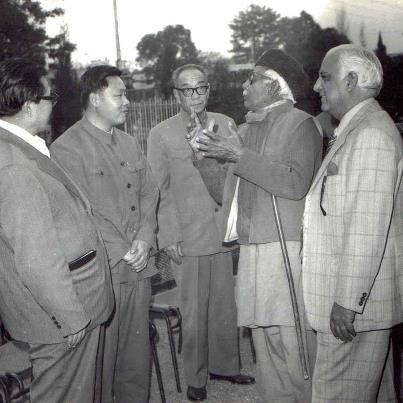
Dada Amir Khan (with cap, d. 1989), Dr Ayub Mirza and the Chinese Ambassador to Pakistan (Photo: 1982)
The renowned Pakistani sociologist and radical activist Professor Hassan Gardezi has been a life-long human rights campaigner. Through his books and articles, he has staunchly stood for the rule of law and has shown the importance and relevance of socialist values in shaping an egalitarian society.
He opposed the policies of General Zia-ul-Haq, whose brutal dictatorship in the 1980s was simply a reign of terror in Pakistan. Under Zia’s rule, thousands of ordinary political workers and activists were rounded up and incarcerated with a view to silence any opposition to his tyrannical rule. Many people were flogged by police publicly and this was meant to be a message from the military ruler to all those who dared to oppose him. The general used his army and police to beat and mishandle Pakistanis as Nazi rulers of the Third Reich did with their opponents, or the Zionist rulers of Israel have been doing and are still doing with the captive population of Palestine. Anyhow, in those beak years in Pakistani history, Hassan Gardezi , who was living in Canada, played an important part to combat Zia’s obscurantist policies of so-called Islamisation and the sharia laws, which, by the way, had nothing to do with Islamic faith or its benevolent moral and social laws.
Dr Gardezi had been a close and trustworthy friend of the great Indo-Pakistani revolutionary Dada Amir Haider Khan. The autobiographical manuscripts that Dada had compiled while in jail in the 1930s or his later updated sketches, notes and letters were in a precarious condition. To organise and systematise all such papers was a daunting task for any editor or schoalr. But Gardezi was the right man for the difficult job; he with a single-minded determination organised and re-wrote the entire manuscript and notes to compile the memoirs of Dada. Last year, he finally published the two-volume autobiography of the great revolutionary. I solute Dr Gardezi for his great work.
I have never me Gardezi, who has lived and taught in Canada for many decades whereas I have worked and lived in Europe for almost five decades; however, Dada had kept me informed about his close friend Hassan Gardezi, his scholarly work and his political activities.
I have great admiration for the work and worldview of Comrade Hassan Gardezi and I offer him my best wishes for the period of his active retirement. I hope he will continue to inspire us, the old radical guard as well as the younger generation, in the years to come.
——————————————————-
Pakistan Today: A Travelogue
By Hassan Gardezi
Periods of national unrest have not been uncommon or unfamiliar occurrences in the history of Pakistan. But the political and economic turbulence the country is facing today is bound to come as a shock to any visitor who has been away from the country for even a couple of years. It is as if all the contradictions that were being nurtured within the institutional structure of the state since the creation of the country have suddenly come to a head, threatening to spell the collapse of the entire edifice.
“How does Pakistan look to you today?” was the question most frequently asked, with some variation, everywhere I went this time, whether it was a meeting with old students, colleagues and political comrades in Lahore, a chat at the “tea” before or after a talk I was invited to give somewhere, a social meeting in Islamabad, or a gathering of close relatives in Multan.
Pakistan’s existential situation of course does not look very good today and everyone in the country knows this. The question being asked was perhaps more of an expression of common anxiety about what is happening in the country, a subterfuge rather than a real question.
The problems behind Pakistan’s latest crisis are not really new. But the one that is being
most palpably felt is that of religious extremism accompanied by unprecedented acts of terrorism. Bombs planted or carried on the person of suicidal individuals went off almost every day in some part of the country when I was there, killing and maiming their hapless victims. The biggest carnage took place in the heart of Peshawar on Dec. 5 when a powerful bomb went off in the Qisa Khwani bazaar crowded with Eid shoppers, killing scores of women and children and lighting up a huge fire. It was intended to destroy a shia imambara. These acts of terror are being committed by Islamic extremists, generally known as Pakistani Taliban, who are most active in the seven agencies of the Federally Administered Areas (FATA) and also control a substantial part of the northerly settled districts of NWFP province, renamed Pakhtunkhwa.
The leaders of the Awami National Party (ANP) which heads the provincial government and their relatives are the latest individual targets of terrorist killings (ostensibly for hobnobbing with Afghanistan’s president, Karzai). The national chairman of the party, Isfandyar Wali, survived a murderous attack on October 2, which killed four of his companions. Peshawar, the seat of provincial government, is virtually a war zone. Neither the once formidable Frontier Corps nor the Pakistan army seem to be able to establish the writ of the government over vast northerly tracts of the province. It has also become impossible for the Pakistani truck convoys to carry supplies for the NATO troops in Afghanistan from the Karachi port through the Peshawar terminals.
The operations of Pakistan army in trying to restore governmental control in FATA and adjoining settled districts of Pakhtunkhwa are neither effective nor hold much credibility in the eyes of the people, despite heavy casualties suffered by soldiers in fighting with the Islamic militants. Many questions are being raised regarding the involvement of the armed forces on the northwestern front. Are they serious in eradicating the menace of Islamic terrorists inside Pakistan? Is the army rank and file willing to kill their Muslim brothers while for decades they have been regimented to fight “Hindu India?” What role did the army and its intelligence services play in creating and nurturing the Islamic insurgents or jihadis as a foreign policy tool in the first place? Whose “war on terror” is the Pakistan army fighting any way? Is it serving the imperial interests of the United States on the northwestern front? and so on go the questions.
In October 2008 the newly elected government decided to hold an in-camera session of the national parliament under tight security to get “everyone on board” on the rationale of fighting the menace of “extremism, militancy and terrorism.” After two weeks of deliberations and extensive briefings on the situation provided by the army High Command, the parliament passed a resolution hailed as representing the consensus of its members. Somewhere in this resolution it was written down that the “nation stands united to combat this growing menace” by addressing its “root causes.”
it appeared that addressing the root causes of extremism and terrorism in Pakistan would be a great opportunity for the elected representatives of the people to face the truth and make a beginning to move towards establishing a new political culture of peace and tolerance. But when I reached Pakistan in November, everyone was talking about the menace of terrorism and religious extremism but there was no sign anywhere of addressing its root causes.
I brought this issue to the first of the talks I was invited to give at the Lahore School of Economics. Any honest attempt to trace the roots of religious extremism and associated terrorism would inevitably lead to two interrelated fundamentals of state policy that have been pursued by every Pakistani government, which has ruled the country since independence, I said. One of these fundamentals is the Islamisation of Pakistani state and society while the other is catering to the global strategic interests of the Unites States of America.
Moves to Islamise the state of Pakistan began as the first order of business for the founding fathers of Pakistan (the worthy exception being Muhammad Ali Jinnah) whatever their political motives, and they were certainly not spiritual. Assembled in the first Constituent Assembly of Pakistan, these men came up with a document known as the Objectives Resolution in 1949, which declared that “Sovereignty belongs to Allah alone but He has delegated it to the state of Pakistan . . .” It further proclaimed that “Muslims shall be enabled to order their lives in accordance with the teachings of Islam as set out in the Holy Quran and Sunnah.” With these beginnings, all subsequent rulers of Pakistan made their own contributions to inject Islam into the affairs of the state, thereby empowering a parasitic and rabidly patriarchal class of mullahs. It was however left to General Zia-ul-Haq to effectively demonstrate what it meant for the Muslims of Pakistan to order their lives in accordance with the teachings of Islam after his coup d’etat in1977.
Islamisation of the Pakistani state and political culture was also a useful asset for the United States to exploit in its aim to keep the country tied to its Cold War military alliances against Soviet communism. Ultimately, with Zia the most ardently Islamist dictator in power, the United States was able to mobilize Pakistan army, intelligence services and Islamist parties to launch its proxy war, designed as Jihad, to overthrow the infant Marxist government of Afghanistan backed by the Soviet Union. This was the critical event which, through various political turns and twists unfolded into today’s global terrorism with Pakistan as its epicentre.
Thus it is reasonable to conclude that the mess that Pakistan is currently in is of its own making, with the opportunistic backing of the United States, I said in my submission to the small professorial circle that had gathered to hear me in the brightly lit library of Lahore School of Economics. How to get out of this mess? The only logical course that I could see was the reversal by the state of its Islamisation, and Americanisation policies.
On the sunny morning of November 21, I was sitting among a hall full of students at the campus of the newly established University of Gujarat. I was invited to speak on the current political and economic crisis, but my mind was picturing the young men and women sitting in front of me as little playful toddlers when Gen. Zia had let lose an orgy of public floggings to implement his primitive sharia laws taken from the books of Jamat-e-Islami, his new found political ally. Do these young people remember all that? I was wondering. Was there anything in their history and Pakistan Studies textbooks about a military dictator who had installed himself as the Islamic ruler, Amir–ul–Momineen, of the wretchedly poor people of Pakistan? Do they know who created and fostered the present day Islamic extremists terrorizing the people, killing them in their mosques, imambaras, and bazaars while taking over the northern areas of Pakistan?
Once I got up to speak I pretty much repeated to my young audience what I had said at the Lahore School of Economics about the roots of Islamic extremism and terrorism in today’s Pakistan. Injecting the beliefs and rituals of a particular religion in the affairs of a modern, pluralistic, state is like playing with fire, I said. And the proof is all around us today as the country’s mosques, imambaras, bazaars and hotels burn, set on fire by the bombs and explosives of religious zealots. It is time for the people of Pakistan to make it very clear that most of them are Muslims, they were born Muslims, They have learned their faith from their elders, and neither the state mullah nor any jihadi has the right to tell them how to practice their faith.
But is it realistic to suggest that Pakistan dismantle its Islamisation project and break its ties with the only superpower on earth? Yes it is, if the government is a democracy run by the consent of the majority. The majority of the people of Pakistan have never endorsed Islamic rule as they have rejected the Islamist parties in every election held in Pakistan which has not been rigged. Religious fervour that is observed today in Pakistan is largely confined to the small middle class, always ready to compromise to protect its precarious existence. The people in general are fed up with the mayhem created by the Islamic militants. Several recent public opinion polls have also confirmed that an overwhelming majority of the adult population does not want the United States to interfere in the affairs of Pakistan.
After a brief stay at the beautifully laid out campus of the University of Gujrat, which incidentally is headed by a noteworthy academic and not a retired military heavy-weight, I was driven to Islamabad.
Islamabad, as the capital of Pakistan has many reasons to be visited, but lately I have been going there to spend a few restful days with a friend, sheltered by the Marghala hills, and to browse through the stores selling used and new books in the F/6 and F/7 markets. But it looks like what used to be the most calm and cloistered capital city in the world is now wide open to scarification by a new breed of militant Islamists. Last time I was there a large area of the city was fenced off where once was a mosque called Lal Masjid. This time my friend drove me by an enormous pile of debris which once was the imposing structure of Marriott Hotel surrounded by the shinny cars of its clients. It was indeed a grim reminder of the deadly power wielded by the men of God in today’s Pakistan.
Next I took a bus to Multan and was hardly in that city of the saints for long when the news broke out of November 26 terrorist attacks on Mumbai hotels. The irate Indian prime minister immediately called up his Pakistani counterpart, naming not only the rabidly anti-Indian jihadist outfit, the Lashkar-e-Tayyiba (LeT), as the perpetrator but also accusing Pakistan’s Inter-services Intelligence agency (ISI) as having directed the atrocity. The Pakistani prime minister, a fellow Multani not known for much political astuteness, denied all accusations and even offered to send the director of the ISI to help in finding out the culprits. However, the poor fellow had to retract his offer soon thereafter and went into the denial mode.
Within next few days all signs of official or unofficial contrition vanished from Pakistan’s media coverage, washed away by a tide of national jingoism. Indian admonitions that Pakistan rein in its Islamic militants were met by a chorus of patriotic war cries vouching to defend Pakistan from its perennial enemy, India. If on the one hand spokespersons of the venerable Lawyer’s Movement were issuing patriotic statements, on the other hand there were the villainous terrorists, the likes of Baitullah Mehsud and Mangal Bagh, voicing eagerness to march their lashkers to the Indian border to defend Pakistan. The rest of this drama is still to unfold.
I had yet to go to Karachi to participate in a discussion panel on Dada Amir Haider Khan’s book of memoirs, Chains to Lose, which I was finally able to get published last year. But Karachi was once again in the grip of riots. This time the riots were sparked by MQM’s fears that Pakhtun refugees from Waziristan and the districts of Pakhtunkhwa, displaced by Pakistan army’s anti-terrorist operations and constant missile attacks launched from the US predatory drones, were flocking to Karachi and taking control of local markets.
In any case I was able to make it to the Karachi event, thanks to an interlude of peace in the city in preparation for the Eid holidays. The book discussion was organized by Dr. Jaffer Ahmed, the able and tireless director of Karachi University’s Pakistan Studies Centre, the publisher of the Chains to Lose. Some half a dozen people, journalists, writers, political activists, presented their very well informed and perceptive reviews. Zahida Hina was one of them whose presentation in Urdu caught the general sense of the house. She said:
Dada’s memoir is a great historical document if one seeks to understand a glorious 20th century movement in South Asia for freedom from world colonialism and imperialism.
If our generation has no idea of who Dada Amir Haider Khan is, it cannot be blamed. This generation has never been told anything about our great compatriots. We make giants out of dwarfs and treat our persons of great stature like lowly creatures.
Feeling happy that Dada’s contributions as a committed communist to make Pakistan, South Asia and the world a better place for humanity are becoming known I returned to Lahore on December 6. Next evening there was a sitting with some like-minded comrades arranged by Awaji Jamhoree Forum. It turned out to be a free-wheeling discussion of the present global economic crisis, war on terror and the rise of Islamic terrorism in Pakistan, terrorist attacks on Mumbai hotels, the US elections and the victory of Obama.
Perhaps the most serious concern was the position and the role of the socialist left in all this. I maintained that the greatest asset of the socialist left is its set of values. These values of freedom, peace, opposition to all wars, human rights, respect for nature and all life, economic, racial and gender equality, religious and ethnic tolerance, are together a powerful antidote to the present global crisis. There is every chance for the socialist left to succeed in its own right if it stops wasting its resources to support the lesser evil in political contests. I gave the example of very active and resourceful anti-war and anti-poverty groups in the United States who squandered their assets by supporting Barack Obama as the lesser evil in the contest between the two mainstream bourgeois parties. There is no sushi thing as more or less evil, I said. All war is evil whether it is more or less, all poverty and all inequality is evil whether it is more or less. A similar mistake was made in the last elections in Pakistan when parties calling themselves “communist” rushed to support the PPP.
I better end here. My apologies if I have bored you with my long story. If you do have any questions and comments I will be glad to receive them. I wish you a very happy new year.
Hassan Gardezi
Gaza and India
January 6, 2009A View From Pakistan
By FAHEEM HUSSAIN | Counterpunch, January 5, 2009
The horror and the massacres continue in Gaza. The scenes of carnage being broadcast by Al-Jazeera are unbearably painful. Police stations, schools, universities, ministries, houses, crowded mosques, ambulances, paramedics, etc. were and are being targeted by the Israeli air force and now ground troops have entered to “finish the job” as the Israelis call it. Hundreds of innocents have been killed and thousands injured and there seems to be no end in sight. This is not a war but a massacre of a population that has been deprived of everything for more than 18 months by the Israeli embargo and is now being bombed to oblivion. The nearest equivalent is the massacre of the Jews in the Warsaw ghetto in 1944. The world watches without lifting a finger to stop this genocide. Arab leaders are either collaborating with this massacre or are totally helpless in front of this brutality. The vast majority of the people of the world are horrified and disgusted with what is going on but are unable to do anything to help the suffering people of Gaza.
The response of Western leaders was expected. Obama’s silence is stunning. They more or less explicitly backed the Israeli attack and the hypocrisy was so evident. When the Mumbai tragedy took place everybody was quite rightly quick to condemn the attackers and to call for action against them and had sympathy with the Indian people. But there is no condemnation of Israeli terrorism that is on an even larger scale than that perpetrated in Mumbai. Obama was quick to offer sympathy to India and to condemn the Mumbai terrorists but when it comes to Israel he is keeping a silence that makes him an accomplice to the crimes being committed there. It is as if everything is permitted to Israel and Arabs are considered no more than “cockroaches”, the term used by Sharon to describe them.
There have been disappointing, muted protests from Pakistan and India who are involved in their own problems. Pakistan has always been quite lukewarm on the Palestinian issue as it has been a staunch ally of the United States for more than fifty years and therefore cannot criticise let alone condemn Israel, the United States’ greatest ally in the region. But what is disappointing to many Pakistani leftists and progressives is the response of the Indian government. There was a time when we looked up to and admired Indian foreign policy which was independent, non-aligned and at times even anti-imperialist in contrast to Pakistan’s foreign policy which was always subservient to US interests. One recalls India’s principled opposition to the Vietnam War. At one time one of the few countries which Indians could not visit was Israel because of its refusal to recognise the rights of Palestinians. How times have changed. Now India vies with Pakistan in trying to demonstrate who is the more loyal subject and says good-bye to all principles. India sees it self now as a big power and no longer as a defender of the weak and the underdeveloped world. India’s economic interests are now closely tied with the US. It sees itself as the main partner of the US in the region.
But apart from its closeness to the USA, India has also developed a special relationship with Israel particularly in the sphere of defence. It is one of the biggest customers for Israeli weapons and Israeli defence chiefs have visited India in recent years to propose training in counterinsurgency for Indian troops in Kashmir, based on Israeli experience in occupied Palestine, especially Gaza. After we see Israeli actions in the West Bank and particularly now in Gaza we can expect the kind of advice which the Israeli military is offering India in Kashmir. Targeted assassinations, collective punishment, massive bombardment, etc. without addressing the fundamental political issues. India seems to be buying into the US’s view that Islamic fundamentalism is the greatest threat to world peace and that a long unending war against so-called “Islamic terrorists” is necessary. The terrorist attack in Mumbai has driven India to join what many view as the new axis of Washington-Tel Aviv-New Delhi that will attempt to decide the future of the region. Given these facts it was perhaps not surprising the muted response from New Delhi to the Israeli genocide in Gaza but nevertheless it was disappointing and confirmed our worst fears of where India is heading.
What is needed from both Pakistan and India is a vigorous denunciation of Israeli war crimes. Pakistan does not have diplomatic relations with Israel but India does. The least India can do is to recall its ambassador from Tel Aviv even if it cannot think of breaking diplomatic relations with Israel.
Faheem Hussain is Professor of Physics at the School of Science and Engineering, Lahore University of Management Sciences.


Feinstein comment on U.S. drones likely to embarrass Pakistan
February 15, 2009February 13, 2009
The disclosure by Sen. Dianne Feinstein (D-Calif.), chairwoman of the Senate Intelligence Committee, marked the first time a U.S. official had publicly commented on where the Predator aircraft patrolling Pakistan take off and land.
“As I understand it, these are flown out of a Pakistani base,” she said.
The basing of the pilotless aircraft in Pakistan suggests a much deeper relationship with the United States on counter-terrorism matters than has been publicly acknowledged. Such an arrangement would be at odds with protests lodged by officials in Islamabad, the capital, and could inflame anti-American sentiment in the country.
The CIA declined to comment, but former U.S. intelligence officials, speaking on condition of anonymity because of the sensitivity of the information, confirmed that Feinstein’s account was accurate.
Philip J. LaVelle, a spokesman for Feinstein, said her comment was based solely on previous news reports that Predators were operated from bases near Islamabad.
“We strongly object to Sen. Feinstein’s remarks being characterized as anything other than a reference” to an article that appeared last March in the Washington Post, LaVelle said. Feinstein did not refer to newspaper accounts during the hearing.
Many counter-terrorism experts have assumed that the aircraft take off from U.S. military installations in Afghanistan and are remotely piloted from locations in the United States. Experts said the disclosure could create political problems for the government in Islamabad, which is considered relatively weak.
The attacks are extremely unpopular in Pakistan, in part because of the high number of civilian casualties inflicted in dozens of strikes.
The use of Predators armed with Hellfire antitank missiles has emerged as perhaps the most important tool of the U.S. in its effort to attack Al Qaeda in its sanctuaries along the Pakistani-Afghan border. A New Year’s Day strike killed two senior Al Qaeda operatives who were suspected of involvement in the bombing of Islamabad’s Marriott Hotel.
They were among at least eight senior Al Qaeda figures reportedly killed in Predator strikes over the last seven months as part of a stepped-up missile campaign.
Bruce Hoffman, a terrorism expert at Georgetown University, said Feinstein’s comments put Pakistan’s government on the spot.
“If accurate, what this says is that Pakistani involvement, or at least acquiescence, has been much more extensive than has previously been known,” he said. “It puts the Pakistani government in a far more difficult position [in terms of] its credibility with its own people. Unfortunately it also has the potential to threaten Pakistani-American relations.”
As chairwoman of the Senate Intelligence Committee, Feinstein is privy to classified details of U.S. counter-terrorism efforts. The CIA does not publicly acknowledge a campaign against Pakistan-based extremists using remotely piloted planes, making Feinstein’s comment all the more unusual.
Feinstein’s disclosure came during testimony before the Senate Intelligence Committee by U.S. Director of National Intelligence Dennis C. Blair on the nation’s security threats. Blair did not respond directly to Feinstein’s remark, except to say that Pakistan was “sorting out” its cooperation with the United States.
Pakistani officials have long denied that they have even granted the U.S. permission to fly the Predator planes over Pakistani territory, let alone to operate the aircraft from within the country.
The civilian leadership that took over from an unpopular former general, Pervez Musharraf, last year, has gone to significant lengths to distance itself from the Predator strikes.
The Pakistani government regularly lodges diplomatic protests against the strikes as a violation of its sovereignty, and officials said the subject was raised with Richard C. Holbrooke, a newly appointed U.S. envoy to the region, who completed his first visit to the country Thursday.
But a former CIA official familiar with the Predator operations said Pakistan’s government secretly approves of the flights because of the growing militant threat.
Feinstein prefaced her comment about the Predator basing Thursday by noting that Holbrooke “ran into considerable concern about the use of the Predator strikes in the FATA areas,” a reference to what Pakistan calls its Federally Administered Tribal Area along the border with Afghanistan.
Many Pakistanis believe that the civilian leadership, despite public anger, has continued Musharraf’s policy of giving the United States tacit permission to carry out the strikes.
The CIA has been working to step up its presence in Pakistan in recent years. It has deployed as many as 200 people to the country, one of its largest overseas operations besides Iraq, current and former agency officials have estimated. That contingent works alongside other U.S. operatives who specialize in electronic communications and spy satellites.
In his prepared testimony Thursday, Blair said that Al Qaeda had “lost significant parts of its command structure since 2008.”
greg.miller@latimes.com
Times staff writer Laura King in Istanbul, Turkey, contributed to this report.
Share this:
Tags:discolsures, missile strikes, Pakistan, Pakistani government's protests, Sen. Dianne Feinstein, US and Pakistan relationship, US drones
Posted in Commentary, Human rights, imperialism, Pakistan, US policy | Leave a Comment »