Archive for the ‘Pakistan’ Category

Pakistan: More than two million people living outside displacement camps face appalling conditions

July 3, 2009
FOR IMMEDIATE RELEASE
July 2, 2009
12:19 PM
CONTACT: Amnesty International
Tel: +44 (0) 20 7413 5566
After hours: +44 7778 472 126
Email: press@amnesty.org

LONDON – July 2 – Pakistan’s central and regional governments must urgently do more to assist the more than two million people who have fled escalating fighting in northwestern Pakistan but do not have access to aid distributed in official displacement camps, Amnesty International said today. In particular, the Pakistani government must ensure that ethnic Pashtuns fleeing the fighting do not face discrimination in receiving assistance.

“As the fighting expands to North and South Waziristan, a displacement crisis that the government had said would last only for weeks looks set to go on for months, with no relief in sight for the millions of displaced people,” said Sam Zarifi, Amnesty International’s Asia-Pacific Director. “To make matters worse, the vast majority of displaced people are living outside the registered camps where aid agencies are distributing shelter, food and water to those in need.”

Continued >>

Pakistan Supreme Court moved against U.S. drone attacks

July 3, 2009

The News International, Thursday, July 02, 2009

ISLAMABAD: A constitutional petition was filed on Wednesday in the Supreme Court, challenging drone attacks in the tribal belt of the country and praying for directing the federal government to submit a report before the court as to who was responsible for causing the “murders” of citizens.

The court was also prayed to direct the federal government to get an FIR registered against US President Barack Obama and those responsible for the murder of “innocent” people in drone attacks. The petition was filed by M Tariq Asad advocate, Chairman of the National Council of Human Rights, under Article 184(3) of the Constitution, making the federal government through its secretary, Ministry of Interior, as respondent.

He prayed to the court to direct the federal government to register murder and genocide cases against US President Barack Obama for ordering drone attacks inside the Pakistani territory. The petitioner also prayed to the court to direct the government to lodge complaint with the United Nations against the US aggression.

It was prayed that the respondents be directed to file complaint against the United States of America before the International Court of Justice or other judicial organs of the United Nations to take action in accordance with international law.

Deaths in suspected US drone strike

July 3, 2009
Al Jazeera, July 3, 2009

An unmanned US drone aircraft has reportedly carried out a missile strike on Taliban targets near Pakistan’s border with Afghanistan.

Missiles struck targets in parts of South Waziristan, in an area controlled by Pakistani Taliban leader and al-Qaeda ally Baitullah Mehsud, Pakistani intelligence officials have said.

The missile strike hit a suspected training facility in the village of Montoi in South Waziristan. A suspected militant hide-out in Kokat Khel was also hit.

There are believed to be casualties from the attack which took place early on Friday morning.

Pakistani aircraft are also reported to have carried out an attack on two targets in North Waziristan in which up to 11 people are said to have been killed.

Imran Khan, Al Jazeera’s correspondent in Islamabad, said the US military has not responded to the attacks.

“The US never ever confirms whether they are behind these suspected drone strikes but popularly, it is believed that this is the kind of attack the US has made within this very troubled area of Pakistan before and they area likely to be behind these attacks,” he said.”

“Drone strikes are causing much controversy in Pakistan – many people say they have killed a number of innocent civilians and act as more of a recruitment tool for Pakistan Taliban.”

At Least 65 Killed as US Drones Attack South Waziristan Funeral Procession

June 24, 2009
Mourners From Early Strike Killed in Second Attack

Jason Ditz, Antiwar.com, June 23, 2009

On Thursday, US drones launched an attack on a compound in South Waziristan, and when locals rushed to the scene to rescue survivors, they launched more missiles at them, leaving a total of 13 dead. The timing and target of the attack were controversial, as was the tactic of luring locals in with a first strike to maximize the kill count. Today, locals were involved in a funeral procession when the US struck again.

Drones attacked what they suspected was a “militant hideout” early today, killing at least 17. When mourners gathered to offer prayers for those slain in the first attack, the drones struck again, attacking the procession it self and bringing the overall toll to at least 65, according to witnesses.

The recent attacks show a level of aggression and a willingness to target gatherings likely to contain many innocent people unseen in previous US strikes in the area. Generally speaking, most of the dozens of attacks against South Waziristan have been isolated strikes against buildings, and were not followed up with supplementary attacks on the gathering crowds.

The attacks come as the Pakistani government begins to ratchet up its own military offensive in the area. It is possible that the Pakistani military’s history of indiscriminate shelling of civilian targets and eagerness for massive kill counts is eliminating the diplomatic obstacles which have kept the deaths from the Americans’ own attacks comparatively low.

‘Dozens dead’ in US drone strike

June 23, 2009

BBC News, June 23, 2009

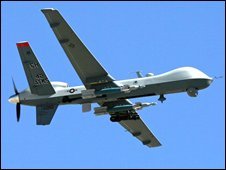
US drone

Pakistan officially objects to the strikes by pilotless US aircraft

At least 45 people have died in a missile strike by a US drone aircraft in Pakistan, officials there have said.

The people killed in South Waziristan region had been attending a funeral for others killed in a US drone strike earlier on Tuesday.

Intelligence officials said at least 45 people had been killed and dozens more injured in the later strike, when two missiles were fired.

But a local official told BBC News the death toll was more than 50.

The region is a stronghold of Pakistani Taliban leader Baitullah Mehsud.

Also on Tuesday, tribal leader Qari Zainuddin, who often criticised Mehsud, was shot dead by a gunman in north-western Pakistan.

Earlier this month, Zainuddin criticised Mehsud after an attack on a mosque, which killed 33 people.

The Pakistani army is preparing to launch an offensive against Taliban fighters under Mehsud’s command, who are blamed for a number of deadly attacks.

But Zainuddin’s killing is being seen as a setback for the government in its efforts to isolate Mehsud ahead of the security forces’ next phase of their anti-Taliban offensive in the tribal areas bordering Afghanistan, says the BBC’s Mike Wooldridge in Islamabad.

Pakistan Declares Swat Valley Offensive Still Almost Over

June 23, 2009
Military Turns Attention to South Waziristan

Jason Ditz, Antiwar.com,  June 22, 2009

Pakistani military spokesman Major General Athar Abbas today announced that the army had entered its “final stages” of its devestating offensive in the Swat Valley. Now, says Abbas, the military is focusing on its preparatory phase of the offensive in South Waziristan.

Major General Athar Abbas

If that sounds familiar, it probably should. Over three weeks ago, Secretary of Defense Athar Ali said the exact same thing, even going so far as to say that the battle would be over “hopefully within two to three days.”

The Swat Valley offensive has killed thousands, driven millions from their homes, and left hundreds of thousands of others trapped in their homes with dwindling access to food and water.

With the situation in the refugee camps continually worsening, the displaced have hoped to return home in short order. Despite weeks of promises that the clashes were almost over and claims that wide swaths of the valley are under control, the military has been preventing all civilians from returning home.

6 killed in US drone attack in South Waziristan

June 23, 2009

The News International, June 23, 2009

PESHAWAR: Six people were killed and several others hurt in a US drone missile attack in South Waziristan on Tuesday.

According to sources, US drones fired three missiles at a house in a village of tehsil Ladha, a stronghold of Taliban commander Baitullah Mehsud. Six people were killed and several others injured in the attack. Security operation is underway in the area against militants.

Obama’s Undeclared War Against Pakistan Continues, Despite His Attempt to Downplay It

June 22, 2009

In a new interview, Obama said he has “no intention” of sending US troops into Pakistan. But US troops are already in the country and US drones attack Pakistan regularly.

By Jeremy Scahill, RebelReports, June 22, 2209

Three days after his inauguration, on January 23, 2009, President Barack Obama ordered US predator drones to attack sites inside of Pakistan, reportedly killing 15 people. It was the first documented attack ordered by the new US Commander in Chief inside of Pakistan. Since that first Obama-authorized attack, the US has regularly bombed Pakistan, killing scores of civilians. The New York Times reported that the attacks were clear evidence Obama “is continuing, and in some cases extending, Bush administration policy.” In the first 99 days of 2009, more than 150 people were reportedly killed in these drone attacks. The most recent documented attack was reportedly last Thursday in Waziristan. Since 2006, the US drone strikes have killed 687 people (as of April). That amounts to about 38 deaths a month just from drone attacks.

The use of these attack drones by Obama should not come as a surprise to anyone who followed his presidential campaign closely. As a candidate, Obama made clear that Pakistan’s sovereignty was subservient to US interests, saying he would attack with or without the approval of the Pakistani government. Obama said if the US had “actionable intelligence” that “high value” targets were in Pakistan, the US would attack. Secretary of State Hillary Clinton, echoed those sentiments on the campaign trail and “did not rule out U.S. attacks inside Pakistan, citing the missile attacks her husband, then-President Bill Clinton, ordered against Osama bin Laden in Afghanistan in 1998. ‘If we had actionable intelligence that Osama bin Laden or other high-value targets were in Pakistan I would ensure that they were targeted and killed or captured,’ she said.”

Last weekend, Obama granted his first extended interview with a Pakistani media outlet, the newspaper Dawn:

Responding to a question about drone attacks inside Pakistan’s tribal zone, Mr Obama said he did not comment on specific operations.

‘But I will tell you that we have no intention of sending US troops into Pakistan. Pakistan and its military are dealing with their security issues.’

There are a number of issues raised by this brief response offered by Obama. First, the only difference between using these attack drones and using actual US soldiers on the ground is that the soldiers are living beings. These drones sanitize war and reduce the US death toll while still unleashing military hell disproportionately on civilians. The bottom line is that the use of drones inside the borders of Pakistan amounts to the same violation of sovereignty that would result from sending US soldiers inside the country. Obama defended the attacks in the Dawn interview, saying:

“Our primary goal is to be a partner and a friend to Pakistan and to allow Pakistan to thrive on its own terms, respecting its own traditions, respecting its own culture. We simply want to make sure that our common enemies, which are extremists who would kill innocent civilians, that that kind of activity is stopped, and we believe that it has to be stopped whether it’s in the United States or in Pakistan or anywhere in the world.”

Despite Obama’s comments about respecting Pakistan “on its own terms,” this is how Reuters recently described the arrangement between Pakistan and the US regarding drone attacks:

U.S. ally Pakistan objects to the U.S. missile strikes, saying they violate its sovereignty and undermine efforts to deal with militancy because they inflame public anger and bolster support for the militants.

Washington says the missile strikes are carried out under an agreement with Islamabad that allows Pakistani leaders to publicly criticise the attacks. Pakistan denies any such agreement.

Pakistan is now the biggest recipient of US aid with the House of Representatives recently approving a tripling of money to Pakistan to about $1.5 billion a year for five years. Moreover, US special forces are already operating inside of Pakistan, along the Pakistan-Afghanistan border in Baluchistan. According to the Wall Street Journal, US Special Forces are:

training Pakistan’s Frontier Corps, a paramilitary force responsible for battling the Taliban and al Qaeda fighters, who cross freely between Afghanistan and Pakistan, the officials said. The U.S. trainers aren’t meant to fight alongside the Pakistanis or accompany them into battle, in part because there will be so few Special Forces personnel in the two training camps.

A senior American military officer said he hoped Islamabad would gradually allow the U.S. to expand its training footprint inside Pakistan’s borders.

In February, The New York Times reported that US forces are also engaged in other activities inside of Pakistan:

American Special Operations troops based in Afghanistan have also carried out a number of operations into Pakistan’s tribal areas since early September, when a commando raid that killed a number of militants was publicly condemned by Pakistani officials. According to a senior American military official, the commando missions since September have been primarily to gather intelligence.

It is clear—and has been for a long time— that the Obama administration is radically expanding the US war in Afghanistan deeply into Pakistan. Whether it is through US military trainers (that’s what they were called in Vietnam too), drone attacks or commando raids inside the country, the US is militarily entrenched in Pakistan. It makes Obama’s comment that “[W]e have no intention of sending US troops into Pakistan” simply unbelievable.

For a sense of how significant US operations are and will continue to be for years and years to come, just look at the US plan to build an almost $1 billion massive US “embassy” in Islamabad, which is reportedly modeled after the imperial city they call a US embassy in Baghdad. As we know very clearly from Iraq, such a complex will result in an immediate surge in the deployment of US soldiers, mercenaries and other contractors.

Baffling indifference to Pakistani ‘exodus’ trauma

June 22, 2009

PAUL O’BRIEN | The Irish Times, June 22, 2009

OPINION: An unprecedented human drama is unfolding in Pakistan and yet few in the wider world are paying attention. Why?

THE STORY is there is no story. The question is “why?” As I remember the destruction and death in north western Pakistan after the earthquake in October 2005, an event that attracted huge international attention and propelled frontline international aid agencies like Concern Worldwide to begin their rapid response emergency work, little did I know then that some four years later over two million people would be on the move in this part of the country, internally displaced by a sustained and ferociously intense military conflict between the Pakistani army and Taliban insurgents.

The UN High Commissioner for Refugees (UNHCR) Antonio Guterres has said of the current situation that he doesn’t recall “any internal displacement crisis in which so many people have moved in such a short amount of time”. Since early May, these two million people have felt compelled to leave their homes, farms, communities and villages.

Continued >>

Iraq, AfPak, beyond: the global cost of war

June 20, 2009

Paul Rogers, OpenDemocracy, June 18, 2009

The toxic phrase “war on terror” has fallen out of use, but the destructive effects of the real thing continue and even escalate in a period of economic crisis.

A major landmark in the in the United States’s military presence in Iraq arrives on 30 June 2009, when the army is scheduled to withdraw its combat-troops from the country’s cities. The terms of the “status-of-forces agreement” with the Iraqi government will see most of these (currently 133,000)  soldiers relocated to a number of major bases in rural areas, though some will join the 30,000 troops that have left Iraq since the peak of the “surge” in mid-2008.

The process is taking place against the background of continuing violence in Iraq, notwithstanding reports of an overall increase in security. Indeed, Iraq’s foreign minister Hoshyar Zebari is warning that al-Qaida and Ba’athist militant clusters will seek to escalate the level of violence in advance of the 30 June deadline, in order to take credit for forcing the Americans into a humiliating retreat (see Patrick Cockburn, “US troops ask Syria to thwart al-Qa’ida offensive“, Independent, 17 June 2009).

Continued >>