Tens of thousands of Kashmiri Muslims marched Wednesday to a town where seven people were killed over the weekend amid a rigid curfew in another day of massive protests against Indian rule in the Himalayan region.
Long lines of people carrying green and black protest flags thronged a big prayer ground in Khrew, a town south of Kashmir’s main city Srinagar.
At least 45 Kashmiri civilians have been killed over the past seven weeks.
Three of the seven people were gunned down by security forces who opened fire on thousands of protesters on the streets of Khrew on Sunday. The remaining four civilians were killed in a blast at a police station after it was set on fire by residents angry at the earlier shooting. A lot of explosive material used in quarry blasting was stored in the police station and it might have fueled the blast, police said.
On Wednesday, Kashmiris chanted slogans “Go India, go back” and “We’ll take bullets on our heads but we’ll not give up.”
SEEKING JUSTICE: Protesters set ablaze police vechile after two young men were killed in firing in Pampore on August 1, 2010. Photo: Nissar Ahmad
If the Prime Minister [Dr Manmohan Singh] does not take bold steps to address the grievances of the Kashmiris, there’s no telling where the next eruption will take us.
Whatever his other failings, Chief Minister Omar Abdullah deserves praise for acknowledging that the protests which have rocked the Kashmir valley these past few weeks are ‘leaderless’ and not the product of manipulation by some hidden individual or group.
This admission has been difficult for the authorities to make because its implications are unpleasant, perhaps even frightening. In security terms, the absence of a central nervous system means the expanding body of protest cannot be controlled by arresting individual leaders. And in political terms, the spectre of leaderless revolt makes the offer of ‘dialogue’ or the naming of a ‘special envoy’ for Kashmir — proposals which might have made sense last year or even last month — seem completely and utterly pointless today.
Farooq called for an end to “killing of innocent
people” in Kashmir [AFP]
Three more people have been killed in continuing unrest in Indian-administered Kashmir after police opened fire on demonstrators venting their anger over recent spate of killings in police firing.
The three, including a 16-year-old-boy, were shot dead on Tuesday after a large crowd took to the streets shouting “We want freedom” and hurled stones at the security forces in the city of Srinagar.
Mohammad Afzal, a police official, said, the fresh protests broke out after a body of a Kashmiri teenager was fished out from a rivulet.
Locals said the boy had jumped into the water in Srinagar and drowned while being chased by security forces during a demonstration on Monday evening.
Police said the teenager had pelted stones at security forces and and set fire to a police building.
Indian security forces have been accused of killing 15 people, mostly protesters, in less than a month in Kashmir, triggering the biggest anti-India demonstrations in the last two years.
Mirwaiz Umar Farooq, a prominent separatist leader who led rallies on Tuesday, called for an end to the “killing of innocent people”.
“Protests and civil disobedience will continue until India withdraws its security forces from all populated areas, and punish those found guilty,” Farooq said.
“These killings will not deter us from pursuing our goal of independence.”
Separatists in Kashmir have fought against Indian rule for 20 years, campaigning for independence or for the region to join neighbouring Pakistan.
Three months ago, our covert story, SIT-ting on the Truth (March 2010) exposed the frivolous and shallow investigations of the Gujarat massacres undertaken by the high-profile Special Investigation Team (SIT) appointed by the Supreme Court and headed by former CBI director RK Raghavan. One of the major issues raised was the deliberate refusal of SIT – influenced as it was by the three officers of the Gujarat police cadre, Shivanand Jha, Geeta Johri and Ashish Bhatia – to examine available documentary evidence to pin responsibility for complicity and gross dereliction of duty by top police officers, civil servants and politicians.
It’s a true and tested tactic. Announce an investigation. Give the public the time and space it needs to get over its outrage. The political storm will subside. The limelight will forsake the activists and their sympathizers. After that it will be back to business as usual. The waiting game has stood the ruling coalition, the Congress-led UPA, in good stead on past occasions and enabled it to tide over turbulent times. And it was expected to save the situation when a white-hot wave of indignation swept across the country in the wake of the Bhopal court’s verdict in the Union Carbide case. No doubt the political establishment believed the government could return to carrying out Washington’s diktat or fulfilling the bidding of business magnates once calm had been restored.
Indian police chase protesters in Srinagar on Sunday
Kashmir is boiling again. The killing of three young men by security forces in the past ten days has ratcheted up tension and sent hundreds of demonstrators into the streets.
The Indian authorities have responded by deploying thousands of police and paramilitary forces.
Yesterday, the city of Srinagar, capital of the Kashmir valley, was brought to a standstill as separatists called yet another strike to protest against the killing of the young Muslim men. Police have imposed a strict curfew in an effort to halt the demonstrations that have reverberated around the city. The most recent protests date from June 11 when a 17-year-old student was killed by police as they fired at demonstrators during a routine protest in the city.
A protest in Kashmir turned deadly when troops open fired on hundreds of demonstrators on Sunday, killing one person and wounding at least five, the Associated Press reported.
Hundreds of people took to the streets, throwing rocks at security forces and surrounding an armored vehicle belonging to paramilitary soldiers, in a protest against the death of Mohammed Rafiq Bangroo, a 25-year-old who died Saturday after being beaten by troops in an earlier demonstration last week. After the demonstrators tried to light a bunker on fire, the officers fired as an act of self defense, authorities say.
“We exercised maximum restraint. Our soldiers opened fire only in self-defense after the protesters tried to torch the bunker,” Prabhakar Tripathi, spokesman for the Central Reserve Police Force, told the AP. Tensions in the Muslim-majority region have been running high since local police accused the military of killing three civilians in April, and officials now say they are clamping down by enforcing a tight curfew and other restrictions.
BP CEO Tony Hayward faces the music on Capitol Hill last week
Moral outrage is seldom a pretty sight. When BP’s chief executive Tony Hayward appeared before a Congressional investigation into the oil spill in the Gulf of Mexico, there was little he could say to placate angry members of the energy sub-committee. Most of the committee members had turned up to take part in a ritual denunciation, a modern version of putting someone in the stocks, and Hayward remained for the most part impassive as the rancid eggs rained down.
India’s Border Security Force soldiers patrol near the fenced border with Pakistan in Suchetgarh, southwest of Jammu, Jan. 12, 2010. (Mukesh Gupta/Reuters)
NEW DELHI, India — In a two-story brick home in Srinagar’s old city, hundreds of relatives and neighbors waited throughout the night for the police to return the body of 17-year-old Tufail Ahmed Mattoo, who was allegedly killed by a teargas shell fired at him by police during a protest last week. When his body finally arrived on the morning of June 12, the gloom erupted into anger. Mattoo’s mother, Rubina, fainted. Scores of other women wailed and beat their chests, and the men raised slogans like “We want freedom,” and “Prosecute the killers.”
Activists write to the US President: ‘Whose ‘ass’ should the citizens of Bhopal kick if governments selectively shield their corporations and officials from legal accountability?’
Mr Barack Obama
President,
United States of America
Dear Mr President Obama,
With a great deal of interest, we have been following your tough stand against BP for the oil spill in the Gulf Of Mexico, particularly your demand to know whose ‘ass needs to be kicked’. We think your demand for corporate accountability for causing huge environmental damages is worthy of emulation by other governments around the World.
May we draw your attention to a bigger disaster that took place in the city of Bhopal in India in December 1984 that has officially killed over 15,000 people (about 25,000 people unofficially) and seriously injured nearly half a million people by now (the situation after twenty five years is attached for ready reference). This disaster was caused by another mega corporate entity called Union Carbide, headquartered in the United States of America, unlike BP whose parent company resides in Great Britain.
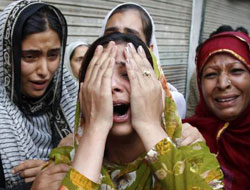 Kashmiris accused New Delhi of adding to the heavy security presence in Kashmir while not reaching out for a political dialogue.


 Peace and Justice Post
The only package Kashmir needs is justice
August 5, 2010Siddharth Varadarajan, The Hindu/India, August 5, 2010
Whatever his other failings, Chief Minister Omar Abdullah deserves praise for acknowledging that the protests which have rocked the Kashmir valley these past few weeks are ‘leaderless’ and not the product of manipulation by some hidden individual or group.
This admission has been difficult for the authorities to make because its implications are unpleasant, perhaps even frightening. In security terms, the absence of a central nervous system means the expanding body of protest cannot be controlled by arresting individual leaders. And in political terms, the spectre of leaderless revolt makes the offer of ‘dialogue’ or the naming of a ‘special envoy’ for Kashmir — proposals which might have made sense last year or even last month — seem completely and utterly pointless today.
Continues >>
Share this:
Tags:civilian deaths, grievances of Kashmiris, India, Indian-held Kashmir, protests, violence
Posted in Commentary, India, Kashmir | Leave a Comment »