Archive for the ‘Human rights’ Category

AFGHANISTAN: US-NATO Airstrikes Bring Higher Civilian Toll

September 9, 2008

Ali Gharib | Inter-Press Service, Sep 8, 2008


WASHINGTON, – Ramped-up U.S. and NATO airstrikes in Afghanistan are causing an increased civilian death toll, raising concerns about the fallout from civilian deaths on the war effort against the Taliban insurgency, according to a major new report by Human Rights Watch (HRW) released here Monday.

The 43-page report, “Troops in Contact: Airstrikes and Civilian Deaths in Afghanistan”, warned that the cost in civilian casualties caused by the increase in bombings goes well beyond the loss of human life and could put the nearly seven-year U.S.-NATO war effort at risk.

“The harm caused by airstrikes is not limited to the immediate civilian casualties,” said the report, which also cited the destruction of homes and property and the displacement of their civilian occupants caused by the bombing.

“Civilian deaths from airstrikes act as a recruiting tool for the Taliban and risk fatally undermining the international effort to provide basic security to the people of Afghanistan,” said Brad Adams, HRW’s Asia director of HRW.

Citing HRW statistics, an editorial in Saturday’s New York Times went further, asserting that civilian deaths caused by the stepped up bombing played into the hands of the Taliban and other insurgents: “America is fast losing the battle for hearts and minds, and unless the Pentagon comes up with a better strategy, the United States and its allies may well lose the war.”

Fuelling a growing controversy here, both the Times and the report said that the increase in air attacks — and the “collateral damage” they caused — was due in part to the relative lack of NATO and U.S. troops on the ground whose fire tends to be considerably more discriminating in their impact than aerial attacks.

Both the Pentagon and leading Democrats have been arguing for months for deploying at least 10,000 more U.S. troops to Afghanistan but have been unable to overcome resistance by military commanders in Iraq who, backed by President George W. Bush, are reluctant to draw down troop levels there below the current 144,000. U.S. ground forces are so stretched globally that deploying additional forces to Afghanistan must await further withdrawals from Iraq.

The increased level of bombing has come as a result of a stepped-up insurgency led by anti-government Taliban fighters and associated groups. Fighting in Afghanistan has intensified dramatically over the past year. At least 540 civilians have been killed in the conflict so far this year, a sharp increase over last year’s total. Casualties among the more than 60,000 U.S. and NATO troops in Afghanistan have also risen sharply this year.

U.S. and NATO forces, according to the report, dropped 362 tonnes of munitions in Afghanistan during the first seven months of this year, including a flurry of bombings in June and July that, by itself, nearly equaled the total amount of bombs, by weight, dropped by the coalition forces on suspected enemy positions in all of 2006.

“[…] While attacks by the Taliban and other insurgent groups continue to account for the majority of civilian casualties,” said the report, “civilian deaths from U.S. and NATO airstrikes nearly tripled from 2006 to 2007 (from 116 to 321).”

That increase prompted Afghan President Hamid Karzai to demand changes in targeting tactics, including using smaller munitions, delaying attacks where civilians might be harmed, and turning over house-to-house searches to the Afghan National Army.

Those changes were adopted by the NATO-led International Security Assistance Force (ISAF) with the result that, despite increased bombing during the first seven months of this year, fewer civilians (119) were killed compared to the same period in 2007.

But that figure does not include a controversial air strike Aug 22 on the village of Azizabad in western Afghanistan which, according to the Afghan government and a U.N. investigating team, killed 90 people, the vast majority of whom were women and children. The U.S. military, which carried out the attack, has insisted that 42 people were killed, 35 of them insurgents.

In some incidents, according to the report, U.S.-NATO air strikes may have violated the laws of war, particularly adherence to the principles of proportionality and the requirement that parties take all feasible precautions to prevent non-combatant casualties.

The report suggested that blame for civilian deaths can be focused fairly narrowly. While most foreign troops in Afghanistan operate under the banner of the NATO-led International Security Assistance Force (ISAF), a disproportionate number of civilian casualties resulted from air strikes called in by the nearly 20,000 U.S. troops who operate exclusively under U.S. command as part of Operation Enduring Freedom. Their rules of engagement, including when they can call for air support, are less strict than NATO’s.

The most problematic engagements have come when insurgents take U.S. Special Operations Forces (SOF) by surprise, and the SOF call in air support. The military term, “troops in contact” (TIC), gave the HRW report its name.

In TIC situations, U.S. forces have often engaged insurgents who then retreat to nearby villages, taking up positions in homes and preventing their civilian residents from leaving.

Faced with a standoff, U.S. troops have called in rapid-response air support to bomb the homes from which they were taking hostile fire. That appears to have been what took place in Azizabad.

While condemning of Taliban “shielding” — using civilian human shields or putting civilians at unnecessary risk so that when hurt, the story can be used as propaganda — the report noted that this does not excuse U.S. forces from the laws of war and considerations of civilian populations.

The report outlined several incidents where questionable rapid-response bombings caused civilian deaths. In one of them, two anti-government fighters were seen entering a compound that was then hit with an airstrike that caused nine casualties.

The U.S. claimed to have killed the two insurgents, but a local Afghan authority denied the claim, and journalists at the scene found no evidence supporting it. Moreover, U.S. troops and local villagers said that U.S. forces had visited the home the day before and should have known that civilians were present.

“The available information about the attack — in particular evidence suggesting that U.S. forces knew the house was inhabited by civilians and that only two lightly armed fighters may have been present — raises serious concerns that the airstrikes violated the international humanitarian law prohibition against disproportionate attacks,” said the report.
Hindutva’s Violent History: Orissa

September 8, 2008

By Angana Chatterji | ZNet, Sep 7, 2008

HINDUTVA’S PRODUCTION of culture and nation is often marked by savagery. On 23 August 2008, Lakshmanananda Saraswati, Orissa’s Hindu nationalist icon, was murdered with four disciples in Jalespeta in Kandhamal district. State authorities alleged the attackers to be Maoists (and a group has subsequently claimed the murder). But the Sangh Parviar held the Christian community responsible, even though there is no evidence or history to suggest the armed mobilisation of Christian groups in Orissa.

After the murder, the All India Christian Council stated: “The Christian community in India abhors violence, condemns all acts of terrorism, and opposes groups of people taking the law into their own hands”. Gouri Prasad Rath, General Secretary, VHPOrissa, stated: “Christians have killed Swamiji. We will give a befitting reply. We would be forced to opt for violent protests if action is not taken against the killers”.

Following which, violence engulfed the district. Churches and Christian houses razed to the ground, frightened Christians hiding in the jungles or in relief camps. Officials record the death toll at 13, local leaders at 20, while the Asian Centre for Human Rights noted 50.

The Sangh’s history in postcolonial Orissa is long and violent. Virulent Hindutva campaigns against minority groups reverberated in Rourkela in 1964, Cuttack in 1968 and 1992, Bhadrak in 1986 and 1991, Soro in 1991. The Kandhamal riots were not unforeseen.

Since 2000, the Sangh has been strengthened by the Bharatiya Janata Party’s coalition government with the Biju Janata Dal. In October 2002, a Shiv Sena unit in Balasore district declared the formation of the first Hindu ‘suicide squad’. In March 2006, Rath stated that the “VHP believes that the security measures initiated by the Government [for protection of Hindus] are not adequate and hence Hindu society has taken the responsibility for it.”

The VHP has 1,25,000 primary workers in Orissa. The RSS operates 6,000 shakhas with a 1,50,000 plus cadre. The Bajrang Dal has 50,000 activists working in 200 akharas. BJP workers number above 4,50,000. BJP Mohila Morcha, Durga Vahini (7,000 outfits in 117 sites), and Rashtriya Sevika Samiti (80 centres) are three major Sangh women’s organisations. BJP Yuva Morcha, Youth Wing, Adivasi Morcha and Mohila Morcha have a prominent base. Bharatiya Mazdoor Sangh manages 171 trade unions with a cadre of 1,82,000. The 30,000-strong Bharatiya Kisan Sangh functions in 100 blocks. The Sangh also operates various trusts and branches of national and international institutions to aid fundraising, including Friends of Tribal Society, Samarpan Charitable Trust, Sookruti, Yasodha Sadan, and Odisha International Centre. Sectarian development and education are carried out by Ekal Vidyalayas, Vanavasi Kalyan Ashrams/Parishads (VKAs), Vivekananda Kendras, Shiksha Vikas Samitis and Sewa Bharatis — cementing the brickwork for hate and civil polarisation.

This massive mobilisation has erupted in ugly incidents against both Christians and Muslims. In 1998, 5,000 Sangh activists allegedly attacked the Christian dominated Ramgiri-Udaygiri villages in Gajapati district, setting fire to 92 homes, a church, police station, and several government vehicles. Earlier, Sangh activists allegedly entered the local jail forcibly and burned two Christian prisoners to death. In 1999, Graham Staines, 58, an Australian missionary and his 10- and six-year-old sons were torched in Manoharpur village in Keonjhar. A Catholic nun, Jacqueline Mary was gangraped by men in Mayurbhanj and Arul Das, a Catholic priest, was murdered in Jamabani, Mayurbhanj, followed by the destruction of churches in Kandhamal. In 2002, the VHP converted 5,000 people to Hinduism. In 2003, the VKA organised a 15,000- member rally in Bhubaneswar, propagating that Adivasi (and Dalit) converts to Christianity be denied affirmative action. In 2004, seven women and a male pastor were forcibly tonsured in Kilipal, Jagatsinghpur district, and a social and economic boycott was imposed against them. A Catholic church was vandalised and the community targeted in Raikia.

Change the cast, the story is still the same. 1998: A truck transporting cattle owned by a Muslim was looted and burned, the driver’s aide beaten to death in Keonjhar district. 1999: Shiekh Rehman, a Muslim clothes merchant, was mutilated and burned to death in a public execution at the weekly market in Mayurbhanj. 2001: In Pitaipura village, Jagatsinghpur, Hindu communalists attempted to orchestrate a land-grab connected to a Muslim graveyard. On November 20, 2001, around 3,000 Hindu activists from nearby villages rioted. Muslim houses were torched, Muslim women were ill-treated, their property, including goats and other animals, stolen. 2005: In Kendrapara, a contractor was shot on Govari Embankment Road, supposedly by members of a Muslim gang. Sangh groups claimed the shooting was part of a gang war associated with Islamic extremism and called for a 12hour bandh. Hindu organisations are alleged to have looted and set Muslim shops on fire.

It is Saraswati who pioneered the Hinduisation of Kandhamal since 1969. Activists targeted Adivasis, Dalits, Christians and Muslims through socio-economic boycotts and forced conversions (named ‘re’conversion, presupposing Adivasis and Dalits as ‘originally’ Hindus).

Kandhamal first witnessed Hindutva violence in 1986. The VKAs, instated in 1987, worked to Hinduise Kondh and Kui Adivasis and polarise relations between them and Pana Dalit Christians. Kandhamal remains socio-economically vulnerable, a large percentage of its population living in poverty. Approximately 90 percent of Dalits are landless. A majority of Christians are landless or marginal landholders. Hindutva ideologues say Dalits have acquired economic benefits, augmented by Christianisation. This is not borne out in reality.

In October 2005, converting 200 Bonda Adivasi Christians to Hinduism in Malkangiri, Saraswati said: “How will we… make India a completely Hindu country? The feeling of Hindutva should come within the hearts and minds of all the people.” In April 2006, celebrating RSS architect Golwalkar’s centenary, Saraswati presided over seven yagnas attended by 30,000 Adivasis. In September 2007, supporting the VHP’s statewide road-rail blockade against the supposed destruction of the mythic ‘Ram Setu’, Saraswati conducted a Ram Dhanu Rath Yatra to mobilise Adivasis.

In 2008, Hindutva discourse named Christians as ‘conversion terrorists’. But the number of such conversions is highly inflated. They claim there are rampant and forced conversions in Phulbani-Kandhamal. But the Christian population in Kandhamal is 1,17,950 while Hindus number 5,27,757. Orissa Christians numbered 8,97,861 in the 2001 census — only 2.4 percent of the state’s population. Yet, Christian conversions are storied as debilitating to the majority status of Hindus while Muslims are seen as ‘infiltrating’ from Bangladesh, dislocating the ‘Oriya (and Indian) nation’.

The right to religious conversion is constitutionally authorised. Historically, conversions from Hinduism to Christianity or Islam have been a way to escape caste oppression and social stigma for Adivasis and Dalits. In February 2006, the VHP called for a law banning (non- Hindu) religious conversions. In June 2008, it urged that religious conversion be decreed a ‘heinous crime’ across India.

‘Reconversion’ strategies of the Sangh appear to be shifting in Orissa. The Sangh reportedly proposed to ‘reconvert’ 10,000 Christians in 2007. But fewer public conversion ceremonies were held in 2007 than in 2004- 2006. Converting politicised Adivasi and Dalit Christians to Hinduism is proving difficult. The Sangh has instead increased its emphasis on the Hinduisation of Adivasis through their participation in Hindu rituals, which, in effect, ‘convert’ Adivasis by assuming that they are Hindu.

The draconian Orissa Freedom of Religion Act (OFRA), 1967, must be repealed. There are enough provisions under the Indian Penal Code to prevent and prohibit conversions under duress. But consenting converts to Christianity are repeatedly charged under OFRA, while Hindutva perpetrators of forcible conversions are not. The Sangh contends that ‘reconversion’ to Hinduism through its ‘Ghar Vapasi’ (homecoming) campaign is not conversion but return to Hinduism, the ‘original’ faith. This allows them to dispense with the procedures under OFRA.

The Orissa Prevention of Cow Slaughter Act, 1960 should also be repealed. It is utilised to target livelihood practices of economically disenfranchised groups, Adivasis, Dalits, Muslims, who engage in cattle trade and cow slaughter.

In fact, a CBI investigation into the activities of the VHP, RSS and Bajrang Dal is crucial as per the provisions of the Unlawful Activities (Prevention) Act, 1967. Groups such as the VHP and VKA are registered as cultural and charitable organisations but their work is political in nature. They should be audited and recognised as political organisations, and their charitable status and privileges reviewed.

The state and central government’s refusal to restrain Hindu militias evidences their linkage with Hindutva (BJP), soft Hindutva (Congress), and the capitulation of civil society to Hindu majoritarianism. How would the nation have reacted if groups with affiliation other than than militant Hinduism executed riot after riot: Calcutta 1946, Kota 1953, Rourkela 1964, Ranchi 1967, Ahmedabad 1969, Bhiwandi 1970, Aligarh 1978, Jamshedpur 1979, Moradabad 1980, Meerut 1982, Hyderabad 1983, Assam 1983, Delhi 1984, Bhagalpur 1989, Bhadrak 1991, Ayodhya 1992, Mumbai 1992, Gujarat 2002, Marad 2003, Jammu 2008?

The BJD-BJP government has repeatedly failed to honour the constitutional mandate separating religion from state. In 2005-06, Advocate Mihir Desai and I convened the Indian People’s Tribunal on Communalism in Orissa, led by Retired Kerala Chief Justice KK Usha. The Tribunal’s findings detailed the formidable mobilisation by majoritarian communalist organisations, including in Kandhamal, and the Sangh’s visible presence in 25 of 30 districts. The report did not invoke any response from the state or central government.

In January 2000, The Asian Age reported: “‘One village, one shakha’ is the new slogan of the RSS as it aims to saffronise the entire Gujarat state by 2005.” Then ensued the genocide of March 2002. In 2003, Subash Chouhan, then Bajrang Dal state convener, stated: “Orissa is the second Hindu Rajya (to Gujarat).”

We all know what has happened in Kandhamal December 2007, and again now. The communal situation in Orissa is dire. State and civil society resistance to Hindutva’s ritual and catalytic abuse cannot wait.

The writer is associate professor of anthropology at California Institute of Integral Studies and author of a forthcoming book: Violent Gods: Hindu Nationalism in India’s Present, Narratives from Orissa

US air power triples deaths of Afghan civilians, says report

September 8, 2008
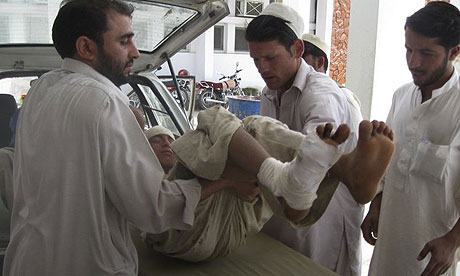
Afghan boy injured in US air strike

An injured Afghan boy is put on a stretcher at a hospital in Jalalabad city, Afghanistan. Photograph: Nesar Ahmad

Civilian deaths in Afghanistan from US and Nato air strikes have nearly tripled over the past year, with the onslaught continuing in 2008 and fuelling a public backlash, a leading human rights group says today.

The report by Human Rights Watch Human Rights Watch says that despite changes in the rules of engagement which had reduced the rate of civilian casualties since a spike in July last year, air strikes killed at least 321 civilians in 2007, compared with at least 116 in 2006. In the first seven months of this year at least 540 Afghan civilians were killed in fighting related to the armed conflict, with at least 119 killed by US or Nato air strikes, such as this July’s attack on a wedding party which killed 47, says Human Rights Watch.

“There has been a massive and unprecedented surge in the use of air power in Afghanistan in 2008,” the report says. It found that few civilians casualties were the result of planned air strikes on suspected Taliban targets. Instead, most were from air strikes during rapid response missions mostly carried out in support of “troops in contact” – ground troops under insurgent attack. Such strikes included situations where American special forces – normally small in number and lightly armed – came under insurgent attack.

“In response to increased insurgent activity, twice as many tons of bombs were dropped in 2007 than in 2006,” the report says. “In 2008, the pace has increased: in the months of June and July alone the US dropped approximately as much as it did in all of 2006. Without improvements in planning, intelligence, targeting, and identifying civilian populations, the massive use of air power in Afghanistan will continue to lead to unacceptably high civilian casualties.”

“Mistakes by the US and Nato have dramatically decreased public support for the Afghan government and the presence of international forces providing security to Afghans,” said Brad Adams, Asia director at Human Rights Watch. The report criticises the response given by US officials when civilian deaths occur. Before conducting investigations, US officials often immediately deny responsibility for civilian deaths or place all blame on the Taliban, the report says.

US investigations have been “unilateral, ponderous, and lacking in transparency, undercutting rather than improving relations with local populations and the Afghan government”.

Last night the US military announced it would reopen its investigation of an air strike last month in which the Afghan government says 90 civilians, mainly women and children, were killed. An initial US inquiry found that up to 35 suspected insurgents and seven civilians died in the attack on Azizabad in Herat province, but General David McKiernan, the senior US officer in Afghanistan, announced a review in the light of “new information”. Afghan and western officials say that videos of the bombing’s aftermath shows dozens of dead civilians.

Wide protests in Kashmir Valley on Coordination Committee call

September 6, 2008
Listen Listen Font Size a+ a-

Police quell demonstration at Geelani’s house

Srinagar, Sep 5: The call for peaceful protests after Friday prayers by the Coordination Committee evoked tremendous response across the Valley in spite of heavy rains in the afternoon.
However police used extensive force to quell peaceful processions outside the house of Hurriyat (G) chairman, Syed Ali Shah Geelani, at Hyderpora here and south Kashmir’s Islamabad district injuring dozens of persons.
The Coordination Committee, which is an amalgam of various pro-freedom parties, traders, lawyers and members of the civil society, had called for peaceful protests after Friday prayers.
Maisuma sit-in
Pro-freedom slogans rented Maisuma and its adjoining areas when hundreds of people staged a peaceful sit-in there amidst heavy rains.
After the Friday prayers a massive procession took off from Central Jamia Masjid Gaw Kadal, led by president of Jamait-e-Ahlihadis, Maulana Showkat. Hurriyat leaders Shahid-ul-Islam and Javid Ahmad Mir and Showkat Bakshi and Bashir Ahmad Bhat of JKLF participated in the sit-in at Maisuma.
The procession was joined by a large number of people, including the traders and shopkeepers of Lal Chowk and its adjoining areas. Shouting pro-freedom slogans the protesters staged a sit-in for half-an-hour at the Maisuma Chowk.
“We want freedom,” the protesters continuously shouted as the troopers of paramilitary CRPF looked on. Addressing the gathering, Maulana Showkat appealed people to maintain unity and make programmes of the Coordination Committee successful.
Talking to Greater Kashmir on the spot, Shahid-ul-Islam termed the peaceful protests across the Valley as huge success. “India cannot suppress the sentiments and aspirations of Kashmiris. The administration led by puppet Governor made all attempts to stop the Lal Chowk march. But we are determined to carry out the march soon and no power can stop it,” Shahid-ul-Islam said.

Continued . . .

The Bush Administration Is an Ongoing Criminal Conspiracy Under International Law and U.S. Domestic Law

September 4, 2008

Justice Robert H. Jackson Conference:

Planning for the Prosecution of High Level American War Criminals
Massachusetts Law School
September 13-14, 2008

Andover, Massachusetts

Since the impeachable installation of George W. Bush as President in January of 2001 by the U.S. Supreme Court’s Gang of Five, the peoples of the world have witnessed a government in the United States that has demonstrated little if any respect for fundamental considerations of international law, human rights, and the United States Constitution.

What the world has watched instead is a comprehensive and malicious assault upon the integrity of the international and domestic legal orders by a group of men and women who are thoroughly Machiavellian and Straussian in their perception of international relations and in their conduct of both foreign policy and domestic affairs. Even more seriously, in many instances specific components of the Bush administration’s foreign policies constitute ongoing criminal activity under well-recognized principles of both international law and U.S. domestic law, and in particular the Nuremberg Charter, the Nuremberg Judgment, and the Nuremberg Principles, as well as the Pentagon’s own U.S. Army Field Manual 27-10 on The Law of Land Warfare (1956), all of which apply to President Bush himself as Commander-in-Chief of United States Armed Forces under Article II, Section 2 of the United States Constitution.

Depending upon the substantive issues involved, those international crimes typically include but are not limited to the Nuremberg offenses of crimes against peace: For example, Afghanistan, Iraq, Somalia, and perhaps their longstanding threatened wars of aggression against Iran and now Pakistan.  Their criminal responsibility also concerns Nuremberg crimes against humanity and war crimes as well as grave breaches of the Four Geneva Conventions of 1949 and of the 1907 Hague Regulations on land warfare:  For example, torture at Guantanamo, Bhagram, Abu Ghraib, and elsewhere; enforced disappearances, assassinations, murders, kidnappings, extraordinary renditions, “shock and awe,” depleted uranium, white phosphorous, cluster bombs, Fallujah, and the Gitmo kangaroo courts.

Furthermore, various members of the Bush administration have committed numerous inchoate crimes incidental to these substantive offences that under the Nuremberg Charter, Judgment, and Principles as well as paragraph 500 of U.S. Army Field Manual 27-10 are international crimes in their own right:  planning and preparation—which they are currently doing today against Iran and Pakistan—solicitation, incitement, conspiracy, complicity, attempt, aiding and abetting.

Finally, according to basic principles of international criminal law set forth in paragraph 501 of U.S. Army Field Manual 27-10, all high level civilian officials and military officers in the U.S. government who either knew or should have known that soldiers or civilians under their control (such as the C.I.A. or private contractors), committed or were about to commit international crimes and failed to take the measures necessary to stop them, or to punish them, or both, are likewise personally responsible for the commission of international crimes.

At the very top of America’s criminal chain-of-command are President Bush and Vice-President Cheney;  former U.S. Secretary of Defense Rumsfeld; Rumsfeld’s Deputy Paul Wolfowitz; Secretary of State Rice; former Director of National Intelligence Negroponte; National Security Advisor Hadley; his Deputy Elliot Abrams; former U.S. Attorneys General Ashcroft and Gonzales, criminally responsible for the torture campaign launched by the Bush Jr. administration; and the Pentagon’s Joint Chiefs of Staffs along with the appropriate Regional Commanders-in-Chief, especially for U.S. Central Command (CENTCOM).

These U.S. government officials and their immediate subordinates are responsible for the commission of crimes against peace, crimes against humanity, and war crimes as specified by the Nuremberg Charter, Judgment, and Principles as well as by U.S. Army Field Manual 27-10.  Today in international legal terms, the Bush Jr. administration itself should now be viewed as constituting an ongoing criminal conspiracy under international criminal law and U.S. domestic law because of its formulation and undertaking of serial wars of aggression, crimes against peace, crimes against humanity, and war crimes in violation of the Nuremberg Charter, Judgment, and Principles that are legally akin to those perpetrated by the former Nazi regime in Germany.

Of course the terrible irony of today’s situation is that six decades ago at Nuremberg the U.S. government participated in the prosecution, punishment and execution of Nazi government officials for committing some of the same types of heinous international crimes that the members of the Bush administration currently inflict upon people all over the world. To be sure, I personally oppose the imposition of capital punishment upon any human being for any reason no matter how monstrous their crimes, whether they be Bush Jr., Tony Blair, or Saddam Hussein.

As a consequence, American citizens possess the basic right under international law and United States domestic law, including the U.S. Constitution, to engage in acts of civil resistance designed to prevent, impede, thwart, or terminate ongoing criminal activities perpetrated by Bush administration officials in their conduct of foreign affairs policies and military operations purported to relate to defense and counter-terrorism.  Today’s civil resisters are the sheriffs!  The Bush administration officials are the outlaws!

We American citizens must reaffirm our commitment to the Nuremberg Charter, Judgment, and Principles by holding our government officials fully accountable under international law and U.S. domestic law for the commission of such grievous international and domestic crimes.  We must not permit any aspect of our foreign affairs and defense policies to be conducted by acknowledged “war criminals” according to the U.S. government’s own official definitions of that term as set forth in the Nuremberg Charter, Judgment, and Principles, U.S. Army Field Manual 27-10, the U.S. War Crimes Act, the Four Geneva Conventions and the Hague Regulations.  The American people must insist upon the impeachment, dismissal, resignation, indictment, conviction, and long-term incarceration of all U.S. government officials guilty of such heinous international and domestic crimes.  If not so restrained, the Bush administration could very well precipitate a Third World War.

In this regard, during the course of an October 17, 2007 press conference, President Bush Jr. terrorized the entire world with the threat of World War III if he could not work his illegal will upon Iran.  It is my opinion that the Bush administration is fully prepared to use tactical nuclear weapons against Muslim and Arab states and peoples in order to break the taboo of Hiroshima and Nagasaki.  After the terrible tragedy of September 11, 2001 the United States of America has vilified and demonized Muslims and Arabs almost to the same extent that America inflicted upon the Japanese and Japanese Americans after Pearl Harbor.  As the Nazis had previously demonstrated with respect to the Jews, a government must first dehumanize and scapegoat a race of people before its citizens will tolerate if not approve their elimination: witness Hiroshima and Nagasaki.  In post -9/11 America we are directly confronted with the prospect of a nuclear war of extermination conducted by our White Racist Judeo-Christian Power Elite against Peoples of Color in the Muslim and Arab worlds in order to steal their oil and gas.  The Crusades all over again.  But this time nuclear Armageddon stares all of humankind right in the face!

We American lawyers must be inspired by the stunning example set by those heroic Pakistani lawyers who led the successful struggle against the brutal Bush-supported Musharraf military dictatorship in Pakistan.  We American lawyers must now lead the fight against the Bush dictatorship and empire! This is our Nuremberg Moment!

Thank you.


Francis A. Boyle is a frequent contributor to Global Research.
Global Research Articles by Francis A. Boyle

Sami Al-Arian’s long-delayed freedom

September 4, 2008

Nicole Colson reports on a proud victory for the family of witch-hunt victim Dr. Sami Al-Arian.

Sami Al-ArianSami Al-Arian

IN A long-overdue victory, Palestinian activist Dr. Sami Al-Arian was released on bail September 2 and reunited with members of his family for the first time since his arrest in early 2003.

“[I]t feels very unbelievable and surreal that he’s finally with us after more than five-and-a-half years of being apart and of only being able to see him behind glass. It’s breathtaking, really,” his daughter, Laila Al-Arian, described her feelings to Democracy Now’s Amy Goodman.

“And the whole time, we–me and my siblings–just kept telling each other, ‘Is this a dream? Is this real?’ We couldn’t believe it. And even when we first heard the news, we were a bit skeptical, because we’ve been in this situation so many times, where we thought my father would finally be released, and he wouldn’t. So we kind of held back our happiness and joy until he was finally with us.”

Sami Al-Arian is the former University of South Florida professor who has been the victim of an ongoing government witch-hunt since the Bush administration, in the days following the September 11 attacks, accused him of using an Islamic think tank and a Muslim school and charity as a cover for raising funds to finance “terrorism” through the Palestinian Islamic Jihad.

Though then-Attorney General John Ashcroft held up Al-Arian’s arrest as an essential part of the “war on terror” here at home, after a six-month trial costing more than $50 million, a Florida jury in 2006 refused to find Al-Arian guilty of a single count of the 17 charges against him.

What you can do

Visit the Free Sami Al-Arian Web site to get regular updates about his case and learn more about what you can do to protest the government’s continued persecution of Dr. Al-Arian.

You can send donations to help the Al-Arian family defray the costs of more than five years of legal defense to: Liberty Defense Fund, P.O. Box 1211, 24525 E. Welches Road, Welches, OR 97067.

The documentary film USA v. Al-Arian can be viewed on the Internet at the LinkTV Web site.

Facing the prospect of a lengthy and costly retrial, not to mention further separation from his wife and children, Al-Arian agreed to plead guilty to a single count of the least-serious charge against him in exchange for what was supposed to be a minor additional sentence and voluntary deportation.

Instead, before his scheduled release date, Assistant U.S. Attorney Gordon Kromberg had Al-Arian moved to Virginia to try to compel his testimony in an unrelated investigation of the International Institute of Islamic Thought (IIIT)–despite an explicit agreement with Florida prosecutors, recorded in court transcripts, that Al-Arian would be exempt from all future testimony.

Because of his continued refusal to testify, Al-Arian has had his prison stay extended first with civil, and then criminal contempt charges. But according to his defense lawyers and family, the government’s request of his testimony is nothing more than a trap–designed to keep Al-Arian imprisoned indefinitely on contempt charges if he refuses to testify, or allow government prosecutors a reason to charge him with perjury if he were to testify.

As Laila Al-Arian noted on Democracy Now, “[W]hat we’ve learned along the way [about Gordon Kromberg]…is that he’s not really interested in the truth. What he’s interested in really is retrying the case that the government lost so badly in Florida.”

Continued . . .

MEDIA-INDIA: Columnists Support Kashmir’s Secession

September 4, 2008

Analysis by Rita Manchanda | Independent Press Service,

NEW DELHI, Sep 4  – “Anti-national” is the charge hurled in India at the usual radical suspects who argue for the right to self-determination of the Kashmiri people.

But the recent outcrop of media columnists asking Indians to, “think the unthinkable”, “let Kashmir go” and “we’d be better off”, are respected mainstream editors of leading national dailies and top columnists. They include Vir Sanghvi of the mass-circulation the Hindustan Times, Jug Suraiya of the Times of India, popular columnist Swaminathan A. Aiyar and activist-writer Arundhati Roy.

Moreover, according to a recent public opinion survey, these writers are reflecting growing popular sentiment. A Times of India survey of young professionals conducted across nine cities revealed a sizeable 30 percent polled feeling that if the economic and human costs were so high, India should not hold on to the Kashmir, though 59 percent felt they should hold on at any cost.

Some two-thirds of those polled said ‘No’ to the question whether the state of Jammu and Kashmir [or part of it] should be allowed to secede. Poll analysts explained that contradiction as indicating that, while thinking on Kashmir remains unclear, Kashmir’s possible secession has, for the first time in years, ‘’become a matter of common debate.”

What has produced this unsettling in the public perception of restored normalcy in the insurgency-wracked Himalayan valley? Kashmiris are back on streets in tumultuous numbers, defiantly chanting “We want freedom” and with equal intensity, “Long live Pakistan”.

The crisis which began two months ago over the proposed transfer of 100 acres forest land in the Muslim-dominated Kashmir valley to a Hindu religious Board based in Jammu has shattered the myth of Kashmiris being reconciled to integrating with India. A new twist is the communalisation of the intra-state Jammu- Kashmir divide posited as Hindu nationalists v/s Islamist separatists. It has buried faith in ‘Kashmiriyat’ (or Kashmiriness), the cultural syncretism of the Muslims, Hindus and Buddhists of Kashmir.

Indian administered Kashmir consists of three distinct regions: Hindu dominated Jammu, the Muslim majority Kashmir valley and Ladakh, which is largely Buddhist. Azad Kashmir and the Northern Areas are administered by Pakistan.

Muslim Pakistan and largely-Hindu but constitutionally secular India have, ever since they were created by the 1947 partition of the subcontinent on religious grounds, been in dispute over the possession of Kashmir. Three wars fought over the issue have not succeeded in altering the fact that two-thirds of the territory is administered by India and one third by Pakistan.

‘Kashmir fatigue’ appears to be driving the new sentiment behind the emerging public debate. “It is not being driven by the recognition of the legitimacy of the Kashmiri people’s right to decide, but by a sense of exasperation at pampered and mollycoddled Kashmiris remaining anti-Indian,’’ says leading Kashmir human rights campaigner Tapan Bose. “Shining India does not want to have the blot of coercively holding onto resentful and alienated Kashmiris,’’ he added.

Sanghvi’s article on Aug. 16 succinctly strikes these several chords — “What does the Centre get in return for the special favours and billions of dollars spent?” ‘’Far from gratitude, there is active hatred of India. Pakistan, a small, second-rate country that has been left far behind by India, suddenly acts as though it is on par with us, lecturing India in human rights”. “We have the world to conquer, and the means to do it. Kashmir is a 20th century problem. We cannot let it drag us down and bleed us as we assume our rightful place in the world.”

Swaminathan Aiyar and Jug Suraiya have a more liberal perspective. Aiyar acknowledges that “democracy (in Kashmir) has been a farce for almost six decades”. There are uncomfortable parallels with colonial rule over British India and the quasi colonialism of India’s rule “over those who resent it” in Kashmir. Suraiya tweaks the argument of Kashmir’s secession fatally wounding the idea of India as a pluralist polity and democratic society. “India can survive without Kashmir, if it has to; it can’t survive without the idea of India, central to which is the idea of democratic dissent and the free association of people”. This is being eroded in holding Kashmiris against their will.

Arundhati Roy, writing in the ‘Guardian’ on Aug. 22, gives it a radical twist: “India needs azadi (freedom) from Kashmir as much as Kashmir needs azadi from India”. Roy asserts, that “the non-violent people’s protest is nourished by people’s memory of years of repression”. Drawing a wider frame, she warns that “Indian military occupation makes monsters of us and allows Hindu chauvinists to target and victimise Muslims in India by holding them hostage to the freedom struggle being waged in Kashmir’’.

Expressing surprise at such articles by people who (except Roy) have never campaigned for azadi, Anuradha Bhasin Jamwal, executive editor of the respected ‘Kashmir Times’ newspaper said: “We have always campaigned for ‘azadi’. This is just the wrong time. Nobody thinks about the repercussions of the disintegration of the state on communal lines (especially, Doda, Rajouri and Poonch). Whose azadi are they talking about? The need is to douse the fires and begin dialogue at different levels.”

Among the flurry of reactive articles, representative of the national security line is strategic analyst K. Subrahmanyam writing in the Times of India on Aug. 22 is adamant against any redrawing of borders. Subrahmanyam, a known nationalist, warns that if Kashmiris are allowed to secede, ‘’there would be consequences that have to be anticipated’’.

‘’During the partition of the subcontinent in 1947-48, such consequences were not foreseen and the result was a bloodbath resulting the death of a million people and ethnic cleansing involving 15 million,’’ Subrahmanyam argues.

Appealing for greater responsibility and efforts to retrieve ‘Kashmiriyat’, eminent journalist Kuldip Nayar warned in the ‘Deccan Herald’ on Aug. 29 that the independence of Kashmir would mean a takeover of the territory by the Taliban or terrorists. Political editor of ‘The Hindu,’ Harish Khare, has on Aug. 28 cautioned against “over reacting to provocative slogans in Lal Chowk’’ and said there is ‘’no need to be apologetic about our democratic values and practices”. Kashmir society could still be “weaned away from violence, distrust and suspicion.”

Sultan Shaheen, editor of the website ‘New Age Islam’, has decried the ‘irresponsibility’ of public intellectuals arguing for letting Kashmir go. “What about the nationalist Muslims of Kashmir? It was the vision of secularism and pluralism that had brought them to India in the first place. Kashmir is important for common Indians because Kashmiriyat is a prototype for Hindustaniyat — a unique blend of unity in ideological diversity.”

(END/2008)

Yasin Malik, Geelani, Mirwaiz salute people of Kashmir

September 3, 2008
Listen Listen Font Size a+ a-

Srinagar, Sept 2: A day after their release, senior pro-freedom leaders, Syed Ali Shah Geelani, Muhammad Yasin Malik and Mirwaiz Umar Farooq, on Tuesday saluted the people of Kashmir for remaining firm on their resolve and for showing tremendous resilience.
Geelani, who was admitted in SK Institute of Medical Sciences here after his release on Monday, said, “India, by using force to crush the popular movement, has been exposed before the international community.”
He lauded the people for remaining firm on their resolve and not succumbing to pressure. “We’ve to carry forward our movement peacefully. India has lost its credibility by using excessive force to crush the movement.”
The veteran leader urged the people to follow the programs given by the Coordination Committee, an amalgam of pro-freedom groups, traders, transporters, lawyers and members of the civil society, spearheading the present movement in Kashmir. “Future course of action will be decided in the next meeting of the Coordination Committee.”
Geelani said, adding that all the aspects would be taken into consideration before finalizing the next program. “We don’t want people to suffer. Life and movement have to move on together.”
Geelani outrightly rejected the recent agreement between the government and Amarnath Yatra Sangharsh Samiti over land row. “For us 800 kanals of land is no issue, we are fighting for a bigger cause of freedom,” he said.
Urging pro-freedom leadership to unite and fight collectively for the cause, Geelani said, “Unity among the pro-freedom leadership is the need of the hour. We’ve to remain united at this crucial juncture.”
Talking to Greater Kashmir, Jammu and Kashmir Liberation Front chairman, Muhammad Yasin Malik, said, “People of Kashmir have won. They have proved it to the world that their movement is indigenous and it’s non-violent.”
“Entire leadership salutes the brave people of Kashmir for remaining firm on their resolve and for showing tremendous resilience,” said Malik.
The JKLF chairman said that till now international community was under the impression that Kashmiris were “terrorists” but by holding peaceful demonstrations they had proved that they are not for violence. “Kashmiris have sent a clear message to the international community and they have won millions of supporters. People in India too have realized that voice of Kashmiris cannot be muzzled through force. It’s heartening to see that Indian media too is giving space to the feelings of Kashmiris,” Malik said, adding, “I’m happy that entire leadership has agreed upon carrying forward the struggle peacefully.”
Malik said that he laid the foundation of peaceful Kashmir struggle by first carrying out the signature campaign and then Safar-e-Azadi (Journey for freedom) across the Valley.
The chairman of Hurriyat (M) Mirwaiz Umar Farooq said that use of force against peaceful demonstrators and confining people within the four walls of their houses was not going to help India’s cause. “By doing so they (New Delhi) made the resolve of Kashmiris stronger. New Delhi cannot keep on resorting to violence against the non-violent people. I salute the people of Kashmir for showing tremendous resilience and courage.”
Mirwaiz reiterated that peaceful movement will continue and mission of martyrs will be taken to its logical end.
“New Delhi cannot frighten us by arresting and intimidating us. Kashmiri leadership is committed to the people of Kashmir and will never let them down,” said Mirwaiz.
He said that pro-freedom leadership will interact with cross section of the society and will take everyone into confidence before deciding the future course of action.

Raiding Democracy in St. Paul

September 3, 2008

Marjorie Cohn | Infowars, September 2, 2008

In the months leading up to the Republican National Convention, the FBI-led Minneapolis Joint Terrorist Task Force actively recruited people to infiltrate vegan groups and other leftist organizations and report back about their activities. On May 21, the Minneapolis City Pages ran a recruiting story called “Moles Wanted.” Law enforcement sought to preempt lawful protest against the policies of the Bush administration during the convention.

Search warrant
“So here we have a massive assault led by Federal Government law enforcement agencies on left-wing dissidents and protestors who have committed no acts of violence or illegality whatsoever, preceded by months-long espionage efforts to track what they do,” Greenwald wrote on Salon.

Since Friday, local police and sheriffs, working with the FBI, conducted preemptive searches, seizures and arrests. Glenn Greenwald described the targeting of protestors by “teams of 25-30 officers in riot gear, with semi-automatic weapons drawn, entering homes of those suspected of planning protests, handcuffing and forcing them to lay on the floor, while law enforcement officers searched the homes, seizing computers, journals, and political pamphlets.” Journalists were detained at gunpoint and lawyers representing detainees were handcuffed at the scene.

“I was personally present and saw officers with riot gear and assault rifles, pump action shotguns,” said Bruce Nestor, the President of the Minnesota chapter of the National Lawyers Guild, who is representing several of the protestors. “The neighbor of one of the houses had a gun pointed in her face when she walked out on her back porch to see what was going on. There were children in all of these houses, and children were held at gunpoint.”

The raids targeted members of “Food Not Bombs,” an anti-war, anti-authoritarian protest group that provides free vegetarian meals every week in hundreds of cities all over the world. They served meals torescue workers at the World Trade Center after 9/11 and to nearly 20 communities in the Gulf region following Hurricane Katrina.

Also targeted were members of I-Witness Video, a media watchdog group that monitors the police to protect civil liberties. The group worked with the National Lawyers Guild to gain the dismissal of charges or acquittals of about 400 of the 1,800 who were arrested during the 2004 Republican National Convention in New York. Preemptive policing was used at that time as well. Police infiltrated protest groups in advance of the convention.

Nestor said that no violence or illegality has taken place to justify the arrests. “Seizing boxes of political literature shows the motive of these raids was political,” he said.

Further evidence the political nature of the police action was the boarding up of the Convergence Center, where protestors had gathered, for unspecified code violations. St. Paul City Council member David Thune said, “Normally we only board up buildings that are vacant and ramshackle.” Thune and fellow City Council member Elizabeth Glidden decried “actions that appear excessive and create an atmosphere of fear and intimidation for those who wish to exercise their first amendment rights.”

“So here we have a massive assault led by Federal Government law enforcement agencies on left-wing dissidents and protestors who have committed no acts of violence or illegality whatsoever, preceded by months-long espionage efforts to track what they do,” Greenwald wrote on Salon.

Preventive detention violates the Fourth Amendment, which requires that warrants be supported by probable cause. Protestors were charged with “conspiracy to commit riot,” a rarely-used statute that is so vague, it is probably unconstitutional. Nestor said it “basically criminalizes political advocacy.”

On Sunday, the National Lawyers Guild and Communities United Against Police Brutality filed an emergency motion requesting an injunction to prevent police from seizing video equipment and cellular phones used to document their conduct.

During Monday’s demonstration, law enforcement officers used pepper spray, rubber bullets, concussion grenades and excessive force. At least 284 people were arrested, including Amy Goodman, the prominent host of Democracy Now!, as well as the show’s producers, Abdel Kouddous and Nicole Salazar. “St. Paul was the most militarized I have ever seen an American city to be,” Greenwald wrote, “with troops of federal, state and local law enforcement agents marching around with riot gear, machine guns, and tear gas cannisters, shouting military chants and marching in military formations.”

Bruce Nestor said the timing of the arrests was intended to stop protest activity, “to make people fearful of the protests, but also to discourage people from protesting,” he told Amy Goodman. Nevertheless, 10,000 people, many opposed to the Iraq war, turned out to demonstrate on Monday. A legal team from the National Lawyers Guild has been working diligently to protect the constitutional rights of protestors.

Marjorie Cohn is president of the National Lawyers Guild and a professor at Thomas Jefferson School of Law. She is author of Cowboy Republic. Her articles are archived at http://www.marjoriecohn.com

Afghan human rights commission: US troops are committing war crimes

September 3, 2008

RINF.Com,Wednesday, September 3rd, 2008

By Parwiz Shamal

AN AFGHAN human rights organisation has accused the United States army of committing war crimes in Afghanistan.

The Afghanistan Independent Human Rights Commission (AIHRC) said on Tuesday that, according to their own investigations, civilians are killed in most operations conducted by US forces.

AIHRC expressed strong concern about the death of innocent Afghans during military operations and urged those responsible for the killings to face trial.

“According to our investigations, 98% of civilian casualties caused by the coalition forces in Afghanistan are intentional,” the head of the AIHRC, Lal Gul, said.

“The actions of the coalition forces, especially the American forces, are not only against the human rights laws, but are considered war crimes. Therefore, these forces have committed war crimes in Afghanistan,” he said.

Foreign forces maintain that they try their best to minimise civilian casualties in their operations.

They also accuse the Taliban of using civilians as human shields by taking shelter in residential homes and areas.

A spokesman for the AIHRC, Nadir Nadiri, said: “Whenever a military force, or one of the two sides in a war, kill innocent people intentionally, it has broken the international human rights law, and according to the human rights law, such people must be tried.”

NATO and the US-led coalition have come under fire from Afghan politicians, ordinary people and the local media for killing innocent civilians in recent weeks.

On Monday, residents accused foreign troops of killing four members of the same family during a midnight raid in Kabul, a claim the international troops strongly deny.

On August 22, a coalition raid on a village in the western province of Herat killed as many as 90 civilians, 60 of them children, a United Nations investigation into the ground and air operation revealed.

Karzai, who has also chided western generals for their failure to minimise civilian casualties, says the death of innocent Afghans only plays into the hands of the Taliban, who use the killings to turn people against the government.

More than 500 civilians have been killed during operations led by foreign and Afghan forces against militants this year, according to the Afghan government and some aid groups.

The UN says the civilian death-toll has increased “sharply” this year on last.