Archive for January, 2009

US-MIDEAST: Media Eyeless in Gaza at Key Moment

January 9, 2009

By Jim Lobe and Ali Gharib | Inter Press Service


WASHINGTON, Jan 7 (IPS) – Consumed by coverage of the Nov. 4 presidential election, U.S. mainstream media ignored a key Israeli military attack on a Hamas target that some Palestinians claim marked the effective end of the ceasefire between the two sides and set the stage for the current round of bloodletting.

While the major U.S. news wire Associated Press (AP) reported that the attack, in which six members of Hamas’s military wing were killed by Israeli ground forces, threatened the ceasefire, its report was carried by only a handful of small newspapers around the country.

The Nov 4 raid — and the escalation that followed — also went unreported by the major U.S. network and cable television new programmes, according to a search of the Nexis database for all English-language news coverage between Nov. 4 and 7.

But the military action, which was followed up by an aerial attack that killed at least one other Palestinian, appears to have dealt a fatal blow to the Egyptian-mediated ceasefire that had taken effect Jun. 19 and largely held for some four and a half months.

In retaliation for the attack, Hamas launched some 35 Qassam rockets into Israeli territory Nov. 5 which, in turn, provoked Israel to severely tighten its then-17-month-old economic siege of the Palestinian territory.

“While neither side ever completely respected the ceasefire terms, the Israeli raid was far and away the biggest violation,” said Stephen Zunes, an expert on the Palestinian-Israeli conflict at the University of San Francisco.

“It was a huge, huge provocation, and it now appears to me that it was actually intended to get Hamas to break off the ceasefire,” he added.

When Israel launched its current military offensive against Hamas-controlled Gaza Dec. 27, most major U.S. media outlets — and particularly television and newspaper commentators — blamed Hamas for breaking the ceasefire by continuing rocket and mortar attacks on Israeli territory and refusing to extend the ceasefire on its current terms beyond its formal Dec. 19 expiration.

“Israel’s air offensive against the Gaza Strip yesterday should not have been a surprise for anyone who has been following the mounting hostilities in the region,” said the lead editorial in the Washington Post the day after Israel began its massive air assault, “least of all the Hamas movement, which invited the conflict by ending a six-month-old ceasefire and launching scores of rockets and mortar shells at Israel during the last 10 days.”

This explanation of events corresponded to a major Israeli public-relations effort that placed top government officials on U.S. network and cable news programmes. In an appearance on NBC’s widely viewed Sunday morning talk show ‘Meet the Press’, as the military offensive got underway, for example, Israeli Foreign Minister Tzipi Livni, also a candidate for prime minister in the Feb. 10 elections, set forth her government’s basic narrative.

“About a half a year ago, according to the Egyptian Initiative, we decided to enter a kind of a truce and not to attack Gaza Strip,” Livni said. “Hamas violated, on a daily basis, this truce. They targeted Israel, and we didn’t answer.”

But that narrative omitted any mention of the critical Nov. 4 raid, and no Palestinian guest, such as Mustafa Barghouti, an independent Palestinian lawmaker and human rights activist from Ramallah, appeared on the programme to rebut her claim.

In an interview on CNN two days later, on Dec. 31, however, Barghouti charged that Livni’s version of events was “incorrect”. He accused Israel of breaking the truce and pointed directly to the Nov. 4 operation in Gaza as the catalysing incident.

“Two months before (Dec. 19), Israel started attacking Rafah, started attacking Hamas…” he declared, adding that Israel’s failure to lift its commercial embargo against Gaza also violated the Palestinian understanding of the original truce terms.

Indeed, Barghouti’s focus on the Nov. 4 attack as the main cause of the ceasefire breakdown was implicitly supported by a lengthy report released the following day by the Intelligence and Terrorism Information Centre, a private Israeli group. It divided the ceasefire into a “period of relative quiet between June 19 and November 4”, when “Hamas was careful to maintain the ceasefire,” and “the escalation and erosion of the …arrangement” which it dated to “November 4 (when) the IDF (Israel Defense Forces) carried out a military action close to the border security fence on the Gazan side…”

It further noted that Hamas began firing rockets and missile shells “in retaliation” to which Israel responded by closing its border crossings and sharply tightening its siege against Gaza. From that point, the ceasefire that had effectively held for the previous four and a half months was never fully restored.

That version of events was not entirely missing from the U.S. press. Indeed, a New York Times “analysis” published Dec. 19 acknowledged that “(w)hile this (escalation) did not topple the agreement, Israel’s decision in early November to destroy a tunnel Hamas had been digging near the border drove the cycle of violence to a much higher level.”

But the Times itself, like virtually all of the U.S. media, had missed the likely impact of the Nov. 4 attack on the ceasefire’s fate at or even shortly after it took place. In its late edition Nov. 5, the newspaper ran a 422-word article datelined Jerusalem that reported Israel’s military operation and the fact that Hamas had retaliated with mortar fire.

One day later, the Washington Post devoted a similar amount of space to a Reuters report whose headline suggested that the truce had been put at risk by the previous day’s exchanges.

But while the U.S. media, distracted by an historic election at home, largely skipped over the significance of the Nov. 4 Israeli raid, several English-language foreign news organisations did publish articles on the event, suggesting that the raid could very well have doomed the ceasefire.

A story in the British newspaper the Guardian on Nov. 6 said the truce was “in jeopardy” after the strike. Another British paper, the Independent, said on the same day that the ceasefire “was foundering yesterday after Israeli special forces entered the besieged territory and fought Hamas.”

A piece for the Canadian news service Canwest on Nov. 6 said that “the fragile peace [of the ceasefire] was shattered overnight by an Israeli raid in Gaza.” The Age newspaper of Australia also headlined its story on the raid itself as “Ceasefire in danger of collapse.”

AP’s Nov. 5 and 6 stories used similar wording in its stories, but they went largely unpublished in the U.S. where media attention was focused virtually exclusively on the historic election results.

The Nexis search found no reference to the raid in the transcripts of any television public-affairs broadcast during the period, a particularly significant omission given the fact that about 70 percent of U.S. citizens say their main source of international news comes through that medium.

“(T)hat Nov. 4 raid, in very real sense, hardly exists in the mainstream media’s collective memory,” said Fairness and Accuracy In Reporting (FAIR)’s activism director Peter Hart, noting that Israel may have been aware that the election would drown out coverage of its raid.

“It does not take much effort to go back and find it, but reporting contextual information that would undermine Israel’s rationale for these attacks is not exactly the kind of thing the U.S. corporate media do very often. The fact that there are only a handful of exceptions is telling — the dominant narrative in the press is unsurprisingly one that supports the Israeli position.”

War in Gaza: Israel accused of shelling house full of children

January 9, 2009

January 9, 2009

Smoke rises during Israeli's offensive in Gaza

(Mohammed Salem/Reuters)

The United Nations has cited witnesses accusing Israeli troops of evacuating scores of Palestinians – including children – into a house in Gaza on Sunday and then shelling the property 24 hours later, killing approximately 30 people.

Just hours after calling for an immediate ceasefire in Gaza, the UN cited witnesses of the alleged attack in the house in Zeitun, an eastern Gaza city neighbourhood.

The UN said that “according to several testimonies, on January 4, Israeli foot soldiers evacuated approximately 110 Palestinians into a single-residence house in Zeitun (half of whom were children) warning them to stay indoors. 24 hours later, Israeli forces shelled the home repeatedly, killing approximately 30”.

The UN Office for the Coordination of Humanitarian Affairs (OCHA) described it as “one of the gravest incidents since the beginning of operations” by Israeli forces in Gaza on December 27. An Israeli military spokesman said the allegation was being investigated, as were other claims that civilians were fired upon and that troops failed to help wounded civilians.

In New York overnight, the 15-member UN Security Council voted for an immediate and durable ceasefire between Hamas militants and Israeli forces in Gaza. The ceasefire resolution, drafted by Britain, was adopted 14-0 by the 15-member council after the US, Israel’s main ally, abstained from voting.

Hassan Gardezi: Pakistan Today

January 8, 2009

Radical political activist Hassan Gardezi

By Nasir Khan,  January 8, 2009


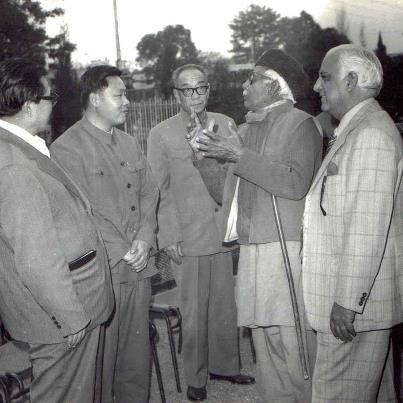
Dada Amir Khan (with cap, d. 1989), Dr Ayub Mirza and the Chinese Ambassador to Pakistan (Photo: 1982)

The renowned Pakistani sociologist and radical activist Professor Hassan Gardezi has been a life-long human rights campaigner. Through his books and articles, he has staunchly stood for the rule of law and has shown the importance and relevance of socialist values in shaping an egalitarian society.

He opposed the policies of General Zia-ul-Haq, whose brutal dictatorship in the 1980s was simply a reign of terror in Pakistan. Under Zia’s  rule, thousands of ordinary political workers and activists were rounded up and incarcerated with a view to silence any opposition to his tyrannical  rule. Many people were flogged by police publicly and this was meant to be a message from the military ruler to all those who dared to oppose him.  The general used his  army and police to beat and mishandle Pakistanis as Nazi rulers of the Third Reich did with their opponents, or the Zionist rulers of Israel have been doing and are still doing with the captive population of Palestine. Anyhow, in those beak years in Pakistani history, Hassan  Gardezi , who was living in Canada,  played an important part to combat Zia’s  obscurantist policies of  so-called Islamisation and the sharia laws, which,  by the way,  had nothing  to do with Islamic faith or its benevolent moral and  social laws.

Dr Gardezi had been a close  and trustworthy friend of the great Indo-Pakistani revolutionary Dada Amir Haider Khan. The autobiographical manuscripts that Dada had compiled while in jail in the 1930s or his later updated sketches, notes and letters  were in a precarious condition. To organise and systematise all such papers was a daunting task for any editor or schoalr. But Gardezi was the right  man for the difficult  job; he with a  single-minded determination organised and re-wrote the entire manuscript and notes to compile the memoirs of Dada. Last year, he finally published the two-volume autobiography of the great revolutionary. I solute Dr  Gardezi for his  great  work.

I have never me Gardezi, who has lived and taught in Canada for many decades whereas I have worked and lived in  Europe for almost five decades; however, Dada  had kept me informed about his close friend  Hassan Gardezi, his scholarly work and  his political activities.

I have great admiration for the work and worldview of Comrade Hassan Gardezi and I offer him my best wishes for the period of his active retirement. I hope he will continue to inspire us,  the old radical guard  as well as the younger generation, in the years  to come.

——————————————————-

Pakistan Today: A Travelogue

By Hassan Gardezi

Periods of national unrest have not been uncommon or unfamiliar occurrences in the history of Pakistan. But the political and economic turbulence the country is facing today is bound to come as a shock to any visitor who has been away from the country for even a couple of years. It is as if all the contradictions that were being nurtured within the institutional structure of the state since the creation of the country have suddenly come to a head, threatening to spell the collapse of the entire edifice.

“How does Pakistan look to you today?” was the question most frequently asked, with some variation, everywhere I went this time, whether it was a meeting with old students, colleagues and political comrades in Lahore, a chat at the “tea” before or after a talk I was invited to give somewhere, a social meeting in Islamabad, or a gathering of close relatives in Multan.

Pakistan’s existential situation of course does not look very good today and everyone in the country knows this. The question being asked was perhaps more of an expression of common anxiety about what is happening in the country, a subterfuge rather than a real question.

The problems behind Pakistan’s latest crisis are not really new. But the one that is being
most palpably felt is that of religious extremism accompanied by unprecedented acts of terrorism. Bombs planted or carried on the person of suicidal individuals went off almost every day in some part of the country when I was there, killing and maiming their hapless victims. The biggest carnage took place in the heart of Peshawar on Dec. 5 when a powerful bomb went off in the Qisa Khwani bazaar crowded with Eid shoppers, killing scores of women and children and lighting up a huge fire. It was intended to destroy a shia imambara. These acts of terror are being committed by Islamic extremists, generally known as Pakistani Taliban, who are most active in the seven agencies of the Federally Administered Areas (FATA) and also control a substantial part of the northerly settled districts of NWFP province, renamed Pakhtunkhwa.

The leaders of the Awami National Party (ANP) which heads the provincial government and their relatives are the latest individual targets of terrorist killings (ostensibly for hobnobbing with Afghanistan’s president, Karzai). The national chairman of the party, Isfandyar Wali, survived a murderous attack on October 2, which killed four of his companions. Peshawar, the seat of provincial government, is virtually a war zone. Neither the once formidable Frontier Corps nor the Pakistan army seem to be able to establish the writ of the government over vast northerly tracts of the province. It has also become impossible for the Pakistani truck convoys to carry supplies for the NATO troops in Afghanistan from the Karachi port through the Peshawar terminals.

The operations of Pakistan army in trying to restore governmental control in FATA and adjoining settled districts of Pakhtunkhwa are neither effective nor hold much credibility in the eyes of the people, despite heavy casualties suffered by soldiers in fighting with the Islamic militants. Many questions are being raised regarding the involvement of the armed forces on the northwestern front. Are they serious in eradicating the menace of  Islamic terrorists inside Pakistan? Is the army rank and file willing to kill their Muslim brothers while for decades they have been regimented to fight “Hindu India?” What role did the army and its intelligence services play in creating and nurturing the Islamic insurgents or jihadis as a foreign policy tool in the first place? Whose “war on terror” is the Pakistan army fighting any way? Is it serving the imperial interests of the United States on the northwestern front? and so on go the questions.

In October 2008 the newly elected government decided to hold an in-camera session of the national parliament under tight security to get “everyone on board” on the rationale of fighting the menace of “extremism, militancy and terrorism.” After two weeks of deliberations and extensive briefings on the situation provided by the army High Command, the parliament passed a resolution hailed as representing the consensus of its members. Somewhere in this resolution it was written down that the “nation stands united to combat this growing menace” by addressing its “root causes.”

it appeared that addressing the root causes of extremism and terrorism in Pakistan would be a great opportunity for the elected representatives of the people to face the truth and make a beginning to move towards establishing a new political culture of peace and tolerance. But when I reached Pakistan in November, everyone was talking about the menace of terrorism and religious extremism but there was no sign anywhere of addressing its root causes.

I brought this issue to the first of the talks I was invited to give at the Lahore School of Economics. Any honest attempt to trace the roots of religious extremism and associated terrorism would inevitably lead to two interrelated fundamentals of state policy that have been pursued by every Pakistani government, which has ruled the country since independence, I said. One of these fundamentals is the Islamisation of Pakistani state and society while the other is catering to the global strategic interests of the Unites States of America.

Moves to Islamise the state of Pakistan began as the first order of business for the founding fathers of Pakistan (the worthy exception being Muhammad Ali Jinnah) whatever their political motives, and they were certainly not spiritual. Assembled in the first Constituent Assembly of Pakistan, these men came up with a document known as the Objectives Resolution in 1949, which declared that “Sovereignty belongs to Allah alone but He has delegated it to the state of Pakistan . . .” It further proclaimed that “Muslims shall be enabled to order their lives in accordance with the teachings of Islam as set out in the Holy Quran and Sunnah.” With these beginnings, all subsequent rulers of Pakistan made their own contributions to inject Islam into the affairs of the state, thereby empowering a parasitic and rabidly patriarchal class of mullahs. It was however left to General Zia-ul-Haq to effectively demonstrate what it meant for the Muslims of Pakistan to order their lives in accordance with the teachings of Islam after his coup d’etat in1977.

Islamisation of the Pakistani state and political culture was also a useful asset for the United States to exploit in its aim to keep the country tied to its Cold War military alliances against Soviet communism. Ultimately, with Zia the most ardently Islamist dictator in power, the United States was able to mobilize Pakistan army, intelligence services and Islamist parties to launch its proxy war, designed as Jihad, to overthrow the infant Marxist government of Afghanistan backed by the Soviet Union. This was the critical event which, through various political turns and twists unfolded into today’s global terrorism with Pakistan as its epicentre.

Thus it is reasonable to conclude that the mess that Pakistan is currently in is of its own making, with the opportunistic backing of the United States, I said in my submission to the small professorial circle that had gathered to hear me in the brightly lit library of Lahore School of Economics. How to get out of this mess? The only logical course that I could see was the reversal by the state of its Islamisation, and Americanisation policies.

On the sunny morning of November 21, I was sitting among a hall full of students at the campus of the newly established University of Gujarat. I was invited to speak on the current political and economic crisis, but my mind was picturing the young men and women sitting in front of me as little playful toddlers when Gen. Zia had let lose an orgy of public floggings to implement his primitive sharia laws taken from the books of Jamat-e-Islami, his new found political ally. Do these young people remember all that? I was wondering. Was there anything in their history and Pakistan Studies textbooks about a military dictator who had installed himself as the Islamic ruler, AmirulMomineen, of the wretchedly poor people of Pakistan? Do they know who created and fostered the present day Islamic extremists terrorizing the people, killing them in their mosques, imambaras, and bazaars while taking over the northern areas of Pakistan?

Once I got up to speak I pretty much repeated to my young audience what I had said at the Lahore School of Economics about the roots of Islamic extremism and terrorism in today’s Pakistan. Injecting the beliefs and rituals of a particular religion in the affairs of a modern, pluralistic, state is like playing with fire, I said. And the proof is all around us today as the country’s mosques, imambaras, bazaars and hotels burn, set on fire by the bombs and explosives of religious zealots. It is time for the people of Pakistan to make it very clear that most of them are Muslims, they were born Muslims, They have learned their faith from their elders, and neither the state mullah nor any jihadi has the right to tell them how to practice their faith.

But is it realistic to suggest that Pakistan dismantle its Islamisation project and break its ties with the only superpower on earth? Yes it is, if the government is a democracy run by the consent of the majority. The majority of the people of Pakistan have never endorsed Islamic rule as they have rejected the Islamist parties in every election held in Pakistan which has not been rigged. Religious fervour that is observed today in Pakistan is largely confined to the small middle class, always ready to compromise to protect its precarious existence. The people in general are fed up with the mayhem created by the Islamic militants. Several recent public opinion polls have also confirmed that an overwhelming majority of the adult population does not want the United States to interfere in the affairs of Pakistan.

After a brief stay at the beautifully laid out campus of the University of Gujrat, which incidentally is headed by a noteworthy academic and not a retired military heavy-weight, I was driven to Islamabad.

Islamabad, as the capital of Pakistan has many reasons to be visited, but lately I have been going there to spend a few restful days with a friend, sheltered by the Marghala hills, and to browse through the stores selling used and new books in the F/6 and F/7 markets. But it looks like what used to be the most calm and cloistered capital city in the world is now wide open to scarification by a new breed of militant Islamists. Last time I was there a large area of the city was fenced off where once was a mosque called Lal Masjid. This time my friend drove me by an enormous pile of debris which once was the imposing structure of Marriott Hotel surrounded by the shinny cars of its clients. It was indeed a grim reminder of the deadly power wielded by the men of God in today’s Pakistan.

Next I took a bus to Multan and was hardly in that city of the saints for long when the news broke out of November 26 terrorist attacks on Mumbai hotels. The irate Indian prime minister immediately called up his Pakistani counterpart, naming not only the rabidly anti-Indian jihadist outfit, the Lashkar-e-Tayyiba (LeT), as the perpetrator but also accusing Pakistan’s Inter-services Intelligence agency (ISI) as having directed the atrocity. The Pakistani prime minister, a fellow Multani not known for much political astuteness, denied all accusations and even offered to send the director of the ISI to help in finding out the culprits. However, the poor fellow had to retract his offer soon thereafter and went into the denial mode.

Within next few days all signs of official or unofficial contrition vanished from Pakistan’s media coverage, washed away by a tide of national jingoism. Indian admonitions that Pakistan rein in its Islamic militants were met by a chorus of patriotic war cries vouching to defend Pakistan from its perennial enemy, India. If on the one hand spokespersons of the venerable Lawyer’s Movement were issuing patriotic statements, on the other hand there were the villainous terrorists, the likes of Baitullah Mehsud and Mangal Bagh, voicing eagerness to march their lashkers to the Indian border to defend Pakistan. The rest of this drama is still to unfold.

I had yet to go to Karachi to participate in a discussion panel on Dada Amir Haider Khan’s book of memoirs, Chains to Lose, which I was finally able to get published last year. But Karachi was once again in the grip of riots. This time the riots were sparked by MQM’s fears that Pakhtun refugees from Waziristan and the districts of Pakhtunkhwa, displaced by Pakistan army’s anti-terrorist operations and constant missile attacks launched from  the US predatory drones, were flocking to Karachi and taking control of local markets.

In any case I was able to make it to the Karachi event, thanks to an interlude of peace in the city in preparation for the Eid holidays. The book discussion was organized by Dr. Jaffer Ahmed, the able and tireless director of Karachi University’s Pakistan Studies Centre, the publisher of the Chains to Lose. Some half a dozen people, journalists, writers, political activists, presented their very well informed and perceptive reviews. Zahida Hina was one of them whose presentation in Urdu caught the general sense of the house. She said:

Dada’s memoir is a great historical document if one seeks to understand a glorious 20th century movement in South Asia for freedom from world colonialism and imperialism.

If our generation has no idea of who Dada Amir Haider Khan is, it cannot be blamed. This generation has never been told anything about our great compatriots. We make giants out of dwarfs and treat our persons of great stature like lowly creatures.

Feeling happy that Dada’s contributions as a committed communist to make Pakistan, South Asia and the world a better place for humanity are becoming known I returned to Lahore on December 6. Next evening there was a sitting with some like-minded comrades arranged by Awaji Jamhoree Forum. It turned out to be a free-wheeling discussion of the present global economic crisis, war on terror and the rise of Islamic terrorism in Pakistan, terrorist attacks on Mumbai hotels, the US elections and the victory of Obama.

Perhaps the most serious concern was the position and the role of the socialist left in all this. I maintained that the greatest asset of the socialist left is its set of values. These values of freedom, peace, opposition to all wars, human rights, respect for nature and all life, economic, racial and gender equality, religious and ethnic tolerance, are together a powerful antidote to the present global crisis. There is every chance for the socialist left to succeed in its own right if it stops wasting its resources to support the lesser evil in political contests. I gave the example of very active and resourceful anti-war and anti-poverty groups in the United States who squandered their assets by supporting Barack Obama as the lesser evil in the contest between the two mainstream bourgeois parties. There is no sushi thing as more or less evil, I said. All war is evil whether it is more or less, all poverty and all inequality is evil whether it is more or less. A similar mistake was made in the last elections in Pakistan when parties calling themselves “communist” rushed to support the PPP.

I better end here. My apologies if I have bored you with my long story. If you do have any questions and comments I will be glad to receive them. I wish you a very happy new year.

Hassan  Gardezi

In Pictures: Massacre of Gazan Children

January 8, 2009

Published on URUKNET

Dec 31, 2008, 15:11
Email this article Printer friendly page

December 30, 2008

PNN -Israeli forces killed two girls in an air attack on Beit Hanoun in the northern Gaza Strip early Tuesday. Local sources report that a missile destroyed a house belonging to Talal Hamdan in Beit Hanoun today, killing his two daughters of 12 and 4 years old. A son is reported seriously injured. Yesterday Israeli forces killed four sisters and a four year old boy. Over 40 children have been killed since Saturday.

The bodies of two girls, aged four and 11, who were killed in an Israeli air strike in Beit Hanun in the northern Gaza Strip Strip December 30, 2008.

Palestinians carry the body of 4-year-old Lama Hamdan during her funeral in the town of Beit Hanoun in the northern Gaza Strip December 30, 2008.

Palestinians bury the body of 4-year-old Lama Hamdan at Beit Hanoun cemetery in the northern Gaza Strip December 30, 2008.

Palestinians mourn beside the bodies of three children in Rafah in the southern Gaza Strip December 29, 2008.

Three Palestinian children from the Balosha family, of five who were all killed in the same Israeli missile strike, are seen in the morgue before their burial at Kamal Edwan hopsital in Beit Lahiya, northern Gaza Strip, Monday, Dec. 29, 2008


Palestinian children from the Balosha family, who were all killed in the same Israeli missile strike, are seen in the morgue before their burial at Kamal Edwan hopsital in Beit Lahiya, northern Gaza Strip, Monday, Dec. 29, 2008.

Palestinian women mourn over the bodies of three Palestinian children from the Balosha family, of five who were all killed in the same Israeli missile strike, in the morgue before their burial at Kamal Edwan hopsital in Beit Lahiya, northern Gaza Strip, Monday, Dec. 29, 2008.

A Palestinian man buries the body of 4-year-old Dena Balosha at Beit Lahiya cemetery in the northern Gaza Strip December 29, 2008.

A Palestinian man carries the body of his 4-year-old daughter Dena Balosha during the funeral for her and her four sisters in Jabalya refugee camp in the northern Gaza Strip December 29, 2008.

A Palestinian mourner shouts as he lifts the body of a child from the Balosha family, of which three children and two teenagers, were killed in an Israeli missile strike,durng their funeral in the Jebaliya refugee camp, northern Gaza Strip, Monday, Dec. 29, 2008.

A Palestinian man buries the body of 5-year-old Sodqi al-Absi in Rafah cemetery in the southern Gaza Strip December 29, 2008.

A Palestinian mourner carries the body of 4-year-old Dena Balosha, foreground, one of five members of the same family including three children and two teenagers who were killed in an Israeli missile strike, during their funeral in the Jebaliya refugee camp, in the northern Gaza Strip, Monday, Dec. 29, 2008

The father of Palestinian Dena Balosha, 4, left, one of five members of the same family including three children and two teenagers who were killed in an Israeli missile strike, carries her body during their funeral in the Jebaliya refugee camp, in the northern Gaza Strip, Monday, Dec. 29, 2008.

Bedroom of 5 killed girls

Samera Baalusha (34) carries her surving child Mohamad (15 months) while she waits to see the body of her daughter Jawaher Baalusha (aged 4) during the funeral held for her and four of her sisters who were killed in an Israeli missile strike, on December 29, 2008 in the Jebaliya refugee camp, in the northern Gaza Strip


BR>
Palestinian mourners bury 8 children killed in Israeli air strikes

Dec 29 – Palestinian mourners on Monday (December 29) buried 8 children who were killed in Israeli air strikes on Gaza Strip.

In the northern Gaza town of Jabalya, hundreds took to the streets to attend a funeral procession for five girls of the same family who were killed in one Israeli strike.


In this image taken from APTN video, Palestinian men carry two injured children into hospital after Israeli aircraft struck Hamas security compounds across Gaza in Gaza City on Saturday Dec. 27 2008.

A wounded Palestinian boy is carried by his father following an Israel air strike in Gaza December 28, 2008.

A Palestinian boy is carried to al-Shifa hospital following an Israel air strike in Gaza December 28, 2008

A Palestinian security force officer carries a wounded girl into the emergency room at Shifa hospital in Gaza City, Saturday, Dec. 27, 2008.

A Palestinian girl wounded in an Israeli missile strike is carried into the emergency area at Shifa hospital in Gaza City, Saturday, Dec. 27, 2008.

A Palestinian man carries his wounded child to the treatment room of Kamal Edwan hospital following an Israeli missile strike in Beit Lahiya, northern Gaza Strip, Monday, Dec. 29, 2008.

A wounded Palestinian boy is carried by his father at a hospital in Gaza City following an Israeli air strike

Children Wounded – Image by Watan News Agency

Shifa hospital ICU: a six year old down’s syndrom with brain trauma

Children From Gaza – December 27, 2008

Children of Gaza – song on guitar

Live recording of Doc Jazz playing a (new!) song emanating from the grief not only over the war crimes committed by the thugs of the state of Israel against defenseless Palestinian children – but over the criminal silence with which this Holocaust is condoned … Break the Silence!

Visit http://www.soundclick.com/docjazzfor more songs by the Palestinian writer of songs of liberation.

http://www.uruknet.info/?p=50118

http://www.wakeupfromyourslumber.com/node/9818

A SATANIC GENOCIDAL ISRAEL

January 8, 2009

5556gazachild.jpg

by Khalid Amayeh |  uruknet.info, Jan 7, 2009

For years, I have been warning that Israel is psychologically and morally capable of carrying out a holocaust or a genocide against the Palestinian people.

Needless to say, the horrible events of the past two weeks in Gaza seem to have enforced and vindicated my convictions in this regard.

Israel, government and people, seem to possess the psychological propensity that would make her embark on such a monstrosity. Yes, there is a minority of Israeli Jews and non-Israeli Jews who say “No” to all the evils and crimes Israel is doing in the name of their name.

However, let us be honest and realistic. These people are a small minority and have very little influence if any on the Israeli government and army.

Today, what many people had thought would be unthinkable or far-fetched in terms of the extent to which Israel would be willing to go in savaging the Palestinian people seems quite possible in light of the Jewish state’s Nazi-like behavior in the Gaza Strip.

Given the Israeli mindset, Israel may well be hoping the latest genocidal onslaught could have a certain desensitizing and de-mystifying effect on people’s perceptions and attitudes.

The logic is quite simple. If the world can be bullied or cajoled into silence and apathy when Gaza is ravaged and thousands of its inhabitants are slaughtered en mass in full view of humanity, the same world can likewise be manipulated in similar fashion to come to terms with a greater genocide.

On Tuesday, 6 January, one Israeli official, Eli Yeshai, called for the total extermination of Gaza. The leader of the ultra Orthodox Shas party argued that “extermination of the enemy is sanctioned by the Torah.”

Other Israeli political and religious leaders have lately spoken enthusiastically of the need for “wiping off Gaza from the face of earth” and “annihilating of every moving thing there.”

Interestingly, this is by no means a minority opinion in Israel. Indeed, one could safely argue that the “ideology of annihilation” now represents the mainstream in the Israeli society.

As we all know, Israel heavily employs mendacity, deception and disinformation to conceal, or at least blur, its criminality and barbarianism.

The Israeli hasbara machine’s main job has always been and continues to be to turn the black into white, the white into black and the big lie into a “truth” glorified by millions, especially in the west.

To effect these obscene lies and “virtual realities,” the Israeli government counts heavily on the Jewish-controlled or Jewish influenced media in the western world, especially in North America where telling the truth about Israel is the ultimate taboo.

In truth, what has been happening in Gaza is a huge massacre of genocidal proportions as many conscientious Jews have testified.

What else can be said of this wanton, deliberate and indiscriminate blanket bombing of densely-populated neighborhoods and refugee camps?

I believe terms such as “huge massacres” and “genocidal onslaught” used in reference to the Gaza nightmare cannot be dismissed by Israel and her supporters as merely overstatements or rhetorical exaggerations.

This is unless Israel views non-Jewish pain and suffering as disingenuous, probably because non-Jews or “goyem” are actually considered “human animals” by a large and growing class of fanatical rabbis, politicians and military leaders.

So far, more than 4000 Gazans have been mercilessly killed or badly mutilated or incinerated in less than two weeks of intensive indiscriminate aerial and artillery bombing targeting everyone and everything.

Mosques, homes, public buildings, shelters, schools, colleges, dormitories, factories, cultural institutions, businesses, even hospitals and drug stores as well as the entire civilian infrastructure have been bombed and reduced to rubble.

The rabid bombing from high altitudes has exterminated numerous whole families and destroyed entire neighborhoods. This is probably what Israeli leaders had in mind when they spoke earlier about a “shock and awe” campaign against Gaza.

On 6 January, Israeli tanks fired several artillery shells at a school at the Jabalya refugee camp, killing more than 40 civilians, mostly children and women, who had sought shelter at the UNRWA-run facility. Dozens others were injured, many critically.

Israeli army spokespersons, who are actually professional liars, claimed that Palestinian fighters were seen in the vicinity of the building and that some of these actually fired on Israeli troops from the school.

However, UN officials in Gaza strongly denied the Israeli account, with one UN official saying that he was “99.99%” that the Israeli army was lying.

Earlier, the Israeli air forces hit a mourning reception, killing 15 members of the same family.

The pornographic killing of civilians has no explanation other than the ostensible fact that Israel is adopting a no-holds-barred approach toward Gaza, which is still under effective Israeli occupation despite the withdrawal of Israeli troops from the coastal enclave more than three years ago.

Well, if we are to accept this logic, namely that everything is fair in war, then Jews should stop complaining about what the armies of Hitler did to them during World War II.

It is just unacceptable to apply two standards of morality, one for Jews and another for non-Jews. For if what Israel is doing in Gaza is right, as Israel and her supporters maintain, then what the Nazis did in Europe several decades ago must have been right as well. And vice versa.

After all, crime doesn’t become kosher when committed by Jewish hands.

Colossal crime

The enormity of the present holocaustic assault is undoubtedly a colossal crime against humanity.

In proportion to the size of population, the murder and maiming of 4000 Gazans (the number keeps rising) is like the US having at least a million of its citizens killed or badly injured as a result of a foreign aggression.

As to the utter destruction of Gaza, it is equally shocking. Some American expatriates here in occupied Palestine have spoken of a double holocaust in Gaza, one targeting humans, and another targeting civilization.

Facing their crimes, pornographic and outrageous as they are, many Israelis, probably the majority, are simply so gleeful that they think Israel is doing the right think and that God is standing on the side of Israel in this war and every war.

Some religious Israelis have become so euphoric, thanks to the Gaza blitz, that they think the Messiah’s coming imminent.

Other “religious” Israeli Jews, including rabbis, readily justify the wanton slaughter by quoting biblical verses justifying genocide.

One Israeli settler leader recently argued during a conversation with a visiting American peace activist that “if it was right to commit genocide during Biblical time, why can’t it be right to commit genocide now . Has God changed his mind,” the settler wondered sarcastically.

As to Israeli leaders and officials, they simply indulge in what they have always been indulging in, namely “denial” and “self-righteousness” or simply playing the role of victim.

Thus behaved Shimon Peres, the Israeli President, when he told al-Jazeera during a live interview on Monday, 5 January.

” We don’t kill and we have not killed any children in Gaza. We are the victim of Hamas aggression,” said the pathological liar and certified war criminal rather shamelessly.

Peres’s pornographic lies don’t need any further comment. They speak for themselves.

Zionist Jews may very well think that might is right, and that morality is unneeded and unnecessary as long as they possess overwhelming material strength.

They may think that the rivers of blood the “only democracy in the Middle East” has been shedding will strengthen Israel and terrorize its neighbors.

Well, it may in the short run. However, in the long run, Israeli criminality and evilness will make it sterile from within to the point of death.

Like evil people, evil states shall not prosper.

Israel Outraged as Vatican Calls Gaza a ‘Big Concentration Camp’

January 8, 2009

Foreign Ministry Says Cardinal’s Comments ‘Based on Hamas Propaganda’

Antiwar.com,

Posted January 7, 2009

Echoing Pope Benedict XVI’s repeated calls to end the ongoing bloodshed in the Gaza Strip, Vatican Justice and Peace Minister Cardinal Renato Martino urged both the Israeli government and Hamas to show more willingness toward peace talks and for the world to help them come an agreement that would end the ongoing Israeli invasion.

He also expressed concerns about the dire humanitarian situation in the Gaza Strip, saying “let’s look at the conditions in Gaza: these increasingly resemble a big concentration camp.”

Israel, as has been so often the case as the international community condemns the situation in Gaza, is outraged. The Foreign Ministry accused the Cardinal of making comments “based on Hamas propaganda” and likewise slammed him for “ignoring its numerous crimes,” even though he explicitly called for both sides to end their attacks. He said the Cardinal’s comments would not “bring the people closer to truth and peace.”

Related Stories

compiled by Jason Ditz [email the author]

European diplomacy in Gaza crisis prepares trap for Palestinians

January 8, 2009

Global Research, January 8, 2009

Unlike the United States, which has given its unconditional backing to Israel and opposed all cease-fire proposals following Israel’s onslaught on the Gaza Strip, Europe has undertaken a series of diplomatic initiatives. There are currently a number of high-level European diplomatic missions in the Middle East.

On behalf of the European Union, EU Commissioner for External Relations Benita Ferrero-Waldner, chief diplomat Javier Solana and the foreign ministers of France, Sweden and the Czech Republic have traveled to the region. The Czech Republic currently holds the chair of the EU. Former British Prime Minister Tony Blair is in the region on behalf of the so-called Middle East Quartet (United Nations, US, EU and Russia). French President Nicolas Sarkozy visited the region on Monday and Tuesday in his function as co-chairman of the recently founded Mediterranean Union. The second chairperson of the Union is Egyptian President Hosni Mubarak.

All of the European representatives have called for an immediate cease-fire. They have discussed their proposals with Mubarak, Palestinian President Mahmoud Abbas, Israeli Prime Minister Ehud Olmert and—in the case of Sarkozy—Syrian President Bashar al-Assad. At the same time, all of the European delegations have ruled out any talks with Hamas, the immediate target of the Israeli aggression.

Many opponents of the Israeli attack on Gaza have welcomed the diplomatic initiatives by Europe. The speaker on foreign affairs for the German Left Party, Wolfgang Gehrke, for example, praised the intervention of the French president.

The Israeli peace activist Michel Warchawski has merely criticized these initiatives for being insufficient and for not moving quickly enough. On the web site of the French “New Anti-capitalist Party” he issued “an urgent appeal to all activists… to put pressure on their governments to intervene to stop the bloodletting and demand that they intervene now and not wait a day longer!” He went on to call for the dispatch of an “international force which places itself between the fronts and protects the people of Gaza.”

Such declarations fail to recognize the real character of the European interventions.

The first point to note is that no European government has condemned the Israeli aggression and called it by its real name—a war crime. Instead, they have justified the actions carried out by Israel—its 18-month blockade of the population of Gaza, its targeted assassinations of Hamas leaders and its bombardment of the densely populated and virtually defenseless territory—as legitimate acts of self-defense.

Before leaving for his trip, President Sarkozy publicly blamed Hamas—and not the Israeli military—for the plight of the Palestinians, citing the firing of Hamas rockets into southern Israel. The head of the Czech government and current president of the European Union, Mirek Topolanek, declared that the Israeli military action had a “defensive” character. And in a telephone call with the Israeli prime minister, German Chancellor Angela Merkel declared that the responsibility for the fighting lay “clearly and exclusively” with Hamas.

In appealing for a cease-fire, the European governments are first and foremost pursuing their own geo-political interests.

They fear that the ruthless methods employed by Israel will undermine the Arab regimes with which they have economic and political ties. The widespread popular anger over Israel’s actions is increasingly being directed against the Arab ruling elites, which collaborate closely with Israel and the US.

Ruling circles in Europe also fear a destabilization of Israel as a result of the latter’s brutal war in Gaza.

An editorial in the French conservative newspaper Figaro on January 5, entitled “Intervene Quickly for a Cease-Fire,” warned against such a development, declaring, “Immediate action is absolutely necessary because dissatisfaction will grow in tandem with the number of victims in this new Palestinian drama.” The newspaper added, “[D]espite the difficulties, it is necessary to conclude a cease-fire without delay because the worst may be yet to come: Any ground intervention in this densely populated area would have murderous consequences. And what would happen if Hezbollah opens up a second front in Lebanon? It is necessary to act quickly because the passivity of the US has created a vacuum which encourages numerous extremists.”

European governments, in particular France, also fear for stability in their own countries, home to millions of immigrants from North Africa and Arab lands. Many youth who have rebelled against intolerable conditions in the French suburbs in recent years are of Arab and Muslim parentage and identify with the Palestinians.

Last but not least, the Europeans regard the passivity of the US, occupied with a change of administrations and a deep economic crisis, as an opportunity to reestablish and strengthen their position in the Middle East. This applies particularly to France, which, following the collapse of the Ottoman Empire, was one of the leading colonial powers in the region until it was later forced out by Great Britain and the US.

This point is also dealt with in the Figaro editorial, which states, “Because of the momentary absence of the Americans, the president of the Republic can hope to once again create a role for the Europeans.”

Since taking power, Sarkozy has worked systematically to strengthen the status of France in the Mediterranean region and the Middle East. This was the purpose of the Mediterranean Union founded in July of last year, as well as Sarkozy’s collaboration with Syrian President Bashar al-Assad, who is regarded as a pariah in Washington. Sarkozy also maintains closer relations with Israel than any of his predecessors as French president.

Before setting out on his Middle East mission, Sarkozy boasted of his close relations in the region. “France bares a particular responsibility because it has been able to establish a bond of trust and friendship with all the concerned parties,” he said in an interview which was published in three Lebanese daily papers.

Germany is also pursuing its own interests in the Middle East. German diplomacy proceeds more quietly than that of Sarkozy—not least because of the country’s past role in the Holocaust—but it is just as ambitious. While Sarkozy has traveled to the Middle East with the media in his wake, German Chancellor Merkel and her foreign minister, Frank-Walter Steinmeier, have been in telephone contact with the main players. In recent years, Germany has played a key role in the formation of the police and legal authorities in the nominally autonomous Palestinian regions.

The ceasefire pursued by the Europeans corresponds to their imperialist ambitions. Rather than securing the liberation of the Palestinian people and any easing of their misery, the European powers are intent on establishing a more effective means for their repression. To this end, they require the services of a reliable police force. The most likely candidates for such a role are the Egyptian regime of strongman Mubarak and the Palestinian Authority backed by the US and headed by Abbas.

While Israel intensifies its bombardment and ground war in Gaza, the Europeans are attempting to reach a deal that suits Tel Aviv and Washington. According to the French newspaper Le Monde in its report on the discussions of EU delegations with the Egyptian government, France regards an end to the smuggling of weapons into Gaza as decisive in winning Israeli agreement to a cease-fire. To this end, it is necessary to establish even stronger controls over the border between Egypt and Gaza, most likely through the deployment of an international force.

The Süddeutsche Zeitung suggests additional motives. The real aim of the Israeli offensive, the newspaper writes, is to drive the Palestinians into the Sinai desert and “give Egypt part of the responsibility for the 1.5 million Palestinians.” It goes on to say that “the situation would be almost comparable to the Six Day War of 1967: Arab war refugees fled at that time from Israeli troops into neighbouring Arab states and stayed there permanently. In the current case, Israel could offer an end to hostilities if a neutral power agreed to supervise the cease-fire. Egypt is a potential candidate. Cairo would be tasked with holding Hamas in check and making sure that people had something to eat. It would assume partial responsibility for administration of the Gaza Strip.”

The Süddeutsche Zeitung concludes that the US would be prepared to accept such a solution and would exert pressure on Cairo, along the lines that “We are Israel’s closest ally and Cairo’s most important source of finance. Mubarak knows that nobody else is available.”

The British Financial Times comes to a similar conclusion. The newspaper writes that Egypt suspects Israel’s “real aim in Gaza consists of transferring responsibility for the Strip and its inhabitants to Cairo.” The paper quotes a high-ranking Egyptian official who complains, “We are the victims of an evil game… when we open the borders and then have a huge refugee problem, what will happen? Should we transfer the population of Gaza into the Sinai?”

Such commentaries make clear that the European diplomacy has a sinister character. Following a war which could well involve the deaths of thousands of Palestinians and the expulsion from Gaza of hundreds of thousands, the Europeans are preparing a solution aimed at ensuring that Gaza remains a huge prison. In collaboration with Israel, the US and Europe, the administration of this prison would be handed over to Egypt and the Palestinian Authority.

India stages “martial law” elections in Kashmir

January 8, 2009
By Deepal Jayasekera and Keith Jones |  World Socialist Web Site,  January 8,  2009

Omar Abdullah was sworn in as the chief minister of the Indian state of Jammu and Kashmir Monday, ending six months of central government or “president’s” rule.

India’s lone Muslim-majority state, Jammu and Kashmir has for two decades been convulsed by a popular insurgency against Indian rule.

Indian authorities recently reported that 47,000 people have died in the conflict, including 20,000 civilians and a like number of anti-Indian insurgents. The Coalition of Civil Society, a prominent Kashmiri-based human rights group, says the true death toll is in excess of 70,000.

Abdullah leads a coalition that was patched together after last month’s state assembly elections produced a fractured verdict. The coalition unites his National Conference, a Kashmiri regionalist party, with the Congress Party, the traditional governing party of the Indian bourgeoisie and the dominant partner in India’s United Progressive Alliance government.

The National Conference captured 28 assembly seats and the Congress 17, meaning that the coalition has only a bare majority in the 87-member state legislature.

Neither party improved its standing from the last election. The National Conference won the same number of seats as it secured in the 2002 election when it fell from power, while the Congress suffered a net loss of 3 seats.

The Kashmiri-based People’s Democratic Party (PDP), which co-governed the state with the Congress from 2002 till last June, won 21 seats, five more than in 2002, and thereby supplanted the Congress as the state’s second largest party. The Hindu communalist Bharatiya Janata Party (BJP) won 11 seats, all of them from the Hindu-majority Jammu region. Smaller parties took six seats and four were won by independents.

India’s political establishment and corporate media have proclaimed the staging of state assembly elections in Jammu and Kashmir, the installation of a new coalition government, and the lifting of president’s rule a triumph for “democracy.”

The reality is that Jammu and Kashmir, especially the Kashmir Valley, remain under military occupation, with half a million security forces deployed in a state whose total population is little more than 10 million. Since 1990 the state has been under the Armed Forces Special Powers Act, which gives the military sweeping powers. These include the right to use deadly force and raid any premises without a warrant, as well as immunity from prosecution.

The elections were held in seven phases, stretching from November 17 to December 24 so as to maximize troop deployment in areas during and immediately before voting.

Curfews, declared and undeclared, were imposed by security forces so as to prevent anti-Indian government protests and those protests that were mounted were brutally suppressed. Several dozen prominent opponents of Indian rule were kept under house arrest throughout the election campaign, under the draconian Public Safety Act, which authorizes police to detain people for up to two years without trial.

The state of siege was intensified following the commando-style terrorist attack on Mumbai in late November. BBC correspondent Chris Morris, reporting from Srinagar on the eve of polling in the state’s largest city, said, “Every 50 meters or so, on every main street, stand several men (or very occasionally women) armed with assault rifles and—more often than not—big sticks.”

Indian authorities continue to adamantly oppose any serious investigation of the horrific human rights abuses, including torture and summary executions, perpetrated by security forces—some of them former insurgents who have been coerced into becoming police “auxiliaries”—in Indian-controlled Kashmir. The “disappeared” number in the thousands, if not tens of thousands.

Much has been made of an increase in the election turnout from the 2002 state election. Although the advocates of union with Pakistan or an independent Kashmir called for an election boycott, 61.5 percent of the electorate voted as compared with just 43 percent in 2002. In the Kashmir Valley, the state’s most populous region, and the center of both its Muslim population and the opposition to Indian rule, half or more of the electorate voted.

The increased voter turnout came as a welcome relief to the Indian elite. Indeed, in announcing last fall that the Jammu and Kashmir state elections would be held on schedule, the head of India’s election commission conceded it was a calculated risk.

In June, the PDP had withdrawn from its coalition with the Congress, forcing the imposition of president’s rule, after popular protests broke out against a state government decision to cede 100 acres of Kashmir Valley land to a Hindu shrine. The shrine has become a major pilgrimage site in recent years, at least in part because of the efforts of Hindu supremacist organizations who view its veneration as a means of asserting Indian/Hindu control over the valley. The protests quickly mushroomed into a mass popular movement against the police-military occupation of the state and to a considerable degree Indian rule itself. State authorities brutally suppressed the protests, killing dozens of people. Meanwhile the Hindu right, with the connivance of local Congress leaders, whipped up a Hindu communal counter-agitation. (See: Indian government mounts brutal campaign of repression in Kashmir)

More astute and less-biased observers concede that the increased turnout in the 2008 election is not indicative of any new-found enthusiasm for the repressive rule of the Indian state among Kashmir’s Muslim majority. Rather, the populace seized on the elections as a means of trying to influence government decisions concerning economic development. “In their approach to the elections,” wrote The Hindu‘s Siddharth Varadarajan, “it is apparent that the people in the valley made a distinction between the ‘masla-e-kashmir,’ or the problem of Kashmir, and ‘kashmiriyon ke masail,’ or the problems of Kashmiris.”

A second factor in the widespread spurning of the anti-Indian opposition’s boycott call is increasing popular disaffection with the insurgency. Not only do the insurgents advance no progressive program to address poverty and economic backwardness, they have become ever-more explicitly communalist and Islamic fundamentalist in program and orientation. Pakistan, it should be noted, played an important part in this process, as it viewed Islamicist elements as the most malleable in its efforts to exploit the grievances of the Kashmiri people to serve its own predatory ends.

The National Conference, which favors increased autonomy for Kashmir within the Indian Union, placed economic issues at the center of its election campaign, promising to improve the state’s dilapidated or non-existent infrastructure and create jobs. “If voted to power, National Conference will usher an era of unparalleled development in the state and open new avenues of employment,” declared Farooq Abdullah, Omar Abdullah’s father, and himself a four-time Jammu and Kashmir chief minister.

The central theme of the PDP election manifesto was “Make Self-Rule Happen.” In a 2006 address to the Center for Strategic and International Studies, a Washington think-tank, Mufti Mohammad Syed, the father of PDP head Mehbooba Mufti, and the party’s official “patron,” argued that autonomy for Jammu and Kashmir and the development of cross-border ties with Pakistan-controlled Azad Kashmir, would allow the state to become the hub of a thriving Indo-Pakistani capitalist trade.

The Kashmiri regional parties speak for rival sections of the local elite. Their autonomy demands and maneuvers with New Delhi—the National Conference was aligned with the Hindu supremacist BJP from 1998 to 2002—have nothing to do with meeting the socio-economic needs and fulfilling the genuine democratic aspirations of the people of Jammu and Kashmir, be they Hindu, Muslim, or Buddhist.

Neither of them challenge the reactionary 1947 communal partition of the subcontinent. Imposed by the Congress and Muslim League in connivance with British imperialism, Partition is at the root of the ordeal of the Kashmiri people, on both sides of the Line of Control that divides Indian- and Pakistani held Kashmir, and of the geo-political rivalry between India and Pakistan—a rivalry that has repeatedly erupted in war.

The Congress and National Conference have had a tumultuous, decades-long association, involving periods of partnership and confrontation. The founder of the National Conference, Omar Abdullah’s grandfather, Sheikh Abdullah, supported the accession of the princely state of Kashmir to India and became the Indian state’s first chief minister. He was jailed by the Congress from 1953 to 1964, after he balked at declaring the state an integral part of the Indian Union.

In 1984, a Congress central government through the centrally-appointed state governor maneuvered to dismiss a National Conference ministry, only to prod the National Conference into an electoral alliance three years later. The joint efforts of the Congress and National Conference to rig the 1987 elections did much to discredit the Indian state and fuel the eruption two years later of mass protests against Indian rule.

If the Congress has rushed to forge a new governmental coalition with the National Conference, agreeing that Abdullah will serve as chief minister for the government’s full prospective six-year term, it is because it is anxious to give the state the appearance of a stable, democratic government. It is leery of the PDP’s more assertive position on autonomy, what many in the press have termed “soft separatism.”

More importantly, it and the Indian elite as a whole have been rattled by last summer’s sudden eruption of mass protests and want to ensure that there is a democratic fig leaf for the continuation of its two decades-long campaign to stamp out opposition, whether in the form of an armed insurgency or civil unrest, to Indian rule.

At the same time, New Delhi, with the full support of the official opposition BJP, has seized on the recent Mumbai terrorist atrocity to push through even more draconian “anti-terrorism” legislation and to ratchet up pressure on Pakistan to end its political and logistical support for the anti-Indian insurgency in Kashmir.

Several factors account for this belligerence. India’s military-security establishment and the Hindu right have long been pressing for a more belligerent stance against Pakistan and various national-ethnic and Naxalite (Maoist) insurgencies within India. With national elections looming, the Congress is anxious to counter any attempt by the BJP to cast it as “soft” on terrorism. The campaign against Pakistan also serves to divert attention from, and channel in a reactionary direction mounting frustration over, the deepening economic crisis.

That said, the Indian government’s attempt to cast Pakistan as a nexus of international terrorism is also clearly aimed at preempting any attempt by the incoming US administration of Barack Obama to take a greater role in the Indo-Pakistani dispute over Kashmir. A number of Obama aides have suggested that as a quid pro quo for Islamabad intensifying its efforts to eradicate support within Pakistan for the insurgency against the US-installed government in Afghanistan, Washington would facilitate a settlement of the Kashmir dispute. Obama himself told Time magazine last October that he wants to “devote serious diplomatic resources” to the Kashmir dispute, including getting “a special envoy in there, to figure out a plausible approach.”

India has long opposed any outside intervention in the Kashmir dispute, since it believes that bilaterally its economic and military power far outweighs that of Pakistan. Obama’s suggestion was, consequently, pilloried in the Indian press and quietly but firmly rejected by Foreign Minister Pranab Mukherjee.

The strength of the reaction from India has been duly noted by members of Washington’s geo-political establishment. Speaking Tuesday, Selig Harrison, a longtime US think-tank specialist on South Asia declared, “A US Kashmir initiative, however veiled, would poison relations between New Delhi and Washington.”

Death toll in Gaza passes 700, including 220 children

January 8, 2009
Article from: Agence France-Presse

From correspondents in Gaza City

heraldsun.com, January 08, 2009 07:26am

THE death toll from Israel’s 12-day-old offensive on Hamas in the Gaza Strip has passed 700, medics said.

The offensive unleashed on December 27 has killed 702 people and wounded more than 3100, the head of Gaza emergency services, Moawiya Hassanein, told Agence France-Presse.

At least 220 of the dead have been children, he said.

Earlier today, two Palestinians were killed in an Israeli strike as the army resumed bombings in Gaza City after a three-hour lull, witnesses said.

The strike hit the eastern Gaza City neighbourhood of Zeitun, they said.

The Israeli army halted bombings around Gaza City for three hours in what the government called a “humanitarian respite”

Israel’s Collective Punishment of Gaza

January 8, 2009

by Professor Marjorie Cohn

Since Israel began its war on Gaza 11 days ago, more than 560 Palestinians – about a quarter of them civilians – have been killed. Some two thousand Gazans, including hundreds of children, have been wounded. Israel’s “Operation Cast Lead” marks an escalation of Israel’s two-year blockade of the Gaza Strip which has deprived 1.5 million Palestinians of necessary food, medicine, fuel and other necessities.

Israel is using white phosphorous gas, an illegal chemical weapon that burns to the bone. Dr. Mads Gilbert, a member of a Norwegian triage medical team working in Gaza, has documented Israel’s use of Dense Inert Metal Explosive (DIME), which cuts its victims to pieces and reportedly causes cancer in survivors. Gilbert, who has worked in several conflict zones, said the situation in Gaza is the worst he has ever seen. Two United Nations schools have been hit by airstrikes, killing at least 30 people. The New York Times reported on Monday that Gazan hospitals are full of civilians, not Hamas fighters.

The targeting of civilians violates the Fourth Geneva Convention. Since the rockets fired from Gaza into Israel cannot distinguish between civilians and military targets, they are illegal. But Israel’s air and ground attack in Gaza violates Geneva in four ways. First, it constitutes collective punishment of the entire population in Gaza for the acts of a few militants. Second, it targets civilians, as evidenced by the large numbers of civilian casualties. Third, it is a disproportionate response to the rockets fired into Israel. Fourth, an occupying power has an obligation to ensure food and medical supplies to the occupied population; Israel’s blockade has created a humanitarian crisis in Gaza.

Israel’s airstrikes and ground assault on the people of Gaza have little to do with the Gazan rockets, which hadn’t killed any Israelis for a year before Israel’s current military operation. Israel’s leaders are bombing and attacking Gaza in order to gain an advantage in the upcoming Israeli elections in February.

Foreign Minister Tsipi Livni is locked in a tight race with Benyamin Netanyahu, who has criticized Livni for her “soft” treatment of the Palestinians. The Israeli government seeks to do as much damage as possible to Gaza while Bush is still in office. The New York Times cited several Middle East experts who “believe that Israel timed its move against Hamas, which began on Dec. 26, 25 days before Mr. Bush leaves office, with the expectation of such backing in Washington.” Obama, in spite of his unequivocal support for the policies of Israel during the campaign and his deafening silence about the recent casualties, is an unknown quantity.

Israel would be unable to carry out its aggressive policies in Gaza without the support of the United States, which gives Israel $3 billion in U.S. taxpayer money each year. The F-16 bombers and Apache attack helicopters Israel is using on Gaza were bought with U.S. money.

The war on Gaza also violates U.S. law. The Human Rights and Security Assistance Act mandates that the United States cease all military aid to Israel, which has engaged in a consistent pattern of gross violations of internationally recognized human rights. The Arms Export Control Act prohibits U.S. weapons from being used for any purpose other than inside the borders of a country for self-defense. Targeting schools, police stations and television broadcast centers is not self-defense.

Although Israel’s supreme court ordered the government to allow international media into Gaza to report on the situation there, Israel has refused. But, according to the New York Times, Israel has given “full access to Israeli political and military commentators.” Ethan Bronner, the Times bureau chief in Jerusalem, said, “Israel has never restricted media access like this before, and it should be ashamed . . . It’s betraying the principles by which it claims to live.”

In spite of the one-sided pro-Israel media coverage in the United States, Newsweek said, “Does it make sense for America to support [Israel’s] policy of punishing Hamas by making life unbearable for 1.5 million Gazans by denying aid and economic development? The answer is no.” An editorial in the Los Angeles Times called for “an end to a blockade that amounts to the collective punishment of Palestinians under Hamas rule.” And the New York Times editorialized that “the longer the Israeli incursion. . . the more Hamas’s popularity grows among its supporters.”

Hundreds of thousands of people around the world are protesting Israel’s aggression in Gaza. Ten thousand demonstrated in Israel and scores have taken to the streets in Europe, the Middle East and throughout the United States.

A recent Rasmussen Reports poll found that Americans generally “are closely divided over whether the Jewish state should be taking military action against militants in the Gaza strip.” But Democratic voters overwhelmingly oppose the Israeli offensive by a 24-point margin (31-55%). Republicans, on the other hand, overwhelmingly support it (62-27%). Nevertheless, Democratic Party leaders have followed Bush in their uncritical support for Israel.

The United States has blocked a ceasefire resolution in the Security Council. In the absence of council action, the General Assembly is empowered to act under the Uniting for Peace Resolution 377. Assembly president Miguel D’Escoto, who has been critical of Israel’s actions in Gaza, said that “the time has come to take firm action if the UN does not want to be rightly accused of complicity by omission.” The Human Rights Council should send a high level fact finding mission to Gaza.

It’s time to call a halt to the violence and bloodshed.

Marjorie Cohn is a professor at Thomas Jefferson School of Law and President of the National Lawyers Guild.  She is the author of Cowboy Republic: Six Ways the Bush Gang Has Defied the Law and co-author of Rules of Disengagement: The Politics and Honor of Military Dissent (with Kathleen Gilberd), which will be published this winter by PoliPointPress.  Her articles are archived at www.marjoriecohn.com (The views expressed in this article are solely those of the writer; she is not acting on behalf of the National Lawyers Guild or Thomas Jefferson School of Law)