Archive for October, 2008

Antiwar vets attacked by police outside debate

October 17, 2008

Lucy Herschel and Hannah Wolfe report on how police met antiwar dissent with batons and horses at the last presidential debate in New York.

Nassau County police injured several people in their assault on antiwar protests outside the presidential debate

Nassau County police injured several people in their assault on antiwar protests outside the presidential debate

WHILE BARACK Obama and John McCain were getting makeup touchups for their Wednesday night debate at Hofstra University, in Hempstead, N.Y., police outside made sure that the voices of antiwar veterans wouldn’t be heard.

Officers of the Nassau County Police Department reacted with reckless violence to a protest organized by Iraq Veterans Against the War (IVAW) outside the debate site. Among several people injured in the assault, former Army Sgt. Nick Morgan was knocked unconscious and his cheekbone broken when he was trampled by a police horse.

“We were there to force the issue that the leaders of this nation are not listening to or are not caring about veterans,” said IVAW member Matthis Chiroux, who was among several veterans and activists arrested. “And they couldn’t have done a better job of proving us right. They stomped my friend Nick’s face into Jell-o. I put this on both candidates, on the major press and on the Nassau County police.”

The IVAW had sent a request to the debate moderator that they be allowed to ask their own questions of the candidates at the Hofstra event, but this was ignored–and so the third and final presidential debate passed without an antiwar voice being represented.

That night, IVAW organized a nonviolent demonstration to request entry into the debate. Marching in uniform and in formation, IVAW members led several hundred activists to an intersection in front of the Hofstra campus gates–where they were confronted by an army of mounted police and riot cops.

Ten IVAW members were arrested, apparently for no more than insisting on their right to be heard. Mounted police then pushed the crowd back onto the sidewalk, recklessly pulling their horses around and at times backing them into the crowd. The police continued to drive protesters back, pinning the crowd up against a fence.

Riot cops reached past the IVAW members at the front of the crowd, grabbing protesters behind them and dragging them into the street. A mounted cop leapt with his horse onto the sidewalk and trampled protesters, including Morgan.

Chiroux said the police took Morgan aside and bandaged him, but then placed him in a truck with other arrestees to go to processing and detention.

“He was incoherent, he couldn’t even say his name,” Chiroux said. “He had blood running down his face. We kept telling the police he needed immediate medical attention. One officer said, with a smirk, ‘Get him to say it. He has to say it.’ I said, ‘He can’t even talk!’ The officer said, ‘Tough luck.’ Finally, we said, ‘Nick, you have to say I need to go to the hospital.’ We got him to say it, and they took him in.”

– – – – – – – – – – – – – – – –

CHIROUX SAID that while they were detained, he and his fellow IVAW members were verbally harassed by police. “They called us traitors, cowards, idiots,” he said.

Three women IVAW members who had been arrested were handcuffed to a bench, and “the male officers kept coming closer to them, verbally sexually harassing them,” Chiroux said. “One kept holding up Marlisa’s ID to her face and saying, ‘Wow, you look like you came out of a Barbie magazine.'”

Morgan was brought back from the hospital, still incoherent and in great pain. He was left chained to a bench for five hours without further medical attention, Chiroux said. IVAW members repeatedly asked officers for their names (they weren’t wearing badges) or to contact lawyers–they were refused on all counts.

When most of the IVAW members were finally released at 2:30 a.m. (according to reports, one vet remained in custody as this report was written), they went, still in uniform, to a nearby diner–where the same group of cops who had detained them were eating.

Chiroux went up to them and asked again for their names. One officer “got up in my face,” he said, “screaming and waving his finger at me and saying, ‘I’m gonna kick your ass if you keep asking that.'”

The IVAW members say they wanted to ask Barak Obama if he would support soldiers who refuse to serve in Iraq, since in the past, he had called the Iraq war illegal. They also wanted to question John McCain about his votes to cut veterans benefits.

“Neither of the candidates have shown real support for soldiers and veterans,” said Jason Lemieux, a former sergeant in the Marine Corps and a member of IVAW who served three tours in Iraq.

“We came here to try and get serious questions answered–questions that we, as veterans of the Iraq war, have a right to ask–but instead we were arrested. We believe that the time has come to end this war and bring our troops home, and we will be pushing for that no matter what happens in this election.”

IVAW members thanked activists for coming to support the march and for enduring the police violence.

“For many of our members, this was their first protest,” said Hannah Fleury of the Campus Antiwar Network, which mobilized chapters from as far away as Boston for this protest. “Now that we see what we’re up against, we’re going to fight even harder on our campuses to end the war, and to support the veterans.”

The New York Civil Liberties Union is asking for an immediate investigation into the use of horses at the demonstration. “It is shocking that someone who served his country would be treated so disgracefully by the Nassau County Police Department,” Tara Keenan-Thomson, director of the group’s Nassau County chapter, said in a press release.

As Chiroux said, “Both candidates claim they support veterans. And this is how we got supported last night: by being pushed back, trampled and arrested.

“We demonstrated to the country and the world that democracy is not dead in the United States–that the people in the U.S. still ultimately hold the power. They can try to force our voices to be silent, to block us out of the media, but we won’t let these people shut us down.”

Activists Celebrate Iran’s Ban on Juvenile Executions

October 17, 2008

By Zainab Mineeia and Jim Lobe | Inter-Press Service

WASHINGTON, Oct 16 – International human rights groups have welcomed the reports out of Tehran Thursday that Iranian courts may no longer order the death penalty against juvenile offenders.

Of the five countries that still permit the execution of juveniles, Iran has been responsible for the most executions in recent years.

“I’m delighted,” Jo Becker, director of the Children’s Rights Project of New York-based Human Rights Watch (HRW) told IPS. “If this directive is implemented, it will be a huge step forward and will move the world very close to a real ban on the execution of juvenile offenders.”

“[We] welcome the announcement and hope that it will pave the way to a complete abolition of the death penalty in Iran,” said a statement issued late Thursday by Amnesty International in London.

The group also called on Iran’s parliament, the Majlis, to ensure that the ban, which was reportedly issued by the office of Iran’s prosecutor general, is made into law and that the Islamic Republic’s Council of Guardians endorses it.

Both Amnesty and HRW, as well as a number of other international and Iranian rights groups, have made the abolition of the execution of juvenile offenders a major priority in their international lobbying efforts.

Earlier this week, they published a statement signed by more than 300 non-governmental organisations (NGOs) from 82 countries around the world calling on the U.N. General Assembly to put pressure on the five hold-out countries, which include Saudi Arabia, Sudan, Pakistan, and Yemen, as well as Iran, to ban the practice.

Together, the five countries had executed 32 individuals who were juveniles at the time they allegedly committed the capital offence of which they were accused between January 2005 and last month. Of the total, however, Iran executed by far the most — 26.

“We, as local , national, regional and international non-governmental organisations from every part of the world, call on each U.N. member state to fully implement the absolute ban on the juvenile death penalty, as required by customary law, the Convention on the Rights of the child, the International Covenant on Civil and Political Rights, and as highlighted by the (U.N.) Secretary-General’s recent study on violence against children,” said the petition, which was organised by the Children’s Rights International Network (CRIN).

Until 2005, when its Supreme Court declared the execution of juvenile offenders unconstitutional, the United States also executed juvenile offenders. From 1976 until the Court’s ruling, 22 individuals who were younger than 18 at the time they committed their crimes were executed in U.S. states, 13 of them in Texas.

According to an interview with the Islamic Republic News Agency (IRNA) Wednesday, the judicial deputy of the Prosecutor General said courts have been ordered to commute death sentences of juvenile offenders to prison terms.

“According to this directive, punishments for offenders under the age of 18 [in capital offence cases], will be reduced to life in prison in the first stage and in the second stage [of parole] will be reduced to 15 years,” the deputy, Hussein Zebhi, stated, according to a translation provided by the International Campaign for Human Rights in Iran.

“In addition, in cases of good behaviour and signs of rehabilitation, juvenile offenders may qualify for conditional release under Islamic compassions guidelines,” he told IRNA, the state news agency.

The Campaign’s coordinator, Hadi Ghaemi, explained that Iranian officials had previously made a distinction between execution for capital offences and executions for under the law of “qisas” (“an eye for an eye”), claiming qisas sentences cannot be reduced by judges.

But while Zebhi did not explicitly address that issue, he told IRNA that “offenders under the age of 18, no matter what their offence is, will not be subject to executions but will receive other punishments according to the law.” Ghaemi called on the Iranian Judiciary to publicly release the entire text of the directive and clearly state that there will be no exceptions for cases of qisas.

“This decision is long overdue given that Iran leads the world in executing juvenile offenders, and it is a significant step towards honouring international law,” Ghaemi said, noting that Iran has ratified the relevant treaties, including the Convention on the Rights of the child and the International Covenant on Civil and Political Rights, which bans the death penalty for offenders under the age of 18.

“We are extremely for the families of nearly 130 juveniles on death row and hope that this directive will put an immediate end to any more executions of juvenile offenders,” he said.

Like Amnesty, however, Ghaemi stressed that the directive still fell short of a legally binding commitment and called for it to be approved into law by the parliament. “The next and urgently needed step is for the parliament to act on this issue and abolish the death penalty for children through legislation,” he said.

One of those apparently spared by the new directive may be Mohammed Feda’i, who allegedly killed another boy in a fight when he was 17. Earlier this summer, he was given a stay of execution to allow his family more time to reach an agreement over financial compensation with the victim’s family, according to Amnesty, which noted that Iran’s Supreme Court had upheld the sentence despite evidence that he had received inadequate representation at his trial.

The directive comes too late for Seeyed Reza Hejazi who was executed Aug. 19 for his role in a murder committed in 2003, when he was 15. Hejazi, who admitted that he stabbed an assailant while trying to break up a fight involving several others, insisted repeatedly that he did not intend to kill him.

Iran executed eight juvenile offenders last year and another six so far in 2008. According to a HRW report released last month, judges in Iran have had the power to impose the death penalty in capital cases if the defendant has attained “majority”, which is defined in Iranian law “as nine years for girls and 15 years for boys”.

The trail of torture

October 17, 2008

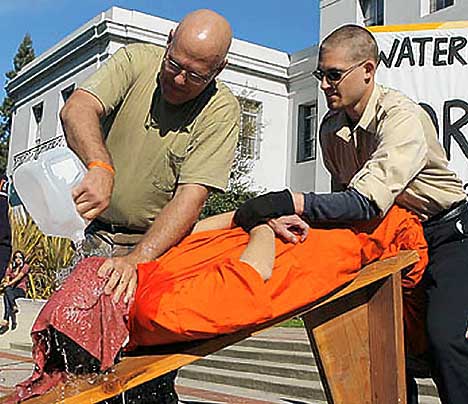
That the White House authorised ‘waterboarding’ is disturbing. But that no one in mainstream US politics seems to care is worse


The revelation, in yesterday’s Washington Post, that the Bush administration “issued a pair of secret memos to the CIA in 2003 and 2004 that explicitly endorsed the agency’s use of interrogation techniques such as waterboarding against al-Qaida suspects” will increase calls for the administration to be held to account for its actions.

It is unlikely, though, that this revelation will lead to significant activity, beyond adding more voices to grassroots impeachment campaigns in the United States – although it may lead to a strengthening of plans in various European countries to indict senior officials for war crimes. As law professor Scott Horton explained in June, the best that opponents of the regime can hope for is that the “Bush administration officials who pushed torture will need to be careful about their travel plans.”

The problem for all parties concerned is that the administration itself still refuses to concede that it has engaged in torture, and is being allowed to get away with it in the two places where opposition could really count: the Senate and the House of Representatives. Rather than pursuing senior officials, house Democrat leader Nancy Pelosi declared that impeachment was “off the table” after the Democrats gained a majority in the House of Representatives two years ago. A month earlier, politicians had endorsed the executive’s attempts to shield itself and its employees from any liability for their actions by passing the Military Commissions Act, parts of which were clearly intended to exempt US officials from being prosecuted for war crimes.

Freed from direct challenges, the administration has, instead, attempted to stifle all mention of torture in its dealings with prisoners seized in the “war on terror”.

A case in point is the British resident Binyam Mohamed. According to his lawyers at the legal action charity Reprieve, Mr Mohamed, who was seized in Pakistan in April 2002, was sent to Morocco by the CIA (before the agency brought torture “in-house”), where proxy torturers extracted a number of false confessions from him. As a result, he was accused of plotting to detonate a radioactive “dirty bomb” in a US city, and was put forward for trial by military commission at Guantánamo.

However, just last week, when a judge in Washington, DC finally had the opportunity to review his case, the US justice department chose to drop the charges relating to the “bomb plot” rather than pursue them, presumably because senior officials were aware that the entire trail of decision-making as to why Mr Mohamed was rendered to Morocco led to the highest levels of government, and to the kinds of discussions between the CIA and senior officials – including Vice President Dick Cheney and defence secretary Donald Rumsfeld – that were discussed in yesterday’s article in the Washington Post.

Even so, Mr Mohamed may still face the same charges in a trial by military commission, because the defence department, safe from judicial scrutiny, still believes that it can pursue prosecutions in a system that is so rigged that, when one of the prosecutors, Lt Col Darrel Vandeveld, resigned two weeks ago, he expressed his profound doubts that the system was “capable of delivering justice”.

The fact that some of these cases – like that of Mr Mohamed – involve the alleged use of extraordinary rendition and torture by or on behalf of the CIA only serves to confirm that even confirmed critics and opponents of the administration’s detention and interrogation policies in the “war on terror” are a long way from holding senior officials to account. Perhaps the greatest shame, however, is that out on the campaign trail, where these issues ought to count for something, they are not being mentioned at all.

Fidel Castro: The unheard of

October 16, 2008

Reflections of Fidel | Granma, Oct 16, 2008

ON Sunday, October 12, the Eurozone countries agreed an anti-crisis plan at the initiative of French President Sarkozy.

On Monday 13th came the announcement of multimillion funds that the European countries are to inject into the financial market to avoid a collapse. Shares rose with the surprising news.

In virtue of the aforementioned agreement, Germany had committed – in the rescue survey – 480 billion euros; France, 360 billion; Holland, 200 billion; Austria and Spain, 100 billion each; and so on until the total reached, with the British contribution of 1.7 trillion euros which, that day – given that the exchange rate between one and another currency is constantly varying – was equivalent to U.S.$2.2 billion, on top of the $700 billion of the United States.

The shares of the major corporations that had not gone bankrupt saw a sudden rise in their value which, while far from compensating the losses suffered in nine tragic days, allowed the politicians and bankers of the developed capitalist system to enjoy a breathing space.

In the evening of that same day, Silvio Berlusconi, the prime minister of Italy, at a banquet given in his honor at the White House, made a speech rendering tribute to Bush; “We trust in the president who had the courage to put into practice what he considered right, what he must do for himself, his people and the world.”

He really went over the top there!

Also on the 13th, the Nobel Prize in Economic Sciences for 2008 was awarded to U.S. citizen Paul Krugman. An undoubted defender of the capitalist system, he is also a very strong critic of President Bush.

Under the headline Gordon’s done a good job, published on the 14th in El País, various ideas are expressed, some of which merit being quoted textually:

“The natural thing to do is to face the problem of the lack of financial capital by having the state supply the financial institutions with more capital in exchange for part ownership…

“This kind of temporary partial nationalization was also the preferred solution, in private, of Ben Bernanke, president of the Federal Reserve.

“On announcing his financial aid plan of 500 billion euros, Henry Paulson, U.S. Treasury secretary, rejected this obvious way, alleging, “that is what is done in the case of bankruptcy.”

“The UK government has gone straight to the root of the problem and has acted with astonishing speed to solve it.”

“Paulson – having supposedly misspent a number of very valuable weeks – has also backpedaled and is now attempting to buy up bank shares instead of toxic mortgage assets.

“As I have said, we still don’t know if these measures will work… That clearsightedness has had to come from London and not from Washington.

“It is hard to ignore the feeling that Paulson’s initial response was distorted by ideology. Remember, he works for a government whose philosophy can be summed up by ‘private is good; public, bad.’”

“Throughout the executive, professional experts have been dismissed; quite possibly there is nobody left in the Treasury with the stature and experience necessary to tell Paulson that what he was doing made no sense.

“Luckily for the world economy, what Gordon Brown and his ministers are doing does make sense. And perhaps they have showed us the way to get over this crisis.”

As he confesses, not even the winner of the 2008 Nobel Prize for Economic Sciences is convinced that those measures will work.

These things are unheard of.

On Tuesday 14th, shares on the Stock Exchange fell a few points. The smiles have become more stereotypic.

The European capitalist countries, their productive and mercantile capacity saturated, desperately in need of markets to avoid strikes by workers and those specialized in services, depositors who are losing their money and ruined campesinos, are in no position to impose conditions and solutions on the rest of the world. That is being proclaimed by leaders of important emerging countries and of those poor and economically plundered nations who are the victims of unequal terms of trade.

Today, Wednesday, the value of stock market shares crashed again.

McCain and Obama are to laboriously debate the economic issue tonight.

In the great democracy of the United States, half of those with the right to vote are not registered; of those registered, half do not vote and only 25% elect those who govern them. Many of those who might now wish to vote for the Black candidate, cannot do so.

According to the polls, that candidate has an overwhelming majority. However, nobody dares to say what the result will be.

November 4 is a day of great interest to world public opinion, given the economic crisis in which U.S. society is enmeshed.

In the electoral context, there is just one thing that we can be sure of: in the next UK elections, Gordon Brown will not be elected prime minister.

Fidel Castro Ruz
October 15, 2008
7:05 p.m.

Reflections oF Fidel

Translated by Granma International

Saudi Arabia: Free Political Prisoners

October 16, 2008

Many Criminals Granted Amnesty, but Activists Remain in Prison

Source: Human Rights Watch

New York, October 3, 2008) – The Saudi government should free unlawfully detained political activists, including Professor Matrook al-Faleh, one of Saudi Arabia’s leading advocates of reform, Human Rights Watch said today. Although Saudi prison officials said that they had amnestied 1,000 convicted criminals during Ramadan in September, dozens of political activists remain behind bars or are subject to arbitrary travel bans.

" Peaceful dissidents continue to be locked up for speaking out, while convicted criminals get amnesty. Apparently the government considers reform advocates a greater danger to their authority. "
Sarah Leah Whitson, Middle East director at Human Rights Watch
Contribute

Also Available in

arabic

“Peaceful dissidents continue to be locked up for speaking out, while convicted criminals get amnesty,” said Sarah Leah Whitson, Middle East director at Human Rights Watch. “Apparently the government considers reform advocates a greater danger to their authority.”

Saudi secret police arrested al-Faleh, a professor of political science at King Saud University in Riyadh, on May 19, 2008 at the university. The arrest came two days after he publicly criticized conditions in Buraida prison following a visit to two fellow human rights activists being held there.

For six days, the secret police denied holding him, and even after they acknowledged that he was in detention, officials allowed his family just one visit during the first 60 days.

Saudi officials have not charged al-Faleh with a crime, though the criminal procedure code adopted in 2002 requires the authorities to charge detained suspects and take their statement within 48 hours. Officials have not interrogated him during his five months in prison, and al-Faleh has not been allowed to see the evidence, if any exists, on which the Investigation and Public Prosecutions Bureau is holding him. He is being held in solitary confinement next to suspected militants at the secret police’s al-Ha’ir prison.

Al-Faleh, denied the right to see his lawyers, started a hunger strike. During that time, prison guards taunted him with food and also shined a bright light in his cell around the clock. He has since broken off his hunger strike. His lawyers, Ibrahim Mubaraki and Khalid al-Mutairi, still have not been allowed to visit him.

Officials said they released at least 1,000 prisoners during the holy month of Ramadan, Saudi newspapers Al-Riyadh, Okaz, and Al-Sharq al-Awsat reported between September 14 and 29. In November 2007, 1,500 suspected militants held in separate prisons run by the secret police were released after undergoing a reeducation program in prison. These detainees had never faced charge or trial.

In February 2007, Saudi secret police arrested nine dissidents in Jeddah, who remain in prison without charge or trial. In December 2007, the secret police detained for almost five months without charge or trial Fu’ad Farhan, a blogger who had written in support of the release of the Jeddah group. Mansur al-‘Awdha, a reform activist from Jawf, has been in al-Ha’ir prison without charge since December 2007.

The Universal Declaration of Human Rights spells out the rights to free expression and freedom from arbitrary arrest. Closely mirroring the International Convention on Civil and Political Rights (ICCPR), articles 14 and 32 of the Arab Charter of Human Rights, which the Saudi Shura Council (an appointed parliament) ratified in March 2008, guarantee freedom from arbitrary arrest and freedom of expression. Saudi Arabia has not signed the ICCPR.

The kingdom has no penal code, and there are only a few statutory offenses, such as drug smuggling and embezzlement. Saudi Arabia implemented a Criminal Procedure Code safeguarding due process rights in 2002; articles 34 and 116 oblige the authorities to charge detained suspects within 48 hours.

The reality of war in Afghanistan

October 16, 2008
By Stephen Kinzer |  The Boston Globe, October 15, 2008

Despite their differences over how to pursue the US war in Iraq, Senators John McCain and Barack Obama both want to send more American troops to Afghanistan. Both are wrong. History cries out to them, but they are not listening.

Both candidates would do well to gaze for a moment on a painting by the British artist Elizabeth Butler called “Remnants of an Army.” It depicts the lone survivor of a 15,000-strong British column that sought to march through 150 kilometers of hostile Afghan territory in 1842. His gaunt, defeated figure is a timeless reminder of what happens to foreign armies that try to subdue Afghanistan.

The McCain-Obama approach to Afghanistan, like much of US policy toward the Middle East and Central Asia, is based on emotion rather than realism. Emotion leads many Americans to want to punish perpetrators of the Sept. 11, 2001 attacks. They see war against the Taliban as a way to do it. Suggesting that victory over the Taliban is impossible, and that the United States can only hope for peace in Afghanistan through compromise with Taliban leaders, has been taken as near-treason.

This knee-jerk response ignores the pattern of fluid loyalties that has been part of Afghan tribal life for centuries. Alliances shift as interests change. Warlords who support the Taliban are not necessarily enemies of the United States. If they are today, they need not be tomorrow.

In recent weeks, this elemental truth has begun to reshape debate over Western policy toward Afghanistan. Warlords on both sides met quietly in Saudi Arabia. The Afghan defense minister called for a “political settlement with the Taliban.” Secretary of Defense Robert Gates would not go that far, but said he might ultimately be open to “reconciliation as part of the political outcome.”

Gates, however, struck a delusionary note of “can-do” cheeriness by repeating the McCain-Obama mantra: More US troops can pacify Afghanistan. Speaking days after a National Intelligence Estimate concluded that the United States was caught in a “downward spiral” there, Gates asserted that there is “no reason to be defeatist or underestimate the opportunity to be successful in the long run.”

In fact, long-run success in Afghanistan – defined as an acceptable level of violence and assurance that Afghan territory will not be used for attacks against other countries – will only be possible with fewer foreign troops on the ground, not more.

A relentless series of US attacks in Afghanistan has produced “collateral damage” in the form of hundreds of civilian deaths, which alienate the very Afghans the West needs. As long as the campaign continues, recruits will pour into Taliban ranks. It is no accident that the Taliban has mushroomed since the current bombing campaign began. It allows the Taliban to claim the mantle of resistance to a foreign occupier. In Afghanistan, there is none more sacred.

The US war in Afghanistan also serves as a recruiting tool for Al Qaeda. It is attracting a new stream of foreign fighters into the region. A few years ago, these jihadists went to Iraq to fight the Great Satan. Now they see the United States escalating its war in Afghanistan and neighboring regions of Pakistan, and are flocking there instead.

Even if the United States de-escalates its war in Afghanistan, the country will not be stable as long as the poppy trade provides huge sums of money for violent militants. Eradicating poppies is like eradicating the Taliban: a great idea but not achievable. Instead of waging endless spray-and-burn campaigns that alienate ordinary Afghans, the United States should allow planting to proceed unmolested, and then buy the entire crop. Some could be turned into morphine for medical use, and the rest destroyed. The Afghan poppy crop is worth an estimated $4 billion per year. That sum would be better spent putting cash into the pockets of Afghan peasants than firing missiles into their villages.

Deploying more US troops in Afghanistan will intensify this highly dangerous conflict, not calm it. Compromise with Al Qaeda would be both unimaginable and morally repugnant, but the Taliban is a different force. Skillful negotiation among clan leaders, based on a genuine willingness to compromise, holds the best hope for Afghanistan. It is an approach based on reality, not emotion.

Stephen Kinzer is author of “A Thousand Hills: Rwanda’s Rebirth and the Man Who Dreamed It.”

The Question To Be Asked: “Where Will the Money Come From?”

October 16, 2008

In India, it didn’t hurt when the farmers were dying. Over 200,000 farmers have committed suicide in the past 15 years, and more than 40 percent of India’s 600 million farmers want to quit agriculture to look for menial jobs in the cities.

The national media kept quiet.

Now that the markets are crashing, the media is up in arms. “Act fast, go big. It is not only about bulls and bears anymore. It’s about India. And it’s hurting,” says a lead story in a national daily. But it didn’t hurt when the farmers were dying.

There is blood on Dalal Street (India’s Wall Street). Yet throughout all these years we refused to acknowledge that farmers were dying, and agriculture was bleeding. Farmers are children of a lesser God, it seemed, who do not belong to India. They only live in Bharat, the countryside.

Just a few months back, when the day Finance Minister P Chidambaram in his budget speech announced a Rs 60,000-crore* loan waiver for the beleaguered farming community, there was an orchestrated outcry: “Where will this money come from?” Television anchors were visibly angry at this supposed ‘windfall’ for the farmers, the print media was outraged at this ‘political and not economic’ decision just before the ensuing elections, and the industry leaders were seen sulking.

Six months later, no one is asking the same question. With the global financial crisis failing to work itself out, the Reserve Bank of India (RBI) is under pressure to intervene. Soon after the Wall Street mayhem, the RBI had pumped in Rs 84,000-crore in the domestic banking system through liquidity facility adjustment. An additional Rs 20,000-crore has been released through a 0.5 percent reduction in a cash reserve ration (CRR), to be further slashed by 100 basis points. It took RBI five years to make the first cut in CRR on Monday, and the next cut comes five days later. That sure is some urgency.

Sounds technical, but let me simplify. Liquidity in layman terms means ‘fund availability’ or, in simple words, making available more cash. All over the industrialized world, governments are stepping in to provide more cash in the hands of the private banks, and India is no exception.

Despite the Finance Minister saying that the fundamentals are strong, the banks are on a massive borrowing spree. In the first week of October alone, they borrowed Rs 90,075-crore every day from RBI through liquid facility adjustment. In the days to come, the RBI is under pressure to release another Rs 30,000-crore through the CRR, and also to cut the repo rate — the rate at which it lends to banks. And thanks to the loan waiver, the banks will receive another Rs 50,000-crore in the coming weeks as part reimbursement for the farm loan waiver and fertilizer loan.

Isn’t it a fact that Rs 60,000-crore loan waiver (later enhanced to Rs 71,000-crore) was actually a relief to the banks? What seemed to be a ‘political’ decision in the name of pulling out the indebted farmers was actually meant to maintain and sustain the health of the banking system. If the government had not provided the loan waiver, banks would have been in a terrible liquidity crisis. With farmers unable to repay, these banks would have been saddled with massive non-performing assets (or a shortfall in liquidity) or non-availability of Rs 71,000-crore in cash.

In other words, the loan waiver was a partial bailout for the banks. Now no one is asking: “Where will this money come from?” On the contrary, most analysts are asking for more ‘speed and sagacity’ to tide over the crisis. The industry has already demanded a bailout package of Rs 100,000-crore.

If only such ‘speed and sagacity’ was shown to tide over the terrible agrarian crisis sweeping throughout the country for over a decade now, thousands of farmers would have been saved from committing suicide. If only the RBI had stepped in to make more cash (or liquidity) available, the nation could have easily provided an assured employment to each and every Indian, not only for 100 days but for all the 365 days in a year. The National Rural Employment Guarantee Programme (NREGA) can be easily extended to bring every unemployed Indian under its gambit.

It is here that I fail to understand the sagacious logic of keeping the poor hungry, and then expecting a higher economic growth trajectory; of paying a multi-million dollar salary (in addition to lucrative perks) to the bosses of the banks and corporate houses, and then to make the man on the street pay for the losses; in other words, the logic behind privatizing the profits and socializing the losses.

Take the case of the bankrupt Lehman Brothers. While the shareholders in the company have been wiped out, Richard Fuld, its chief executive, walked away with US $480 million as his personal remuneration over eight years, which includes a $14 million ocean-front villa in Florida, and a home in an exclusive ski resort. Lawmakers investigating the bailed out insurance company AIG were shocked to learn that days after the government rescued the company, it unashamedly spent US $44,000 on a posh California retreat for its executives, complete with spa, banquets and golf outings.

Why blame the American corporate leaders when US president George Bush himself had given them a free rope: “Government should not decide the compensation for America’s corporate executives.” What he probably meant was that come what may, the US government will continue to provide funds to meet obscene corporate salaries and perks.

Prime Minister Manmohan Singh had also removed the upper ceiling on corporate salaries. According to Merrill-Lynch and Capgemini, driven by impressive economic gains and robust market capitalism growth in 2007, India led the world in high net worth individual (HNWI) population growth at 22.7 per cent. Two year earlier in 2005, there were 83,000 high net worth individuals with a wealth of at least $1 million (without including immovable property). And you guessed right – the number of millionaires has gone up quite considerably in the meantime.

This brings me back to the same question. How long will the world go on encouraging an economic system that makes the rich richer and the poor poorer? While 36 billionaires in India have a collective economic wealth equivalent to one third of the country’s GDP, the country’s 600 million farmers collectively account for only a 17 percent share. With every passing year, the share of agriculture in GDP continues to slide down even further.

The average monthly income of a farm household (which includes five members of a family and two cattle) does not exceed Rs 2,400 (US $60). The value erosion in real farm income over the past few decades has never been discussed, but the erosion in paper wealth of shareholders is being projected as a national disaster.

Bailing out the farmers from a distressing situation is always considered to be bad economics. It is branded as a political compulsion, and the sooner politicians emerge out of it the better it is supposed to be for economic growth and development. This economic prescription, which every economist worth his title is willing to endorse, is invariably given for the farming community, the landless workers and the marginalized communities. They need to learn to be enterprising, is the assumption, and therefore must stop living on government subsidies.

But when it comes to the enterprising millionaires — corporates and leading bankers — government bailouts are not only a must, but should be done speedily. ‘Where will the money come from?’ is not a question to be asked when you are subsidizing the rich and the elite. That, we must understand, is their birthright.

* one crore = 10 million

Devinder Sharma is a New Delhi-based food and trade policy analyst. He is a regular contributor to Share the World’s Resources (STWR), where this article originally appeared, and can be reached at hunger55@gmail.com. Read other articles by Devinder, or visit Devinder’s website.

Poison stalks trial of murdered Putin critic

October 16, 2008

By Miriam Elder in Moscow | The Independent, Thursday, 16 October 2008

Protesters mark the anniversary of Anna Politkovskaya's murder

AFP/GETTY IMAGES

Protesters mark the anniversary of Anna Politkovskaya’s murder

Change font size: A | A | A

A lawyer representing the family of investigative journalist Anna Politkovskaya has apparently been targeted by poisoners as the trial of three men accused of involvement in her murder was about to begin.

French police confirmed the discovery of mercury pellets in the car of Karinna Moskalenko, who suffered headaches, dizziness and nausea after getting into the vehicle.

Ms Moskalenko was taken to hospital for tests in Strasbourg on Tuesday, which prevented her from flying to Moscow for the Politkovskaya trial. The preliminary hearing opened almost exactly two years after the crusading reporter died in a hail of bullets in the entrance to her apartment block.

The three men, including a former police officer, are on trial in connection with the murder of Ms Politkovskaya, who made her name challenging Vladimir Putin’s regime. Friends and colleagues believe her killers may never be found.

Lawyers for the defendants and Ms Politkovskaya’s family have called for an open trial to provide transparency in a case charged with politics and cloaked in conspiracy. “It was made clear to us all that the hearing will likely take place behind closed doors, as the case contains secret materials,” said defence lawyer Murat Musayev.

Ms Moskalenko is a leading defender of the Kremlin’s critics, including the jailed former oil tycoon and ex-chief executive of Yukos, Mikhail Khodorkovsky and the chess-champion-turned opposition politician Garry Kasparov. She said that she believed the poisoning was a warning. “When we got to the car, we realised something was not normal. My husband is a chemist and the substance looked like mercury. I’m worried for my family,” she said.

Another lawyer for Mr Khodorkovsky, Robert Amsterdam, said the timing was suspicious. “This type of event gives us all pause to consider what it takes now in Russia to defend human rights. There are ongoing attacks on lawyers and journalists.”

Kremlin critics have often been the targets of poisoners. Ms Politkovskaya herself fell ill after drinking a cup of tea while on her way to cover the aftermath of the Beslan school siege in which more than 300 people died, while the former KGB agent Alexander Litvinenko died in London from radiation poisoning. Scotland Yard wants to extradite his fellow ex-KGB operative, Andrei Lugovoi, to be tried for his murder. Another case of alleged mercury poisoning was reported two years ago, involving the wife of an ex-director of Yukos, Alexei Golubovich. Mr Amsterdam said: “What matters is not if it’s related to Yukos or Politkovskaya but that it’s another human rights defender that’s in this situation.”

Sergei Sokolov, the deputy editor of Ms Politkovskaya’s newspaper, Novaya Gazeta, said that Ms Moskalenko “takes part in a lot of prominent cases. It’s not necessarily directly linked to this case.” Ms Moskalenko helps Russians press claims against the government at the European Court of Human Rights in Strasbourg.

The trial judge reportedly refused to postpone yesterday’s preliminary hearing, which involved two ethnic Chechen brothers, Dzhabrail and Ibragim Makhmudov, and Sergei Khadzhikurbanov, a former police officer. All stand accused of aiding the killer, who remains on the run. Investigators suspect him to be Rustam Makhmudov, although investigators d do not know who ordered the murder.

Ms Politkovskaya won countless enemies through her articles and books chronicling human rights abuses and the fall of democracy in modern Russia, particularly through her scrutiny of Moscow’s brutal wars in Chechnya.

She was killed on 7 October 2006 – the then President Vladimir Putin’s birthday. He denied any Kremlin link to the killing but failed for days to comment on the death, before dismissing it as “insignificant”. Last week, hundreds commemorated the second anniversary of Ms Politkovskaya’s death. “It’s sad we don’t know, two years after the murder, who did it, who ordered it,” Vladimir Milov, a former deputy energy minister turned Putin critic, said at the rally.

The military court is due to meet again on 17 November to decide if the trial will be open to the public and the media, and to assemble a jury.

The settlers’ war with Israel

October 16, 2008

In any peace deal with the Palestinians, Israel will also have to tackle the problem of militant Jewish settlers

Paul Raymond | guardian.co.uk, Thursday October 16 2008 08.00 BST

While it is not unusual for events on the Temple Mount to trigger renewed Israeli-Palestinian conflict – the second Palestinian intifada (uprising) was triggered in 2001 by then Israeli defence minister Ariel Sharon’s controversial visit to the site – the latest events also have much to say about the current political situation in Israel itself. A growing current of hardline neo-Zionist militancy is terrorising Palestinians, leftwing Israelis and state authorities alike. As the Israeli government desperately tries to come to an agreement with the Palestinian Authority and undermine Hamas, the problem of evacuating settlements inhabited by violent ultra-nationalists will be near the top of a list of thorny challenges for the next Israeli administration.

There is plenty of evidence that the right wing radical fringe is growing. In mid-September, over 200 vigilantes from the illegal West Bank settlement of Yitzhar invaded the nearby Palestinian village of Asira al-Qibliyyah with guns and slingshots, in response to the stabbing of a Jewish boy from the settlement.

But settler violence is not limited to attacks against Palestinians. Two weeks after the assault on Asira, leftwing Israeli professor Ze’ev Sternhell, a staunch critic of the settlement movement, was injured by a pipe bomb on his doorstep. It was widely assumed that rightwing activists placed it there, although the settlers’ supporters were quick to accuse Israeli intelligence forces of launching a sinister leftwing conspiracy to discredit them. Later, prominent settler leader Daniela Weiss was arrested for attacking Israeli police officers during the evacuation of the illegal settlement of Shvut Ami, giving a further indication of the gulf between Israeli state authorities and the radical right.

It is clear that the rift has implications for the current round of talks with the Palestinians. Ehud Olmert, the outgoing Israeli prime minister, has argued that Israelis should abandon the Zionist utopia of the Greater Land of Israel, resorting instead to a territorial compromise in order to achieve peace with the Palestinians. After the events of September 13, Yitzhar’s rabbi, David Dudkevich, who claims that the Arabs should emigrate from the “Land of Israel”, launched a public tirade against the idea. Among other things, he endorsed the proposal of a separate state, Judea, which would be established alongside Israel should the latter decide to abandon the Zionist dream.

“It’s obvious that a great many people who are secure in their Judaism feel emotionally distant from the state, which is in another place altogether,” he told Haaretz newspaper. “The state of Israel is not the be-all and end-all. If it decides it does not want to be in the hereditary lands of our forefathers, then other Jews have the right to organise themselves in order to live there, even without a link to the state. When there’s talk about another expulsion, then on the ideological level, the ‘State of Judea’ is no worse than expulsion.”

The irony is that settler radicalism was nurtured by the Israeli state in the first place. Over the years, Likud governments in particular encouraged non-ideological Israelis to settle in the West Bank in the hope that they would adopt views that fitted the rightwing agenda of that party. It was also an effective strategy for gaining control of the Occupied Territories and guaranteeing that the maximum possible territory would be ceded to Israel should the US force her into a deal with the Palestinians.

However, the 2005 Israeli withdrawal from Gaza placed the state authorities charged with implementing government policy – namely the police – at loggerheads with those settlers. The image of Israeli police forcibly evicting Jews from their homes created a wound in Israeli society that has been festering ever since. Several thousand young people who lived their entire childhoods in Gaza settlements now feel abandoned by the state and are willing to take out their frustration, often violently, against both Palestinians and the Israeli authorities.

Thus the Israeli government now faces huge dilemmas in the context of the current round of Israeli-Palestinian talks and also in how it deals with its own citizens. If the implication of Olmert’s comments is that more settlement evacuations are on the cards, and forcing that past a group of armed, radical settlers who have sworn their enmity to the state will be every bit as hard as negotiating an agreement with the Palestinians.

No religious festival in Jerusalem would be complete without a controversial political incident, and this year’s Yom Kippur was no exception. A group of nearly a hundred rightwing radicals forced their way on to the plaza of the Dome of the Rock, one of the most sacred sites in Islam. Entering the precinct on Yom Kippur was a symbolic way of claiming Jewish sovereignty over the site many consider to be the location of the second temple, destroyed by the Romans in AD 70.

Waterboarding Got White House Nod

October 15, 2008

CIA Tactics Endorsed In Secret Memos

Joby Warrick
Washington Post Staff Writer
Wednesday, October 15, 2008; Page A01

The Bush administration issued a pair of secret memos to the CIA in 2003 and 2004 that explicitly endorsed the agency’s use of interrogation techniques such as waterboarding against al-Qaeda suspects — documents prompted by worries among intelligence officials about a possible backlash if details of the program became public.

The classified memos, which have not been previously disclosed, were requested by then-CIA Director George J. Tenet more than a year after the start of the secret interrogations, according to four administration and intelligence officials familiar with the documents. Although Justice Department lawyers, beginning in 2002, had signed off on the agency’s interrogation methods, senior CIA officials were troubled that White House policymakers had never endorsed the program in writing.

The memos were the first — and, for years, the only — tangible expressions of the administration’s consent for the CIA’s use of harsh measures to extract information from captured al-Qaeda leaders, the sources said. As early as the spring of 2002, several White House officials, including then-national security adviser Condoleezza Rice and Vice President Cheney, were given individual briefings by Tenet and his deputies, the officials said. Rice, in a statement to congressional investigators last month, confirmed the briefings and acknowledged that the CIA director had pressed the White House for “policy approval.”

The repeated requests for a paper trail reflected growing worries within the CIA that the administration might later distance itself from key decisions about the handling of captured al-Qaeda leaders, former intelligence officials said. The concerns grew more pronounced after the revelations of mistreatment of detainees at the Abu Ghraib prison in Iraq, and further still as tensions grew between the administration and its intelligence advisers over the conduct of the Iraq war.

Continued . . .