Posts Tagged ‘Peru’

Peru Indian tribes join forces to fight off Amazon sale to oil companies

October 9, 2009

Times Online/UK, Oct 9, 2009

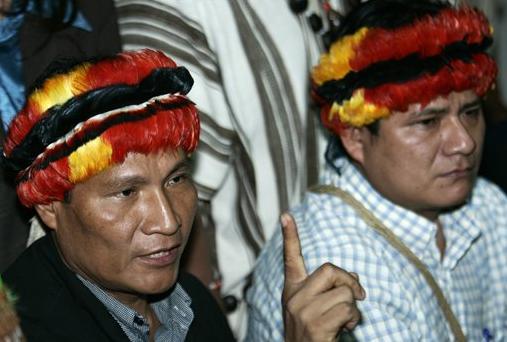
Achuar elders in Washintsa, Peru. The Government plans to auction off 75 per cent of the Amazon to companies

Ramita Navai in Washintsa, Peru

They emerged from the thick, green jungle clenching their spears: a long file of barefoot chiefs and elders, their faces painted with their tribal markings and crowns of red, blue and yellow parrot feathers.

They had been summoned by the chief of Washintsa village for a meeting to discuss an oil company’s efforts to buy the rights to their land. Most had travelled for hours, padding silently through the dark undergrowth.

They came from Achuar Indian communities scattered along the Pastaza River, one of the most remote parts of the Peruvian Amazon near the border with Ecuador.

These men are part of a growing resistance movement crystallising deep in the jungles of Peru. For the first time isolated indigenous groups are uniting to fight the Government’s plans to auction off 75 per cent of the Amazon — which accounts for nearly two thirds of the country’s territory — to oil, gas and mining companies.

Continues >>

Images reveal full horror of ‘Amazon’s Tiananmen’

June 21, 2009

Peru accused of cover-up after indigenous protest ends in death at Devil’s Bend

By Guy Adams in Los Angeles | The Independent/UK, June 19, 2009

The bloodied face of a protester as behind him fellow protestors are arrested by police

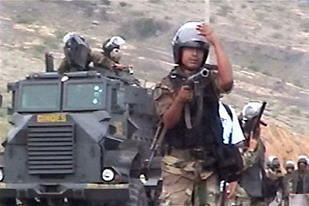
First, the police fire tear gas, then rubber bullets. As protesters flee, they move on to live rounds. One man, wearing only a pair of shorts, stops to raise his hands in surrender. He is knocked to the ground and given an extended beating by eight policemen in black body-armour and helmets.

Demonstrators getting worked-over by the rifle butts and truncheons of Peru’s security forces turn out to be the lucky ones, though. Dozens more were shot as they fled. You can see their bullet-ridden bodies, charred by a fire that swept through the scene of the incident, which has since been dubbed “the Amazon’s Tiananmen”.

Continued >>

Indigenous peoples’ global fight with big business

June 16, 2009

As mining and oil firms race for dwindling resources, indigenous peoples battle to protect their land, and often pay the ultimate price

Taipi Times,

By John Vidal | THE GUARDIAN, LONDON
Monday, Jun 15, 2009, Page 9

It has been called the world’s second “oil war,” but the only similarity between Iraq and events in the jungles of northern Peru over the last few weeks has been the mismatch of force. On one side have been the police armed with automatic weapons, tear gas, helicopter gunships and armored cars. On the other are several thousand Awajun and Wambis natives, many of them in war paint and armed with bows and arrows and spears.

In some of the worst violence seen in Peru in 20 years, the natives this week warned Latin America what could happen if companies are given free access to the Amazonian forests to exploit an estimated 6 billion barrels of oil and take as much timber they like. After months of peaceful protests, the police were ordered to use force to remove a road bock near Bagua Grande.

In the fights that followed, nine police officers and at least 50 Indians were killed, with hundreds more wounded or arrested. The indigenous rights group Survival International described it as “Peru’s Tiananmen Square.”

Continued >>

The jungle massacre: Peru’s tribal chief flees country

June 11, 2009

Amazon leader seeks refuge at Nicaraguan embassy after followers killed in clashes over oil and logging laws

The Independent/UK, June 11, 2009

Protesters block access to Yurimagua city in the Amazon
REUTERS

Protesters block access to Yurimagua city in the Amazon

The leader of Peru’s Amazon Indians will be flown to exile in Nicaragua after seeking asylum following violent demonstrations that killed scores of police and protesters.

Alberto Pizango, the head of Aidesep, which represents 56 tribes, spent yesterday at the Nicaraguan embassy in Lima. Dozens of his followers died during protests against new laws that will leave swathes of their ancestral homelands open to oil and gas exploration. He has been charged by his own government with “sedition, conspiracy and rebellion”.

The London-based pressure group, Survival International, called on oil firms to withdraw from Peru, describing the incident as “The Amazon’s Tiananmen” and accusing security forces, who have since imposed a curfew over the region, of burying and burning corpses to hide the scale of the killing.

Continued >>

Police Violently Attack Peaceful Indigenous Blockade in the Peruvian Amazon

June 7, 2009

From Axis of Logic

By Press Release
Amazon Watch, Saturday, June 6, 2009

The clash is the latest in a series over land rights in Peru. AFP

Bagua, Peru (June 5, 2009) – At approximately 5 am this morning, the Peruvian special forces police staged a violent raid on a group of indigenous people at a peaceful blockade on a road outside of Bagua, in a remote area of northern Peruvian Amazon. Several thousand Awajun and Wambis indigenous peoples were forcibly dispersed by tear gas and real bullets, among them are confirmed reports of at least 50 injured and 22 indigenous people and 9 police officers dead.

At 2am police began to approach the demonstrators as they were sleeping along the Fernando Belaúnde Terry road. Demonstrators refused to move from the roadblock as helicopters dropped teargas bombs from overhead. Eyewitnesses report that police attacked from both sides firing real bullets into the crowd as people fled into the steep hillsides. Many had no where to go. As the unarmed demonstrators were killed and injured some wrestled the Police and took away their guns and fought back in self-defense. The violence was clearly provoked by the Police as protesters had been peacefully blockading the road for over 56 days.

In local radio reports, the chief of Police claimed that the indigenous demonstrators were armed with guns necessitating the use of bullets for dispersal. This claim is refuted by dozens of local eyewitnesses including local journalists. A local conservationist reported from the scene that the Amazonian demonstrators have been entirely peaceful and only bear   traditional spears and in no way provoked any violence. However several conservative media sources are propagating the government’s misinformation campaign that aims to blame the victims for the violence.

The Garcia Government yesterday accused the indigenous movement of being violent, conflating non-violent civil disobedience with violent rebellion to justify its actions. The President issued an order for the police to begin forcibly removing indigenous demonstrations that have paralyzed the Amazon region of Peru for nearly two months.

Gregor MacLennan of Amazon Watch who is currently in Peru stated: “It is outrageous and absolutely untrue that indigenous   peoples provoked violence. Rather, they are engaged in peaceful and non-violent civil disobedience. It has been the Peruvian Government forces who have provoked violence against peaceful people who are trying to protect their forests, their sacred   lands from shortsighted pollution and industrial development. They are sacrificing a lot to safeguard the Amazon for future  generations and for all Peruvians.”

Indigenous peoples have vowed to continue protests until the Peruvian Congress revokes the “free trade” decrees issued by  President Garcia under special powers granted by Congress in the context of the Free Trade Agreement with the United States.

In the past two weeks, the constitutional committee of Congress has ruled that legislative decree 994 and 1090 were unconstitutional. The Peruvian Congress was scheduled to debate the revocation of decree 1090 again yesterday, however, Garcia’s political party for the third time prevented the debate preferring instead to attack the peaceful blockades. The   government Ombudsman office has filed a legal action with the constitutional tribunal on the unconstitutionality of decree 1064, which affects the land rights laws in Peru.

The protests have provoked national debate about government policies in the Amazon that ignore indigenous peoples and encourage large-scale extractive industries and the privatization of Amazonian lands. Indigenous peoples claim that new laws undermine their rights and open up their ancestral lands to private companies for mining, logging, plantations and oil drilling.

Alberto Pizango, left, president of the Peruvian Jungle Inter-Ethnic Development Association, speaks during a news conference in Lima, June 5, 2009. Karel Navarro


AIDESEP, the national indigenous organization of Peru presented a legal petition for “precautionary measures” to the Inter-American Commission on Human Rights requesting intervention to prevent more bloodshed. Orders for the arrest of leaders of AIDESEP, including Alberto Pizango was put in effect today.

Indigenous Peoples are planning a nationwide general strike starting June 11th.

A coalition of human rights and environmental organizations are urging the Garcia Government to stand down and cease violent   confrontations by the military and calling for solidarity demonstrations at Peruvian Embassies around the world. Today, there were demonstrations at the Peruvian Government Mission in San Francisco and Washington DC.

For Background information see www.amazonwatch.org or www.aidesep.org.pe

Amazon Watch

The Fujimori Verdict and the Justice Cascade: Ending Impunity

April 8, 2009

Scott Gilmore | The Huffington Post, April 8, 2009

“I governed from hell, not from the palace.”

With these fateful words, Alberto Fujimori closed his defense last Friday. After 491 days of trial – where a mountain of evidence tied Fujimori to a campaign of massacres, kidnapping and torture – the one-time Peruvian president claimed that he merely did his job: his policies were the product of Peru’s long and brutal counterinsurgency war. In the end, the argument failed him.

Today, a three-judge panel of the Peruvian Supreme Court handed down a 25-year sentence, marking the first time an elected head of state has been convicted of human rights violations in his own country.

The verdict was not a surprise. An air of culpability had surrounded Fujimori in the final sessions of the trial. Gone was the indignant “¡Soy inocente!” of the trial’s opening day – a phrase that became an instant viral ring-tone, percolating throughout Latin America. The denials were still intact, but the tone had changed. I was just defending my country from terrorists: History will judge me as one who saved his nation.

Somehow this all sounds very familiar. From Dick Cheney’s rhetorical stabs at President Obama’s stance on interrogation to Douglas Feith’s sniveling criticism of a criminal complaint filed in the Spanish National Court against him and other Bush-era officials, the ‘counterterrorism defense‘ is all the rage. But what government officials like Feith, Cheney, and Fujimori are asking for is a very dangerous thing. It’s impunity: the status of being above the law and immune from accountability.

History shows that impunity can be a far more insidious threat to a democracy than the dramatic shock of terrorism. The case of Peru is a prime example. Fujimori rose to power in 1990 on a promise of saving the country from economic crisis and political conflict. During his campaign, he was an almost comical, populist candidate who tooled around the streets of Lima on his bicycle, reveling to cries of “El Chino”. Once in power, he proved German political theorist Karl Schmitt’s dictum, “Sovereign is he who decides the exception.” [PDF, international relations flow chart]

Along with his spy chief – an alleged CIA asset with the Dracula-esque name Vladimir Montesinos – Fujimori created a parallel government with two objectives: to subvert the political opposition, via a blend of bribery and surveillance, and to destroy the Shining Path, by terrorizing its alleged base of supporters among the rural and urban poor. What followed for the next decade were two streams of crime whose waters converged.

Death squads carried out forced disappearances and massacres; intelligence agents wire-tapped telephones and set up covert cameras in the offices of activists, jurists, and elected officials. Human rights violations and corruption fed each other. Funds were required for black-ops and pay-offs. Laws needed to be overturned or eviscerated by interpretation. In 1992, Fujimori adopted a simpler measure: the self-coup. Ordering the army to close Congress and the Constitutional Court, Fujimori assumed dictatorial power. A semblance of democracy was eventually restored, but only once an amnesty law and a new, favorable Constitution had been drafted.

And so, the whole edifice of a Constitutional democracy was dragged down in the name of national defense. Once the contours of the parallel government were exposed, Peru dealt with the intellectual authors of this massive crime the way any legitimate democracy should: in its courts.

Today’s sentence against Fujimori is a victory against impunity, and a repudiation of the notion that government leaders are bound by no limits when it comes to national security. But even victories in the courts can be undone: Fujimori’s daughter Keiko – who earned an MBA at Colombia University – is a likely frontrunner in the 2011 elections. She has already promised to pardon her father if elected.

From a North American vantage point, we can only hope that the impact of the Fujimori trial will cascade throughout the Americas, from Central America – where the fledgling justice systems of countries like El Salvador, Guatemala and Honduras are beginning to reckon with a legacy of human rights abuse – to the United States, where all eyes are watching the White House, Congress and the Justice Department, waiting for the investigations to begin on the crimes of our own war on terrorism.