Posts Tagged ‘Palestinians’

Widespread anger in Egypt at Mubarak regime

January 25, 2009
Johannes Stern reports from Cairo | WSWS, 24 January 2009

Muhammad lights up a cigarette and quietly utters an oath directed at Egyptian president Hosni Mubarak. The 25-year-old expresses what many Egyptians think at present: “Mubarak is a swine who has worked together with Israel to turn Gaza into a prison and is responsible for the suffering of the Palestinians.”

The student from downtown Cairo continues to speak harshly about the government. Today, three days after Israeli troops began to withdraw from the Gaza Strip, he remains angry and criticizes the role played by Egypt in the Gaza conflict. “Probably Mubarak gave [Israeli Foreign Minister Tzipi] Livni permission to attack Hamas, which he regards as a thorn in his side.”

In fact, Livni met Mubarak two days prior to the Israeli attack and, according to a report in the Israeli daily Haa’retz, Egyptian government officials were informed in advance of the planned offensive.

Many other Cairo residents share Muhammad’s anger and revulsion. They are shocked by the crimes committed by Israel during its three-week offensive in the Gaza Strip and furious with the Egyptian government, which—in the midst of the Hamas-Fatah fighting in June 2007—blocked its own border with the enclave and effectively turned the densely-populated region into a prison camp.

The fact that Mubarak refused to open the Rafah border crossing during the latest continuous bombardment by Israel, thereby leaving Palestinians to their fate, has left many Egyptians feeling just as much hatred for their own government as for American and Israeli militarism.

When asked about the role of other Arab governments, Muhammad declares: “The most treacherous, of course, are the regimes that cooperate more or less openly with the US, i.e., Jordan and Saudi Arabia, alongside Egypt. The fact that Venezuela expelled the Israeli ambassador in protest, but not Egypt, is a disgrace.”

The largest demonstration in Egypt took place on 9 January in Alexandria, with over 50,000 protestors taking part. Police anti-riot units, who originally intended to suppress and disperse the demonstration, were forced by the sheer number of those participating to withdraw and allow the rally to proceed.

Women protesting with Palestinian flags in front of the Israeli embassy in CairoWomen protesting with Palestinian flags in front of the Israeli embassy in Cairo

Another large demonstration, with more than 15,000 participants, occurred one week later in Mahalla Al-Kubra. Last April that city experienced some of the most extensive riots in Egypt in 30 years against rising food prices and declining wages. This time demonstrators protested the war crimes in the Gaza Strip, but they also directed slogans against the complicity of Arab governments and particularly the Egyptian regime.

Since the start of the Israeli withdrawal the streets of Cairo have been dominated by large numbers of police and units of heavily armed anti-riot squad units, ready to suppress violently any form of spontaneous protest.

Last Saturday thousands of demonstrators responded to an appeal by the country’s largest, but officially banned opposition party, the Muslim Brotherhood, to participate in an anti-war demonstration in the city’s Ramses Square.

Anti-riot policeman in CairoAnti-riot policeman in Cairo

In the event, the demonstration was blocked by a large force of police. In order to prevent the demonstration the police and city administration went so far as to close down the nearest subway station to Ramses Square (ironically, the station is named after Mubarak) and subway trains bypassed it. Following clashes with demonstrators, the police made many arrests, including a journalist from the independent daily paper, al-Masry al-Youm.

The protests against the war in Gaza revealed the huge gulf between the Arab masses and the despotic and corrupt governments in the region. In Egypt these tensions are so pronounced that every major protest causes the Mubarak regime to fear for its existence. It responds in turn with ever increasing brutality to suppress popular opposition.

Resistance is growing particularly among workers and students, who have organized a series of protest actions beyond the control of the established parties or trade unions.

On 10 January the Egyptian Popular Committee for Solidarity with the Palestinian People organized a solidarity convoy involving hundreds of activists, which headed towards Gaza and demanded the opening of the Rafah border crossing. After passing three checkpoints the convoy was stopped shortly before el-Arish, in the middle of the desert, by heavily armed security forces and forced to turn around.

Another aid convoy was organized by strike leaders in Mahalla Al-Kubra. On 11 January approximately 1,000 textile workers employed at Masr Spinning and Weaving organized a sit-in-strike in front of the local office of the state-run trade union. The workers protested against the arbitrary punishment of co-workers who had taken part in a protest against the privatization of the factory on 30 October last year. The sit-in continues and is directed primarily against the union, which the workers accuse of cooperating with management.

Despite the radicalization of workers and students during the weeks of protests, it is clear that most large demonstrations were organized and dominated by the Muslim Brotherhood. The Islamic fundamentalists are only able to retain the leadership of such protests in a period of rapidly growing poverty because of the absence of a progressive political alternative. The Brotherhood, a bourgeois party with backing from some wealthy businessmen, offers no solution to the unbearable economic conditions in Egypt or to the suppression of the Palestinians.

For its part, the “left” Tagammu—a party consisting of diverse Nasserists, Stalinists and self-proclaimed “progressive” nationalists, founded by Anwar Sadat in 1976 as a union of leftist currents in the old Nasserist Unity Party ASU (Arab Socialist Union)—has shifted far to the right and is unable to offer any sort of alternative to the Muslim Brotherhood and provide the protests with a progressive perspective.

Such a perspective is necessary, however, to resolve the suffering of the Palestinians and the suppression of the Arab masses. The aim must be the building of a political movement that consciously seeks to unite the Palestinian, Jewish and Arab working class in the fight for a socialist federation in the Middle East. This would eliminate the artificial borders with which the imperialist powers divide and control the region. This is the only way to halt the Israeli war machine and provide a lasting solution for the social, economic and political needs of all those in the region.

Jewish Voices of Dissent on Gaza

January 25, 2009

by César Chelala | Middle East Time, January 25, 2009

As the dust is settling on the barren Gazan landscape, it is appropriate to listen to the voices of Jewish intellectuals who have forcefully spoken against the Israeli government actions in Gaza. Their opinion helps bring a much needed perspective on the situation.

Uri Avnery, one of the most outspoken leaders in the Israeli human rights community, a former Israeli soldier and member of the Knesset writes, “In this war, as in any modern war, propaganda plays a major role. The disparity between the forces, between the Israeli army – with its airplanes, gunships, drones, warships, artillery and tanks – and the few thousand lightly-armed Hamas fighters, is one to a thousand, perhaps one to a million. In the political arena the gap between them is even wider. But in the propaganda war, the gap is almost infinite.”

“Almost all the Western media initially repeated the official Israeli propaganda line. They almost entirely ignored the Palestinian side of the story, not to mention the daily demonstrations of the Israeli peace camp. The rationale of the Israeli government (“The state must defend its citizens against the Qassam rockets”) has been accepted as the whole truth. The view from the other side, that the Qassams are retaliation for the siege that starves the 1.5 million inhabitants of the Gaza Strip, was not mentioned at all.”

The Qassam rockets fired at Israeli towns were the excuse for the more than 1,400 people, many of them civilians, killed by the Israeli Defense Forces (IDF), and for the thousands of maimed.

In a speech in the House of Commons on Jan. 15 MP Gerald Kaufman said, “My parents came to Britain as refugees from Poland. Most of their families were subsequently murdered by the Nazis in the Holocaust. My grandmother was ill in bed when the Nazis came to her home in Staszow. A German soldier shot her dead in her bed.”

“My grandmother did not die to provide cover for Israeli soldiers murdering Palestinian grandmothers in Gaza. The current Israeli government ruthlessly and cynically exploits the continuing guilt among gentiles over the slaughter of Jews in the Holocaust as justification for the murder of Palestinians. The implication is that Jewish lives are precious, but the lives of Palestinians don’t count.”

The IDF claim that maximum care had been taken to minimize civilians lost of lives. Sara Roy, a senior research scholar at the Center for Middle Eastern Studies at Harvard University, wrote recently in the Christian Science Monitor, “One Palestinian friend asked me, ‘Why did Israel attack when the children were leaving school and the women were in the markets’?”

“And what will happen to Jews as a people whether we live in Israel or not? Why have we been unable to accept the fundamental humanity of Palestinians and include them within our moral boundaries? Rather, we reject any human connection with the people we are oppressing. Ultimately, our goal is to tribalize pain, narrowing the scope of human suffering to ourselves alone.”

With the cease-fire now in effect, it is fair to ask what has been the result of this tragic war. Has it made Israel safer, has it destroyed Hamas, has it eliminated the threat of Hamas firing Qassam rockets into Israeli towns and cities? Has it made the population of Gaza more moderate? Let’s listen to Gideon Levy.

Writing in the Israeli newspaper Haaretz Levy states: “On the morrow of the return of the last Israeli soldier from Gaza, we can determine with certainty that they had all gone out there in vain. This war has ended in utter failure for Israel…. We have gained nothing in this war save hundreds of graves, some of them very small, thousands of maimed people, much destruction and the besmirching of Israel’s image…. The conclusion is that Israel is a violent and dangerous country, devoid of all restraints and blatantly ignoring the resolutions of the United Nations Security Council, while not giving a hoot to international law.”

Or, as Sara Roy also states, “Israel’s victories are pyrrhic and reveal the limits of Israeli power and our own limitations as a people: our inability to live a life without barriers. Are these the boundaries of our rebirth after the Holocaust? As Jews in a post-Holocaust world empowered by a Jewish state, how do we as people emerge from atrocity and abjection, empowered but also humane? How do we move beyond fear to envision something different, even if uncertain? The answers will determine who we are and what, in the end, we become.”

César Chelala, MD, PhD, is a co-winner of an Overseas Press Club of America award. He is also the foreign correspondent for Middle East Times International (Australia).

Galloway: From London to Gaza

January 25, 2009

Despite official apathy to the suffering in Gaza, Londoners are gathering for a solidarity convoy to deliver aid to Palestine

The government is always looking for some Islamic organisation to proscribe or some Muslim cleric – preferably with a steel claw – to ban. All in the name of community cohesion and preventing violent extremism. But how many Muslims does the government think have been radicalised by the horrific scenes coming out of Gaza and the complacent hypocrisy of the British foreign office?

The appeal for a policy that breaks with slavish support for Israel’s actions operates on a number of different levels. I’ve long since stopped addressing the great lacuna which passes for an ethical sense at King Charles Street. An argument based on naked self-interest stands a better chance. And from that point of view the efforts by various branches of government not only to justify the unjustifiable in Palestine, but to delegitimise protests over it are extremely difficult to fathom.

Take the official policy of systematically undercounting the number of people who take part in protests. Among other things, that tells those who take part in the hope of making a difference that peaceful, democratic protest will not even be registered properly, let alone make a difference to political outcomes. Then there are the extraordinary attempts to clamp down on protest. In Birmingham, for example, the council, the largest local authority in Europe, withdrew permission for a demonstration over Gaza just days before it was due to take place. It went ahead, without incident, thanks to the leadership of my friend Councillor Salma Yaqoob, who marshalled a cross-section of politicians behind it.

In Tower Hamlets young people organised a 100-strong car cavalcade in protest at the massacres in Gaza and advertising a national demonstration in central London. The following day the police were handing out fliers at Brick Lane mosque telling people that such activities were illegal. Of all the problems we face in Tower Hamlets – including illegal activities – not one of them is young men cooperating with one another and using their cars to form peaceful convoys with a socially engaged message. I’m sure the same is true elsewhere in the capital.

If the authorities in London and across Britain thought this through they would welcome this efflorescence of political protests over Gaza. How better to marginalise the violent extremists than by creating the space for radical but democratic political engagement?

And that space is burgeoning, whether the government likes it or not. The upsurge in solidarity and political engagement over Palestine is astonishing – and almost wholly outwith the political mainstream. The kinds of meetings I and others in the anti-war movement have been addressing across Britain are reminiscent of 2002 and the build-up to the Iraq war. This time, however, people want to do much more than march and rally. There is a groundswell of solidarity.

That’s why I’ve taken the initiative to launch a solidarity convoy from Britain to Gaza, through north Africa, headed by firefighting equipment donated by the Fire Brigades Union. The convoy will contain trucks and vans from towns and cities across the country containing medicines and other necessities the Palestinians of Gaza desperately need.

This is not an alternative, of course, to the vast amounts of aid that ought to be airlifted now to Gaza. The purpose of the convoy, however, is not simply to bring aid. It is to provide a focus for solidarity and actions such as those in Birmingham city council, which has taken a big step towards boycotting Israel. I think the time is ripe to push these issues into London councils and the London Assembly. The mayor of London’s silence over Gaza is out of step with the feeling of most Londoners. That gap is going to be keenly felt in the coming months.

The convoy’s route through north Africa is deliberately chosen. It will take it through big Arab centres and into Egypt, which holds the key to the liberation of Gaza and Palestine. The response to the call for the convoy has been overwhelming. Mosques, community groups, trade unions and other organisations are busy organising to get a truck on the road and to fill it with useful things.

In my experience it is tapping something wider than a basic humanitarian response to the suffering in Gaza. I cannot think of anything better to forge the bonds of social solidarity the government says it wants to see. In the 1930s ordinary people across Europe rallied to aid the people of Republican Spain, who faced the bombing of towns and the massacres of civilians by the jackbooted General Franco. The cry was “Aidez L’Espagne!” – today the call should be “Viva Palestina!”

Israel bombs Gaza despite ‘ceasefire’

January 23, 2009

The Morning Star

(Thursday 22 January 2009)
Hamas-linked Popular Resistance Committee militants holding a press conference to declare victory in the recent conflict with Israel.

DEFIANT: Hamas-linked Popular Resistance Committee militants holding a press conference to declare victory in the recent conflict with Israel.

ISRAELI naval gunships shelled a refugee camp near Gaza City in violation of a shaky truce on Thursday, injuring at least five Palestinians.

Residents said that several Israeli naval vessels had fired dozens of shells at the western coast of the Gaza Strip, mainly at Shati refugee camp, wounding at least five people, two seriously.

Another shell landed near a UN aid distribution centre.

The Israeli military says that it was firing to deter a Palestinian fishing vessel that had strayed off-limits. Israeli gunboats have been firing off Gaza’s shore for several days, despite the ceasefire.

The humanitarian situation in the besieged Strip has not improved since Israel called off its devastating three-week offensive, as Tel Aviv has refused to ease the blockade.

And Israeli military operations have exacerbated the already dire humanitarian crisis in Gaza.

UN humanitarian chief John Holmes, who toured the Gaza Strip on Wednesday to examine the extent of the devastation left behind by the Israeli offensive, has urged Israel to reopen Gaza’s border crossings.

Israel’s offensive destroyed much of the network of tunnels between the Gaza Strip and Egypt that Palestinians use to bring in vitally needed goods.

Palestinians have already repaired many of the tunnels, but Israel, which claims that they are used to bring Iranian arms into the enclave, has warned of renewed military strikes if the tunnels are reopened.

Some of the tunnels are reportedly already back in operation, with fuel being smuggled in.

Foreign Minister Tzipi Livni said: “Things must be clear: Israel reserves the right to react militarily against the tunnels once and for all.

“If we have to act, we will do so. We will exercise our right to legitimate defence, we will not leave our fate to the Egyptians, nor to the Europeans nor to the Americans,” Ms Livni warned.

UN Middle East envoy Robert Serry, who toured Gaza on Wednesday, stressed that the Middle East peace process must be resuscitated “because the only reasonable way” to bring a durable peace “is a two-state solution.”

Mr Serry described Israel’s offensive, which killed 1,330 people, as “proof of our collective failure for so long to address the root cause of this conflict, which is occupation.”

Gazing On Gaza

January 22, 2009

By Ninotchka Rosca | PinoyPress, Manila, Jan 22, 2009

The pale moon ruled over my last three nights in Hawaii, laying a magical veneer over an already perfect landscape. As I watched it from the 25th floor lanai (balcony), I wondered if it was refusing to shine over Gaza, so as not to witness a continuing inhumanity of human beings upon human beings.

Years ago, I used to wonder how Israel could do what it was doing to the Palestinians, or even to ally itself with the apartheid government of White South Africa – but since then, I’ve seen the abused take on the persona of the abuser – prisoners doing the guards’ work, women maligning other women – all to align themselves with brute authority. Underlying the repetitive cycle of violence is survival at all costs – and Israel has bluntly used and overused this to justify the most extreme measures taken against a people whose land and patrimony it expropriated in successive acts of violence.

The siege of Gaza underscores the senselessness of what has gone on with the Palestinians: the assault began for no reason, continues with no clear far-reaching objective and ends without any goal reached. Population control, perhaps?

For the last 50 years, Israel has gotten away with this by stoking the guilt feelings of the West by elevating victimhood as the hallmark of its history. The Germans, if for nothing else, owe the Palestinians a great debt of gratitude for having taken their place as villains in Israel’s self-image as victim and for enduring collective punishment for a Holocaust they did not commit.

Deeper still, behind all these surface relationships, lies the Bush administration’s determination to leave as much of a mess as possible for the new political leadership. Make no mistake about it: this was Bush’s last war. Israel would not have embarked on this silly adventure without a go-signal from the US government. It was a last flip of the finger to the people of the US – to the millions who marched against the invasion of Iraq and those who now march against the siege of Gaza.

There are those who leave an office or a residence neat and clean, ready for the next occupant; there are those who improve on what they find and leave behind potential for even greater achievement; and there are those who make sure that they’ve thoroughly messed up the terrain so that it would be impossible to accomplish, much less change, anything. Legacies are determined not simply by accomplishment but what doors have been opened, what new pathways have been created, what possibilities have been made clear… Bush’s legacy is a complicated political terrain that leaves his successor very little maneuverability.

The old leadership refuses to let go while the new hasn’t crystallized a vision for how it will govern. And we are all held hostage at this between the intake of breath and its release.

Does the moon also shine over Gaza?

Understanding Gaza

January 22, 2009

How to Inflame the Entire Muslim World

By GABRIEL KOLKO | Counterpunch, January 21, 2009

How will history describe the Israeli war against the Palestinians in Gaza? Another Holocaust, this time perpetrated by the descendants of the victims? An election ploy by ambitious Israeli politicians to win votes in the February 10 elections? A test range for new American weapons? Or an effort to lock in the new Obama Administration into an anti-Iranian position? An attempt to establish its military “credibility” after its disastrous defeat in the war with Hezbollah in Lebanon in 2006? Perhaps all of these…and more.

But one thing is certain. Israel has killed at least 100 Palestinians for each of its own claimed losses, a vast disproportion that has produced horror in much of the world, creating a new cause which has mobilized countless numbers of people—possibly as strong as the Vietnam war movement. It has made itself a pariah nation—save in the United States and a few other countries. Above all, it has enflamed the entire Muslim world

As Bruce Riedel, a “hawk” who has held senior posts in the CIA for nearly 30 years and is now one of President Obama’s many advisers, has just written: “…the Israeli-Palestinian conflict is the central all-consuming issue for al Quaeda,” and “Muslims feel a profound sense of wrong about the creation of Israel that infuses every aspect thinking and activities and has become the rallying cry used the convince the ummah of the righteousness of al Quaeda’s cause.” That was before Gaza. Much of the world now detests Israel but most it will live for many years to come with the consequences of Israel’s atrocities. Muslim extremists will now become much stronger.

Charges of war crimes are now being leveled—and justifiably so—at the Israelis, many of whom themselves come from families that suffered in the hands of the Nazis over 60 years ago and now claim that the Holocaust was the only tragedy—as if the far more numerous deaths of goyim throughout the world after 1945 count for nothing. The United Nations and human rights groups are demanding that Israel be brought to justice for what now amounts to having killed over 1300 Gazans with immense firepower, many of which, like phosphorous bombs, are illegal. Israel has already prepared its senior officers to be ready to defend themselves against war crimes charges and Israeli Attorney General Menahem Mazuz several weeks ago warned the government was expecting a “wave of international lawsuits.”

It will now have to live with the geo-political consequences in the region. Israel has, perhaps irreparably, imperiled its relations with the neighboring Arab states and other Muslim nations—Qatar and Mauritania have already suspended diplomatic relations with it—less because the ruling classes of these nations want to penalize it but because the Arab masses demand it, imperiling their own positions as rulers.

Even more important, although the United States has loyally supported Israel for decades, deluging it with the most modern arms and giving it diplomatic protection, it is now in an economic crisis and needs Arab money, not to mention oil imports, as never before. The stability of this crucial alliance will now be tested.

Since its inception, a cult of machismo—called self-defense—characterized much of Zionism, and although there were idealists like A. D. Gordon, the mainstream was more and more committed to a violent response to the Arabs who surrounded them. The military was increasing glorified, including by nominal Leftists like David Ben Gurion, so that today Israel is a regional Sparta armed with the most modern military and nuclear weapons, giving it a virtual monopoly in a vast region—one that will inevitably be challenged.

Uri Avnery, a leading Israeli anti-war activist, has just written that “… hundreds of millions of Arabs around us… will they see the Hamas fighters as the heroes of the Arab nation, but they will also see their own regimes in their nakedness: cringing, ignominious, corrupt and treacherous….In coming years it will become apparent that this war was sheer madness.”

We are living through yet another great tragedy, and tragedies have been the staple of world history for centuries. Now former victims and their descendants are the executioners.

Gabriel Kolko is the leading historian of modern warfare. He is the author of the classic Century of War: Politics, Conflicts and Society Since 1914, Another Century of War? and The Age of War: the US Confronts the World . He has also written the best history of the Vietnam War, Anatomy of a War: Vietnam, the US and the Modern Historical Experience. His latest book is After Socialism.

Gazans count cost of war

January 20, 2009
Al Jazeera,  January 20, 2009

Palestinians say 25,000 buildings were damaged
or destroyed in Israel’s assault on Gaza [EPA]

Palestinians returning to their neighbourhoods have begun to unearth the true scale of destruction left by Israel’s 22-day offensive on the Gaza Strip.

Fragile ceasefires – declared separately by Israel and Palestinian fighters – continued to hold on Tuesday, as Israeli troops pulled back from some key points in Gaza towards the border.

Israeli army radio quoted unnamed military officials as saying that troops would pull out of Gaza by the time Barack Obama, the US president-elect, takes office on Tuesday.

Ban Ki-moon, the UN secretary-general, is also set to survey the destruction in a trip to Gaza during the day.

Estimates for the rebuilding of Gaza’s devastated infrastructure have been put at billions of dollars.

Dire situation

In video
Unearthing Gaza’s destruction
Israel’s scorched earth tactics

John Holmes, the UN humanitarian chief, says hundreds of millions of dollars in emergency aid supplies will be needed for the people of Gaza.

Although 100,000 people had running water restored in their homes as of Sunday, 400,000 were still without it, Holmes said.

Electricity in Gaza is available for less than half the day and about 100,000 people have been displaced by the war.

Despite the three-week Israeli onslaught that killed more than 1,300 Palestinians and destroyed thousands of buildings, Hamas and other Palestinian factions claimed victory in the fighting.

Israel had said the aim of its operations in Gaza was to cripple Hamas’s ability to launch rockets into the south of the country.

But a masked man calling himself Abu Obeida and claiming to be a spokesman for Ezzedine al-Qassam Brigades, Hamas’s armed wing, said the group’s rocket-launching capacity had not been diminished, and threatened to renew fighting if Israeli forces did not withdraw.

“They [Israel] say they weakened Hamas. We assure you that what we have lost in this war is nothing compared to what we [still] have,” he said in a televised news conference on Monday.

Abu Obeida vowed that Hamas would replenish its arsenal of rockets and other weapons, in defiance of any Israeli or international efforts to cut off smuggling routes.

“Do whatever you want, bringing in and manufacturing the holy weapons is our mission, and we know how to acquire weapons,” he said.

Disease fears

GAZA TOLL

At least 1,300 people killed, including more than 400 children and more than 100 women

At least 5,300 Palestinians injured, including nearly 1,900 children and 800 women

At least 100,000 people forced from their homes

At least 13 Israelis killed, including three civilians

Meanwhile, scores of bodies have been discovered in the rubble of destroyed buildings since the fighting was halted.

Abed Sharafi, an ambulance driver, said on Monday that he had helped pull out the bodies of 15 children and women from under their house.

“They were so badly decomposed that we couldn’t distinguish boys from girls. Some had been there for 15 days,” he said.

Al Jazeera’s Ayman Mohyeldin, reporting from Gaza City, said the World Health Organisation was warning of an outbreak of disease with bodies now several weeks old and sewage flowing over many areas because of the destruction to infrastructure.

The deposed Hamas-led government in Gaza estimates that more than 5,000 buildings were completely destroyed and 20,000 damaged or partially destroyed in the fighting.

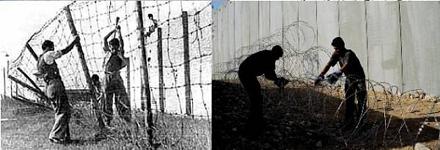
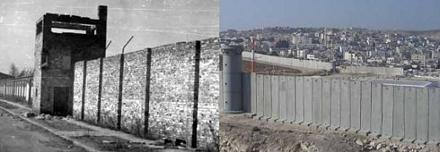
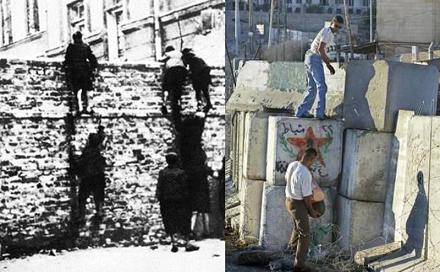
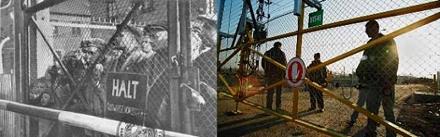
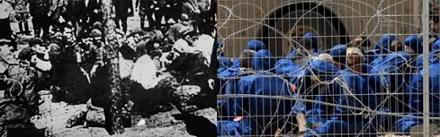
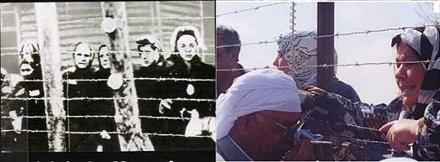
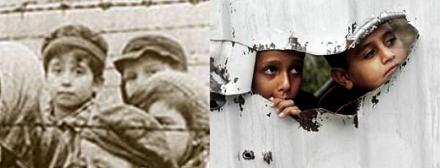
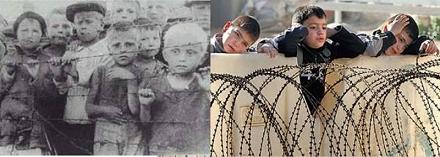
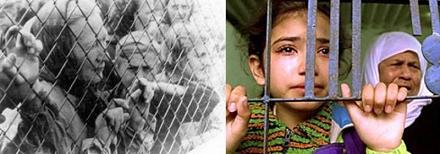
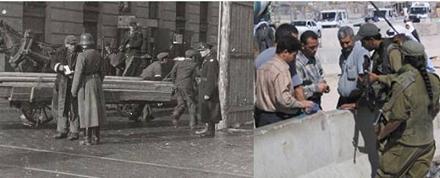
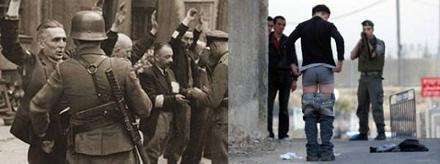
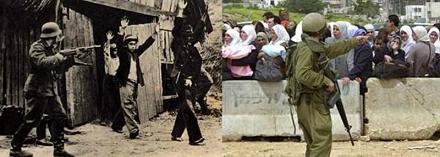
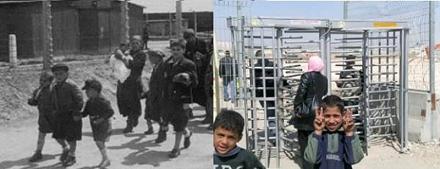
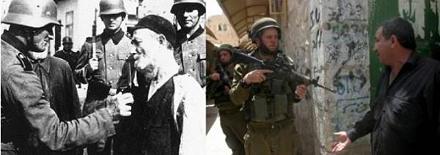
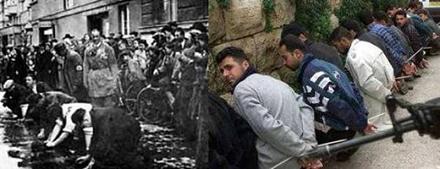
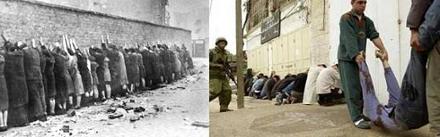
PHOTO ESSAY: JEWISH HOLOCAUST AND GAZA – PART I

January 19, 2009

Axis of Logic, January 18, 2009

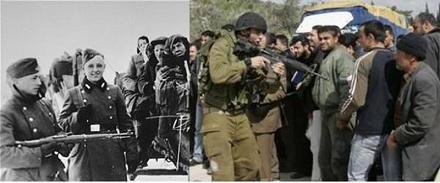
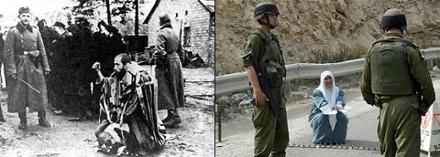
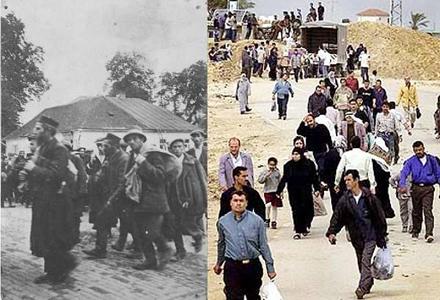
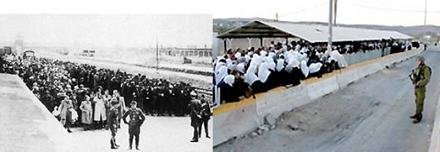
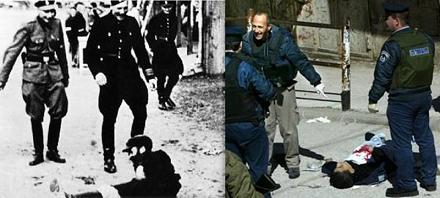
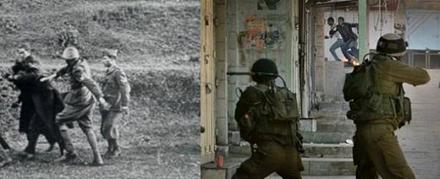
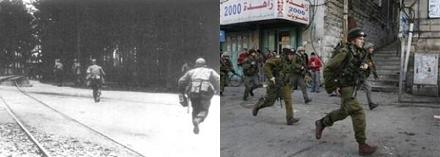
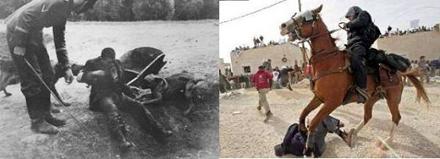
The grandchildren of Jewish holocaust survivors from World War II are doing to the Palestinians exactly what was done to them by Nazi Germany.

BUILDING WALLS & FENCES TO KEEP PEOPLE IN PRISONS

CHECK POINTS NOT TO ALLOW PEOPLE
BASIC FREEDOM OF MOVEMENT

ARRESTS & HARASSMENTS

Received via email at Axis of Logic. Original source, unknown

See: Photo Essay: Jewish Holocaust and Gaza, Part II

Israelis Applaud Massacre of Palestinians

January 19, 2009

Press Action, January 17, 2009

Israel’s massacre of Palestinians in the Gaza Strip represents a terrible atrocity committed by a terrorist, outlaw state. And yet the intensity of Israel’s killing machine is probably not the most disturbing part of its three-week-long onslaught. Shamefully, we’ve grown accustomed to Israel committing one atrocity after another against Palestinians while other nation-states sit on their hands—or in the case of the U.S. Congress, pass almost unanimous resolutions endorsing the slaughter—and let the rogue state get away with its terrible crimes.

Perhaps more appalling is how the Israeli public is cheering on the massacre. The Associated Press reported Jan. 17 that a Haaretz-Dialog poll found that 82% of Israelis believe their military has not “gone too far” with its attacks against Palestinians in Gaza.

Regarding U.S. public opinion, the Jerusalem Post reports that two new polls show Americans strongly back Israel over Palestinians in Israel’s assault on Gaza.

“A McClatchy/Ipsos poll found that 44 percent of Americans support Israel’s use of force, in comparison to 18% who think Hamas’s use of force is appropriate. And 57% think the latter is using excessive force – something only 36% believe Israel to be doing.

The poll also found that more Americans now oppose rather than support creating a Palestinian state, with 45% saying the US shouldn’t favor one, versus 31% who said it should and 24% who didn’t know. …

A large plurality, 49%, put the blame for the current conflict squarely on Hamas, with only 14% blaming Israel and 29% undecided. Nine percent said both, and 4% said neither.

A recent poll by the pro-Israel advocacy group The Israel Project also found that more Americans (55%) hold Palestinians responsible for the violence rather than Israelis (11%), with 23% blaming both and 5% blaming neither. They also fault Palestinian leaders over Israeli ones for the humanitarian crisis (66%-17%), and see the latter as working toward peace more than the Palestinians (48%-5%).”

Several commentators have highlighted the bloodthirstiness of both the Israeli and U.S. public with regard to Israel’s attack on Palestinians. Gary Corseri, for example, writes on Thomas Paine’s Corner:

Among the terrible pictures that I have seen on the Web, pictures that Palestinians and friends of Palestine have sent me, the most terrible was not of shattered, mutilated bodies, of blasted lives and unendurable pain. The most terrible was a picture of young Israelis standing within their secure borders (of occupied Palestine!) looking at the devastation being visited on the terrified civilians of Gaza a couple of miles away. And the unremitting horror of that image was that those who watched the bombs bursting in air and the puffs of death rising—they were smiling.

I searched my memory banks to recall where I’d seen such an image before. It was many years ago in a book about the Civil Rights struggle in America and it showed a lynching of a black man and a crowd of grinning whites—men, women and children in a party mood under the limbs of the tree upon which hung the burnt and crucified corpse. It used to be possible for travelers in the apartheid US south to purchase postcards depicting such scenes—and they had captions like, “One less Nigger to worry about!”

Another War, Another Defeat

January 19, 2009

The Gaza offensive has succeeded in punishing the Palestinians but not in making Israel more secure.

By John J. Mearsheimer | The American Conservative, January 26, 2009

Israelis and their American supporters claim that Israel learned its lessons well from the disastrous 2006 Lebanon war and has devised a winning strategy for the present war against Hamas. Of course, when a ceasefire comes, Israel will declare victory. Don’t believe it. Israel has foolishly started another war it cannot win.

The campaign in Gaza is said to have two objectives: 1) to put an end to the rockets and mortars that Palestinians have been firing into southern Israel since it withdrew from Gaza in August 2005; 2) to restore Israel’s deterrent, which was said to be diminished by the Lebanon fiasco, by Israel’s withdrawal from Gaza, and by its inability to halt Iran’s nuclear program.

But these are not the real goals of Operation Cast Lead. The actual purpose is connected to Israel’s long-term vision of how it intends to live with millions of Palestinians in its midst. It is part of a broader strategic goal: the creation of a “Greater Israel.” Specifically, Israel’s leaders remain determined to control all of what used to be known as Mandate Palestine, which includes Gaza and the West Bank. The Palestinians would have limited autonomy in a handful of disconnected and economically crippled enclaves, one of which is Gaza. Israel would control the borders around them, movement between them, the air above and the water below them.

The key to achieving this is to inflict massive pain on the Palestinians so that they come to accept the fact that they are a defeated people and that Israel will be largely responsible for controlling their future. This strategy, which was first articulated by Ze’ev Jabotinsky in the 1920s and has heavily influenced Israeli policy since 1948, is commonly referred to as the “Iron Wall.”

What has been happening in Gaza is fully consistent with this strategy.

Let’s begin with Israel’s decision to withdraw from Gaza in 2005. The conventional wisdom is that Israel was serious about making peace with the Palestinians and that its leaders hoped the exit from Gaza would be a major step toward creating a viable Palestinian state. According to the New York Times’ Thomas L. Friedman, Israel was giving the Palestinians an opportunity to “build a decent mini-state there—a Dubai on the Mediterranean,” and if they did so, it would “fundamentally reshape the Israeli debate about whether the Palestinians can be handed most of the West Bank.”

This is pure fiction. Even before Hamas came to power, the Israelis intended to create an open-air prison for the Palestinians in Gaza and inflict great pain on them until they complied with Israel’s wishes. Dov Weisglass, Ariel Sharon’s closest adviser at the time, candidly stated that the disengagement from Gaza was aimed at halting the peace process, not encouraging it. He described the disengagement as “formaldehyde that’s necessary so that there will not be a political process with the Palestinians.” Moreover, he emphasized that the withdrawal “places the Palestinians under tremendous pressure. It forces them into a corner where they hate to be.”

Arnon Soffer, a prominent Israeli demographer who also advised Sharon, elaborated on what that pressure would look like. “When 2.5 million people live in a closed-off Gaza, it’s going to be a human catastrophe. Those people will become even bigger animals than they are today, with the aid of an insane fundamentalist Islam. The pressure at the border will be awful. It’s going to be a terrible war. So, if we want to remain alive, we will have to kill and kill and kill. All day, every day.”

In January 2006, five months after the Israelis pulled their settlers out of Gaza, Hamas won a decisive victory over Fatah in the Palestinian legislative elections. This meant trouble for Israel’s strategy because Hamas was democratically elected, well organized, not corrupt like Fatah, and unwilling to accept Israel’s existence. Israel responded by ratcheting up economic pressure on the Palestinians, but it did not work. In fact, the situation took another turn for the worse in March 2007, when Fatah and Hamas came together to form a national unity government. Hamas’s stature and political power were growing, and Israel’s divide-and-conquer strategy was unraveling.

To make matters worse, the national unity government began pushing for a long-term ceasefire. The Palestinians would end all missile attacks on Israel if the Israelis would stop arresting and assassinating Palestinians and end their economic stranglehold, opening the border crossings into Gaza.

Israel rejected that offer and with American backing set out to foment a civil war between Fatah and Hamas that would wreck the national unity government and put Fatah in charge. The plan backfired when Hamas drove Fatah out of Gaza, leaving Hamas in charge there and the more pliant Fatah in control of the West Bank. Israel then tightened the screws on the blockade around Gaza, causing even greater hardship and suffering among the Palestinians living there.

Hamas responded by continuing to fire rockets and mortars into Israel, while emphasizing that they still sought a long-term ceasefire, perhaps lasting ten years or more. This was not a noble gesture on Hamas’s part: they sought a ceasefire because the balance of power heavily favored Israel. The Israelis had no interest in a ceasefire and merely intensified the economic pressure on Gaza. But in the late spring of 2008, pressure from Israelis living under the rocket attacks led the government to agree to a six-month ceasefire starting on June 19. That agreement, which formally ended on Dec. 19, immediately preceded the present war, which began on Dec. 27.

The official Israeli position blames Hamas for undermining the ceasefire. This view is widely accepted in the United States, but it is not true. Israeli leaders disliked the ceasefire from the start, and Defense Minister Ehud Barak instructed the IDF to begin preparing for the present war while the ceasefire was being negotiated in June 2008. Furthermore, Dan Gillerman, Israel’s former ambassador to the UN, reports that Jerusalem began to prepare the propaganda campaign to sell the present war months before the conflict began. For its part, Hamas drastically reduced the number of missile attacks during the first five months of the ceasefire. A total of two rockets were fired into Israel during September and October, none by Hamas.

How did Israel behave during this same period? It continued arresting and assassinating Palestinians on the West Bank, and it continued the deadly blockade that was slowly strangling Gaza. Then on Nov. 4, as Americans voted for a new president, Israel attacked a tunnel inside Gaza and killed six Palestinians. It was the first major violation of the ceasefire, and the Palestinians—who had been “careful to maintain the ceasefire,” according to Israel’s Intelligence and Terrorism Information Center—responded by resuming rocket attacks. The calm that had prevailed since June vanished as Israel ratcheted up the blockade and its attacks into Gaza and the Palestinians hurled more rockets at Israel. It is worth noting that not a single Israeli was killed by Palestinian missiles between Nov. 4 and the launching of the war on Dec. 27.

As the violence increased, Hamas made clear that it had no interest in extending the ceasefire beyond Dec. 19, which is hardly surprising, since it had not worked as intended. In mid-December, however, Hamas informed Israel that it was still willing to negotiate a long-term ceasefire if it included an end to the arrests and assassinations as well as the lifting of the blockade. But the Israelis, having used the ceasefire to prepare for war against Hamas, rejected this overture. The bombing of Gaza commenced eight days after the failed ceasefire formally ended.

If Israel wanted to stop missile attacks from Gaza, it could have done so by arranging a long-term ceasefire with Hamas. And if Israel were genuinely interested in creating a viable Palestinian state, it could have worked with the national unity government to implement a meaningful ceasefire and change Hamas’s thinking about a two-state solution. But Israel has a different agenda: it is determined to employ the Iron Wall strategy to get the Palestinians in Gaza to accept their fate as hapless subjects of a Greater Israel.

This brutal policy is clearly reflected in Israel’s conduct of the Gaza War. Israel and its supporters claim that the IDF is going to great lengths to avoid civilian casualties, in some cases taking risks that put Israeli soldiers in jeopardy. Hardly. One reason to doubt these claims is that Israel refuses to allow reporters into the war zone: it does not want the world to see what its soldiers and bombs are doing inside Gaza. At the same time, Israel has launched a massive propaganda campaign to put a positive spin on the horror stories that do emerge.

The best evidence, however, that Israel is deliberately seeking to punish the broader population in Gaza is the death and destruction the IDF has wrought on that small piece of real estate. Israel has killed over 1,000 Palestinians and wounded more than 4,000. Over half of the casualties are civilians, and many are children. The IDF’s opening salvo on Dec. 27 took place as children were leaving school, and one of its primary targets that day was a large group of graduating police cadets, who hardly qualified as terrorists. In what Ehud Barak called “an all-out war against Hamas,” Israel has targeted a university, schools, mosques, homes, apartment buildings, government offices, and even ambulances. A senior Israeli military official, speaking on the condition of anonymity, explained the logic behind Israel’s expansive target set: “There are many aspects of Hamas, and we are trying to hit the whole spectrum, because everything is connected and everything supports terrorism against Israel.” In other words, everyone is a terrorist and everything is a legitimate target.

Israelis tend to be blunt, and they occasionally say what they are really doing. After the IDF killed 40 Palestinian civilians in a UN school on Jan. 6, Ha’aretz reported that “senior officers admit that the IDF has been using enormous firepower.” One officer explained, “For us, being cautious means being aggressive. From the minute we entered, we’ve acted like we’re at war. That creates enormous damage on the ground … I just hope those who have fled the area of Gaza City in which we are operating will describe the shock.”

One might accept that Israel is waging “a cruel, all-out war against 1.5 million Palestinian civilians,” as Ha’aretz put it in an editorial, but argue that it will eventually achieve its war aims and the rest of the world will quickly forget the horrors inflicted on the people of Gaza.

This is wishful thinking. For starters, Israel is unlikely to stop the rocket fire for any appreciable period of time unless it agrees to open Gaza’s borders and stop arresting and killing Palestinians. Israelis talk about cutting off the supply of rockets and mortars into Gaza, but weapons will continue to come in via secret tunnels and ships that sneak through Israel’s naval blockade. It will also be impossible to police all of the goods sent into Gaza through legitimate channels.

Israel could try to conquer all of Gaza and lock the place down. That would probably stop the rocket attacks if Israel deployed a large enough force. But then the IDF would be bogged down in a costly occupation against a deeply hostile population. They would eventually have to leave, and the rocket fire would resume. And if Israel fails to stop the rocket fire and keep it stopped, as seems likely, its deterrent will be diminished, not strengthened.

More importantly, there is little reason to think that the Israelis can beat Hamas into submission and get the Palestinians to live quietly in a handful of Bantustans inside Greater Israel. Israel has been humiliating, torturing, and killing Palestinians in the Occupied Territories since 1967 and has not come close to cowing them. Indeed, Hamas’s reaction to Israel’s brutality seems to lend credence to Nietzsche’s remark that what does not kill you makes you stronger.

But even if the unexpected happens and the Palestinians cave, Israel would still lose because it will become an apartheid state. As Prime Minister Ehud Olmert recently said, Israel will “face a South African-style struggle” if the Palestinians do not get a viable state of their own. “As soon as that happens,” he argued, “the state of Israel is finished.” Yet Olmert has done nothing to stop settlement expansion and create a viable Palestinian state, relying instead on the Iron Wall strategy to deal with the Palestinians.

There is also little chance that people around the world who follow the Israeli-Palestinian conflict will soon forget the appalling punishment that Israel is meting out in Gaza. The destruction is just too obvious to miss, and too many people—especially in the Arab and Islamic world—care about the Palestinians’ fate. Moreover, discourse about this longstanding conflict has undergone a sea change in the West in recent years, and many of us who were once wholly sympathetic to Israel now see that the Israelis are the victimizers and the Palestinians are the victims. What is happening in Gaza will accelerate that changing picture of the conflict and long be seen as a dark stain on Israel’s reputation.

The bottom line is that no matter what happens on the battlefield, Israel cannot win its war in Gaza. In fact, it is pursuing a strategy—with lots of help from its so-called friends in the Diaspora—that is placing its long-term future at risk. __________________________________________

John J. Mearsheimer is a professor of political science at the University of Chicago and coauthor of The Israel Lobby and U.S. Foreign Policy.