Posts Tagged ‘Liberation Tigers of Tamil Eelam’

Sri Lankan troops shot Tamil prisoners of war

August 28, 2009
Morning Star Online, Thursday 27 August 2009
by Paddy McGuffin

Graphic footage which appears to show Sri Lankan forces summarily executing Tamil prisoners during or after the recent bloody conflict has been handed to the British media.

The footage, captured on a mobile phone, was supplied to the media on Wednesday by Journalists for Democracy in Sri Lanka.

It shows uniformed troops dragging naked and bound prisoners into a clearing and shooting them in the back of the head.

Continues >>

Sri Lankan police interrogate doctors who witnessed war crimes

June 13, 2009
By Nanda Wickramesinghe |wsws.org, 13 June 2009

The Sri Lankan government is continuing to detain and interrogate three doctors—Dr Thurairajah Varatharajah, Dr Thangamuttu Sathyamurthi and Dr V. Shanmugarajah—who risked their lives to provide medical care to thousands of Tamil civilians caught in fighting between the army and the separatist Liberation Tigers of Tamil Eelam (LTTE).

With journalists and most aid workers barred from the war zone, the government-appointed medical officers provided a glimpse into the horrific conditions facing over a quarter of a million civilians in the small LTTE-held enclave. Their testimony provided first-hand evidence of the war crimes being carried out by the Sri Lankan military in shelling civilian areas. Their makeshift clinic was hit several times in the last weeks of fighting.

The three doctors fled along with thousands of civilians just days before the army overran the last LTTE territory. They were detained by soldiers and handed over to police. To deflect attention from its own crimes, the government accused the doctors of aiding the LTTE and denounced their accounts as propaganda. Only the International Committee of the Red Cross (ICRC) has had access to the men.

Continued >>

British newspapers expose cold-blooded killing of LTTE leaders in Sri Lanka

June 3, 2009
By Robert Stevens | wsws.org, 3 June 2009

The British press last week revealed that senior leaders of the Liberation Tigers of Tamil Eelam (LTTE) were in negotiations with British and American diplomats to surrender, immediately prior to their killing by the Sri Lankan army on May 18. Also involved in the talks was the United Nations secretary general’s chief of staff, Vijay Nambiar.

The Guardian and the Sunday Times both published reports stating that Balasingham Nadesan, the leader of the LTTE’s political wing, and Seevaratnam Puleedevan, the head of its peace secretariat, held talks with Nambiar through a series of intermediaries, including a journalist and a delegation of British diplomats.

The Guardian states that the LTTE leaders also made further contact with Norwegian Environment and Development Cooperation Minister Erik Solheim prior to their deaths. Solheim had been involved as a special envoy in attempts to broker a peace agreement following the 2002 ceasefire in Sri Lanka’s protracted civil war.

The Sunday Times article by journalist Marie Colvin was headlined, “Tigers begged me to broker surrender.” She explained how the initial contact between the LTTE, British and United States officials, and the United Nations had been facilitated through her.

Colvin has covered the civil war in Sri Lanka since being “smuggled into territory eight years ago” in order “to investigate reports that the government was blocking food and medical supplies to half a million Tamils.” She had met and came to know Nadesan and Puleedevan since that time.

The Guardian details how the two leaders of the LTTE attempted to agree to a last minute deal with the Sri Lankan government just hours before they were killed by the army in the early hours of May 18—while in the process of surrendering.

A British official states that UK involvement was “at most indirect”, but the article includes a quote from Nambiar saying that he had had “direct contact” with British diplomats in New York and also with an unnamed British minister. Nambiar added, “There was a ministerial demarche [a formal diplomatic representation] to the secretary general from the UK office in New York.”

Nambiar passed on the information obtained by the Times journalist regarding the proposal of Nadesan and Puleedevan to surrender to the Sri Lankan government. He says that he also spoke to Sri Lankan Foreign Secretary Palitha Kohona about the proposal.

The government had no intention of brokering a ceasefire or allowing any surrender by the LTTE leadership. Nambiar told the Guardian, “The Sri Lankan government did not say that they would accept the surrender. They said it may be too late.”

After being contacted by the LTTE regarding the surrender, Solheim “then contacted the International Committee of the Red Cross and the Sri Lankan government”.

A text message was then sent from Kohona to the Red Cross, which read, “Just walk across to the troops, slowly! With a white flag and comply with instructions carefully. The soldiers are nervous about suicide bombers.”

In Colvin’s Times article she described the harrowing conditions facing the LTTE fighters as they were cornered into a tiny strip of jungle and a beach area during the final army offensive: “Tens of thousands of Tamil civilians were trapped with them, hiding in hand-dug trenches, enduring near constant bombardment.”

“For several days I had been the intermediary between the Tiger leadership and the United Nations as the army pressed in on the last enclave at the end of a successful military campaign to defeat the rebellion,” she writes. “Nadesan had asked me to relay three points to the UN: they would lay down their arms, they wanted a guarantee of safety from the Americans or British, and they wanted an assurance that the Sri Lankan government would agree to a political process that would guarantee the rights of the Tamil minority.

“Through highly placed British and American officials I had established contact with the UN special envoy in Colombo, Vijay Nambiar, chief of staff to Ban Ki-Moon, the secretary-general. I had passed on the Tigers’ conditions for surrender, which he had said he would relay to the Sri Lankan government.”

Colvin corroborates the Guardian’s report. She states that in conversation with Nambiar during the morning of May 18, he told her that he had been told by Sri Lankan President Mahinda Rajapakse that the two leaders would be able to surrender by hoisting “a white flag high”.

Colvin stated, “Once more, the UN 24-hour control centre in New York patched me through to Nambiar in Colombo, where it was 5.30 a.m. on Monday. I woke him up.

“I told him the Tigers had laid down their arms. He said he had been assured by Mahinda Rajapakse, the Sri Lankan president, that Nadesan and Puleedevan would be safe in surrendering. All they had to do was ‘hoist a white flag high,’ he said.”

Shortly after this Colvin lost contact with Nadesan’s satellite phone and spoke to an LTTE contact in South Africa, to whom she relayed the instructions to hoist the white flag.

Colvin reports, “A Tamil who was in a group that managed to escape the killing zone described what happened. This source, who later spoke to an aid worker, said Nadesan and Puleedevan walked towards Sri Lankan army lines with a white flag in a group of about a dozen men and women. He said the army started firing machineguns at them. Nadesan’s wife, a Sinhalese, yelled in Sinhala at the soldiers, ‘He is trying to surrender and you are shooting him.’ She was also shot down.”

The incident underscores the ruthlessness with which the Sri Lankan government and army slaughtered the LTTE leadership on the morning of May 18. Virtually all of the top LTTE leaders, including LTTE chief V. Prabhakaran, died in circumstances that have not been adequately explained. The Sri Lankan government claimed that Prabhakaran was killed in a gun battle trying to flee, but he may well have met the same fate as Nadesan and Puleedevan.

Certainly the army pursued the destruction of the last pocket of LTTE resistance with criminal indifference to the consequences of nearly a quarter of a million Tamil civilians trapped in the war zone. While Rajapakse’s government denies responsibility for any civilian deaths, the latest reports based on leaked UN estimates put the death toll at more than 20,000 since January.

Sri Lanka says wins civil war, kills rebel leader

May 18, 2009

By C. Bryson Hull and Ranga Sirilal | Reuters, May 18, 2009

COLOMBO (Reuters) – Sri Lankan troops won the final battle in a separatist conflict seen as one of the world’s most intractable wars, and put the island nation under government control for the first time since 1983, the military said.

In the climactic final gun battle, special forces troops killed Liberation Tigers of Tamil Eelam (LTTE) leader Vellupillai Prabhakaran as he tried to flee the war zone in an ambulance early on Monday, state television reported.

LTTE intelligence chief Pottu Amman and Soosai, head of the “Sea Tiger” naval wing, were also believed killed, the report said. Prabhakaran founded the LTTE on a culture of suicide before surrender, and had sworn he would never be taken alive.

Army commander Lt-Gen. Sarath Fonseka said troops on Monday morning had finished the task given to them by President Mahinda Rajapaksa three years ago.

“We have liberated the entire country by completely liberating the north from the terrorists. We have gained full control of LTTE-held areas,” Fonseka announced on state TV.

The end of combat and Prabhakaran’s death sent the currency and stock markets to one-month and seven-month highs respectively by 0900 GMT (5:00 a.m. EDT). They had already surged at the opening in anticipation of the war’s end.

Rajapaksa declared victory on Saturday, even as the final battle in Asia’s longest modern war was intensifying.

The final fight played out on a sandy patch of just 300 sq meters (3,230 sq ft) near the Indian Ocean island’s northeastern coast, where the military said the last Tiger fighters had holed up in bunkers and surrounded themselves with land mines and booby traps.

COUNTING BODIES

The LTTE on Sunday conceded defeat in a 25-year civil war, after a relentless Sri Lankan military offensive that retook the 15,000 sq km the rebels ran as a separate state when a 2002 truce began falling apart three years ago.

The official Media Center for National Security said more than 250 Tigers had been killed in the final battle, which intensified on Saturday after the military said it had freed the last of 72,000 civilians trapped in the tiny war zone.

News of the Tiger chief’s death came as state TV for the first time broadcast images of the body of his son and heir apparent, Charles Anthony, and other dead rebels.

He was killed overnight, the military said, along with a host of other top LTTE fighters and political cadres, including political chief B. Nadesan and spokesman Seevaratnam Puleedevan.

In Colombo, demonstrators threw rocks at the British High Commission, tossed a burning effigy of Foreign Secretary David Miliband inside and spray-painted its heavily fortified wall with epithets and a message: “LTTE headquarters.”

Miliband has been critical of the Sri Lankan government’s prosecution of the war, and is seen here as sympathetic to the vocal pro-LTTE lobby that has protested outside parliament for weeks in Britain. London has said it backs a war crimes’ probe.

Sri Lanka has been furious that a number of its embassies in foreign capitals have been vandalized by Tamil Tiger backers.

Rajapaksa prorogued parliament on Monday, the required step for him to take the role of speaker and address the body. He was due to make his formal declaration of victory there on Tuesday.

In less than three years, Sri Lanka’s bulked-up military has answered critics who said there was no way to defeat the LTTE, which had carefully crafted an aura of military invincibility.

The LTTE at the height of its power had run a de facto state for Sri Lanka’s Tamil minority that it called Tamil Eelam.

The Tigers collected taxes, ran courts and kept a standing army, naval wing and small air force, even though the government paid for health and education services there.

Sri Lanka: Distant voices, desperate lives

May 17, 2009

John Pilger |  New Statesman, May 14, 2009

History teaches us that when no one listens, tragedy ensues. Sri Lanka’s Tamils face terrible suffering. They urgently need to be heard

In the early 1960s, it was the Irish of Derry who would phone late at night, speaking in a single breath, spilling out stories of discrimination and injustice. Who listened to their truth, until the violence began? Bengalis from what was then East Pakistan did much the same. Their urgent whispers described terrible state crimes that the news ignored, and they implored us reporters to “let the world know”. Palestinians speaking above the din of crowded rooms in Bethlehem and Beirut asked no more. For me, the most tenacious distant voices have been the Tamils of Sri Lanka, to whom we ought to have listened a very long time ago.

It is only now, as they take to the streets of western cities, and the persecution of their compatriots reaches a crescendo, that we listen, though not intently enough to understand and act. The Sri Lankan government has learned an old lesson from, I suspect, a modern master: Israel. In order to conduct a slaughter, you ensure the pornography is unseen, illicit at best. You ban foreigners and their cameras from Tamil towns such as Mulliavaikal, which was bombarded recently by the Sri Lankan army, and you lie that the 75 people killed in the hospital were blown up quite wilfully by a Tamil suicide bomber. You then give reporters a ride into the jungle, providing what in the news business is called a dateline, which suggests an eyewitness account, and you encourage the gullible to disseminate only your version and its lies. Gaza is the model.

From the same masterclass you learn to manipulate the definition of terrorism as a universal menace, thus ingratiating yourself with the “international community” (Washington) as a noble sovereign state blighted by an “insurgency” of mindless fanaticism. The truth and lessons of the past are irrelevant. And, having succeeded in persuading the United States and Britain to proscribe your insurgents as terrorists, you affirm you are on the right side of history, regardless of the fact that your government has one of the world’s worst human rights records and practises terrorism by another name. Such is Sri Lanka.

This is not to suggest that those who resist attempts to obliterate them culturally if not actually are innocent in their methods. The Liberation Tigers of Tamil Eelam (LTTE) have spilled their share of blood and perpetrated their own atrocities. But they are the product, not the cause, of an injustice and a war that long pre-date them. Neither is Sri Lanka’s civil strife as unfathomable as it is often presented: an ancient religious-ethnic rivalry between the Hindu Tamils and the Buddhist Sinhalese government.

Sri Lanka, as British-ruled Ceylon, was subjected to classic divide-and-rule. The British brought Tamils from India as virtual slave labour while building an educated Tamil middle class to run the colony. At independence in 1948, the new political elite, in its rush for power, cultivated ethnic support in a society whose imperative should have been the eradication of poverty. Language became the spark. The election of a government pledging to replace English, the lingua franca, with Sinhalese was a declaration of war on the Tamils. Under the new law, Tamils almost disappeared from the civil service by 1970; and as “nationalism” seduced both left and right, discrimination and anti-Tamil riots followed.

The formation of a Tamil resistance, notably the LTTE, the Tamil Tigers, included a demand for a state in the north of the country. The response of the government was judicial killing, torture, disappearances and, more recently, the reported use of cluster bombs and chemical weapons. The Tigers responded with their own crimes, including suicide bombing and kidnapping.

In 2002, a ceasefire was agreed, and it held until last year, when the government decided to finish off the Tigers. Tamil civilians were urged to flee to military-run “welfare camps”, which have become the symbol of an entire people under vicious detention, and worse, with nowhere to escape the army’s fury.

This is Gaza again, although the historical parallel is the British treatment of Boer women and children more than a century ago, who “died like flies”, as a witness wrote.

Foreign aid workers have been banned from Sri Lanka’s camps, except the International Committee of the Red Cross, which has described a catastrophe in the making. The United Nations says that 60 Tamils a day are being killed in the shelling of a government-declared “no-fire zone”.

In 2003, the Tigers proposed a devolved Interim Self-Governing Authority that included possibilities for negotiation. Today, the government gives the impression it will use its imminent “victory” to “permanently solve” the “Tamil minority problem”, as many of its more rabid supporters threaten. The army commander says all of Sri Lanka “belongs” to the Sinhalese majority. The word “genocide” is used by Tamil expatriates, perhaps loosely; but the fear is true.

India could play a critical part. The south Indian state of Tamil Nadu has a Tamil-speaking population with centuries-long ties to the Tamils of Sri Lanka. In the current Indian election campaign, anger over the siege of Tamils in Sri Lanka has brought hundreds of thousands to rallies. Having initially helped to arm the Tigers, Indian governments sent “peacekeeping” troops to disarm them. Delhi now appears to be allowing the Sinhalese supremacists in Colombo to “stabilise” its troubled neighbour. In a responsible regional role, India could stop the killing and begin to broker a solution.

The great moral citadels in London and Washington offer merely silent approval of the violence and tragedy. No appeals are heard in the United Nations from them. David Miliband has called for a “ceasefire”, as he tends to do in places where British “interests” are served, such as the 14 impoverished countries racked by armed conflict where the British government licenses arms shipments. In 2005, British arms exports to Sri Lanka rose by 60 per cent.

The distant voices from there should be heard, urgently.

The Bloodbath in Sri Lanka

April 28, 2009

Why Battering the Tamil Tigers Won’t Bring Peace

By MITU SENGUPTA | Counterpunch, April 28, 2009

Over the course of a long and brutal war with Sri Lanka’s armed forces, the Liberation Tigers of Tamil Eelam (the LTTE) emerged as one of the world’s most formidable insurgent groups.  Besides engaging the Sri Lankan government in a bloody battle for more than 25 years, the LTTE (or, more informally, the ‘Tamil Tigers’) managed to seize substantial chunks of government territory, and operated these as a quasi-state for well over a decade.  Today, however, the mighty Tigers are on the verge of  total military defeat.  Will their demise bring peace to Sri Lanka?

Unsurprisingly, the LTTE’s hammering has come at an enormous price.  Since its beginnings in the early 1980s, the war has claimed more than 70,000 lives, rendered some half a million Tamils refugees in their own country, and driven an equal number out of Sri Lanka. The last six months of fighting have been particularly intense, with the Sri Lankan government at its most aggressive in decades.  Reports from the United Nations, Red Cross and several other reputed humanitarian organizations indicate that the country is on the brink of a colossal humanitarian disaster.  Some 6,500 civilians have been killed since January, and another 100,000 are caught – facing carnage, and without adequate food, shelter and medicine – in the crossfire between the Tigers and government forces.  An additional 40,000 or so that have fled the war zone are being held in military-run camps, where conditions, according to the most recent reports, are similar to those in Nazi-run concentration camps (journalists and humanitarian workers have been banned from these camps for over a month).

Led by the United Nations, concerned voices in the international community have repeatedly pleaded for a halt to the fighting, or even a ceasefire of a reasonable length, in which more civilians may be moved to safety, and aid workers allowed access to the sick and wounded.  Determined to run the Tigers to the ground, however, the Sri Lankan President, Mahinda Rajapaksa, has remained undeterred, apparently confident that a full purging of the LTTE – now perhaps only days away – will have been worth the carnage and dislocation, and the palpable damage to his country’s international reputation.  Rajapaksa evidently believes that a Sri Lanka free of the Tigers will be a Sri Lanka whither all good things will come.

Over the years, the LTTE has earned the reputation of being a ruthless organization; one that turns children into hardened soldiers; that has perfected suicide bombing as a tactic; that relies on extortion and smuggling for funding, and that has zero tolerance for critics and competitors.  While there are no reliable measures of the extent of support for the LTTE among Tamils in Sri Lanka, or within the vast diaspora, Tamil human rights activists both inside and outside the country have spoken out against the LTTE’s cruel ways, totalitarian structure, and uncompromising, maximalist demands.  The LTTE has duly assassinated many of these detractors.  Indeed, given all of this, it is tempting to presume that Sri Lanka will be infinitely better off without the LTTE, and that its elimination will necessarily steer the country towards order, stability and reconciliation.  But though appealing, this conclusion ultimately rests on a wrongheaded view of the Tigers’ role in the conflict.  The LTTE is the product, not the cause, of Sri Lanka’s deadly politics.

To begin with, the conflict, if not the war, predates the LTTE by a few generations.  Its origins may be traced to the effects of the nefarious “divide and rule” policies devised by British colonial administrators to govern Sri Lanka (then Ceylon) in the nineteenth and early twentieth centuries.  The British used the island’s Tamil minority to keep its Sinhalese majority in check, and in return, gave Tamils the best government jobs and the benefit of English education.  With independence in 1948, however, the Tamils were deprived of their patrons, and found themselves outnumbered and marginalized inside the new Sri Lanka’s unitary state and majoritarian institutional framework. With the Tamils rendered politically irrelevant, short-sighted politicians competed with each other for the Sinhalese vote, and soon discovered that the political party with the stronger anti-minority stance was almost always guaranteed electoral success.

Such “ethnic outbidding,” as scholars have characterized the dreadful process, led to the rise of a ferocious Sinhala nationalism that demanded revenge for the Tamils’ supremacy during the colonial period, along with a revival of Sinhala language and culture.  It saw Sri Lanka as for the Sinhalese alone, and insisted that the Tamil minority submit to its second-class position or, better still, simply leave the island.  In the first few decades following independence, Sri Lanka’s Tamils were systematically stripped of their erstwhile social and economic privileges, with the demotion of their language (Tamil) to secondary status, and the imposition of strict quotas that shrank their employment and educational opportunities.  Sinhalese farmers were encouraged to settle in and around the island’s north-east, in an obvious attempt to reduce the concentration of Tamils in these areas.

Initially, the Tamils attempted to resist these changes through democratic means, forming political parties that pressed for federalism and various minority guarantees.  While many sensible Sinhalese politicians warmed to such appeals, the forces of majoritarianism always seemed to triumph.  Any government seen as making too many concessions to the Tamils was swiftly pulled down, a disheartening ritual that eventually left most Tamils alienated, and the Tamil parties largely discredited.  By the late 1970s, the conflict had taken a violent turn, with the surfacing of several militant outfits, including the LTTE, which called for armed struggle and secession – the creation of a Tamil ‘homeland’ (‘eelam’) out of the Tamil majority areas in Sri Lanka’s north-east. The LTTE proved the strongest of these militant groups, and, out-powering its rivals, became locked in bitter conflict with the Sri Lankan state.

As an insurgent force, the LTTE has been remarkably successful.  By the early 2000s, it had captured much of the north and east, and was governing these territories as though they were already a separate state (the LTTE provided schools, postal services, and even rudimentary hospitals).  The LTTE brought forth a harsh and authoritarian regime, but one that was, perhaps, an inevitable response to the harsh and authoritarian regime that the Sri Lankan government had become.  Human Rights Watch has characterized the Sri Lankan government as one of the world’s worst perpetrators of enforced disappearances.  Indeed, in many ways, the LTTE and the Sri Lankan state have been reflections of each other’s total lack of generosity.  Both have squandered numerous opportunities for peace, though it is unlikely that the Sri Lankan government would have agreed to negotiate at all – as it did in 2003, following a ceasefire – had it faced a lesser organization than the Tigers.  The annihilation of the LTTE will mean that only one of the two fearsome, unbending contenders in the country’s long and bloody war will have left the arena and, that too, probably not for good.  Far from being a recipe for peace, this will probably ignite a new cycle of grotesque injustice and pitiless retaliation.

One danger that looms heavily is that the Sri Lankan state will try to use its victory to seek a permanent solution to its “Tamil minority problem.”  The government might begin by preventing Tamil civilians interned in its military camps from returning to their villages.  These camps have already taken on an air of permanence, with the government arguing that no-one can be moved until the LTTE is fully flushed out, and the military demines the conflict zone. This could take months, if not years.  It is entirely possible that while tens of thousands of Tamils languish in these camps, encircled by razor-wired fences, the government will move large numbers of Sinhalese settlers into the island’s north and east, thus stamping out, once and for all, the geographical rationale for a separate Tamil homeland.  The counterpoint to the government’s expected belligerence might be an even darker phase in the Tamil resistance; one with a more lucid and focused fury that will bring great disquiet to Tamils everywhere.

To most governments, the bloodbath in Sri Lanka is the consequence of a sovereign power besieged by a brutal domestic insurgency.  This is to be expected in a world where states are generally considered legitimate, no matter what they do, and those that challenge their authority are immediately viewed as criminal – a distinction that’s been sharpened, of course, by the menacing language around the “war on terror.”  Indeed, following Sri Lanka’s success in having the LTTE proscribed as a terrorist organization by 31 countries, including the United States, the sense that the Sri Lankan state is on the right side of history has gone from strength to strength, which might explain the muted condemnation of its actions in the rapidly unfolding tragedy.

It’s probably too much to expect the US government – or any other government for that matter – to accept the argument, however rigorously advanced, that the Sri Lankan state and the LTTE have mirrored each other’s unyielding attitudes and methods, and, that ultimately, the noble sovereign power and the sinister terrorist organization are two sides of the same bloodied coin.  The one, small opening for peace that the LTTE’s retreat may provide, however, is that without its looming spectre, the Sri Lankan government will be less able to shield its decaying democracy and ugly human rights record from the eyes of the world.  It will, hopefully, be the subject of an international initiative that helps rein in the country’s majoritarian forces, thus barring any further acceleration of the vicious cycle of injury and retribution these tend to set in motion.

Mitu Sengupta, Ph.D., is an Assistant Professor of Politics at Ryerson University in Toronto, Canada. She may be reached by email: mitu.sengupta@gmail.com

Trapped Sri Lankans face starvation

April 25, 2009
Al Jazeera, Apr 25, 2009

The UN says 6,500 people have died in the conflict in three months [AFP]

Tens of thousands of civilians in Sri Lanka’s northern war zone face starvation, Tamil Tiger separatists and government officials have said.

The warning comes as the UN’s senior humanitarian official is due in the country to assess the crisis.

The Liberation Tigers of Tamil Eelam (LTTE) said in a statement on Saturday that food stocks had dwindled, making starvation “imminent”.

They have called on the UN and the international community to ensure that supplies are swiftly sent to the area where an estimated 50,000 people remain.

“We fear that further delay can result in a crisis similar to that faced in Darfur or even deadlier,” the group said in a statement published on the rebel-allied TamilNet website.

Dire situation

The civilians’ dire situation has deteriorated in recent days with the Sri Lankan military pressing ahead with its offensive to destroy the LTTE in a war that has been raging for a quarter of a century.

Al Jazeera’s David Chater, reporting from Sri Lanka, said: “We have heard from many people that humanitarian supplies still around were being taken by the Tamil Tigers and sold to the people [displaced by fighting].

“Many of the people I saw were in an advanced state of dehydration. Many of the older people were extremely malnourished and you can only imagine what it is like for the children trapped inside the conflict zone.”

Camps for the displaced have received 100,000 people in just a week [AFP]

He said that the camps for internally displaced people had recieved a “huge influx” – more than 100,000 in just one week – and they “definitely need help as well not only from the UN but also from any government that can bring aid to them”.”It is a desperate situation for those who have just escaped and the Tigers said it was equivalent to Darfur and might even be deadlier,” Chater reported.

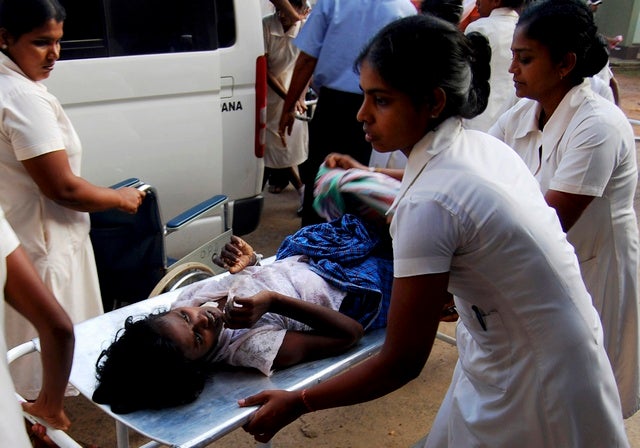
Aid workers say more than 100,000 civilians have fled the tiny coastal strip still under the control of the LTTE, flooding hospitals in the north and overwhelming government-run camps for the displaced.

Dr Gnana Gunalan, director of health services in Trincomalee district and former chairman of Sri Lanka Red Cross, told Al Jazeera that the displaced people he saw had starved for days and were malnourished and needed food.

“Their first priority is food. Everybody is asking for food,” he said.

The UN says at least 50,000 civilians remain caught in the war zone.

The Tamil Tigers says the number of civilians is three times that estimated by the UN.

Medicine shortage

Dr Thangamuttu Sathyamurthi, a senior Sri Lankan government health official, said on Friday that there was a severe shortage of food and medicines.

The government has barred aid groups and journalists from the area since last year, arguing that it is too dangerous for them.

The UN sent John Holmes, its senior humanitarian official, to Sri Lanka on Saturday to look into the welfare of the civilians, Marie Okabe, the UN deputy spokeswoman,  said.

The humanitarian situation “continues to be critical, civilian casualties have been tragically high and their suffering horrendous,” Okabe said.

Thousands killed

The UN says nearly 6,500 civilians have been killed in the fighting over the past three months.

The Tigers, listed as a terror group by many Western nations, have been fighting since 1983 for an ethnic Tamil state in the north and east after decades of what they call marginalisation by governments dominated by the Sinhalese majority.

After more than three years of intense fighting, the government appears on the verge of crushing the group.

Riding a wave of popularity from its war success, Sri Lanka’s ruling party appeared the favorite to win Saturday’s council election in the Western province.

Sri Lanka: Disregard for Civilian Safety Appalling

February 6, 2009
Tamil Tigers Also Preventing Civilians From Fleeing Fighting

Human Rights Watch, February 3, 2009

Laws-of-war violations by one side never justify violations by the other. The government and the LTTE appear to be holding a perverse contest to determine who can show the least concern for civilian protection.

Brad Adams, Asia director at Human Rights Watch.

(New York) – A Sri Lankan government statement that it is not responsible for the safety of civilians who remain in areas controlled by the separatist Liberation Tigers of Tamil Eelam (LTTE) indicates an appalling disregard for the well-being of the civilian population and is contrary to international law, Human Rights Watch said today. There are continuing reports of high civilian casualties in the fighting between government forces and the LTTE in the Mullaittivu district of the northern Vanni area.

A Ministry of Defense statement issued on February 2, 2009, states: “While the Security Forces accept all responsibility to ensure the safety and protection of civilians in the Safety Zones, they are unable to give such an assurance to those who remain outside these zones. Therefore, the government, with full responsibility, urges all civilians to come to the Safety Zones; and also states that as civilians who do not heed this call will be among LTTE cadres, the Security Forces will not be able to accept responsibility for their safety.”

“The Sri Lankan government knows full well that the civilians caught up in the current fighting are dangerously trapped,” said Brad Adams, Asia director at Human Rights Watch. “The government shows callous indifference by saying civilians should not expect the government to consider their safety and security.”

Under the laws of war applicable to the fighting in Sri Lanka, parties to a conflict must take all feasible precautions during military operations to minimize loss of civilian life. Disregarding the distinction between civilians and combatants, as the government statement suggests, violates a fundamental principle of the laws of war. Combatants who order or conduct deliberate or indiscriminate attacks against civilians are responsible for war crimes.

The International Committee of the Red Cross (ICRC) and local health workers have expressed considerable concern over civilian deaths and injuries from artillery shelling. The ICRC reported that over the past weekend, the hospital in LTTE-controlled Puthukkudiyiruppu, known as PTK, was hit three times by artillery during a 24-hour period, causing at least nine deaths and numerous injuries. The hospital was struck a fourth time on February 2, killing three people and wounding 10, resulting in the hospital’s partial evacuation.

Under the laws of war, hospitals are strictly protected from attack unless they are being used for military purposes and ample warning is provided. Because the Sri Lankan government has denied independent journalists and human rights monitors access to the area, Human Rights Watch has not been able to conduct its own field investigations into the conduct of hostilities by government forces and the LTTE.

Human Rights Watch also reiterated its deep concerns that the LTTE was placing civilians at grave risk by preventing them from leaving conflict zones. The political leader of the LTTE, B. Nadesan, recently told the media: “Of course our people can move wherever they want.” However Nadesan’s assertion was not borne out by reports from sources on the ground, Human Rights Watch said. Civilians in LTTE-controlled areas have consistently been prevented from fleeing the battle zone to reach safer areas under government control.

The laws of war require a party to an armed conflict to remove civilians from areas where they are deploying their military forces. Combatants who deliberately use civilians as “human shields” to deter attacks on their forces are responsible for war crimes (http://www.hrw.org/en/reports/2008/12/15/trapped-and-mistreated-0 ).

Human Rights Watch again called on the Sri Lankan government to stop detaining civilians who manage to flee LTTE-controlled areas, including entire families, in government camps, and to permit them to move in with relatives and host families. Both sides should permit impartial humanitarian agencies to have full access to the population at risk (http://www.hrw.org/en/reports/2008/12/22/besieged-displaced-and-detained ).

“Laws-of-war violations by one side never justify violations by the other,” said Adams.  “The government and the LTTE appear to be holding a perverse contest to determine who can show the least concern for civilian protection.”