Posts Tagged ‘invasion and occupation of Iraq’

Calling a Time Out

January 24, 2009

As you settle into the Oval Office, Mr. President, may I offer a suggestion? Please do not try to put Afghanistan aright with the U.S. military. To send our troops out of Iraq and into Afghanistan would be a near-perfect example of going from the frying pan into the fire. There is reason to believe some of our top military commanders privately share this view. And so does a broad and growing swath of your party and your supporters.

True, the United States is the world’s greatest power — but so was the British Empire a century ago when it tried to pacify the warlords and tribes of Afghanistan, only to be forced out after excruciating losses. For that matter, the Soviet Union was also a superpower when it poured some 100,000 troops into Afghanistan in 1979. They limped home, broken and defeated, a decade later, having helped pave the way for the collapse of the Soviet Union.

It is logical to conclude that our massive military dominance and supposedly good motives should let us work our will in Afghanistan. But logic does not always prevail in South Asia. With belligerent Afghan warlords sitting atop each mountain glowering at one another, the one factor that could unite them is the invasion of their country by a foreign power, whether British, Russian or American.

I have believed for some time that military power is no solution to terrorism. The hatred of U.S. policies in the Middle East — our occupation of Iraq, our backing for repressive regimes such as Egypt and Saudi Arabia, our support of Israel — that drives the terrorist impulse against us would better be resolved by ending our military presence throughout the arc of conflict. This means a prudent, carefully directed withdrawal of our troops from Iraq, Afghanistan, Saudi Arabia, Qatar and elsewhere. We also need to close down the imposing U.S. military bases in this section of the globe, which do so little to expand our security and so much to stoke local resentment.

We cannot evade this reckoning. The British thought they could extend their control over Iraq even while pulling out their ground forces by creating a string of bases in remote parts of the country, away from the observation of most Iraqis. It didn’t work. No people that desires independence and self-determination wishes to have another nation’s military bases in its country. In 1776, remember, 13 little colonies drove the mighty British Empire from American soil.

In 2003, the Bush administration ordered an invasion of Iraq, supposedly to reduce terrorism. But six years later, there is more terrorism and civil strife in Iraq, not less. The same outcome may occur in Afghanistan if we make it the next American military conflict.

Mr. President, the bright promise of your brilliant campaign for the White House and the high hopes of the millions who thronged the Mall on Tuesday to watch you be sworn in could easily be lost in the mountains and wastelands of Afghanistan.

The Nobel Prize-winning economist Joseph E. Stiglitz has estimated that the war in Iraq will have a total cost of more than $3 trillion. That war has clearly weakened our economy and our armed forces even as it has made the national debt soar. The Bush administration committed itself to Iraq before the recession. Today, with our economy teetering, does the Obama administration believe that it is time for yet another costly war in yet another Muslim country?

I’m aware that some of my fellow Americans regard me as too idealistic. But sometimes idealism is the best realism. And at a minimum, realism and idealism need not be contradictory. The invasion and occupation of Iraq has not only angered Iraqis who have lost family members, neighbors or homes; it has also increased the level of anger throughout the Muslim world and thrown up obstacles to our political leadership in that deeply important part of the planet.

Like you, Mr. President, I don’t oppose all wars. I risked my life in World War II to protect our country against genuine danger. But it is the vivid memory of my fellow airmen being shot out of the sky on all sides of me in a war that I believe we had to fight that makes me cautious about sending our youth into needless conflicts that weaken us at home and abroad, and may even weaken us in the eyes of God.

As you have noted, Mr. President, we take pride in our soldiers who conduct themselves bravely. But as you have also said, some of these soldiers have served two, three and even four tours in dangerous combat. Many of them have come home with enduring brain and nerve damage and without arms and legs. These troops need rest, rehabilitation and reunions with their families.

So let me suggest a truly audacious hope for your administration: How about a five-year time-out on war — unless, of course, there is a genuine threat to the nation?

During that interval, we could work with the U.N. World Food Program, plus the overseas arms of the churches, synagogues, mosques and other volunteer agencies to provide a nutritious lunch every day for every school-age child in Afghanistan and other poor countries. Such a program is now underway in several countries approved by Congress and the United Nations, under the auspices of the George McGovern-Robert Dole International Food for Education and Child Nutrition Act. (Forgive the self-serving title.) Although the measure remains painfully underfunded, with the help of other countries, we are reaching millions of children. We could supplement these efforts with nutritional packages for low-income pregnant and nursing mothers and their infants from birth through the age of 5, as is done here at home by WIC, the Special Supplemental Nutrition Program for Women, Infants and Children.

Is this proposal pie-in-the-sky? I don’t think so. It’s food in the stomachs of hungry kids. It would draw them to school and enable them to learn and grow into better citizens. It would cost a small fraction of warfare’s cost, but it might well be a stronger antidote to terrorism. There will always be time for another war. But hunger can’t wait.
George McGovern, a former senator from South Dakota, was the Democratic nominee for president in 1972.

Bush’s ‘coalition of the willing’ abandons Iraq

November 29, 2008

President Bush’s “coalition of the willing” is set to all but disappear from Iraq by the end of the year, with 13 countries, including South Korea, Japan, Moldova and Tonga preparing to withdraw their few remaining troops.

Britain, Australia, Romania, Estonia and El Salvador are the only nations, apart from the US, that plan to remain after a UN mandate authorising their presence expires on December 31.

London must still reach an agreement with Baghdad, however, to keep its 4,100-strong contingent on the ground into the new year. Failure to do so in time would leave British troops without legal cover and they too would have to leave.

“We are going to say farewell to 13 different nations in the space of two and a half weeks,” said Brigadier-General Nicolas Matern, a deputy commander for Multi-National Corps Iraq, which oversees the US military’s coalition partners.

“We started off with 35 countries but it has steadily been going down … As from December it is going to go all the way down,” he told The Times.

A farewell ceremony took place on Wednesday for 76 Macedonian soldiers. Another is due today for 86 troops from Bosnia and Herzegovina and a third is scheduled for South Korea’s contingent tomorrow. Others set to follow suit include soldiers from Albania, Azerbaijan, the Czech Republic, Denmark, Lithuania and Ukraine.

President Bush and Tony Blair scrambled the coalition together in the build-up to the Iraq invasion in a bid to put an international face on what was fast becoming an unpopular war. But the list of participants drew scorn for failing to include a greater number of powerful states, with the US and Britain the main contributors.

The size of the outgoing contingents ranges from just 4 Lithuanians to 300 South Koreans. Many countries have reduced their presence over the past five years, but it has always been a fraction of the US deployment, now standing at 146,000.

Bulgaria – with only 150 troops left in Iraq – has had forces south of Baghdad since June 2003, taking part in various operations, including patrols and guard duty. Thirteen Bulgarian soldiers have been killed and 81 injured in that time.

Lieutenant Colonel Valeri Kolev Valchanov said: “I think we have contributed somehow towards the stabilisation of the country.”

Bulgaria’s troops are also preparing to pull out next month, a move that triggers mixed emotions for the Bulgarian officer. “I will never forget my friendships with Romanian soldiers, Ukrainian soldiers, Polish soldiers, American soldiers,” he said. “We were in dangerous conditions together and celebrated good moments together.”

Major Mario Ernesto Argueta is from El Salvador, which has 200 troops working on humanitarian projects in Wasit province, south of the Iraqi capital. He too believes that the efforts of a tiny contingent make an impact.

“It doesn’t matter how many we are, the most important part is that you made a difference, not for the whole country but for the person who got the aid,” he said.

El Salvador is one of four coalition countries – excluding the United States and Britain – which have been invited to stay in Iraq beyond the end of the year.

“The US approached the Government of Iraq asking that we consider asking a few countries other than the United Kingdom to continue to provide some specialist forces for non-combat tasks after 31 December,” said Mowaffak al-Rubaie, Iraq’s National Security Adviser. “After considering the request, the Prime Minister agreed and those countries were invited to continue to assist us.”

Formal agreements will be made with El Salvador, Australia, Romania and Estonia once a long-awaited security pact with the United States, which was approved by Parliament on Thursday, becomes law.

Outside the coalition, the North Atlantic Treaty Organisation, which has 200 troops from 15 countries in Iraq, is also trying to finalise an accord with Baghdad to continue a training mission in the country beyond the end of 2008.

In addition, the United Nations has a number of Fijian troops working in Iraq.

While the coalition is dissolving, another force of foreigners is still thriving in the country: thousands of private contractors from developing countries such as Peru, Uganda, the Philippines and Bangladesh.

Zionism, the United States, and Hegemony in the Middle East

November 26, 2008

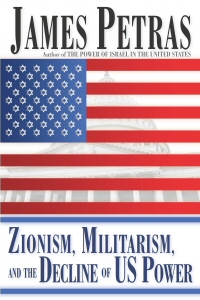
Zionism, Militarism, and the Decline OF US Power
By James Petras

Paperback: 192 pages
(Clarity Press, 2008)
ISBN-10: 0-932863-60-4
ISBN-13: 978-0-932863-60-7

Professor James Petras has written another book — Zionism, Militarism, and the Decline OF US Power — probing deeper into what he contends is a Zionist Power Configuration (ZPC) that has infiltrated and largely usurped US foreign policy even using the US military for its ends in the Middle East. Petras fills his book with lots of evidence backed by sound rationales.

Petras’s thesis is that Israel — and not Big Oil — was behind the push to invade and occupy Iraq. That has already happened. What concerns Petras now is the push by the ZPC to have the United States again breach international law and launch an attack against Iran.

Petras reasons that the ZPC’s purpose is to incorporate Palestine and consolidate its hegemony in the Middle East. Strategically, gaining and holding sway over the planet’s preeminent military power has been a major plank toward this goal.

The professor provides numerous examples of the sway the ZPC wields and how it wields it: through its propaganda and media arms (Petras cites how, pre-“war,” the Lobby produced about 8,800 pro-Iraq attack pieces which were circulated to major Anglo-American media versus zero pro-Iraq attack pieces published from Big Oil spokespeople); through its academic acolytes; through involving US soldiers to fight its wars (Petras charges that the Israel Firsters “ridicule the US military precisely to instigate them to prosecute wars and thereby avoid the loss of Israeli-Jewish lives”); through the relative silence of dissenting voices, including dissenting Jewish voices in mass media; through members of the US Congress beholden through acceptance of campaign contributions form the Lobby.

Campaign contributions turn out, actually, to be an investment. Through seeding the US Congress, Israel has become the prime beneficiary of US “aid,” even though Israel is a relatively well-to-do state, especially compared to many of its neighbors. Petras wavers on what the “US annual ‘tribute to Israel’” is. On page 68, he cites a figure of $6 billion a year; on page 68 he states $3 billion a year; on page 156, it is $2.4 billion a year; and on page 164 it is “well over $3 billion” a year. This irritation contributes to unevenness in Petras’s account.

Exacerbating this irritation is an uneven patchwork of endnotes. Sometimes key points are in the endnotes, and sometimes key points are not in the endnotes. For example, he writes that Big Oil is anxious and fearful about an Israeli-instigated warmongering destabilizing the Middle East citing a source for this claim (p. 32). On page 92 he claims electoral chicanery without citation. Whether the claims are true or not is beside the point, which is that the reader is hindered from checking the professor’s sources. And when there are endnotes, many convey scanty information (e.g., no author, no title, no page) that forces a reader to spend inordinate time tracking down a citation.

Petras, however, deserves kudos for taking on the Lobby which resorts to disreputable tactics to try and silence its critics. Petras does not shirk from identifying how he perceives the threat from the ZPC: “The lesson is clear: the rise of Judeo-fascism represents a clear and present danger to our democratic freedoms in the United States.”

The ZPC is ruthless says Petras, who observes that Israel reneges on obligations as an occupier in Palestine and engages in “meat-grinder genocidal policies in Gaza.” And yet, it has vulnerabilities, such as the “repeated failures and incredible stupidity of the Israeli intelligence agencies.”

The ZPC control apparatus is necessarily twined with the corporate media. “State provocations,” writes Petras, “require uniform mass media complicity in the lead-up to open warfare.”

With a massive media blitz and compliant government, Israel recruits US soldiers to fight its wars. The US, on the other hand, tries to get its victims to fight against their fellow countryfolk. This is a dubious strategy reasons Petras, as Iraqis fighters under occupation “recruited on basis of hunger and unemployment (caused by US war) are unreliable soldiers.”

This, according to Petras, is a losing tactic: “US colonization of Iraq is a blatant denial of the conditions necessary for reconciliation.”

Just how losing a strategy it is to run a militaristic economy is evidenced by the massive capitalistic expansion of non-belligerent China. In fact, the US is becoming less competitive and falling into an increasingly dire economic situation

Petras describes a schism among Jewry. He notes that “most Jewish Americans differ from the leaders of the major American Jewish organizations” … but that “they have not or do not challenge” this leadership. Antiwar sentiment among Jewish Americans, finds Petras, is quite vague.

He writes that “both the progressive majority of Jews and the reactionary minority … have a fundamental point of agreement and convergence: support for and identity with Israel and its anti-Arab prejudices, its expansion, and the dispossession of Palestine [sic].”

Given that the peace movement has gone AWOL, this bodes ill for the peoples of the Middle East. Here again, Petras holds the ZPC responsible since he charges that it has also infiltrated the antiwar movement and split it, rendering it anemic.

Petras notes that everywhere he visits around the globe people from all walks ask him why American citizens tolerate the killing done by the US government/military. This is a good question, but another question is unasked by Petras. Why do these citizens not demand the same answers from their complicit governments which, even when they do not contribute fighters to a so-called Coalition of the Willing, remain silent to the great criminal breaches of international law and the abandonment of morality?

That is why Petras’s thesis in Zionism, Militarism, and the Decline OF US Power is important: innocent people are dying for wicked reasons.

Kim Petersen is co-editor of Dissident Voice. He can be reached at: kim@dissidentvoice.org. Read other articles by Kim.

Will International Law Reach Bush?

September 24, 2008

RINF.INFO, Tuesday, September 23rd, 2008

By Peter Dyer

Q: What do Radovan Karadzic, former French Prime Minister Dominique de Villepin, and George W. Bush have in common? A: Each lives under the slowly growing shadow of a body of international criminal law.

This law is evolving towards the ultimate goal of holding even the most powerful leaders personally accountable for crimes committed by the State.

It is manifested in international agreements and statutes such as the Geneva Conventions, case law, two ad hoc war crimes tribunals (Yugoslavia and Rwanda), and a permanent International Criminal Court.

Radovan Karadzic, former Bosnian Serb President, has been arrested and now awaits trial in The Hague before the International Criminal Tribunal for the former Yugoslavia (I.C.T.Y.) on charges of genocide and crimes against humanity.

Dominique de Villepin is one of 33 French military and political leaders who have recently been accused in a report released by the Rwandan government of arming and advising Hutu leaders in the genocide and crimes against humanity of 1994.

(At the time Rwanda was a French client state and de Villepin was chief aide to French Foreign Minister Alain Juppe. The 500-page report, based on a two-year investigation, accuses both men of crimes including enabling the genocide by violating a United Nations Security Council Arms Embargo against Rwanda.)

George W. Bush in March 2003 ordered “Operation Shock and Awe” (though officially dubbed “Operation: Iraqi Freedom”) – the unprovoked invasion and occupation of Iraq – presenting the world with a clear prima facie case of aggression.

Aggression, in the words of the judgment delivered at the first Nuremberg Trial, is “the supreme international crime” because it unleashes all the other devastation and inhumanity of war.

Personal accountability by state leaders for the crime of aggression – initiating an unprovoked war – is the most profound as well as the most difficult goal of the continuing evolution of international criminal law.

For this reason, and because President Bush is head of the world’s most powerful state, clearly the shadow of the law is at present less ominous to him than to Karadzic or perhaps to de Villepin.

But there is no statute of limitations for any of these crimes. Things change over time, often unpredictably. And the international community has been working steadily towards this difficult goal for decades.

No doubt the work will continue.

Continued . . .

This is a tale of US expansion not Russian aggression

August 14, 2008

War in the Caucasus is as much the product of an American imperial drive as local conflicts. It’s likely to be a taste of things to come

Seumas Milne

The Guardian, Thursday August 14 2008

The outcome of six grim days of bloodshed in the Caucasus has triggered an outpouring of the most nauseating hypocrisy from western politicians and their captive media. As talking heads thundered against Russian imperialism and brutal disproportionality, US vice-president Dick Cheney, faithfully echoed by Gordon Brown and David Miliband, declared that “Russian aggression must not go unanswered”. George Bush denounced Russia for having “invaded a sovereign neighbouring state” and threatening “a democratic government”. Such an action, he insisted, “is unacceptable in the 21st century”.

Could these by any chance be the leaders of the same governments that in 2003 invaded and occupied – along with Georgia, as luck would have it – the sovereign state of Iraq on a false pretext at the cost of hundreds of thousands of lives? Or even the two governments that blocked a ceasefire in the summer of 2006 as Israel pulverised Lebanon’s infrastructure and killed more than a thousand civilians in retaliation for the capture or killing of five soldiers?

You’d be hard put to recall after all the fury over Russian aggression that it was actually Georgia that began the war last Thursday with an all-out attack on South Ossetia to “restore constitutional order” – in other words, rule over an area it has never controlled since the collapse of the Soviet Union. Nor, amid the outrage at Russian bombardments, have there been much more than the briefest references to the atrocities committed by Georgian forces against citizens it claims as its own in South Ossetia’s capital Tskhinvali. Several hundred civilians were killed there by Georgian troops last week, along with Russian soldiers operating under a 1990s peace agreement: “I saw a Georgian soldier throw a grenade into a basement full of women and children,” one Tskhinvali resident, Saramat Tskhovredov, told reporters on Tuesday.

Might it be because Georgia is what Jim Murphy, Britain’s minister for Europe, called a “small beautiful democracy”. Well it’s certainly small and beautiful, but both the current president, Mikheil Saakashvili, and his predecessor came to power in western-backed coups, the most recent prettified as a “Rose revolution”. Saakashvili was then initially rubber-stamped into office with 96% of the vote before establishing what the International Crisis Group recently described as an “increasingly authoritarian” government, violently cracking down on opposition dissent and independent media last November. “Democratic” simply seems to mean “pro-western” in these cases.

The long-running dispute over South Ossetia – as well as Abkhazia, the other contested region of Georgia – is the inevitable consequence of the breakup of the Soviet Union. As in the case of Yugoslavia, minorities who were happy enough to live on either side of an internal boundary that made little difference to their lives feel quite differently when they find themselves on the wrong side of an international state border.

Such problems would be hard enough to settle through negotiation in any circumstances. But add in the tireless US promotion of Georgia as a pro-western, anti-Russian forward base in the region, its efforts to bring Georgia into Nato, the routing of a key Caspian oil pipeline through its territory aimed at weakening Russia’s control of energy supplies, and the US-sponsored recognition of the independence of Kosovo – whose status Russia had explicitly linked to that of South Ossetia and Abkhazia – and conflict was only a matter of time.

The CIA has in fact been closely involved in Georgia since the Soviet collapse. But under the Bush administration, Georgia has become a fully fledged US satellite. Georgia’s forces are armed and trained by the US and Israel. It has the third-largest military contingent in Iraq – hence the US need to airlift 800 of them back to fight the Russians at the weekend. Saakashvili’s links with the neoconservatives in Washington are particularly close: the lobbying firm headed by US Republican candidate John McCain’s top foreign policy adviser, Randy Scheunemann, has been paid nearly $900,000 by the Georgian government since 2004.

But underlying the conflict of the past week has also been the Bush administration’s wider, explicit determination to enforce US global hegemony and prevent any regional challenge, particularly from a resurgent Russia. That aim was first spelled out when Cheney was defence secretary under Bush’s father, but its full impact has only been felt as Russia has begun to recover from the disintegration of the 1990s.

Over the past decade, Nato’s relentless eastward expansion has brought the western military alliance hard up against Russia’s borders and deep into former Soviet territory. American military bases have spread across eastern Europe and central Asia, as the US has helped install one anti-Russian client government after another through a series of colour-coded revolutions. Now the Bush administration is preparing to site a missile defence system in eastern Europe transparently targeted at Russia.

By any sensible reckoning, this is not a story of Russian aggression, but of US imperial expansion and ever tighter encirclement of Russia by a potentially hostile power. That a stronger Russia has now used the South Ossetian imbroglio to put a check on that expansion should hardly come as a surprise. What is harder to work out is why Saakashvili launched last week’s attack and whether he was given any encouragement by his friends in Washington.

If so, it has spectacularly backfired, at savage human cost. And despite Bush’s attempts to talk tough yesterday, the war has also exposed the limits of US power in the region. As long as Georgia proper’s independence is respected – best protected by opting for neutrality – that should be no bad thing. Unipolar domination of the world has squeezed the space for genuine self-determination and the return of some counterweight has to be welcome. But the process of adjustment also brings huge dangers. If Georgia had been a member of Nato, this week’s conflict would have risked a far sharper escalation. That would be even more obvious in the case of Ukraine – which yesterday gave a warning of the potential for future confrontation when its pro-western president threatened to restrict the movement of Russian ships in and out of their Crimean base in Sevastopol. As great power conflict returns, South Ossetia is likely to be only a taste of things to come.

s.milne@guardian.co.uk