From Axis of Logic
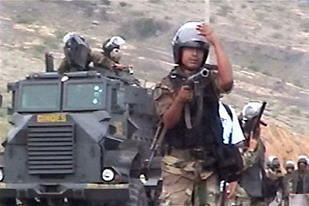 |
| The clash is the latest in a series over land rights in Peru. AFP |
Bagua, Peru (June 5, 2009) – At approximately 5 am this morning, the Peruvian special forces police staged a violent raid on a group of indigenous people at a peaceful blockade on a road outside of Bagua, in a remote area of northern Peruvian Amazon. Several thousand Awajun and Wambis indigenous peoples were forcibly dispersed by tear gas and real bullets, among them are confirmed reports of at least 50 injured and 22 indigenous people and 9 police officers dead.
At 2am police began to approach the demonstrators as they were sleeping along the Fernando Belaúnde Terry road. Demonstrators refused to move from the roadblock as helicopters dropped teargas bombs from overhead. Eyewitnesses report that police attacked from both sides firing real bullets into the crowd as people fled into the steep hillsides. Many had no where to go. As the unarmed demonstrators were killed and injured some wrestled the Police and took away their guns and fought back in self-defense. The violence was clearly provoked by the Police as protesters had been peacefully blockading the road for over 56 days.
In local radio reports, the chief of Police claimed that the indigenous demonstrators were armed with guns necessitating the use of bullets for dispersal. This claim is refuted by dozens of local eyewitnesses including local journalists. A local conservationist reported from the scene that the Amazonian demonstrators have been entirely peaceful and only bear traditional spears and in no way provoked any violence. However several conservative media sources are propagating the government’s misinformation campaign that aims to blame the victims for the violence.
The Garcia Government yesterday accused the indigenous movement of being violent, conflating non-violent civil disobedience with violent rebellion to justify its actions. The President issued an order for the police to begin forcibly removing indigenous demonstrations that have paralyzed the Amazon region of Peru for nearly two months.
Gregor MacLennan of Amazon Watch who is currently in Peru stated: “It is outrageous and absolutely untrue that indigenous peoples provoked violence. Rather, they are engaged in peaceful and non-violent civil disobedience. It has been the Peruvian Government forces who have provoked violence against peaceful people who are trying to protect their forests, their sacred lands from shortsighted pollution and industrial development. They are sacrificing a lot to safeguard the Amazon for future generations and for all Peruvians.”
Indigenous peoples have vowed to continue protests until the Peruvian Congress revokes the “free trade” decrees issued by President Garcia under special powers granted by Congress in the context of the Free Trade Agreement with the United States.
In the past two weeks, the constitutional committee of Congress has ruled that legislative decree 994 and 1090 were unconstitutional. The Peruvian Congress was scheduled to debate the revocation of decree 1090 again yesterday, however, Garcia’s political party for the third time prevented the debate preferring instead to attack the peaceful blockades. The government Ombudsman office has filed a legal action with the constitutional tribunal on the unconstitutionality of decree 1064, which affects the land rights laws in Peru.
The protests have provoked national debate about government policies in the Amazon that ignore indigenous peoples and encourage large-scale extractive industries and the privatization of Amazonian lands. Indigenous peoples claim that new laws undermine their rights and open up their ancestral lands to private companies for mining, logging, plantations and oil drilling.
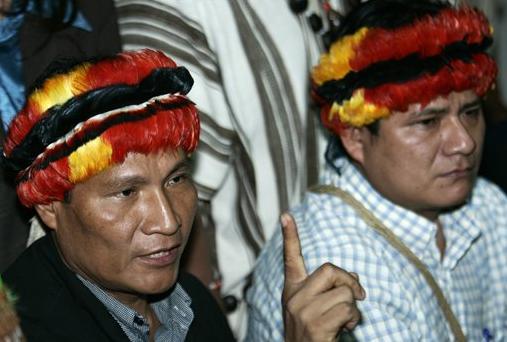 |
| Alberto Pizango, left, president of the Peruvian Jungle Inter-Ethnic Development Association, speaks during a news conference in Lima, June 5, 2009. Karel Navarro |
AIDESEP, the national indigenous organization of Peru presented a legal petition for “precautionary measures” to the Inter-American Commission on Human Rights requesting intervention to prevent more bloodshed. Orders for the arrest of leaders of AIDESEP, including Alberto Pizango was put in effect today.
Indigenous Peoples are planning a nationwide general strike starting June 11th.
A coalition of human rights and environmental organizations are urging the Garcia Government to stand down and cease violent confrontations by the military and calling for solidarity demonstrations at Peruvian Embassies around the world. Today, there were demonstrations at the Peruvian Government Mission in San Francisco and Washington DC.
For Background information see www.amazonwatch.org or www.aidesep.org.pe

 Peace and Justice Post
Indigenous People Across Latin America Protest Spanish ‘Genocide’
October 14, 2009GUATEMALA CITY – Tens of thousands of indigenous people took to the streets across Latin America on Monday to protest the anniversary of Christopher Columbus’s 1492 discovery of the Americas.
Columbus Day is celebrated as the Day of Hispanic Heritage in Latin America, but protesters marked the holiday as a reminder of the atrocities Spanish conquistadors wrought on indigenous people throughout the region.
In Guatemala City, 19-year-old demonstrator Imer Boror was killed and two were wounded as Maya Indians blocked entry points into the capital to protest their government’s mining policies.
Protesters were marching on what they called the Day of Dignity and Resistance of the Indian People, protest leader Juana Mulul told AFP, saying the movement “is purely in defense of Mother Earth and our territory.”
In a gesture toward reconciliation with indigenous groups, a special roundtable appointed by President Alvaro Colom after the incident was to meet with 14 poor farmers late Monday to discuss their demands.
Continues >>
Share this:
Tags:anniversary of Columbus, atrocities, indigenous people, Latin America, protests, Spanish conquistadors
Posted in Commentary, crime, Uncategorized | Leave a Comment »