Posts Tagged ‘Donald Rumsfeld’

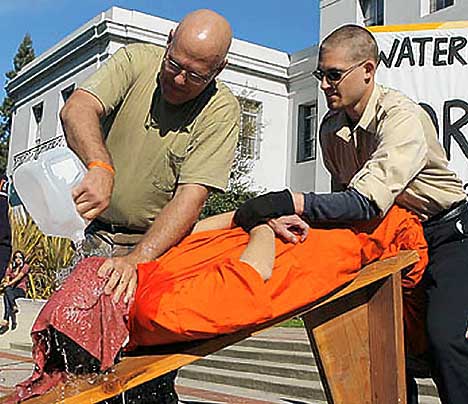
Waterboarding Got White House Nod

October 15, 2008

CIA Tactics Endorsed In Secret Memos

Joby Warrick
Washington Post Staff Writer
Wednesday, October 15, 2008; Page A01

The Bush administration issued a pair of secret memos to the CIA in 2003 and 2004 that explicitly endorsed the agency’s use of interrogation techniques such as waterboarding against al-Qaeda suspects — documents prompted by worries among intelligence officials about a possible backlash if details of the program became public.

The classified memos, which have not been previously disclosed, were requested by then-CIA Director George J. Tenet more than a year after the start of the secret interrogations, according to four administration and intelligence officials familiar with the documents. Although Justice Department lawyers, beginning in 2002, had signed off on the agency’s interrogation methods, senior CIA officials were troubled that White House policymakers had never endorsed the program in writing.

The memos were the first — and, for years, the only — tangible expressions of the administration’s consent for the CIA’s use of harsh measures to extract information from captured al-Qaeda leaders, the sources said. As early as the spring of 2002, several White House officials, including then-national security adviser Condoleezza Rice and Vice President Cheney, were given individual briefings by Tenet and his deputies, the officials said. Rice, in a statement to congressional investigators last month, confirmed the briefings and acknowledged that the CIA director had pressed the White House for “policy approval.”

The repeated requests for a paper trail reflected growing worries within the CIA that the administration might later distance itself from key decisions about the handling of captured al-Qaeda leaders, former intelligence officials said. The concerns grew more pronounced after the revelations of mistreatment of detainees at the Abu Ghraib prison in Iraq, and further still as tensions grew between the administration and its intelligence advisers over the conduct of the Iraq war.

Continued . . .

POLITICS-US: Vested Interests Drove New Pakistan Policy

September 18, 2008

Analysis by Gareth Porter | Inter-Press Service News

WASHINGTON, Sep 17 – The George W. Bush administration’s decision to launch commando raids and step up missiles strikes against Taliban and al Qaeda figures in the tribal areas of Pakistan followed what appears to have been the most contentious policy process over the use of force in Bush’s eight-year presidency.

That decision has stirred such strong opposition from the Pakistani military and government that it is now being revisited. Adm. Mike Mullen, chairman of the Joint Chiefs of Staff, arrived in Pakistan Tuesday for the second time in three weeks, and U.S. officials and sources just told Reuters that any future raids would be approved on a mission-by-mission basis by a top U.S. administration official.

The policy was the result of strong pressure from the U.S. command in Afghanistan and lobbying by the Special Operations Command (SOCOM) and the CIA’s operations directorate (DO), both of which had direct institutional interests in operations that coincided with their mandate.

State Department and some Pentagon officials had managed to delay the proposed military escalation in Pakistan for a year by arguing that it would be based on nearly nonexistent intelligence and would only increase support for the Islamic extremists in that country.

But officials of SOCOM and the CIA prevailed in the end, apparently because Bush and Vice President Dick Cheney believed they could not afford to be seen as doing nothing about bin Laden and al Qaeda in the administration’s final months.

SOCOM had a strong institutional interest in a major new operation in Pakistan.

The Army’s Delta Force and Navy SEALS had been allowed by the Pakistani military to accompany its forces on raids in the tribal area in 2002 and 2003 but not to operate on their own. And even that extremely limited role was ended by Pakistani President Pervez Musharraf in 2003, which frustrated SOCOM officials.

Defence Secretary Donald Rumsfeld, whose antagonism toward the CIA was legendary, had wanted SOCOM to take over the hunt for bin Laden. And in 2006, SOCOM’s Joint Special Operations Command branch in Afghanistan pressed Rumsfeld to approve a commando operation in Pakistan aimed at capturing a high-ranking al Qaeda operative.

SOCOM had the support of the U.S. command in Afghanistan, which was arguing that the war in Afghanistan could not be won as long as the Taliban had a safe haven in Pakistan from which to launch attacks. The top U.S. commander, Lt. Gen. Karl Eikenberry, worked with SOCOM and DO officers in Afghanistan to assemble the evidence of Pakistan’s cooperation with the Taliban. .

Despite concerns that such an operation could cause a massive reaction in Pakistan against the U.S. war on al Qaeda, Rumsfeld gave in to the pressure in early November 2006 and approved the operation, according to an account in the New York Times Jun. 30. But within days, Rumsfeld was out as defence secretary, and the operation was put on hold.

Nevertheless Bush and Cheney, who had been repeating that Musharraf had things under control in the frontier area, soon realised that they would be politically vulnerable to charges that they weren’t doing anything about bin Laden.

The July 2007 National Intelligence Estimate (NIE) was the signal for the CIA’s DO to step up its own lobbying for control over a Pakistan operation, based on the Afghan model — CIA officers training and arming a local militia while identifying targets for strikes from the air.

In a Washington Post column only two weeks after the NIE’s conclusions were made public, David Ignatius quoted former CIA official Hank Crumpton, who had run the CIA operation in Afghanistan after the Sep. 11, 2001 attacks, on the proposed DO operation: “We either do it now, or we do it after the next attack.”

That either-or logic and the sense of political vulnerability in the White House was the key advantage of the advocates of a new war in Pakistan. Last November, the New York Times reported that the Defence Department had drafted an order based on the SOCOM proposal for training of local tribal forces and for new authority for “covert” commando operations in Pakistan’s frontier provinces.

But the previous experience with missile strikes against al Qaeda targets using predator drones and the facts on the ground provided plenty of ammunition to those who opposed the escalation. It showed that the proposed actions would have little or no impact on either the Taliban or al Qaeda in Pakistan, and would bring destabilising political blowback.

In January 2006, the CIA had launched a missile strike on a residential compound in Damadola, near the Afghan border, on the basis of erroneous intelligence that Ayman al-Zawahiri would be there. The destruction killed as many 25 people, according to local residents interviewed by The Telegraph, including 14 members of one family.

Some 8,000 tribesmen in the Damadola area protested the killing, and in Karachi tens of thousands more rallied against the United States, shouting “Death to America!”

Musharraf later claimed that the dead included four high-ranking al Qaeda officials, including al-Zawahiri’s son-in-law. The Washington Post’s Craig Whitlock reported last week, however, that U.S. and Pakistani officials now admit that only local villagers were killed in the strike.

It was well known within the counter-terrorism community that the U.S. search for al Qaeda leaders in Pakistan was severely limited by the absence of actionable intelligence. For years, the U.S. military had depended almost entirely on Pakistan’s Inter-Services Intelligence Directorate, despite its well-established ties with the Taliban and even al Qaeda.

One of the counter-terrorism officials without a direct organisational stake in the issue, State Department counterterrorism chief Gen. Dell L. Dailey, bluntly summed up the situation to reporters last January. “We don’t have enough information about what’s going on there,” he said. “Not on al Qaeda, not on foreign fighters, not on the Taliban.”

A senior U.S. official quoted by the Post last February was even more scathing on that subject, saying “Even a blind squirrel finds a nut now and then.”

Meanwhile, the Pakistani military, reacting to the U.S. aim of a more aggressive U.S. military role in the tribal areas, repeatedly rejected the U.S. military proposal for training Frontier Corps units.

The U.S. command in Afghanistan and SOCOM increased the pressure for escalation early last summer by enlisting visiting members of Congress in support of the plan. Texas Republican Congressmen Michael McCaul, who had visited Afghanistan and Pakistan, declared on his return that was “imperative that U.S. forces be allowed to pursue the Taliban and al Qaeda in tribal areas inside Pakistan.”

In late July, according to The Times of London, Bush signed a secret national security presidential directive (NSPD) which authorised operations by special operations forces without the permission of Pakistan.

The Bush decision ignored the disconnect between the aims of the new war and the realities on the ground in Pakistan. Commando raids and missile strikes against mid-level or low-level Taliban or al Qaeda operatives, carried out in a sea of angry Pashtuns, will not stem the flow of fighters from Pakistan into Afghanistan or weaken al Qaeda. But they will certainly provoke reactions from the tribal population that can tilt the affected areas even further toward the Islamic radicals.

At least some military leaders without an institutional interest in the outcome understood that the proposed escalation was likely to backfire. One senior military officer told the Los Angeles Times last month that he had been forced by the “fragility of the current government in Islamabad,” to ask whether “you do more long-term harm if you act very, very aggressively militarily”.

*Gareth Porter is an investigative historian and journalist specialising in U.S. national security policy. The paperback edition of his latest book, “Perils of Dominance: Imbalance of Power and the Road to War in Vietnam”, was published in 2006.

(END/2008)
Divide and Conquer: The Anglo-American Imperial Project

July 11, 2008
Global Research, July 10, 2008

Establishing an “Arc of Crisis”

Many would be skeptical that the Anglo-Americans would be behind terrorist acts in Iraq, such as with the British in Basra, when two British SAS soldiers were caught dressed as Arabs, with explosives and massive arsenal of weapons.[1] Why would the British be complicit in orchestrating terror in the very city in which they are to provide security? What would be the purpose behind this? That question leads us to an even more important question to ask, the question of why Iraq was occupied; what is the purpose of the war on Iraq? If the answer is, as we are often told with our daily dose of CNN, SkyNews and the statements of public officials, to spread democracy and freedom and rid the world of tyranny and terror, then it doesn’t make sense that the British or Americans would orchestrate terror.

However, if the answer to the question of why the Anglo-American invasion of Iraq occurred was not to spread democracy and freedom, but to spread fear and chaos, plunge the country into civil war, balkanize Iraq into several countries, and create an “arc of crisis” across the Middle East, enveloping neighboring countries, notably Iran, then terror is a very efficient and effective means to an end.

An Imperial Strategy

In 1982, Oded Yinon, an Israeli journalist with links to the Israeli Foreign Ministry wrote an article for a publication of the World Zionist Organization in which he outlined a “strategy for Israel in the 1980s.” In this article, he stated, “The dissolution of Syria and Iraq into ethnically or religiously unique areas such as in Lebanon is Israel’s primary target on the Eastern front. Iraq, rich in oil on the one hand and internally torn on the other is guaranteed as a candidate for Israel’s targets. Its dissolution is even more important for us than that of Syria. Iraq is stronger than Syria. In the short run, it is Iraqi power which constitutes the greatest threat to Israel.” He continued, “An Iraqi-Iranian war will tear Iraq apart and cause its downfall at home even before it is able to organize a struggle on a wide front against us. Every kind of inter-Arab confrontation will assist us in the short run and will shorten the way to the more important aim of breaking up Iraq into denominations as in Syria and Lebanon.” He continues, “In Iraq, a division into provinces along ethnic/religious lines as in Syria during Ottoman times is possible. So, three (or more) states will exist around the three major cities: Basra, Baghdad and Mosul and Shiite areas in the South will separate from the Sunni and Kurdish north.”[2]

The Iran-Iraq War, which lasted until 1988, did not result in Oded Yinon’s desired break-up of Iraq into ethnically based provinces. Nor did the subsequent Gulf War of 1991 in which the US destroyed Iraq’s infrastructure, as well as the following decade-plus of devastating sanctions and aerial bombardments by the Clinton administration. What did occur during these decades, however, were the deaths of millions of Iraqis and Iranians.

A Clean Break for a New American Century

In 1996, an Israeli think tank, the Institute for Advanced Strategic and Political Studies, issued a report under the think tank’s Study Group on a New Israeli Strategy Toward 2000, entitled, “A Clean Break: A New Strategy for Securing the Realm.” In this paper, which laid out recommendations for Israel’s Prime Minister Benjamin Netanyahu, they state that Israel can, “Work closely with Turkey and Jordan to contain, destabilize, and roll-back some of its most dangerous threats,” as well as, “Change the nature of its relations with the Palestinians, including upholding the right of hot pursuit for self defense into all Palestinian areas,” and to, “Forge a new basis for relations with the United States—stressing self-reliance, maturity, strategic cooperation on areas of mutual concern, and furthering values inherent to the West.”

The report recommended Israel to seize “the strategic initiative along its northern borders by engaging Hizballah, Syria, and Iran, as the principal agents of aggression in Lebanon,” and to use “Lebanese opposition elements to destabilize Syrian control of Lebanon.” It also states, “Israel can shape its strategic environment, in cooperation with Turkey and Jordan, by weakening, containing, and even rolling back Syria. This effort can focus on removing Saddam Hussein from power in Iraq — an important Israeli strategic objective in its own right — as a means of foiling Syria’s regional ambitions.”[3]

The authors of the report include Douglas Feith, an ardent neoconservative who went on to become George W. Bush’s Under Secretary of Defense for Policy from 2001 to 2005; David Wurmser, who was appointed by Douglas Feith after 9/11 to be part of a secret Pentagon intelligence unit and served as a Mideast Adviser to Dick Cheney from 2003 to 2007; and Meyrav Wurmser, David’s wife, who is now an official with the American think tank, the Hudson Institute.

Richard Perle headed the study, and worked on the Pentagon’s Defense Policy Board Advisory Committee from 1987 to 2004, and was Chairman of the Board from 2001 to 2004, where he played a key role in the lead-up to the Iraq war. He was also a member of several US think tanks, including the American Enterprise Institute and the Project for the New American Century.

The Project for the New American Century, or PNAC, is an American neoconservative think tank, whose membership and affiliations included many people who were associated with the present Bush administration, such as Dick Cheney, Donald Rumsfeld, Paul Wolfowitz, John Bolton, Richard Armitage, Jeb Bush, Elliott Abrams, Eliot A. Cohen, Paula Dobriansky, Francis Fukuyama, Zalmay Khalilzad, I. Lewis “Scooter” Libby, Peter Rodman, Dov Zakheim and Robert B. Zoellick.

PNAC produced a report in September of 2000, entitled, “Rebuilding America’s Defenses: Strategy, Forces and Resources for a New Century,” in which they outlined a blueprint for a Pax Americana, or American Empire. The report puts much focus on Iraq and Iran, stating, “Over the long term, Iran may well prove as large a threat to US interests in the Gulf as Iraq has.”[4] Stating that, “the United States has for decades sought to play a more permanent role in Gulf regional security,” the report suggests that, “the unresolved conflict with Iraq provides the immediate justification,” however, “the need for a substantial American force presence in the Gulf transcends the issue of the regime change of Saddam Hussein.”[5]

Continued . . .