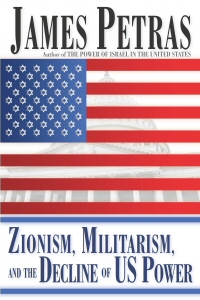
 Zionism, Militarism, and the Decline OF US Power
By James Petras
Paperback: 192 pages
(Clarity Press, 2008)
ISBN-10: 0-932863-60-4
ISBN-13: 978-0-932863-60-7
Professor James Petras has written another book — Zionism, Militarism, and the Decline OF US Power — probing deeper into what he contends is a Zionist Power Configuration (ZPC) that has infiltrated and largely usurped US foreign policy even using the US military for its ends in the Middle East. Petras fills his book with lots of evidence backed by sound rationales.
Petras’s thesis is that Israel — and not Big Oil — was behind the push to invade and occupy Iraq. That has already happened. What concerns Petras now is the push by the ZPC to have the United States again breach international law and launch an attack against Iran.
Petras reasons that the ZPC’s purpose is to incorporate Palestine and consolidate its hegemony in the Middle East. Strategically, gaining and holding sway over the planet’s preeminent military power has been a major plank toward this goal.
The professor provides numerous examples of the sway the ZPC wields and how it wields it: through its propaganda and media arms (Petras cites how, pre-“war,” the Lobby produced about 8,800 pro-Iraq attack pieces which were circulated to major Anglo-American media versus zero pro-Iraq attack pieces published from Big Oil spokespeople); through its academic acolytes; through involving US soldiers to fight its wars (Petras charges that the Israel Firsters “ridicule the US military precisely to instigate them to prosecute wars and thereby avoid the loss of Israeli-Jewish lives”); through the relative silence of dissenting voices, including dissenting Jewish voices in mass media; through members of the US Congress beholden through acceptance of campaign contributions form the Lobby.
Campaign contributions turn out, actually, to be an investment. Through seeding the US Congress, Israel has become the prime beneficiary of US “aid,” even though Israel is a relatively well-to-do state, especially compared to many of its neighbors. Petras wavers on what the “US annual ‘tribute to Israel’” is. On page 68, he cites a figure of $6 billion a year; on page 68 he states $3 billion a year; on page 156, it is $2.4 billion a year; and on page 164 it is “well over $3 billion” a year. This irritation contributes to unevenness in Petras’s account.
Exacerbating this irritation is an uneven patchwork of endnotes. Sometimes key points are in the endnotes, and sometimes key points are not in the endnotes. For example, he writes that Big Oil is anxious and fearful about an Israeli-instigated warmongering destabilizing the Middle East citing a source for this claim (p. 32). On page 92 he claims electoral chicanery without citation. Whether the claims are true or not is beside the point, which is that the reader is hindered from checking the professor’s sources. And when there are endnotes, many convey scanty information (e.g., no author, no title, no page) that forces a reader to spend inordinate time tracking down a citation.
Petras, however, deserves kudos for taking on the Lobby which resorts to disreputable tactics to try and silence its critics. Petras does not shirk from identifying how he perceives the threat from the ZPC: “The lesson is clear: the rise of Judeo-fascism represents a clear and present danger to our democratic freedoms in the United States.”
The ZPC is ruthless says Petras, who observes that Israel reneges on obligations as an occupier in Palestine and engages in “meat-grinder genocidal policies in Gaza.” And yet, it has vulnerabilities, such as the “repeated failures and incredible stupidity of the Israeli intelligence agencies.”
The ZPC control apparatus is necessarily twined with the corporate media. “State provocations,” writes Petras, “require uniform mass media complicity in the lead-up to open warfare.”
With a massive media blitz and compliant government, Israel recruits US soldiers to fight its wars. The US, on the other hand, tries to get its victims to fight against their fellow countryfolk. This is a dubious strategy reasons Petras, as Iraqis fighters under occupation “recruited on basis of hunger and unemployment (caused by US war) are unreliable soldiers.”
This, according to Petras, is a losing tactic: “US colonization of Iraq is a blatant denial of the conditions necessary for reconciliation.”
Just how losing a strategy it is to run a militaristic economy is evidenced by the massive capitalistic expansion of non-belligerent China. In fact, the US is becoming less competitive and falling into an increasingly dire economic situation
Petras describes a schism among Jewry. He notes that “most Jewish Americans differ from the leaders of the major American Jewish organizations” … but that “they have not or do not challenge” this leadership. Antiwar sentiment among Jewish Americans, finds Petras, is quite vague.
He writes that “both the progressive majority of Jews and the reactionary minority … have a fundamental point of agreement and convergence: support for and identity with Israel and its anti-Arab prejudices, its expansion, and the dispossession of Palestine [sic].”
Given that the peace movement has gone AWOL, this bodes ill for the peoples of the Middle East. Here again, Petras holds the ZPC responsible since he charges that it has also infiltrated the antiwar movement and split it, rendering it anemic.
Petras notes that everywhere he visits around the globe people from all walks ask him why American citizens tolerate the killing done by the US government/military. This is a good question, but another question is unasked by Petras. Why do these citizens not demand the same answers from their complicit governments which, even when they do not contribute fighters to a so-called Coalition of the Willing, remain silent to the great criminal breaches of international law and the abandonment of morality?
That is why Petras’s thesis in Zionism, Militarism, and the Decline OF US Power is important: innocent people are dying for wicked reasons.

 Peace and Justice Post
MIDEAST: ‘EU Paying for Gaza Blockade’
February 22, 2009By David Cronin | Inter Press Service
BRUSSELS, Feb 20 (IPS) – European Union aid has been given to an Israeli oil company which has reduced the supply of fuel to Gaza as part of an economic blockade internationally recognised as illegal, Brussels officials have admitted.
Almost 97 million euros (124 million dollars) in funds managed by the European Commission, the executive arm of the EU, were handed over directly to the firm Dor Alon between February 2008 and January this year. Under orders from the Israeli authorities, Dor Alon has been rationing the amount of industrial diesel brought into Gaza in order to deprive its 1.5 million inhabitants of electricity. Power cuts have been a regular occurrence in Gaza because of Israeli actions undertaken since the militant party Hamas won an unexpected victory in Palestinian legislative elections during 2006.
Charles Shamas from the Mattin Group, an organisation based in the West Bank that monitors Europe’s relationship with Israel, said that the EU has been helping to accommodate the economic blockade of Gaza. This is despite how the Union’s most senior diplomats, including its foreign policy chief Javier Solana and the external relations commissioner Benita Ferrero-Waldner, have condemned the blockade as ‘collective punishment’ of a civilian population. Collective punishment constitutes a war crime, according to the 1949 Geneva convention.
“The European Union has to give aid lawfully,” said Shamas. “That means a good faith effort not to conform to the wrongful acts of others. In this case, the EU is giving effect to wrongful measures by Israel. You can’t really credibly call on Israel to correct its behaviour if you are adjusting what you do to fit in to that behaviour.”
Christiane Hohmann, spokeswoman on external relations for the European Commission, said that the diesel provided by Dor Alon is used in a power plant that meets 30 percent of Gaza’s electricity requirements. Schools and hospitals are the primary beneficiaries of the EU’s aid, she added, stating that Dor Alon delivered more than 96 million litres to Gaza as a result of the money it received from the Commission over the past 12 months. Dor Alon has also benefitted from aid granted by Germany and Belgium, both EU member states.
“This is not abetting the blockade,” she said. “It is not part of it. What we are always saying to the Israelis is that they need to open the crossings (into Gaza). The heavy diesel needs to get in.”
The Commission’s aid is administered through a mechanism known as Pegase. Beginning its operations last year, Pegase is designed to bypass Hamas, while supporting activities run by its rival Fatah, the party in charge of the Palestinian Authority in the West Bank. Hohmann stressed, however, that aid to Dor Alon is paid to the company itself and “doesn’t go through any Palestinian structure.”
A spokesman for Dor Alon said that any reduction in its deliveries to Gaza has been the result of Israeli government policies. “Dor Alon is a private company, it has to do whatever the ministry of defence tells us to do,” he added. “I cannot tell you that we deliver more one day and less another day. That doesn’t concern us. We follow orders in that matter.”
One of the four largest fuel companies in Israel, Dor Alon also owns two chains of convenience stores, Alonit and AM:PM. As well as its activities in Gaza, it runs a network of petrol stations and shops in Israeli settlements in the West Bank.
“What’s happening here is that the Israeli economy is controlling access to the Palestinian markets to ensure the benefit of certain Israeli companies,” said Merav Amir, campaigner with the Coalition of Women for Peace, an organisation that studies how Israeli firms can profit from the occupation of Palestine.
Amir pointed out that all international aid destined to the Palestinian Authority has been routed through Israel since the Oslo accords. Signed between Israel’s president Shimon Peres, then foreign minister, and Palestinian president Mahmoud Abbas in 1993, this was the first agreement negotiated face-to-face between the two sides. Yet while its official title referred to the self-government of the Palestinians, many observers feel that Israel has used the agreement to reinforce its control over the West Bank and Gaza.
“Israel holds a lot of money that actually belongs to the Palestinian Authority,” added Amir. “With some of that money, it pays the suppliers in a way that sustains the dependence of the Palestinian economy (on Israel). The European Union is in a position to pressure Israel to change how all of this is done.”
Chris Davies, a British Liberal member of the European Parliament, this week described how the blockade of Gaza, which he recently visited, is having devastating consequences in a densely populated area that is struggling to come to terms with the 22-day bombardment that Israel launched in late December last year.
Although 500 lorry loads of food and other supplies are needed each day in Gaza, Israel is only allowing 130 to pass through checkpoints controlled by its troops. “Paper for schools, nappies, water purifying tablets, concrete for rebuilding, they are all prohibited,” he said. “The normal life of a big city is impossible.”
Share this:
Tags:Aid, European Union, Gaza, israeli attack on Gaza, Israeli firm Dor Alon, Israeli oil company
Posted in Commentary | Leave a Comment »