|
By Chris Bollyn |
|
|
Global Research, May 24, 2007 |
|
|
I am an independent journalist who has investigated the events of 9/11 since that terrible day in which our lives and national political reality were so drastically changed. My original research and articles have resulted in several discoveries that are central to understanding what really happened at the World Trade Center, the Pentagon, and the reclaimed mine in Lambertsville, Pennsylvania. Unfortunately, because my discoveries do not support the official government conspiracy version, I was branded an “anti-government conspiracy theorist” by those who refuse to investigate any evidence that challenges the official version. Last August 15, a gang of three undercover cops came to my house and assaulted me during an unjustified arrest. I was TASERed while restrained and my right elbow was broken in front of my wife and 8-year-old daughter. My writings made me a target of those who are dedicated to promoting the lies about 9/11. Naturally, this brutal assault took a heavy toll on me. I was thrown into a cell with no water and told to “drink from the toilet.” When I asked why undercover cops with body armor had been prowling around my house, I was told – “We are watching you.” I was subsequently charged with two trumped-up misdemeanor charges and immediately became the subject of a well-orchestrated international campaign to discredit me – and by extension my writings and research. I now face a jury trial on May 31st in the Cook County Circuit Court and would appreciate if you would contact the mayor and police chief of Hoffman Estates and express your concern for what happened to me. In today’s America, what happened to me could happen to anyone. For that reason it needs to be addressed by concerned citizens. The contact information is available here: http://www.bollyn.com/index/?id=10451 WHY ARE 9/11 RESEARCHERS TARGETED? Three weeks after I was assaulted and arrested, 9/11 researcher Professor Steven E. Jones of Brigham Young University, was slandered on the local NPR affiliate as a “anti-Semite” and removed from his teaching position at that prestigious Mormon school. Jones and I had collaborated in the spring of 2006 on his research into the molten metal seen at the World Trade Center. I had learned and reported about the molten iron found in the basements of the three collapsed towers in the summer of 2002. These reports had piqued the interest of Jones several years later. His scientific interest resulted in a thesis that Thermite-type cutter charges had been used to facilitate the destruction of the twin towers and the 47-story WTC 7. I took Jones’ research to the University of California at Davis where I met with Professor Thomas Cahill. Cahill had collected data and analyzed the smoke (with a Davis DRUM) that rose from the WTC debris pile from early October until Christmas 2001. The extraordinary abundance of nano-size particles in the smoke indicated that the molten metal beneath the towers was hotter than the boiling point of iron and the other metals found in the bluish smoke. This is the kind of evidence that those who support the official version hate. SMEAR-AND-FEAR CAMPAIGN Were the attacks on me and Professor Jones related? Were we attacked, slandered, and discredited because we were asking too many questions about 9/11? In her recent article, “War and the Police State: Complicity of the American People,” published by Global Research Donna J. Thorne wrote, “Fearing exposure, the Czars of Propaganda know that ‘Truthers’ must be branded and discredited if government corruption and corporate fraud is to flourish unabated.” “Fear attempts to silence dissenters,” Thorne wrote. “As the Truth Movement gains momentum and amasses credibility, the fear profiteers have begun heralding yet another ‘threat’ to National Security – inquiring minds. This is both good news and bad news. We are no longer ignorable. Fearing exposure, the Czars of Propaganda know that ‘Truthers’ must be branded and discredited if government corruption and corporate fraud is to flourish unabated. This said, prepare for an intensified Smear-and-Fear Campaign. Any group or individual who vocally questions the official story of 9/11 or who exercises the right to demand Government accountability will be labeled ‘Anti-American and Anti-Patriotic.'” Will we allow that? Will we stand up for the Truth – or will we quietly submit to the lies? Photo: Christopher Bollyn and Professor Steven Jones discussing the evidence of Thermite from the World Trade Center. Shortly after this photo was taken in May 2006, both Jones and Bollyn were targeted victims of organized smear campaigns.
|
|
| Global Research Articles by Chris Bollyn | |
Why are Honest 9/11 Researchers Targetted
June 11, 2007 Email this article to a friend
 Print this article

Pet Panacea of India’s Ruling Classes
June 11, 2007Source: Z Net
The Two-Party System
|
|
Printer Friendly Version
EMail Article to a Friend 
India’s ruling think gurus are forever on the lookout for a smart panacea for what they perceive the country’s ills. In arguing for a two-party political system, the idea seems to be to subdue the proliferation of organic discontent among the lower orders of the polity by imposing a mechanical structural arrangement from the top.
The line that is sought to be pushed here is that the multiplicity of political formations in India bears no significant relation to felt grievances on the ground, or to any respectable ideological persuasions that diverge from the “mainlines” of India’s party-political apparatus as reflected in the careers of the two “national” parties.
Since such multiplicity is viewed as merely a capricious nuisance issuing from the limited purposes of individual satraps in the “peripheries,” a managerial answer is sought to be floated to bind these caprices into two oceanic organizations into which all the haywire streams can be assimilated. The problem of political waste, as it were, can then be resolved.
Charmingly simple as the two-party formulation seems, the informing impetus behind the offer is far either from innocent or benign. Indeed, it is something of a disappointment that as astute a student of the issue as Paranjoy Guha Thakurta (author of A Time of Coalitions), and one who is usually alertly critical of most right-wing emphases in India’s political life, should have missed the calling to underline forthrightly the class-based design from which the two-party formulation, recommended most recently by the President of India himself, issues.
In a recent lead article in the Hindustan Times (May 18) he expends most of his text on indicating the unlikelihood of a two-party system consolidating any time soon in India rather than on critiquing the ideological source of the poser. Indeed, while stressing that something may be said “in favour of many parties and coalitions co-existing in a heterogeneous, plural, deeply divided and highly hierarchical society such as ours,” he is willing to concede “that a bipolar polity is better than a fragmented multi-party political system.” It is of course possible that writing for the HT such a critique may have been inadmissible.
II
To put the matter baldly, the proponents of the two-party thesis do not have in mind formations that are ideological polarities. As in all other matters (militarism, technological ascendance, great consumerist prowess, centralized mega-markets—all that with a dash of “values”), the idea is to emulate the political superstructure of the American system wherein the two parties are in fact one and the same—a Tweedledum and a Tweedledee that agree permanently on the nature and components of the base that is to be protected and furthered at all costs.
The substance of that base may be encapsulated briefly in the following unstated stipulations:
that Capitalism is provenly the only (and eternally) valid system of
economic organization;
that private ownership of the means of production and consequent
expropriation by the owning class benefit all citizens;
that all varieties of the socialist experiment must be understood to have “failed” once and for all;
that the ills that often accompany Capitalist democracy (poverty,
unemployment, malnutrition, waste, dearth of equitous health care,
gender discrimination, racism, bigotry, insensate corruption and crime,
and war, to name just a few) do not constitute “failure”;
that these consequences do not flow from the Capitalist system but, as Malthus, Darwin and others have so astutely pointed out, from “nature”;
that the free-market is not the expression of man-made preference but reflects the principle of liberty that is autonomous, ordained, and thus above and beyond “ideology”;
that the state must never interfere in the operations of the free market, but must at all times retain sufficient coercive apparatus to intervene whenever disgruntled sections of the polity seek to thwart those operations;
that the state, however secular, must retain a regard for “values” since, apart from their intrinsic worth, these come in handy as the cultural arm of control, discipline, and social punishment;
and that all challenges to the authority of the state thus constituted must be unequivocally dubbed at the least, malafide, and, at their worst, “terroristic”, deserving of the severest reprisal, even if for the time being the requirement of reprisal involves the Capitalist democratic state in contravening the noble principles of liberty from which it derives its legitimacy;
that the informing principles of equality and fraternity must not be
construed to mean that equality and fraternity can either be obtained or are even desirable of attainment.
Going down that table of substance, it should be obvious that the two major, “national” parties in the Indian political system share most of its meat. It may be argued that the one area in which the Congress party has consistently made protestations of divergence from the BJP is the one that concerns allegiance to secularism. Yet, it is curious that not once in the sixty years of India’s existence as an independent republic, especially during the dark moments of intense right-wing Hindu resurgence, has the Congress given a general call to the people to fill the streets in defence of secularism—a lack that is starkly underscored, for example, by recent events in Turkey (commonly perceived as an “Islamic” nation). Not a day passes when hundreds of thousands of Turkish citizens do not materialize from all corners to make explicit their preference for separation of state and religion. Despite every vicissitude, the Congress remains wedded to a notion of secularism that, rather than disregarding religion in the operations of the state (not to speak of coming down with any heavy hand on its nefarious attempts to usurp the state), looks upon all religions with a benign and equitous concern—a stance that repeatedly leads to a policy of catering. It is hardly a secret that many distinguished Cabinet ministers reserve a corner, not just at home (which would be fine) but in their offices for a holy idol or two.
III
It is understandable, therefore, why the two-party slogan should receive instant favour from India’s upwardly-mobile elites. Everyday contemptuous of politicians, their strongest desire is to evacuate Indian democracy of “politics” in toto. An ideal democracy is visualized as one wherein managers and technocrats take over the state, wherein “knowledge commissions” distribute enlightened and efficient governance to the hinterland, and wherein people at large are taught to keep their place and peace, if not through persuasion, then by the might of the regimented state.
Alas, sixty years of democratic practice, however guided, has brought home to the people of India the realization that the interests and predilections of the major parties do not necessarily reflect their felt needs and urges. Be it the issue of democratic rights and concrete equality in law, be it the matter of justice in relation to talent and opportunity, or of livelihood and stake in the environments which they traditionally populate, be it the matter of full and free cultural and political expression, or be it the question whether “we the people” truly possess the Constitution that operates in their name—Capitalist democracy, unbeknown to itself, teaches them that other and better things are desirable and possible.
And the agendas of those aspirations may not, as they patently do not, bear convergence with the hegemonic designs that inform the two-party slogan. Often they see in the major national parties a relay team that but carries further forward the same baton. And writ over that baton is often one and the same message as well.
It is just as well, then, to acknowledge (sooner the better) that India’s democratic career and agenda has not arrived at the finishing line. By no stretch of the imagination has history ended. And also to acknowledge, crucially, that the plethora of political expressions that obtain are not simply the evidence of some naughty, pointless mischief, directed crudely at the best interests of the state, but projections of dissent and divergence that issue from concrete historical need.
In the years to come, it would be worthwhile to explore the possibility of gathering the chief contending features of that divergence into a broad coalition of right-wing, centrist, and left-wing forces. Perhaps such a process is already underway. But to hope or propagate that two parties, clones at best, may be trusted to answer the call of India’s incomparably diverse and complex polity is to live in a cloistered complacence of potentially dangerous consequence.
Let it be understood that consensus about the political superstructure can happen only when a consensus exists in regard to the base. In a situation where some seventy percent of the population remain unfulfilled by the character of the base, it is folly to wish that what “knowledge commissions” at the top believe to be knowledge is truly so.
Managers and technocrats but run the given; politics seeks to make the new. And in India there is a lot of making waiting to be done that would seem to lie beyond the will or ideological preference of the two major parties.
First Strike against Russia: The Real Danger behind US ABM Deployment in Eastern Europe
June 11, 2007|
Global Research, June 11, 2007 |
|
| by Chimes of Freedom
|
|
|
Recent disinformation by the western media about Russia starting a new Cold War not only masks the threat of a US Anti-Ballistic Missile shield deployment but, as always, projects the blame on the victim, Russia. The US missile shield must be understood in the context of its geo-strategic nuclear deployment. Far from being defensive, its ultimate purpose is to obtain such an unassailable advantage over any other nuclear power as to be able to threaten any would-be opponent with nuclear extinction if it were not to comply with the wishes of the US. This new form of nuclear strategy has been called ‘compellence’. Remember the word because you won’t hear it mentioned by the western MSM which has already tried to distract us from the real dangers behind the deployment of the US missile shield with matters which bear no relevance such as the Litvinenko affair and the inevitable Russian response to retaliate with its own missiles. By means of a US first strike about 99%+ of Russian nuclear forces would be taken out. So Bush Jr. needs ABMs to take care of what remains. And in any event what really matters here is the perception. Namely, the United States Government believes that with the deployment of a facially successful first strike capability, they can move beyond deterrence and into “compellence.” In other words, with an apparent first strike capability, the USG can compel Russia to do its bidding during a crisis. The classic case in point here was the Cuban Missile Crisis where the Soviet Union knew the USG could strike first and get away with it. Hence they capitulated. This has been analyzed ad nauseam in the professional literature. But especially by one of Harvard’s premier warmongers in chief, Thomas Schelling, winner of the Nobel Prize in Economics granted by the Bank of Sweden– who developed the term “compellence” and distinguished it from “deterrence.” The USG is breaking out of a “deterrence” posture and moving into a “compellence” posture. Easier to rule the world that way. Henceforth the USG will be able to compel even nuclear-armed adversaries to do its bidding in a crisis or otherwise. Deterrence strategy was abandoned over twenty years ago when the US upped the ante in its Arms Race by introducing new, microchip-controlled nuclear weapons, including the medium-range Cruise missile, and replacing the idea of deterrence with ‘pre-emption’ or first strike. It was no longer necessary to wait for the other side to attack first. Instead, you attack first if you think the other side is planning to attack you. Any sane person can see the danger in a strategy that inevitably leads to paranoia. But when you add to it the fact that everything is handled, not by humans, but by computers a War Games doomsday scenario is what we are faced with. What the US is now dumping is no longer deterrence. That was dumped over 20 years ago. What it’s doing is to develop the second stage of First Strike by introducing an element, compellence, which will effectively coerce all its competitors, through terror, to do its bidding. It was concerning this that Vladimir Putin warned the world at the Munich Conference last February. ” I am convinced that we have reached that decisive moment when we must seriously think about the architecture of global security,” he said. “In Russia’s opinion, the militarisation of outer space could have unpredictable consequences for the international community, and provoke nothing less than the beginning of a nuclear era. And we have come forward more than once with initiatives designed to prevent the use of weapons in outer space.” And, in the context of the expansion of NATO into the old Warsaw Pact countries: “I think it is obvious that NATO expansion does not have any relation with the modernisation of the Alliance itself or with ensuring security in Europe. On the contrary, it represents a serious provocation that reduces the level of mutual trust.” “And we have the right to ask: against whom is this expansion intended?” Remember, it is in Czechoslovakia and Poland where the US now intends to install its ABM radar systems. The pattern of aggressive closing in on the USSR is clear for all to see. Finally, in that speech, Putin warned the US that if it were to go ahead with a new arms race, including ABM deployment, Russia would respond asymetrically. As the US and NATO have chosen to ignore Putin’s warnings and go ahead they have now drawn the inevitable response of retaliation. It is this background to the current new aggression of the USA and NATO that the western media hides by trying to distract attention with events which have no bearing on the real dangers of US geo-strategic nuclear deployment. In the ‘eighties, it was the late radical historian, Edward Thompson, and the European Nuclear Disarmament movement that campaigned against US First Strike strategy and who alerted the world to its danger. Now there is no Edward Thompson or an END. So it is up to the likes of we humble bloggers to demystify the MSM spin and let the truth be known. |
|
| Global Research Articles by Chimes of Freedom | |
In Iraq’s four-year looting frenzy, the allies have become the vandals
June 11, 2007Source: The Guardian, London
British and American collusion in the pillaging of Iraq’s heritage is a scandal that will outlive any passing conflict
Simon Jenkins
Friday June 8, 2007
Fly into the American air base of Tallil outside Nasiriya in central Iraq and the flight path is over the great ziggurat of Ur, reputedly the earliest city on earth. Seen from the base in the desert haze or the sand-filled gloom of dusk, the structure is indistinguishable from the mounds of fuel dumps, stores and hangars. Ur is safe within the base compound. But its walls are pockmarked with wartime shrapnel and a blockhouse is being built over an adjacent archaeological site. When the head of Iraq’s supposedly sovereign board of antiquities and heritage, Abbas al-Hussaini, tried to inspect the site recently, the Americans refused him access to his own most important monument.
Yesterday Hussaini reported to the British Museum on his struggles to protect his work in a state of anarchy. It was a heart breaking presentation. Under Saddam you were likely to be tortured and shot if you let someone steal an antiquity; in today’s Iraq you are likely to be tortured and shot if you don’t. The tragic fate of the national museum in Baghdad in April 2003 was as if federal troops had invaded New York city, sacked the police and told the criminal community that the Metropolitan was at their disposal. The local tank commander was told specifically not to protect the museum for a full two weeks after the invasion. Even the Nazis protected the Louvre.
When I visited the museum six months later, its then director, Donny George, proudly showed me the best he was making of a bad job. He was about to reopen, albeit with half his most important objects stolen. The pro-war lobby had stopped pretending that the looting was nothing to do with the Americans, who were shamefacedly helping retrieve stolen objects under the dynamic US colonel, Michael Bogdanos (author of a book on the subject). The vigorous Italian cultural envoy to the coalition, Mario Bondioli-Osio, was giving generously for restoration.
The beautiful Warka vase, carved in 3000BC, was recovered though smashed into 14 pieces. The exquisite Lyre of Ur, the world’s most ancient musical instrument, was found badly damaged. Clerics in Sadr City were ingeniously asked to tell wives to refuse to sleep with their husbands if looted objects were not returned, with some success. Nothing could be done about the fire-gutted national library and the loss of five centuries of Ottoman records (and works by Piccasso and Miro). But the message of winning hearts and minds seemed to have got through.
Today the picture is transformed. Donny George fled for his life last August after death threats. The national museum is not open but shut. Nor is it just shut. Its doors are bricked up, it is surrounded by concrete walls and its exhibits are sandbagged. Even the staff cannot get inside. There is no prospect of reopening.
Hussaini confirmed a report two years ago by John Curtis, of the British Museum, on America’s conversion of Nebuchadnezzar’s great city of Babylon into the hanging gardens of Halliburton. This meant a 150-hectare camp for 2,000 troops. In the process the 2,500-year-old brick pavement to the Ishtar Gate was smashed by tanks and the gate itself damaged. The archaeology-rich subsoil was bulldozed to fill sandbags, and large areas covered in compacted gravel for helipads and car parks. Babylon is being rendered archaeologically barren.
Meanwhile the courtyard of the 10th-century caravanserai of Khan al-Raba was used by the Americans for exploding captured insurgent weapons. One blast demolished the ancient roofs and felled many of the walls. The place is now a ruin.
Outside the capital some 10,000 sites of incomparable importance to the history of western civilisation, barely 20% yet excavated, are being looted as systematically as was the museum in 2003. When George tried to remove vulnerable carvings from the ancient city of Umma to Baghdad, he found gangs of looters already in place with bulldozers, dump trucks and AK47s.
Hussaini showed one site after another lost to archaeology in a four-year “looting frenzy”. The remains of the 2000BC cities of Isin and Shurnpak appear to have vanished: pictures show them replaced by a desert of badger holes created by an army of some 300 looters. Castles, ziggurats, deserted cities, ancient minarets and mosques have gone or are going. Hussaini has 11 teams combing the country engaged in rescue work, mostly collecting detritus left by looters. His small force of site guards is no match for heavily armed looters, able to shift objects to eager European and American dealers in days.
Most ominous is a message reputedly put out from Moqtada al-Sadr’s office, that while Muslim heritage should be respected, pre-Muslim relics were up for grabs. As George said before his flight, his successors might be “only interested in Islamic sites and not Iraq’s earlier heritage”. While Hussaini is clearly devoted to all Iraq’s history, the Taliban’s destruction of Afghanistan’s pre-Muslim Bamiyan Buddhas is in every mind.
Despite Sadr’s apparent preference, sectarian militias are pursuing an orgy of destruction of Muslim sites. Apart from the high-profile bombings of some of the loveliest surviving mosques in the Arab world, radical groups opposed to all shrines have begun blasting 10th- and 11th-century structures, irrespective of Sunni or Shia origin. Eighteen ancient shrines have been lost, 10 in Kirkuk and the south in the past month alone. The great monument and souk at Kifel, north of Najaf – reputedly the tomb of Ezekiel and once guarded by Iraqi Jews (mostly driven into exile by the occupation) – have been all but destroyed.
It is abundantly clear that the Americans and British are not protecting Iraq’s historic sites. All foreign archaeologists have had to leave. Troops are doing nothing to prevent the “farming” of known antiquities. This is in direct contravention of the Geneva Convention that an occupying army should “use all means within its power” to guard the cultural heritage of a defeated state.
Shortly after the invasion, the British minister Tessa Jowell won plaudits for “pledging” £5m to protect Iraq’s antiquities. I can find no one who can tell me where, how or whether this money has been spent. It appears to have been pure spin. Only the British Museum and the British School of Archaeology in Iraq have kept the flag flying. The latter’s grant has just been cut, presumably to pay for the Olympics binge.
As long as Britain and America remain in denial over the anarchy they have created in Iraq, they clearly feel they must deny its devastating side-effects. Two million refugees now camping in Jordan and Syria are ignored, since life in Iraq is supposed to be “better than before”. Likewise dozens of Iraqis working for the British and thus facing death threats are denied asylum. To grant it would mean the former defence and now home secretary, the bullish John Reid, admitting he was wrong. They will die before he does that.
Though I opposed the invasion I assumed that its outcome would at least be a more civilised environment. Yet Iraq’s people are being murdered in droves for want of order. Authority has collapsed. That western civilisation should have been born in so benighted a country as Iraq may seem bad luck. But only now is that birth being refused all guardianship, in defiance of international law. If this is Tony Blair’s “values war”, then language has lost all meaning. British collusion in such destruction is a scandal that will outlive any passing conflict. And we had the cheek to call the Taliban vandals.
We got it wrong, says former torturer
June 11, 2007
Telegraph, London
Tim Shipman in Washington
June 11, 2007
A FORMER US Army torturer has described the traumatic effects of American interrogation techniques in Iraq – on their victims and on the perpetrators themselves.
Tony Lagouranis said he conducted mock executions, forced men and boys into agonising stress positions, kept suspects awake for weeks on end, used dogs to terrify prisoners and subjected others to hypothermia.
But he said he was deeply scarred by the realisation that what he did had contributed to the plight of US forces in Iraq.
Mr Lagouranis, 37, said he suffered nightmares and anxiety attacks after returning to Chicago, where he works as a pub doorman.
Between January 2004 and January 2005, first at Abu Ghraib prison and then in Mosul, in northern Babil province, he tortured suspects, most of whom he said were innocent. He realised he had entered a moral dungeon when he found himself reading a Holocaust memoir, hoping to pick up torture tips from the Nazis.
Mr Lagouranis told The Sunday Telegraph: “When I first got back I had a lot of anxiety. I had a personal crisis because I felt I had done immoral things and I didn’t see a way to cope with that.”
Disturbingly for the British military, which has distanced itself from the worst excesses of Abu Ghraib, Mr Lagouranis says the Americans learnt much of their uncompromising approach from British interrogators.
“We heard about interrogators in Northern Ireland who were successful. Some of our interrogators went on the British interrogation course, which was tough. People wanted to emulate that, but we went too far.”
Mr Lagouranis said he never beat a prisoner. “[But] these coercive techniques – isolation, dogs, sleep deprivation, stress positions, hypothermia – crossed a legal line because they violated the Geneva Conventions,” he said.
His story raises disturbing questions about the effectiveness of enhanced interrogation techniques. British intelligence has used information supplied under torture in Uzbekistan, and the Government has been accused of turning a blind eye to suspects being abducted and sent to secret prisons where they could be tortured.
Mr Lagouranis, who has written a recently published book about his experiences, said these techniques were developed by the Soviet Union during the Cold War because they are successful in breaking a person’s will and spirit. “That doesn’t mean they work in terms of extracting intelligence,” he said. “I didn’t get actionable intelligence using the harsher methods; I got it using manipulation and lying and by promising them things I didn’t deliver on.”
Mr Lagouranis is scathing about a system in which inexperienced young interrogators copied what they saw in Hollywood and on television programs such as 24, whose lead character Jack Bauer regularly uses torture on terrorists.
In the book, Fear Up Harsh – a term for intimidating a prisoner by shouting at him – he says torture has cost the US its moral authority in Iraq by detaining innocent people and treating them badly.
“I could blame [President George] Bush and [former defence secretary Donald] Rumsfeld, but I would always have to also blame myself,” he wrote.
The campaign group Human Rights Watch and two of Mr Lagouranis’s fellow interrogators confirmed details of his account.
The Bandar cover-up: who knew what, and when?
June 11, 2007Source: The Guardian,
Attorney general urged to clarify role in concealing $1bn payments to prince
David Leigh and Rob Evans
Saturday June 9, 2007
The government was last night fighting to contain the fallout over £1bn in payments to a Saudi prince as the attorney general came under renewed pressure to explain how much he knew about the affair.While in public the government was issuing partial denials about its role in the controversy, in private there were desperate efforts to secure a new BAE £20bn arms deal with Saudi Arabia.
And any hopes that the furore could be halted were dashed last night when the Guardian learned that the world’s anti-corruption organisation, the OECD, was poised to resume its own inquiry into why the British government suddenly abandoned its investigations into the £43bn al-Yamamah arms deal.
The OECD’s anti-bribery panel will meet in Paris on June 19 and is expected to discuss the disclosures. When it travels to London, its inspectors are likely to ask ministers for a full explanation of their conduct.Last night, the Liberal Democrat leader, Menzies Campbell, demanded to know the role of the attorney general in concealing from the OECD the payments of more than £1bn from BAE to Prince Bandar as part of the al-Yamamah contract.
The money was paid from an account at the Bank of England into accounts in Washington controlled by Prince Bandar. Details of the transfers were discovered by the Serious Fraud Office during the marathon investigation into BAE.
However, the SFO inquiry was suddenly halted late last year. Al-Yamamah, Britain’s biggest ever arms deal, which was signed in 1985, involves the sale of Tornado fighter jets and Hawk aircraft.
The Guardian has this week published accusations that £30m a quarter – for at least 10 years – was paid into accounts controlled by Prince Bandar at the Riggs bank in Washington.
The attorney general yesterday categorically denied part of the Guardian story in the affair.
He said that he had not ordered British investigators to conceal the £1bn payments from the OECD.
The director of the SFO took responsibility for the decision to withhold information. In a statement, Robert Wardle said the decision was made by his own organisation “having regard to the need to protect national security”.
The Guardian investigation has revealed that:
· The attorney general became aware of these payments because of the SFO inquiry into BAE corruption allegations.
· He recognised the vulnerability of the government to accusations of complicity over a long period in the secret payments.
· There is no dispute that, as reported by the Guardian, the fact of the payments was concealed from the OECD when it demanded explanations for the dropping of the SFO inquiry.
· UK government officials have been exposed as seeking to undermine the OECD process, and complaining that its Swiss chairman has been too outspoken.
· When, before publication, the Guardian originally asked the attorney general’s office who was responsible for concealing the information from the OECD, the newspaper was told: “The information presented to the OECD bribery working group … was prepared by AGO and SFO”.
The AGO is the attorney general’s office. Both departments report to Lord Goldsmith himself.
Last night, when Lord Goldsmith was asked if the concealment was done with his knowledge, he said he could not respond. His spokesman had previously said that full evidence had not been given to the OECD because of “national security” considerations. He also refused to discuss the allegations concerning the payments. “I am not going into the detail of any of the individual allegations,” he said.
It also emerged yesterday that Des Browne, the defence secretary, held talks this week with the Saudi crown prince, Prince Sultan bin Abdul Aziz – the father of Prince Bandar – to try to secure a £20bn arms deal for BAE Systems.
Sir Menzies said the attorney general had more questions to answer.
“If it is true that information about payments made to Prince Bandar was not given to the OECD, then that is an allegation of the utmost seriousness. It would be unsupportable for Britain to sign up to an international agreement on bribery and then fail to honour its obligations when an investigation comes too close to home.”
The Two State Solution?
June 11, 2007CounterPunch,
June 6, 2007
Inevitable Truths
The Mirage of the Two State Solution
By GEORGE BISHARAT
Forty years ago this week, Israel conquered the West Bank and Gaza Strip, re-establishing a political system in which one sovereign ruled over all of former Palestine. Unnoticed by the world, this brought about a version of a “single state solution” to the Palestinian-Israeli conflict — albeit one in which Palestinians and Jews do not have equal rights.
Instead, Israel has ruled the West Bank and Gaza Strip through military governments that control the daily lives of millions of Palestinians in every aspect, yet in which they have no say. Although Palestinians now elect representatives to a Palestinian Authority, these officials administer the tiny Gaza Strip, and less than 20 percent of the West Bank. Their powers scarcely exceed those of county supervisors.
Meanwhile, international opinion has steadily solidified behind a “two state solution.” In this scenario, independent Jewish and Palestinian states would divide the land between the Mediterranean coast and the River Jordan. By the mid-1970s, most states in the U.N. General Assembly supported Palestinian nationhood. In 1988, the PLO explicitly recognized Israel within its pre-1967 borders, agreeing to sovereignty over the West Bank and Gaza Strip, together comprising just 22 percent of former Palestine.
The United States finally joined the bandwagon in 2002, when President Bush called for two democratic states living side by side in his “Roadmap to Peace.” Even Israel has signed on, although its conception of what territory and powers a Palestinian state should possess is more constrictive than anyone else’s.
Ironically, this unanimity, so laboriously assembled over decades, upholds a solution that is now impossible to achieve. Israel’s program of colonizing the West Bank has become irreversible, and the land base for a viable Palestinian state has disappeared. Some 450,000 Israeli settlers now occupy more than 140 settlements in East Jerusalem and the West Bank. These Jewish settlements, the security swaths around them, the roads linking them to each other and to Israel, and the “separation wall” that pens Palestinians into discontiguous islands of land, cover more than 40 percent of the West Bank. Much of this is either private Palestinian property, seized without compensation, or state lands in which Palestinians hold traditional use rights that Israel refuses to respect.
Meanwhile, Israel’s colonizing juggernaut rolls ahead. Recently, plans to build 2,500 new homes for Israeli settlers east of Jerusalem were announced, and orders were given to continue construction of the “separation wall” in the Jordan Valley. There appears to be no political force capable of slowing, let alone halting, this movement.
A comforting illusion has been fostered that if Palestinians and Israelis could only be coaxed back into negotiations, the elusive two-state solution would somehow materialize. The interests of leaders on all sides are served by this fiction, although for different reasons. For President Bush, an appearance of progress toward Palestinian-Israeli peace quells hostility toward the United States in the Middle East, and eases policy options elsewhere in the region, including Iraq. The PLO leadership, personified in the hapless Mahmoud Abbas, staked its entire political legitimacy in the Oslo accords and the endless “peace process” it inaugurated. Abandoning negotiations toward a two-state solution would constitute an admission that it had led the Palestinians into a terrible dead-end. Israel mollifies the United States by engaging in the negotiation charade, exploits the continuing indeterminacy to continue colonizing the West Bank, and advances its strategic objective of permanent control over most or all of former Palestine. Like the shimmering waters of a desert mirage, the two-state solution moves just out of reach with every apparent advancing step.
The tragedy is that temporizing in the face of this inevitable truth ultimately serves neither Israeli Jews, nor Palestinian Arabs, nor Americans. Continued conflict in the region hurts the direct parties in obvious ways, and also deeply undermines the status of the United States in the Arab and Muslim worlds. Our reflexive support of Israel, even in its self-destructive policies, is a prime cause of hostility against us.
The number of Israeli Jews and Palestinian Arabs living within the borders of former Palestine are now roughly equivalent, at just more than 5 million each. The question is: Will political power within this single political system continue to be exercised in what former ANC member and current South African Intelligence Minister Ronnie Kasrils and others have described as an acute form of apartheid? Or will Palestinian Arabs and Israeli Jews enjoy equal rights and share power fairly in what is already a joint polity? For those who support peace, justice and respect for international law, the choice should be obvious.
George Bisharat is a professor of law at Hastings College of the Law, and writes frequently on law and politics in the Middle East.
Endorsing the Right of Conquest
June 10, 2007| Antiwar.com June 9, 2007 |
| Jerusalem: Endorsing the Right of Conquest |
| by Stephen Zunes |
| In a flagrant attack on the longstanding international legal principle that it is illegitimate for any country to expand its territory by military means, the U.S. House of Representatives, by an overwhelming bipartisan majority, passed House Concurrent Resolution 152 congratulating Israel for its forcible “reunification of Jerusalem” and its victory in the June 1967 war.The resolution, passed by a voice vote on June 5 – the 40th anniversary of the Israeli conquest of East Jerusalem and other Arab territories – states that U.S. policy should recognize that Jerusalem is “the undivided capital of Israel.” There is no mention that Jerusalem – which has the largest Palestinian population of any city and which for centuries served as the commercial, cultural, education and religious center for Palestinian life – should also be recognized as the capital of a future Palestinian state.The resolution was sponsored by House Foreign Affairs Committee chairman Tom Lantos (D-CA), widely recognized as the Democratic Party’s chief foreign policy spokesman, and co-sponsored by such Democratic Party foreign policy leaders as Howard Bermaen (D-CA), Eliot Engel (D- NY), Robert Wexler (D-FL), Joseph Crowley (D-NY), and Middle East subcommittee chairman Gary Ackerman (D-NY).
Israel has formally annexed East Jerusalem and surrounding lands, unlike the rest of the West Bank, which is either under the control of Israeli military administration or the Palestine Authority. No government outside Israel recognizes this illegal annexation or supports the idea of a Jerusalem united under exclusive Israeli sovereignty. International organizations and leaders of major religious bodies throughout the world have repeatedly stressed the importance of not allowing Israel’s unilateral takeover to remain unchallenged. UN Security Council resolutions 252, 267, 271, 298, 476 and 478 – passed without U.S. objections during both Democratic and Republican administrations – specifically call on Israel to rescind its annexation and other efforts to alter the city’s legal status. Given that Article 5 of resolution 478 specifically calls on all UN member states not to recognize Israel’s annexation efforts, the Democratic-controlled Congress is effectively calling on the Bush administration to put the United States in direct violation of the UN Security Council. |
Council of Europe Report on CIA Jails in Europe
June 10, 2007| Source: Council Of Europe Report08/06/2007 |
|
|
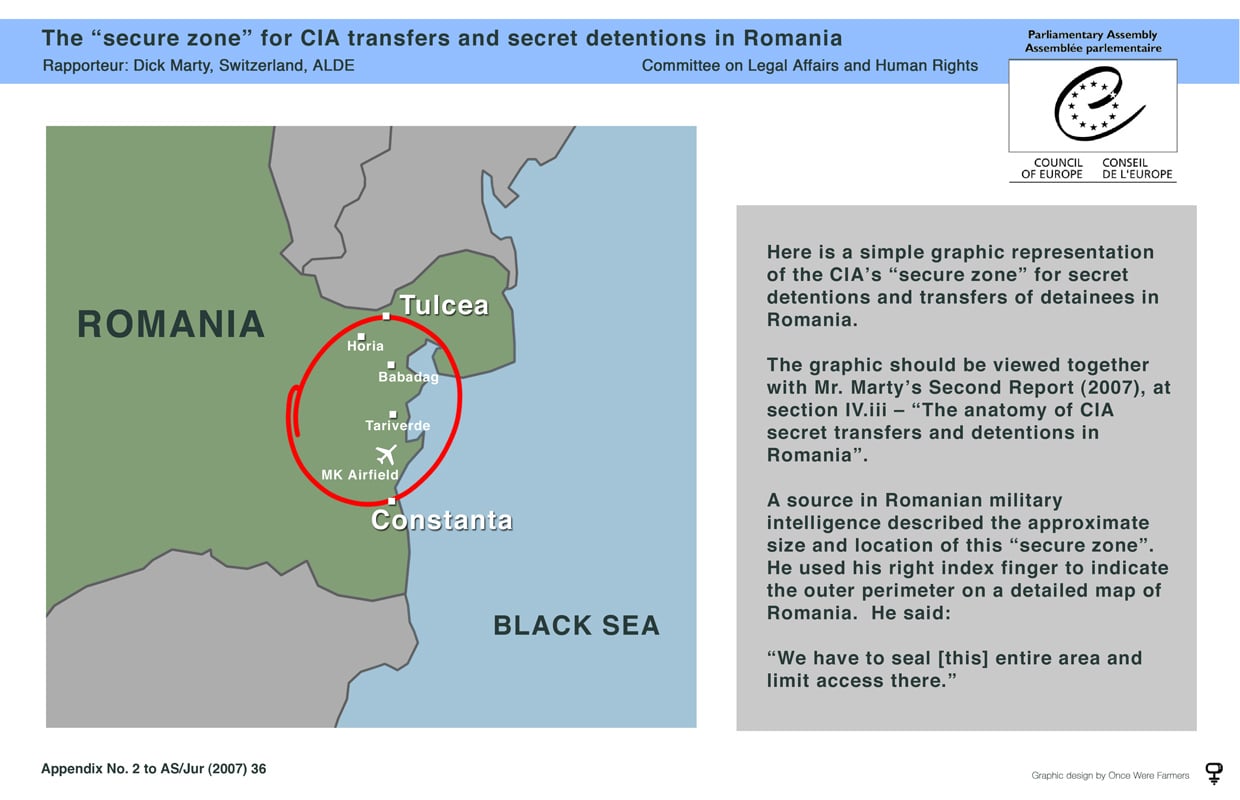
‘High-value’ detainees were held in secret CIA detention centres in Poland and Romania, says PACE committee
Strasbourg, 08.06.2007 – So-called US “high-value” detainees (HVD) – whose existence were revealed by President Bush in September 2006 – were held in secret CIA detention centres in Poland and Romania between 2002 and 2005, according to a report of the Legal Affairs Committee of the Council of Europe Parliamentary Assembly (PACE) adopted today.
The report was based in part on the cross-referenced testimonies of over 30 serving and former members of intelligence services in the US and Europe, and on a new analysis of computer “data strings” from the international flight planning system.
It describes in detail the scope and functioning of the US’s “high-value detainees” programme, which it says was set up by the CIA “with the co-operation of official European partners belonging to Government services” and kept secret for many years thanks to strict observance of the rules of confidentiality laid down in the NATO framework.
The programme “has given rise to repeated serious breaches of human rights”, the committee declared, including the torture of detainees. In an explanatory memorandum, rapporteur Dick Marty (Switzerland, ALDE) also revealed:
• US “high-value detainees” (HVDs) were held at the Stare Kiejkuty intelligence training base during the period from 2002 to 2005
• A secret agreement between the US and NATO allies in October 2001 provided the framework for the CIA to hold “high-value detainees” in Europe
• Former Polish President Kwasniewski and former Romanian President Iliescu knew about and authorised such secret detentions
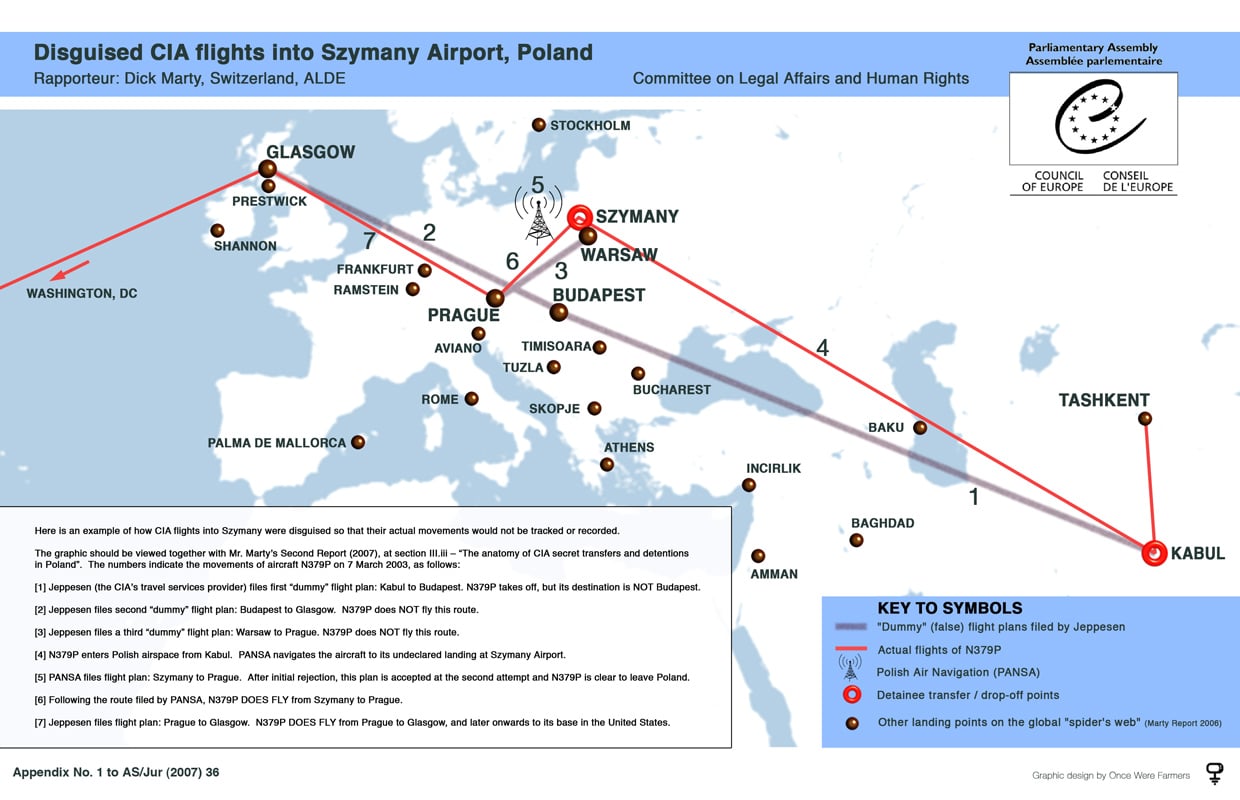
• Flights to Poland – including one that may have carried Khalid Sheikh Mohammed from Kabul to Szymany on 7 March 2003 – were deliberately disguised through the filing of “dummy” flight plans and the complicity of Polish air traffic controllers (see graphic 1)
• Mistaken terror suspect Khaled El-Masri was “homeward rendered” by the CIA from Kabul to the Bezat-Kuçova Aerodrome in Albania on 28 May 2004 (see graphic 3)
The committee said that only Bosnia and Herzegovina and Canada, a Council of Europe observer state, had fully acknowledged their responsibilities with regard to the unlawful transfers of detainees.
The parliamentarians said information as well as evidence concerning the liability of the state’s representatives for serious violations of human rights “must not be considered as worthy of protection as state secrets”.
The disclosure of the truth, they said, “is the the best way of restoring the vital co-operation between secret services for the prevention and suppression of terrorism”.
Adopted draft resolution and recommendation Mr Marty’s explanatory memorandum (PDF) Appendix 3 – graphic (PDF) |

Washington and Israel discuss possible war against Syria
June 10, 2007|
Washington and Israel discuss possible war against Syria by Chris Marsden |
|
|
Global Research, June 9, 2007 |
|
|
The Bush administration has used discussions between Israeli Transportation Minister and former Defense Minister Shaul Mofaz, US Secretary of State Condoleezza Rice and Under Secretary of State Nicholas Burns to insist that there should be no talks between Israel and Syria. State Department spokesman Sean McCormack told reporters Wednesday June 6, “We’re not going to manage Israeli foreign policy. But let’s take a look at Syria’s behavior over the recent past, and I don’t think you’re going to find many indications of Syria showing the rest of the world that they are interested in playing a constructive, positive role in trying to bring about a more peaceful, secure region.” McCormack accused Syria of continuing to support terrorist groups in Lebanon and in the Palestinian territories and cited its links to Iran. The possibility of opening a dialogue with the regime of Bashar al-Assad in Damascus had earlier been mooted at a special security cabinet meeting that same day in Israel by President Ehud Olmert. The meeting was called to discuss the growing threat of war with Syria. Olmert took the occasion to stress that Israel wanted peace with Syria and must be wary of miscalculations that could lead to war. He also stated that he did not rule out direct dialogue with Syria, without any preconditions. The newspaper Yedioth Ahronoth reported that Olmert had also relayed a secret message to Damascus saying Israel would return Golan to Syria in exchange for a comprehensive peace. This included the insistence that Syria severed all ties to Iran, the Lebanese Shia Islamist movement Hezbollah and “the Palestinian terror organisations and stop funding and promoting terror.” The framing of Olmert’s demands is deliberately provocative and strongly suggests that his pose is largely motivated by an attempt to shore up his crisis-ridden coalition government with Labour. Olmert has no functioning defence minister, after Labour’s Amir Peretz was knocked out in the first round of the party’s leadership contest. Peretz will be replaced as party leader next week by either former Prime Minister Ehud Barak or retired admiral and former Shin Bet internal security chief Ami Ayalon, both of whom have called for Olmert to resign over the debacle suffered by Israel in the war against Lebanon last summer. Ayalon has even threatened to take Labour out of the coalition, which would force a general election. At the security cabinet meeting Olmert claimed—without providing any evidence—that Syria had refused his call for peace talks. However, last week Syria’s Foreign Minister Walid Muallem had told the Guardian newspaper that Damascus was “ready to resume peace talks with Israel based on the principle of land for peace. Unfortunately we received many signals from Israeli public opinion but we have seen no official readiness.” Whatever his real intentions—or indeed his own eventual fate—Olmert is responding to a very real possibility of war. His remarks are at least in part meant to placate a section of the Israeli ruling elite that has been arguing for a concerted effort to engage with Syria, utilizing military and diplomatic threats as a stick and the Golan Heights as a carrot to drive a wedge between Damascus and what many consider to be the main enemy, Iran. These elements also seek to isolate Hezbollah prior to a possible military offensive by Lebanon’s pro-Western government of Fouad Siniora and to weaken Hamas in Gaza, where Israel is supporting President Mahmoud Abbas and Fateh in the factional warfare that has broken out. Within the ruling coalition Peretz, who remains a significant player within Labour, has argued, “A diplomatic process with Syria could immediately and dramatically change the balance on three fronts [i.e., Syria, Lebanon and the Palestinian front], so picking up the gauntlet, or exploring any chance for sincere negotiations with Syria is, in my opinion, an option that absolutely must not be neglected.” Several other ministers, including Meir Sheetrit of Kadima and Labour’s Benjamin Ben-Eliezer, have also called for a renewal of peace talks. On the other side of the foreign policy dispute in Israel are those opposed to any talk of concessions to Syria, who insist that Damascus must continue to be bracketed alongside Tehran and stress the need for Israel to prepare for open military conflict. The leader of the opposition Likud, Benjamin Netanyahu, this week used the occasion of the fortieth anniversary of the 1967 Six Day war to insist that withdrawal from “Judea and Samaria” would expose Israel to the threat of annihilation. Victory had transformed Israel from a “feeble and fragile country whose existence was questionable, into a state which cannot be defeated,” he said. On the Golan Heights, which Israel first captured in 1967 and annexed in 1981, he added, “As we are on these mountains, we are unbeatable.” At a debate organized by Peace Now, he declared, “What is a peace agreement with Syria worth? A piece of paper!” Within the coalition Avigdor Lieberman of the right-wing Yisrael Beiteinu is vehemently against even a partial withdrawal from the Golan Heights and talks are also opposed by Shas ministers Eli Yishai and Yitzhak Cohen. Differences of emphasis notwithstanding, both positions have developed within the framework of advanced military and political preparations for a possible war against Syria, which many sources predict could take place by the summer. One Israeli intelligence report has suggested that Syria, Iran and Hezbollah are coordinating to form a joint front in preparation for war over the summer. Security sources also allege a Syrian arms build-up, including sophisticated Russian anti-aircraft systems and long-range missiles, and military preparations on its northern borders, including an underground missile command center capable of striking any part of Israel. The day before the security cabinet meeting and the discussions in Washington, Israel staged a large-scale exercise involving infantry units, tank divisions and the air force in the southern Negev simulating the invasion of Syria. Peretz told the media that the Israeli Defence Force was indeed preparing for the possibility of war with Syria. Commenting on the exercise in the Jerusalem Post, Yaakov Katz described it as an expression of the IDF’s “shift from the Palestinian and Hizbullah threat to Syria.” He noted, “For the first time in years, the annual exercise simulated the conquest of a Syrian village by infantry armor and airborne units, and not a Palestinian one, as had been tradition since the second intifada. ‘The IDF is preparing for an escalation on both the Palestinian and the northern fronts,’ Chief of General Staff Lt.-Gen. Gabi Ashkenazi said, as he watched the tanks cross over makeshift bridges to invade a ‘Syrian village.’ ‘The display seen here today is quite impressive. Only one element is lacking—an enemy.’” The day the security cabinet met, Israel’s Channel 2 news reported that Syria has set August as the month it will finalise preparations for war and “planned to complete training of its military forces within eight months.” Channel 2 showed pictures of Israeli military tanks “ready for any possible Syrian attack” and quoted Mofaz claiming that Syria possesses long range missiles “which can hit Jerusalem in case war erupted.” The security cabinet established an 11-member ministerial committee on Syria, which will receive regular briefings and details of the army’s preparations. Senior IDF commanders had presented to the cabinet the army’s preparations for a possible conflict on Israel’s northern border. Military Intelligence chief Major General Amos Yadlin had stressed the possibility of a war breaking out due to a “miscalculation.” He stated that the Syrian Army was capable of redeploying from its defensive formation and attacking Israel with relative speed, but he did not believe Damascus wanted to do so. His principal concern was that Syria might react wrongly to an Israeli move and encourage an attack by Hezbollah from Lebanon. Olmert appealed for cabinet members not to discuss the possibility of war with Syria, but Lieberman actually left the cabinet meeting at one point to give a radio interview in which he claimed that Syria was arming itself at an unprecedented pace. “Managing Israeli foreign policy” is in fact precisely what Washington is doing. The political divisions in Israel over how to deal with Syria echo those within the Bush administration, with Rice reportedly favouring diplomatic efforts to drive a wedge between Damascus and Tehran and Vice President Dick Cheney opposed. Cheney was reportedly in favour of Israel directly engaging with Syria during last summer’s attack on Lebanon and led Republican denunciations of the visit to Syria in April by House Speaker Nancy Pelosi, a Democrat. Rice herself met with Syria’s foreign minister for a “business-like” 30 minutes on May 3 at a conference on how to stabilize Iraq at Sharm el Sheik, Egypt—and also tried unsuccessfully to meet with her Iranian counterpart. But afterwards she again assumed a hard line, insisting that Damascus had to close its Iraq border to foreign fighters and crack down on Palestinian “extremists” if it wanted to restore relations with Washington. After his meeting with Rice and Under Secretary of State Nicholas Burns, Mofaz, who had also earlier raised the possibility of talks with Syria, stressed that Israel wanted to give greater priority to building peace with the Palestinians. When asked whether peace efforts would be revived with Syria, he replied several times, “Our first priority should be Palestinian discussions.” He also insisted that “Hezbollah will never leave southern Lebanon. It is arming with missiles that could hit central and even southern Israel.” And he urged that a deadline of the end of this year be placed on Iranian compliance with US demands for the suspension of its nuclear programme. The next day, Mofaz responded to reports of a seizure of armaments by the Lebanese army by insisting that the weapons had come from Iran via Syria. En route to Berlin for a meeting of Middle East Quartet, Rice denied Washington was blocking Israeli efforts to engage in peace talks with Syria. “No one is opposed to Israel pursuing other tracks, including a Syria track,” she said, “But my understanding is that it’s the view of the Israelis and certainly our view that the Syrians are engaged in behavior right now that is destabilizing to the region.” Such a track could be pursued at a future date, she added. For its part, Syria has indicated its belief that Israel will initiate military hostilities. Muhammad Habash, a member of parliament, told Al-Jazeera on May 5 that it was no secret that Syria was “actively” preparing for a military encounter with Israel, which wanted war in order to survive politically. |
|
| Chris Marsden is a frequent contributor to Global Research. Global Research Articles by Chris Marsden | |