What the US Secretary of State Blinken says clearly shows how the present US rulers, like previous US administrations, view the tragedy of the Palestinian people at the hands of the rulers of Israel, a tragedy towards which the United States has made its major contribution as the protector and supporter of Israeli expansion and hegemony in the Middle East, North Africa to start with.
Washington is not concerned about what Israeli settlers and the Israeli army are doing in the occupied West Bank. Instead, their main focus remains to bring the Saudi rulers into the embrace of Israel by using all political and diplomatic leverage on them to normalise their relations with Israel. Washington is following this course to neutralize international solidarity with the national aspirations of Palestine’s colonized people.
Now that the Ukrainian counteroffensive is underway, it is clear that the government and its Western allies are maintaining silence to conceal the brutal cost Ukraine’s brave young people are paying.
As Ukraine prepared to launch its much heralded but long delayed counteroffensive, the media published a photograph of a Ukrainian soldier with his finger on his lips, symbolizing the need for secrecy to retain some element of surprise for this widely telegraphed operation.
Now that the offensive has been under way for two weeks, it is clear that the Ukrainian government and its Western allies are maintaining silence for quite a different reason: to conceal the brutal cost Ukraine’s brave young people are paying to recover small scraps of territory from Russian occupation forces, in what some are already calling a suicide mission.
Western pundits at first described these first two weeks of fighting as “probing operations” to find weak spots in Russia’s defenses, which Russia has been fortifying since 2022 with multiple layers of minefields, “dragon’s teeth,” tank-traps, pre-positioned artillery, and attack helicopters, unopposed in the air, that can fire 12 anti-tank missiles apiece.
“This is a very difficult fight. It’s a very violent fight, and it will likely take a considerable amount of time and at high cost.”
On the advice of British military advisers in Kyiv, Ukraine flung Western tanks and armored vehicles manned by NATO-trained troops into these killing fields without air support or demining operations. The results have been predictably disastrous, and it is now clear that these are not just “probing” operations as the propaganda at first claimed, but the long-awaited main offensive.
A Western official with intelligence access told The Associated Press on June 14, “Intense fighting is now ongoing in nearly all sectors of the front… This is much more than probing. These are full-scale movements of armor and heavy equipment into the Russian security zone.”
Other glimpses are emerging of the reality behind the propaganda. At a press conference after a summit at NATO Headquarters, U.S. General Mark Milley warned that the offensive will be long, violent, and costly in Ukrainian lives.
“This is a very difficult fight. It’s a very violent fight, and it will likely take a considerable amount of time and at high cost,” Milley said.
Russian videos show dozens of Ukrainian tanks and armored vehicles lying smashed in minefields, and NATO military advisers in Ukraine have confirmed that it lost 38 tanks in one night on June 8, including newly delivered German-built Leopard IIs.
Rob Lee of the Foreign Policy Research Institute explained to TheNew York Times that the Russians are trying to inflict as many casualties and destroy as many vehicles as possible in the areas in front of their main defensive lines, turning those areas into lethal kill zones. If this strategy works, any Ukrainian forces that reach the main Russian defense lines will be too weakened and depleted to break through and achieve their goal of severing Russia’s land bridge between Donbas and Crimea.
Russia’s Ministry of Defense reported that Ukraine’s forces suffered 7,500 casualties in the first 10 days of the offensive. If Ukraine’s real losses are a fraction of that, the long, violent bloodbath that General Milley anticipates will destroy the new armored brigades that NATO has armed and trained, and serve only to escalate the gory war of attrition that has destroyed Mariupol, Sievierodonetsk, and Bakhmut, killing and wounding hundreds of thousands of young Ukrainians and Russians.
A senior European military officer in Ukraine provided more details of the carnage to Asia Times, calling Ukraine’s operations on June 8 and 9 a “suicide mission” that violated the basic rules of military tactics.
“They were trained by the British, and they’re playing Light Brigade.”
“We tried to tell them to stop these piecemeal tactics, define a main thrust with infantry support and do what they can,” he said. “They were trained by the British, and they’re playing Light Brigade,” he added, comparing the offensive to a suicidal charge into massive Russian cannon fire that wiped out Britain’s Light Cavalry Brigade in Crimea in 1854.
If Ukraine’s “Spring Offensive” plunges on to the bitter end, it could be more like the British and French Somme Offensive, fought near the French River Somme in 1916. After 19,240 British troops were killed on the first day (including Nicolas’s 20-year-old great-uncle, Robert Masterman), the battle raged on for more than four months of pointless, wanton slaughter, with over a million British, French, and German casualties. It was finally called off after advancing only six miles and failing to capture either of the two small French towns that were its initial objectives.
The current offensive was delayed for months as Ukraine and its allies grappled with the likelihood of the outcome we are now witnessing. The fact that it went ahead regardless reflects the moral bankruptcy of U.S. and NATO political leaders, who are sacrificing the flower of Ukraine’s youth in a proxy war they will not send their own children or grandchildren to fight.
As Ukraine launches its offensive, NATO is conducting Air Defender, the largest military exercise in its history, from June 12 to 23, with 250 warplanes, including nuclear-capable F-35s, flying from German bases to simulate combat operations in and over Germany, Lithuania, Romania, the North Sea, and the Baltic Sea. The exercise has led to at least 15 incidents between NATO and Russian aircraft in the skies near Lithuania.
It seems that nobody in NATO’s foreboding fortress in Brussels has stumbled on the concept of a “security dilemma,” in which supposedly defensive actions by one party are perceived as offensive threats by another and lead to a spiral of mutual escalation, as has been the case between NATO and Russia since the 1990s. Professor of Russian history Richard Sakwa has written, “NATO exists to manage the risks created by its existence.”
These risks will be evident in the upcoming NATO Summit in Vilnius on July 11-12, where Ukraine and its eastern allies will be pushing for Ukraine membership, while the U.S. and western Europe insist that membership cannot be offered while the war rages on and will instead offer “upgraded” status and a shorter route to membership once the war ends.
The continued insistence that Ukraine will one day be a NATO member only means a prolongation of the conflict, as this is a red line that Russia insists cannot be crossed. That’s why negotiations that lead to a neutral Ukraine are key to ending the war.
But the United States will not agree to that as long as President Joe Biden keeps U.S. Ukraine policy firmly under the thumbs of hawkish neoconservative desk warriors like Antony Blinken and Victoria Nuland at the State Department and National Security Adviser Jake Sullivan at the White House. Pressure to keep escalating U.S. involvement in the war is also coming from Congress, where Republicans accuse Biden of “hemming and hawing” instead of “going all in” to help Ukraine.
The Chairman of the Joint Chiefs of Staff, General Milley, has called for diplomacy to bring peace to Ukraine, and U.S. intelligence sources have challenged dominant false narratives of the war in leaks to Newsweek and Seymour Hersh, telling Hersh that the neocons are ignoring genuine intelligence and inventing their own, just as they did to justify the invasion of Iraq in 2003.
Paradoxically, the Pentagon and intelligence agencies are more realistic than their civilian colleagues about the lack of any military solution. The Chairman of the Joint Chiefs of Staff, General Milley, has called for diplomacy to bring peace to Ukraine, and U.S. intelligence sources have challenged dominant false narratives of the war in leaks to Newsweek and Seymour Hersh, telling Hersh that the neocons are ignoring genuine intelligence and inventing their own, just as they did to justify the invasion of Iraq in 2003.
With the retirement of Deputy Secretary of State Wendy Sherman, the State Department is losing the voice of a professional diplomat who was President Barack Obama’s chief negotiator for the JCPOA with Iran and urged Biden to rejoin the agreement, and who has taken steps to moderate U.S. brinkmanship toward China. While publicly silent on Ukraine, Sherman was a quiet voice for diplomacy in a war-mad administration.
Many fear that Sherman’s job will now go to Nuland, the leading architect of the ever-mounting catastrophe in Ukraine for the past decade, who already holds the #3 or #4 job at State as Under Secretary of State for Political Affairs.
Other departures from the senior ranks at State and the Pentagon are likely to cede more ground to the neocons. Colin Kahl, the Under Secretary of Defense for Policy, who worked with Sherman on the JCPOA, opposed sending F-16s to Ukraine, and has maintained that China will not invade Taiwan in the near future. Kahl is leaving the Pentagon to return to his position as a professor at Stanford, just as China hawk General C.Q. Brown will replace General Milley as Chairman of the Joint Chiefs when Milley retires in September.
Meanwhile, other world leaders continue to push for peace talks. A delegation of African heads of state led by President Cyril Ramaphosa of South Africa met with President Volodymyr Zelenskyy in Kyiv, and President Vladimir Putin in Moscow on June 17, to discuss the African peace plan for Ukraine.
President Putin showed the African leaders the 18-point Istanbul Agreement that a Ukrainian representative had signed back in March 2022, and told them that Ukraine had thrown it in the “dustbin of history,” after the now disgraced Boris Johnson told Zelenskyy the “collective West” would only support Ukraine to fight, not to negotiate with Russia.
The catastrophic results of the first two weeks of Ukraine’s offensive should focus the world’s attention on the urgent need for a ceasefire to halt the daily slaughter and dismemberment of hundreds of brave young Ukrainians, who are being forced to drive through minefields and kill zones in Western gifts that are proving to be no more than U.S.- and NATO-built death-traps.
Our work is licensed under Creative Commons (CC BY-NC-ND 3.0). Feel free to republish and share widely.
Medea Benjamin is co-founder of Global Exchange and CODEPINK: Women for Peace. She is the co-author, with Nicolas J.S. Davies, of War in Ukraine: Making Sense of a Senseless Conflict, available from OR Books in November 2022. Other books include, “Inside Iran: The Real History and Politics of the Islamic Republic of Iran” (2018); “Kingdom of the Unjust: Behind the U.S.-Saudi Connection” (2016); “Drone Warfare: Killing by Remote Control” (2013); “Don’t Be Afraid Gringo: A Honduran Woman Speaks from the Heart” (1989), and (with Jodie Evans) “Stop the Next War Now” (2005).
Nicolas J. S. Davies is an independent journalist and a researcher with CODEPINK. He is the co-author, with Medea Benjamin, of War in Ukraine: Making Sense of a Senseless Conflict, available from OR Books in November 2022, and the author of Blood On Our Hands: the American Invasion and Destruction of Iraq.
As Ukraine prepared to launch its much heralded but long delayed counteroffensive, the media published a photograph of a Ukrainian soldier with his finger on his lips, symbolizing the need for secrecy to retain some element of surprise for this widely telegraphed operation.
Now that the offensive has been under way for two weeks, it is clear that the Ukrainian government and its Western allies are maintaining silence for quite a different reason: to conceal the brutal cost Ukraine’s brave young people are paying to recover small scraps of territory from Russian occupation forces, in what some are already calling a suicide mission.
Western pundits at first described these first two weeks of fighting as “probing operations” to find weak spots in Russia’s defenses, which Russia has been fortifying since 2022 with multiple layers of minefields, “dragon’s teeth,” tank-traps, pre-positioned artillery, and attack helicopters, unopposed in the air, that can fire 12 anti-tank missiles apiece.
“This is a very difficult fight. It’s a very violent fight, and it will likely take a considerable amount of time and at high cost.”
On the advice of British military advisers in Kyiv, Ukraine flung Western tanks and armored vehicles manned by NATO-trained troops into these killing fields without air support or demining operations. The results have been predictably disastrous, and it is now clear that these are not just “probing” operations as the propaganda at first claimed, but the long-awaited main offensive.
A Western official with intelligence access told The Associated Press on June 14, “Intense fighting is now ongoing in nearly all sectors of the front… This is much more than probing. These are full-scale movements of armor and heavy equipment into the Russian security zone.”
Other glimpses are emerging of the reality behind the propaganda. At a press conference after a summit at NATO Headquarters, U.S. General Mark Milley warned that the offensive will be long, violent, and costly in Ukrainian lives.
“This is a very difficult fight. It’s a very violent fight, and it will likely take a considerable amount of time and at high cost,” Milley said.
Russian videos show dozens of Ukrainian tanks and armored vehicles lying smashed in minefields, and NATO military advisers in Ukraine have confirmed that it lost 38 tanks in one night on June 8, including newly delivered German-built Leopard IIs.
Rob Lee of the Foreign Policy Research Institute explained to TheNew York Times that the Russians are trying to inflict as many casualties and destroy as many vehicles as possible in the areas in front of their main defensive lines, turning those areas into lethal kill zones. If this strategy works, any Ukrainian forces that reach the main Russian defense lines will be too weakened and depleted to break through and achieve their goal of severing Russia’s land bridge between Donbas and Crimea.
Russia’s Ministry of Defense reported that Ukraine’s forces suffered 7,500 casualties in the first 10 days of the offensive. If Ukraine’s real losses are a fraction of that, the long, violent bloodbath that General Milley anticipates will destroy the new armored brigades that NATO has armed and trained, and serve only to escalate the gory war of attrition that has destroyed Mariupol, Sievierodonetsk, and Bakhmut, killing and wounding hundreds of thousands of young Ukrainians and Russians.
A senior European military officer in Ukraine provided more details of the carnage to Asia Times, calling Ukraine’s operations on June 8 and 9 a “suicide mission” that violated the basic rules of military tactics.
“They were trained by the British, and they’re playing Light Brigade.”
“We tried to tell them to stop these piecemeal tactics, define a main thrust with infantry support and do what they can,” he said. “They were trained by the British, and they’re playing Light Brigade,” he added, comparing the offensive to a suicidal charge into massive Russian cannon fire that wiped out Britain’s Light Cavalry Brigade in Crimea in 1854.
If Ukraine’s “Spring Offensive” plunges on to the bitter end, it could be more like the British and French Somme Offensive, fought near the French River Somme in 1916. After 19,240 British troops were killed on the first day (including Nicolas’s 20-year-old great-uncle, Robert Masterman), the battle raged on for more than four months of pointless, wanton slaughter, with over a million British, French, and German casualties. It was finally called off after advancing only six miles and failing to capture either of the two small French towns that were its initial objectives.
The current offensive was delayed for months as Ukraine and its allies grappled with the likelihood of the outcome we are now witnessing. The fact that it went ahead regardless reflects the moral bankruptcy of U.S. and NATO political leaders, who are sacrificing the flower of Ukraine’s youth in a proxy war they will not send their own children or grandchildren to fight.
As Ukraine launches its offensive, NATO is conducting Air Defender, the largest military exercise in its history, from June 12 to 23, with 250 warplanes, including nuclear-capable F-35s, flying from German bases to simulate combat operations in and over Germany, Lithuania, Romania, the North Sea, and the Baltic Sea. The exercise has led to at least 15 incidents between NATO and Russian aircraft in the skies near Lithuania.
It seems that nobody in NATO’s foreboding fortress in Brussels has stumbled on the concept of a “security dilemma,” in which supposedly defensive actions by one party are perceived as offensive threats by another and lead to a spiral of mutual escalation, as has been the case between NATO and Russia since the 1990s. Professor of Russian history Richard Sakwa has written, “NATO exists to manage the risks created by its existence.”
These risks will be evident in the upcoming NATO Summit in Vilnius on July 11-12, where Ukraine and its eastern allies will be pushing for Ukraine membership, while the U.S. and western Europe insist that membership cannot be offered while the war rages on and will instead offer “upgraded” status and a shorter route to membership once the war ends.
The continued insistence that Ukraine will one day be a NATO member only means a prolongation of the conflict, as this is a red line that Russia insists cannot be crossed. That’s why negotiations that lead to a neutral Ukraine are key to ending the war.
But the United States will not agree to that as long as President Joe Biden keeps U.S. Ukraine policy firmly under the thumbs of hawkish neoconservative desk warriors like Antony Blinken and Victoria Nuland at the State Department and National Security Adviser Jake Sullivan at the White House. Pressure to keep escalating U.S. involvement in the war is also coming from Congress, where Republicans accuse Biden of “hemming and hawing” instead of “going all in” to help Ukraine.
The Chairman of the Joint Chiefs of Staff, General Milley, has called for diplomacy to bring peace to Ukraine, and U.S. intelligence sources have challenged dominant false narratives of the war in leaks to Newsweek and Seymour Hersh, telling Hersh that the neocons are ignoring genuine intelligence and inventing their own, just as they did to justify the invasion of Iraq in 2003.
Paradoxically, the Pentagon and intelligence agencies are more realistic than their civilian colleagues about the lack of any military solution. The Chairman of the Joint Chiefs of Staff, General Milley, has called for diplomacy to bring peace to Ukraine, and U.S. intelligence sources have challenged dominant false narratives of the war in leaks to Newsweek and Seymour Hersh, telling Hersh that the neocons are ignoring genuine intelligence and inventing their own, just as they did to justify the invasion of Iraq in 2003.
With the retirement of Deputy Secretary of State Wendy Sherman, the State Department is losing the voice of a professional diplomat who was President Barack Obama’s chief negotiator for the JCPOA with Iran and urged Biden to rejoin the agreement, and who has taken steps to moderate U.S. brinkmanship toward China. While publicly silent on Ukraine, Sherman was a quiet voice for diplomacy in a war-mad administration.
Many fear that Sherman’s job will now go to Nuland, the leading architect of the ever-mounting catastrophe in Ukraine for the past decade, who already holds the #3 or #4 job at State as Under Secretary of State for Political Affairs.
Other departures from the senior ranks at State and the Pentagon are likely to cede more ground to the neocons. Colin Kahl, the Under Secretary of Defense for Policy, who worked with Sherman on the JCPOA, opposed sending F-16s to Ukraine, and has maintained that China will not invade Taiwan in the near future. Kahl is leaving the Pentagon to return to his position as a professor at Stanford, just as China hawk General C.Q. Brown will replace General Milley as Chairman of the Joint Chiefs when Milley retires in September.
Meanwhile, other world leaders continue to push for peace talks. A delegation of African heads of state led by President Cyril Ramaphosa of South Africa met with President Volodymyr Zelenskyy in Kyiv, and President Vladimir Putin in Moscow on June 17, to discuss the African peace plan for Ukraine.
President Putin showed the African leaders the 18-point Istanbul Agreement that a Ukrainian representative had signed back in March 2022, and told them that Ukraine had thrown it in the “dustbin of history,” after the now disgraced Boris Johnson told Zelenskyy the “collective West” would only support Ukraine to fight, not to negotiate with Russia.
The catastrophic results of the first two weeks of Ukraine’s offensive should focus the world’s attention on the urgent need for a ceasefire to halt the daily slaughter and dismemberment of hundreds of brave young Ukrainians, who are being forced to drive through minefields and kill zones in Western gifts that are proving to be no more than U.S.- and NATO-built death-traps.
Our work is licensed under Creative Commons (CC BY-NC-ND 3.0). Feel free to republish and share widely.
Medea Benjamin is co-founder of Global Exchange and CODEPINK: Women for Peace. She is the co-author, with Nicolas J.S. Davies, of War in Ukraine: Making Sense of a Senseless Conflict, available from OR Books in November 2022. Other books include, “Inside Iran: The Real History and Politics of the Islamic Republic of Iran” (2018); “Kingdom of the Unjust: Behind the U.S.-Saudi Connection” (2016); “Drone Warfare: Killing by Remote Control” (2013); “Don’t Be Afraid Gringo: A Honduran Woman Speaks from the Heart” (1989), and (with Jodie Evans) “Stop the Next War Now” (2005).
Nicolas J. S. Davies is an independent journalist and a researcher with CODEPINK. He is the co-author, with Medea Benjamin, of War in Ukraine: Making Sense of a Senseless Conflict, available from OR Books in November 2022, and the author of Blood On Our Hands: the American Invasion and Destruction of Iraq.
“If I were a dictator, religion and state would be separate. I swear by my religion. I will die for it. But it is my personal affair. The state has nothing to do with it. The state would look after your secular welfare, health, communications, foreign relations, currency and so on, but not your or my religion. That is everybody’s personal concern!”
― Mahatma Gandhi (1869-1948)
These are the words of a wise leader of the Indian freedom movement, who inspired millions of people worldwide with his message of non-violence and love for truth.
It is important for us to remember that Gandhi was not an atheist or an agnostic. He was a devout Hindu and a believer in God, like Muslim, Christian, Zoroastrian, Baha’i, Sikh and Jewish believers. However, for him, an individual’s religion was a personal matter. No one should impose a religion or a belief on others. It was not for the state to tell people which religion to follow or which god to believe in (there are different views about god in many religions and his attributes, etc.). In the Middle Ages, the state and Church in European countries were united. But that changed. The secularisation process became the norm and new ways of looking at the roles of state and religion became widely accepted.
Secularism is rooted in the political idea that the state and religion have two different spheres and roles. They should remain separate and we should not allow anyone to mix them. People should follow whatever religions they want to follow without the interference of the state. As a result, there is no more religious coercion from the state or public bodies/institutions of the people. People have freedom of religion, freedom to practise any religion, freedom to convert to any other religion if any choose to do so, freedom to leave or reject religion and accept agnosticism, atheism, humanism or any other viewpoint. In democratic countries and their civil societies, these freedoms are essential ingredients of a civilised existence.
Unfortunately, such views have had much opposition in traditional, conservative societies. For example, in my country of origin, Pakistan (‘Land of the Pure’!), Muslim clerics and political manipulators have distorted the meaning of secularism. According to their version, which most Pakistanis accept, it means rejection of Islam and Allah! It is anti-Islam and a threat to Islam and Pakistan!
The escalation of attacks on Masafer Yatta in the West Bank comes after the Israeli Supreme Court named the area an Israeli army “firing zone” from which villagers can be expelled.
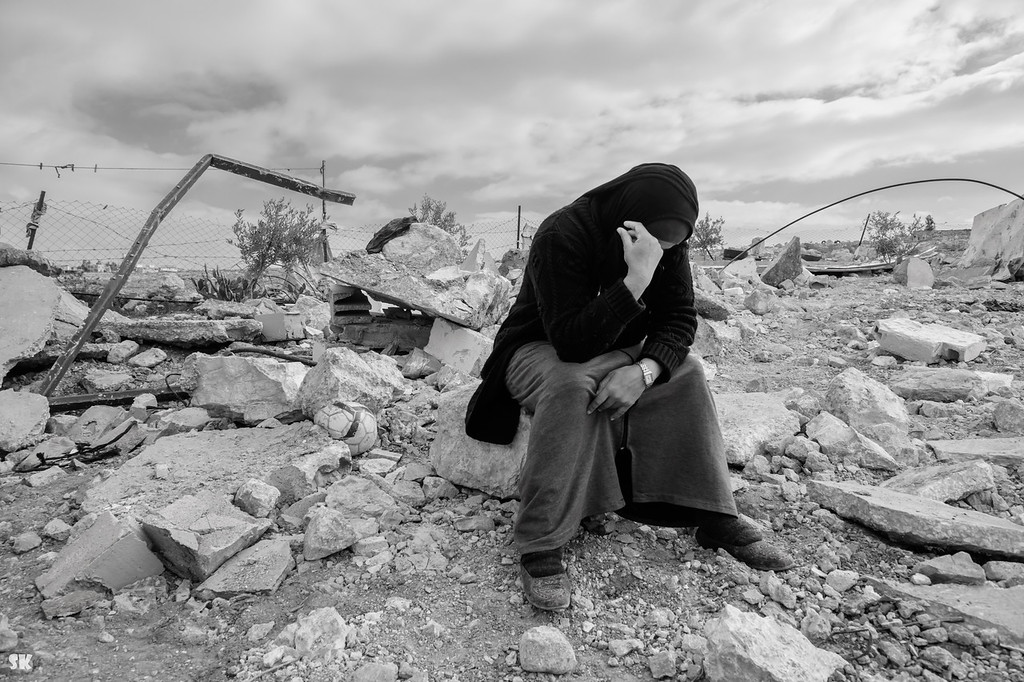
Woman sitting on the ruins of her house destroyed by Israeli authorities in Masafer Yatta in January. (Wikimedia Commons, CC BY-SA 4.0)
Israeli forces continued their campaign of repression and colonization in the Palestinian village of Masafer Yatta over the weekend, leading to multiple injuries, including to a 6-year old child.
Settlers from the nearby settlement in Hebron, along with the Israeli army, harassed and physically assaulted activists and residents of Masafer Yatta, intensifying the attempts to expel the Palestinians from their homes, according to multiple reports from the ground.
The escalation comes in the aftermath of the Israeli Supreme Court’s ruling last year that the village falls under the “firing zone” of the Israeli army and that Palestinian residents can be expelled from the area.
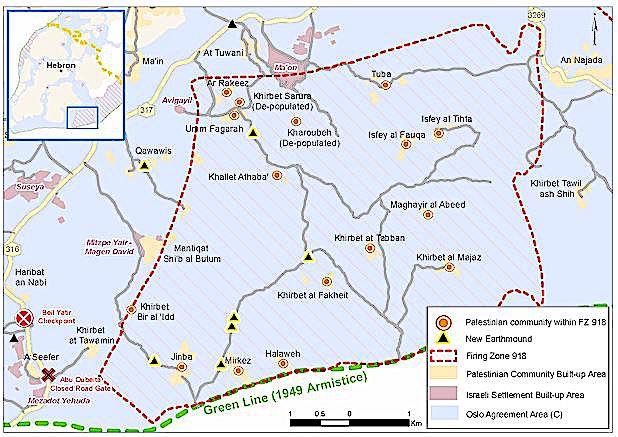
Massafer Yatta in the Hebron Hills, West Bank. (UN OCHA, Wikimedia Commons, CC BY-SA 4.0)
Over 3,000 Palestinians live in Masafer Yatta, spread out over 14 smaller villages. Rights groups warn that following the court order the Israeli army can evict and forcibly relocate villagers at any moment.
On Sunday, illegal Israeli settlers, under the protection of Israeli soldiers, invaded the village and attacked Palestinians and their property, including agricultural land. Some of the settlers let their livestock free on Palestinian-owned agricultural land which led to extensive damage, while others set fire to the Palestinians’ crops. They also prevented Palestinian livestock from grazing on nearby pastoral areas.
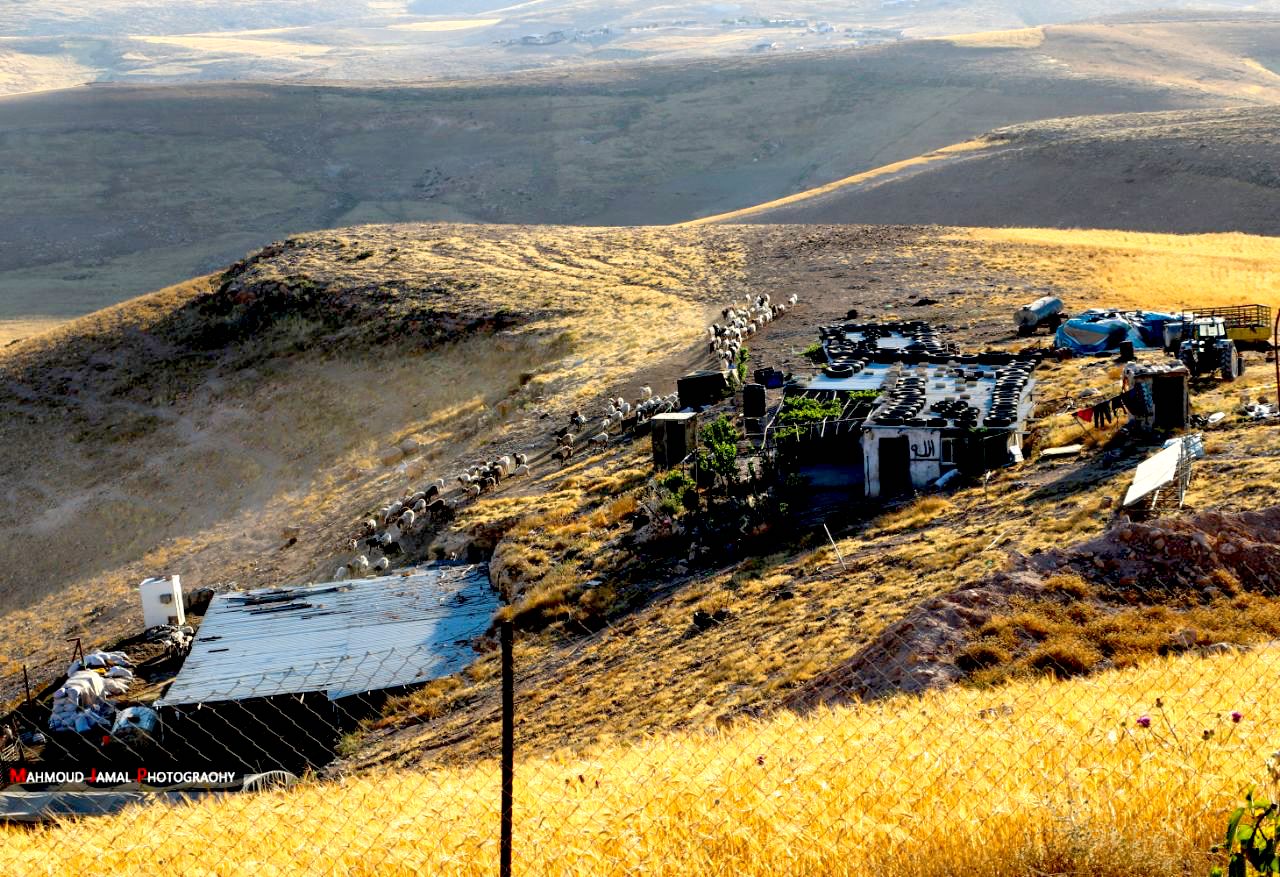
Masafer Yatta, West Bank. (Wikimedia Commons, CC BY-SA 4.0)
Following the Supreme Court order, the Israeli army has paved the way for settlers to build six new settlement outposts and herd their livestock in the area, in blatant violation of international law.
As threats of displacement and dispossession have intensified, so has the resistance to these efforts. Palestinians have been holding regular protests and demonstrations against the violence and attacks from settlers and the Israeli army. These protests have been met with more state repression.
Palestinians have also appealed to the international community and human rights groups to pressure Israel to end its illegal attempts to take over their land.
The Palestinian Foreign Ministry reiterated this appeal over the weekend, calling on the international community, especially the United Nations Security Council (UNSC) and Israel’s foremost ally, the United States, to hold Israel accountable for its ongoing war crimes and human rights violations in defiance of U.N. resolutions and international law.
The director-general of Palestinian human rights group Al-Haq noted that the recent intensification of Israeli settlement and annexation activities is due to waning international pressure and scrutiny on the Israeli government. According to reports, Israel plans to build and expand 10 illegal Israeli settlements and outposts in the area.
The US will focus its efforts on arming Ukraine and not attempting to bring the war to a negotiated settlement, America’s top diplomat said. Secretary of State Antony Blinken laid out a plan to massively expand Kiev’s military before talks begin.
In a speech delivered in Finland on Friday, Blinken stated, “The United States – together with our allies and partners – is firmly committed to supporting Ukraine’s defense today, tomorrow, for as long as it takes.” He continued, “We believe the prerequisite for meaningful diplomacy and real peace is a stronger Ukraine, capable of deterring and defending against any future aggression.”
Blinken dismissed the idea of even a temporary pause in the fighting. “Some countries will call for a ceasefire. And on the surface, that sounds sensible – attractive, even. After all, who doesn’t want warring parties to lay down their arms? Who doesn’t want the killing to stop?” He said. “But a ceasefire that simply freezes current lines in place and enables Putin to consolidate control over the territory he’s seized…It would legitimize Russia’s land grab. It would reward the aggressor and punish the victim.”
The Secretary of State offered an ambitious vision of Kiev’s future military capabilities. “America and our allies are helping meet Ukraine’s needs on the current battlefield while developing a force that can deter and defend against aggression for years to come.” He added, “That means helping build a Ukrainian military of the future, with long-term funding, a strong air force centered on modern combat aircraft, an integrated air and missile defense network, advanced tanks and armored vehicles, national capacity to produce ammunition, and the training and support to keep forces and equipment combat-ready.”
It is unclear how long it would take to build the deterrence force envisioned by Blinken. American arms stockpiles are dwindling as Washington attempts to transfer Kiev enough military equipment to keep its army fighting. The US additionally has plans to significantly increase arms transfers to Taiwan.
Blinken claimed, “Our support for Ukraine hasn’t weakened our capabilities to meet potential threats from China or anywhere else – it’s strengthened them.” In November, the Wall Street Journal reported, “US government and congressional officials fear the conflict in Ukraine is exacerbating a nearly $19 billion backlog of weapons bound for Taiwan, further delaying efforts to arm the island.”
Additionally, the White House may not have the support it needs in the Capitol for such a massive military buildup in Ukraine. Blinken asserted that “in America, this support is bipartisan.” However, at the beginning of May, Rep. Michael McCaul (R-TX), chairman of the House Foreign Affairs Committee, said future support for Ukraine would be contingent on success in Kiev’s long-planned counteroffensive.
Since McCaul’s statement, Ukraine has slowly lost more territory to Russian forces, including Bakhmut. Zelensky committed endless resources to the city in a months-long battle despite the advice from his Western backers. The White House is now preparing for the counteroffensive to fail.
Washington’s strategy, as laid out by Blinken, calls for arming Ukraine and weakening Russia. “Russia is significantly worse off today than it was before its full-scale invasion of Ukraine – militarily, economically, geopolitically,” he stated, adding, “President Putin has diminished Russian influence on every continent.”
However, Gen. Christopher Cavoli, the commander of US European Command, told Congress in April that Moscow’s ground forces are “bigger today” than before Moscow launched its invasion of Ukraine last year.
While the White House has attempted to isolate the Kremlin, Moscow has weathered Western sanctions by developing relationships in the global south. On Friday, Russian officials met with prospective members of the BRICS coalition, including Saudi Arabia, Iran and the UAE. In September, Iran’s President Ebrahim Raisi said in a meeting with Putin, “The relationship between countries that are sanctioned by the US, such as Iran, Russia or other countries, can overcome many problems and issues and make them stronger.”
Blinken justified the Biden administration’s commitment to a militaristic approach by claiming the White House attempted to engage the Kremlin in meaningful diplomacy before the invasion of Ukraine. “President Biden told President Putin that we were prepared to discuss our mutual security concerns – a message that I reaffirmed repeatedly – including in person, with Foreign Minister Lavrov.” The Secretary of State continued, “We offered written proposals to reduce tensions. Together with our allies and partners, we used every forum to try to prevent war, from the NATO-Russia Council to the OSCE, from the UN to our direct channels.”
In April 2022, Biden administration official Derek Chollet admitted that the White House refused to negotiate with the Kremin on Putin’s core concern, Ukraine becoming a member of NATO. “We made clear to the Russians that we were willing to talk to them on issues that we thought were genuine concerns,” Chollet said, adding that the administration didn’t think that “the future of Ukraine” was one of those issues and that its potential NATO membership was a “non-issue.”
To surmount the debt crisis, America needs to stop feeding the Military-Industrial Complex, the most powerful lobby in Washington.
By Jeffrey D. Sachs, Information Clearing House
In the year 2000, the U.S. government debt was $3.5 trillion, equal to 35% of the Gross Domestic Product (GDP). By 2022, the debt was $24 trillion, equal to 95% of GDP. The U.S. debt is soaring, hence America’s current debt crisis. Yet both Republicans and Democrats are missing the solution: stopping America’s wars of choice and slashing military outlays.
Suppose the government’s debt had remained at a modest 35% of GDP, as in 2000. Today’s debt would be $9 billion, as opposed to $24 trillion. Why did the U.S. government incur the excess $15 trillion in debt?
The single biggest answer is the U.S. government’s addiction to war and military spending. According to the Watson Institute at Brown University, the cost of U.S. wars from fiscal year 2001 to fiscal year 2022 amounted to a whopping $8 trillion, more than half of the extra $15 trillion in debt. The other $7 trillion arose roughly equally from budget deficits caused by the 2008 financial crisis and the Covid-19 pandemic.
Facing down the military-industrial lobby is the vital first step to putting America’s fiscal house in order
To surmount the debt crisis, America needs to stop feeding the Military-Industrial Complex (MIC), the most powerful lobby in Washington. As President Dwight D. Eisenhower famously warned on January 17, 1961, “In the councils of government, we must guard against the acquisition of unwarranted influence, whether sought or unsought, by the military-industrial complex. The potential for the disastrous rise of misplaced power exists and will persist.” Since 2000, the MIC led the U.S. into disastrous wars of choice in Afghanistan, Iraq, Syria, Libya, and now Ukraine.
The Military-Industrial Complex long ago adopted a winning political strategy by ensuring that the military budget reaches into every Congressional district. The Congressional Research Service recently reminded Congress that, “Defense spending touches every Member of Congress’s district through pay and benefits for military servicemembers and retirees, economic and environmental impact of installations, and procurement of weapons systems and parts from local industry, among other activities.” Only a brave member of Congress would vote against the military-industry lobby, yet bravery is certainly no hallmark of Congress.
America’s annual military spending is now around $900 billion, roughly 40% of the world’s total, and greater than the next 10 countries combined. U.S. military spending in 2022 was triple that of China. According to Congressional Budget Office, the military outlays for 2024-2033 will be a staggering $10.3 trillion on current baseline. A quarter or more of that could be avoided by ending America’s wars of choice, closing down many of America’s 800 or so military bases around the world, and negotiating new arms control agreements with China and Russia.
Yet instead of peace through diplomacy, and fiscal responsibility, the MIC regularly scares the American people with a comic-book style depictions of villains whom the U.S. must stop at all costs. The post-2000 list has included Afghanistan’s Taliban, Iraq’s Saddam Hussein, Syria’s Bashar al-Assad, Libya’s Moammar Qaddafi, Russia’s Vladimir Putin, and recently, China’s Xi Jinping. War, we are repeatedly told, is necessary for America’s survival.
A peace-oriented foreign policy would be opposed strenuously by the military-industrial lobby but not by the public. Significant public pluralities already want less, not more, U.S. involvement in other countries’ affairs, and less, not more, US troop deployments overseas. Regarding Ukraine, Americans overwhelmingly want a “minor role” (52%) rather than a “major role” (26%) in the conflict between Russia and Ukraine. This is why neither Biden nor any recent president has dared to ask Congress for any tax increase to pay for America’s wars. The public’s response would be a resounding “No!”
While America’s wars of choice have been awful for America, they have been far greater disasters for countries that America purports to be saving. As Henry Kissinger famously quipped, “To be an enemy of the United States can be dangerous, but to be a friend is fatal.” Afghanistan was America’s cause from 2001 to 2021, until the U.S. left it broken, bankrupt, and hungry. Ukraine is now in America’s embrace, with the same likely results: ongoing war, death, and destruction.
The military budget could be cut prudently and deeply if the U.S. replaced its wars of choice and arms races with real diplomacy and arms agreements. If presidents and members of congress had only heeded the warnings of top American diplomats such as William Burns, the U.S. Ambassador to Russia in 2008, and now CIA Director, the U.S. would have protected Ukraine’s security through diplomacy, agreeing with Russia that the U.S. would not expand NATO into Ukraine if Russia also kept its military out of Ukraine. Yet relentless NATO expansion is a favorite cause of the MIC; new NATO members are major customers of U.S. armaments.
The U.S. has also unilaterally abandoned key arms control agreements. In 2002, the U.S. unilaterally walked out of the Anti-Ballistic Missile Treaty. And rather than promote nuclear disarmament—as the U.S. and other nuclear powers are required to do under Article VI the Nuclear Non-Proliferation Treaty—the Military-Industrial Complex has sold Congress on plans to spend more than $600 billion by 2030 to “modernize” the U.S. nuclear arsenal.
Now the MIC is talking up the prospect of war with China over Taiwan. The drumbeats of war with China are stoking the military budget, yet war with China is easily avoidable if the U.S. adheres to the One-China policy that properly underpins U.S.-China relations. Such a war should be unthinkable. More than bankrupting the U.S., it could end the world.
Military spending is not the only budget challenge. Aging and rising healthcare costs add to the fiscal woes. According to the Congressional Budget Office, debt will reach 185 percent of GDP by 2052 if current policies remain unchanged. Healthcare costs should be capped while taxes on the rich should be raised. Yet facing down the military-industrial lobby is the vital first step to putting America’s fiscal house in order, needed to save the U.S., and possibly the world, from America’s perverse lobby-driven politics.
Views expressed in this article are solely those of the author and do not necessarily reflect the opinions of Information Clearing House.
The Russia-Ukraine War has been an unmitigated disaster. Hundreds of thousands have been killed or wounded. Millions have been displaced. Environmental and economic destruction have been incalculable. Future devastation could be exponentially greater as nuclear powers creep ever closer toward open war.
We deplore the violence, war crimes, indiscriminate missile strikes, terrorism, and other atrocities that are part of this war. The solution to this shocking violence is not more weapons or more war, with their guarantee of further death and destruction.
As Americans and national security experts, we urge President Biden and Congress to use their full power to end the Russia-Ukraine War speedily through diplomacy, especially given the grave dangers of military escalation that could spiral out of control.
Sixty years ago, President John F. Kennedy made an observation that is crucial for our survival today. “Above all, while defending our own vital interests, nuclear powers must avert those confrontations which bring an adversary to a choice of either a humiliating retreat or a nuclear war. To adopt that kind of course in the nuclear age would be evidence only of the bankruptcy of our policy–or of a collective death-wish for the world.”
The immediate cause of this disastrous war in Ukraine is Russia’s invasion. Yet the plans and actions to expand NATO to Russia’s borders served to provoke Russian fears. And Russian leaders made this point for 30 years. A failure of diplomacy led to war. Now diplomacy is urgently needed to end the Russia-Ukraine War before it destroys Ukraine and endangers humanity.
The Potential for Peace
Russia’s current geopolitical anxiety is informed by memories of invasion from Charles XII, Napoleon, the Kaiser and Hitler. U.S. troops were among an Allied invasion force that intervened unsuccessfully against the winning side in Russia’s post-World War I civil war. Russia sees NATO enlargement and presence on its borders as a direct threat; the U.S. and NATO see only prudent preparedness. In diplomacy, one must attempt to see with strategic empathy, seeking to understand one’s adversaries. This is not weakness: it is wisdom.
We reject the idea that diplomats, seeking peace, must choose sides, in this case either Russia or Ukraine. In favoring diplomacy we choose the side of sanity. Of humanity. Of peace.
We consider President Biden’s promise to back Ukraine “as long as it takes” to be a license to pursue ill-defined and ultimately unachievable goals. It could prove as catastrophic as President Putin’s decision last year to launch his criminal invasion and occupation. We cannot and will not endorse the strategy of fighting Russia to the last Ukrainian.
We advocate for a meaningful and genuine commitment to diplomacy, specifically an immediate ceasefire and negotiations without any disqualifying or prohibitive preconditions. Deliberate provocations delivered the Russia-Ukraine War. In the same manner, deliberate diplomacy can end it.
U.S. Actions and Russia’s Invasion of Ukraine
As the Soviet Union collapsed and the Cold War ended, U.S. and Western European leaders assured Soviet and then Russian leaders that NATO would not expand toward Russia’s borders. “There would be no extension of…NATO one inch to the east,” U.S. Secretary of State James Baker told Soviet leader Mikhail Gorbachev on February 9, 1990. Similar assurances from other U.S. leaders as well as from British, German and French leaders throughout the 1990s confirm this.
Since 2007, Russia has repeatedly warned that NATO’s armed forces on Russian borders were intolerable – just as Russian forces in Mexico or Canada would be intolerable to the U.S. now, or as Soviet missiles in Cuba were in 1962. Russia further singled out NATO expansion into Ukraine as especially provocative.
Seeing the War Through Russia’s Eyes
Our attempt at understanding the Russian perspective on their war does not endorse the invasion and occupation, nor does it imply the Russians had no other option but this war.
Yet, just as Russia had other options, so too did the U.S. and NATO leading up to this moment.
The Russians made their red lines clear. In Georgia and Syria, they proved they would use force to defend those lines. In 2014, their immediate seizure of Crimea and their support of Donbas separatists demonstrated they were serious in their commitment to defending their interests. Why this was not understood by U.S. and NATO leadership is unclear; incompetence, arrogance, cynicism, or a treacherous mixture of all three are likely contributing factors.
Again, even as the Cold War ended, U.S. diplomats, generals and politicians were warning of the dangers of expanding NATO to Russia’s borders and of maliciously interfering in Russia’s sphere of influence. Former Cabinet officials Robert Gates and William Perry issued these warnings, as did venerated diplomats George Kennan, Jack Matlock and Henry Kissinger. In 1997, fifty senior U.S. foreign policy experts wrote an open letter to President Bill Clinton advising him not to expand NATO, calling it “a policy error of historic proportions.” President Clinton chose to ignore these warnings.
Most important to our understanding of the hubris and Machiavellian calculation in U.S. decision-making surrounding the Russia-Ukraine War is the dismissal of the warnings issued by Williams Burns, the current director of the Central Intelligence Agency. In a cable to Secretary of State Condoleezza Rice in 2008, while serving as Ambassador to Russia, Burns wrote of NATO expansion and Ukrainian membership:
“Ukraine and Georgia’s NATO aspirations not only touch a raw nerve in Russia, they engender serious concerns about the consequences for stability in the region. Not only does Russia perceive encirclement, and efforts to undermine Russia’s influence in the region, but it also fears unpredictable and uncontrolled consequences which would seriously affect Russian security interests. Experts tell us that Russia is particularly worried that the strong divisions in Ukraine over NATO membership, with much of the ethnic-Russian community against membership, could lead to a major split, involving violence or at worst, civil war. In that eventuality, Russia would have to decide whether to intervene; a decision Russia does not want to have to face.”
Why did the U.S. persist in expanding NATO despite such warnings? Profit from weapons sales was a major factor. Facing opposition to NATO expansion, a group of neoconservatives and top executives of U.S. weapons manufacturers formed the U.S. Committee to Expand NATO. Between 1996 and 1998, the largest arms manufacturers spent $51 million ($94 million today) on lobbying and millions more on campaign contributions. With this largesse, NATO expansion quickly became a done deal, after which U.S. weapons manufacturers sold billions of dollars of weapons to the new NATO members.
So far, the U.S. has sent $30 billion worth of military gear and weapons to Ukraine, with total aid to Ukraine exceeding $100 billion. War, it’s been said, is a racket, one that is highly profitable for a select few.
NATO expansion, in sum, is a key feature of a militarized U.S. foreign policy characterized by unilateralism featuring regime change and preemptive wars. Failed wars, most recently in Iraq and Afghanistan, have produced slaughter and further confrontation, a harsh reality of America’s own making. The Russia-Ukraine War has opened a new arena of confrontation and slaughter. This reality is not entirely of our own making, yet it may well be our undoing, unless we dedicate ourselves to forging a diplomatic settlement that stops the killing and defuses tensions.
Let’s make America a force for peace in the world.
Dennis Fritz, Director, Eisenhower Media Network; Command Chief Master Sergeant, US Air Force (retired) Matthew Hoh, Associate Director, Eisenhower Media Network; Former Marine Corps officer, and State and Defense official. William J. Astore, Lieutenant Colonel, US Air Force (retired) Karen Kwiatkowski, Lieutenant Colonel, US Air Force (retired) Dennis Laich, Major General, US Army (retired) Jack Matlock, U.S. Ambassador to the U.S.S.R., 1987-91; author of Reagan and Gorbachev: How the Cold War Ended Todd E. Pierce, Major, Judge Advocate, U.S. Army (retired) Coleen Rowley, Special Agent, FBI (retired) Jeffrey Sachs, University Professor at Columbia University Christian Sorensen, Former Arabic linguist, US Air Force Chuck Spinney, Retired Engineer/Analyst, Office of Secretary of Defense Winslow Wheeler, National security adviser to four Republican and Democratic US Lawrence B. Wilkerson, Colonel, US Army (retired) Ann Wright, Colonel, US Army (retired) and former US diplomat
TIMELINE
1990 – U.S. assures Russia that NATO will not expand towards its border “…there would be no extension of…NATO one inch to the east,” says US Secretary of State James Baker.
1996 – U.S. weapons manufacturers form the Committee to Expand NATO, spending over $51 million lobbying Congress.
1997 – 50 foreign policy experts including former senators, retired military officers and diplomats sign an open letter stating NATO expansion to be “a policy error of historic proportions.”
1999 – NATO admits Hungary, Poland and the Czech Republic to NATO. U.S. and NATO bomb Russia’s ally, Serbia.
2001 – U.S. unilaterally withdraws from the Anti-Ballistic Missile Treaty.
2004 – Seven more Eastern European nations join NATO. NATO troops are now directly on Russia’s border.
2004 – Russia’s parliament passed a resolution denouncing NATO’s expansion. Putin responded by saying that Russia would “build our defense and security policy correspondingly.”
2008 – NATO leaders announced plans to bring Ukraine and Georgia, also on Russia’s borders, into NATO.
2009 – U.S. announced plans to put missile systems into Poland and Romania.
2014 – Legally elected Ukrainian president, Viktor Yanukovych, fled violence to Moscow. Russia views ouster as a coup by U.S. and NATO nations.
2020 – U.S. unilaterally withdraws from Open Skies Treaty.
2021 – Russia submits negotiation proposals while sending more forces to the border with Ukraine. U.S. and NATO officials reject the Russian proposals immediately.
Feb 24, 2022 – Russia invades Ukraine, starting the Russia-Ukraine War.
This ad reflects the views of the signers. Paid for by Eisenhower Media Network, a project of People Power Initiatives.
Officials tell Axios that the idea was proposed by Milley and Austin during recent visits to Israel
by Dave DeCamp, Antiwar. com, May 17, 2023
The US has proposed to Israel to conduct joint military planning on potential attacks on Iran, Axios reported Wednesday.
The report cited US and Israeli officials who said the idea was proposed a few weeks ago during recent visits to Israel by Chairman of the Joint Chiefs of Staff Gen. Mark Milley and Secretary of Defense Lloyd Austin.
Israel is known for conducting covert attacks inside Iran and has stepped up its threats to launch an overt military attack against the Islamic Republic in recent years, although it’s not clear if Israel could pull off such an operation without US support.
The US and Israel have been stepping up military cooperation and held their largest-ever joint military exercises in January. US officials told Axios that the proposal for joint planning against Iran is unprecedented and could significantly boost US-Israel military ties even more.
The report said Israeli officials have taken the proposal with suspicion, worrying that it could “tie Israel’s hands.” A US official said that the idea is “not about planning any kind of joint US-Israeli strike against Iran’s nuclear program.”
But a US official also told Axios that the proposal was meant as a reassurance that the US backs Israel and is not meant to tie their hands. An Israeli official said that Israel is looking for the US to clarify exactly what joint planning means.
US-Iran tensions have been soaring since indirect negotiations to revive the nuclear deal, known as the JCPOA, fell apart toward the end of 2022. The US announced last week that it was increasing its military presence in the Persian Gulf after Iran seized two tankers, which came after the US seized a tanker carrying Iranian oil and stole the cargo.
—
Author: Dave DeCamp
.
Dave DeCamp is the news editor of Antiwar.com, follow him on Twitter @decampdave.
The provision of Storm Shadow missiles marks an escalation of NATO support for Ukraine
by Dave DeCamp, Antiwar. com, May 11, 202
British Defense Secretary Ben Wallace confirmed on Thursday that London is providing Ukraine with longer-range missiles, marking another escalation of NATO support for Kyiv.
The UK is sending Storm Shadow missiles, which are air-launched and can be fired by Ukraine’s Soviet fighter jets. According to CNN, the Storm Shadows London is sending Kyiv have a range of 250km (155 miles).
Wallace said the Storm Shadows are “now going in, or are in the country itself,” signaling some have been delivered. He didn’t specify how many London is sending. “The use of Storm Shadow will allow Ukraine to push back Russian forces based within Ukrainian sovereign territory,” he said.
US officials have welcomed the British move but have said it won’t mean the US will be providing Kyiv with the Army Tactical Missile Systems (ATACMS) it has been requesting. ATACMS have a range of up to 190 miles and can be fired by the HIMARS rocket systems.
The current munitions Ukraine has been using with the HIMARS have a range of up to 50 miles, although there have been reports of Kyiv using Ground Launched Small Diameter Bombs (GLSDB), which can hit targets up to 94 miles away. The US first pledged the GLSDBs for Ukraine in February.
The provision of longer-range weapons to Ukraine risks a major escalation as they can be used to target Russian territory. Ukrainian officials have insisted they wouldn’t use them for attacks inside Russia, but leaked Pentagon documents have indicated President Volodymyr Zelensky would want to.
Ukraine and its Western backers also don’t recognize Crimea as Russian territory, meaning targeting the peninsula is not off-limits. attacks on Crimea can be just as escalatory, as even Secretary of State Antony Blinken has acknowledged the peninsula is a “red line” for President Vladimir Putin.
–
Author: Dave DeCamp
Dave DeCamp is the news editor of Antiwar.com, follow him on Twitter @decampdave. View all posts by Dave DeCamp
Thank you, Rashida Tlaib, for stating the facts in commemoration of the crime against humanity that was the Nakba (Catastrophe) when, in 1948, Israel started the ethnic cleansing and systematic destruction of Palestine and its people. We know that the colonial settler state in Palestine came into existence because of the British imperial power. Since its creation, it has received all the material and diplomatic support of imperial powers, especially the United States, to commit crimes against colonized people which are still going on.
It is obvious to many people around the world that the rulers and power elites of the United States fully stand by and defend all the cowardly killings, violence and terror against the Palestinians. Speaker McCarthy is only fulfilling a traditional role to emasculate the voice and memory of the Nakba among the Palestinians and other people who ask for freedom and justice for the colonized people of occupied Palestine.





 Peace and Justice Post
You must be logged in to post a comment.