Courtesy of OpenSecrets.org, I saw a chart on AIPAC contributions to U.S. senators that showed that all 100 senators have taken AIPAC money. Leading the way are senate “giants” like Mitch McConnell (nearly two million dollars) and Chuck Schumer (roughly $1.7 million). Talk about bipartisanship! I’m sure it’s just a coincidence that the U.S. Senate is so strongly pro-Israel. It obviously has nothing to do with the power of AIPAC and all that money.
Bipartisanship and no divisiveness. Who says we have a dysfunctional and divided Congress? Nonsense!
Here’s how AIPAC (American Israel Public Affairs Committee) describes itself on its own web site:
The Largest Pro-Israel PAC in America
WE STAND with those who stand with Israel. The AIPAC PAC is a bipartisan, pro-Israel political action committee. It is the largest pro-Israel PAC in America and contributed more resources directly to candidates than any other PAC. 98% of AIPAC-backed candidates won their general election races in 2022.
That last sentence is a killer. AIPAC is reminding Members of Congress that if you want to be elected, or win reelection, you very much want AIPAC on your side. And if you don’t kowtow to their agenda, they will do everything in their power to defeat you.
Imagine if there was an American Palestine Public Affairs Committee, an APPAC, that contributed hundreds of thousands if not millions to every U.S. senator and that boasted of a 98% success rate in getting APPAC-anointed candidates elected or reelected. Do you think maybe the U.S. Senate would have a different position on Gaza and the West Bank?
Speaking of Gaza, I watched Chris Hedges interview Ilan Pappé, an Israeli historian. Pappé put it simply and clearly: Israel is engaged in “incremental genocide” against the Palestinian people, a genocide in slow motion, a strategy of “displacement and replacement.” The “displacement” of the Palestinians is done by mass bombing, mass destruction, mass death, and (hopefully for the Israelis) mass migration, and the “replacement” will come when Jewish settlers take possession of Gaza (after a lot of munitions cleanup and infrastructure redevelopment, I suppose, probably paid for by the U.S. taxpayer).
There’s an Orwellian term for this. For mass death followed by forced expulsion, Israel is using the term “voluntary migration” (or “voluntary” emigration). But of course there is nothing “voluntary” about any of this.
If U.S. government officials appear clueless about what’s happening in Gaza, they’re not. They’re just bought and paid for.
Al Jazeera journalist Wael Dahdouh holds the hand of his son Hamza, who also worked for Al Jazeera and who was killed in an Israeli airstrike in Rafah, Gaza Strip, Sunday, Jan. 7, 2024. Dahdouh lost his wife, two other children and a grandson earlier in the war and was nearly killed himself. (AP Photo/Hatem Ali)
On Sunday, the Israel Defense Forces (IDF) murdered two Al Jazeera reporters, Hamza al-Dahdouh and Mustafa Thuraya, in a targeted airstrike on their vehicle while they were returning from a reporting assignment.
Hamza was the eldest son of Al Jazeera Gaza bureau chief Wael al-Dahdouh, whose wife, two other children and infant grandson were murdered in an October IDF airstrike on their home. In December, another targeted drone strike injured Wael and killed his camera operator near the southern Gaza city of Khan Younis.
The systematic and deliberate massacre of al-Dahdouh’s family and the repeated efforts to kill him are part of a deliberate Israeli policy of murdering journalists. As of Sunday, the number of journalists killed by Israel over the past three months stood at 109, a figure that grew to 111 by Monday with the murder of two more journalists: Abdullah Breis and Mohammad Abu Dayer.
Israel’s aim is to prevent the world from learning of the crimes it is inflicting every single day upon the Palestinian people by systematically murdering and intimidating the press. Journalists operating in Gaza have extensively documented Israel’s campaign of genocide, which has killed over 30,000 people in just three months, has displaced 90 percent of Gaza’s population, and has destroyed 70 percent of its civilian infrastructure.
Israel operates as a criminal regime, functioning outside of international law as a sort of Murder Incorporated. Its bloody crimes are made possible by the arms, funding and political backing provided by the United States and other imperialist powers.
The killing of journalists is accompanied by the deliberate murder of critics of the genocide, including prominently Refaat Alareer, a Palestinian writer, poet, professor and activist, who was killed in a targeted bombing by the Israeli military on December 7, following weeks of death threats.
Such is the brazenness of Israel’s policy of murdering journalists that, after the killing of al-Dahdouh and Thuraya, the IDF released a statement referring to them as “suspects” and saying that their car was targeted because photojournalist Hazem Rajab was a “terrorist operative.”
On the day of Hamza’s murder, US Secretary of State Antony Blinken was asked whether the Biden administration condemns Israel’s policy of deliberately targeting journalists.
Blinken refused to condemn the policy, and instead asserted he was “sorry” for the killing. Blinken declared, “I am deeply, deeply sorry for the almost unimaginable loss suffered by your colleague Wael al-Dahdouh. I am a parent myself. I can’t begin to imagine the horror that he’s experienced, not once, but twice. This is an unimaginable tragedy.”
No, the murder of Hamza and the other members of Wael al-Dahdouh’s family is not only an immense personal “tragedy,” it is the outcome of a cold-blooded criminal slaughter for which Blinken and the Biden administration bear full responsibility. The Biden administration has publicly asserted that there are no “red lines” for the crimes that Israel will be allowed to commit. In fact, the United States, which has extensively coordinated airstrike targets with Israel, is likely to have directly collaborated with Israel in selecting which journalists would be murdered.
On October 25, Axios reported that Blinken asked the prime minister of Qatar to “turn down the volume on Al Jazeera’s coverage because it is full of anti-Israel incitement.”
Israel responded to these comments by systematically murdering Al Jazeera correspondents and their families in Gaza. Just three days after Axios reported Blinken’s statement, on October 28, Israel carried out the strike on al-Dahdouh’s home that killed his wife, two children and infant grandson.
The question immediately arises: Where does Washington’s collaboration in Israel’s murder of journalists lead? If the United States declares that there are “no red lines” for Israel’s crimes, will the US allow the Israeli regime to kill its political opponents and critical journalists on its own territory? And if the US endorses these actions by Israel, what is to prevent the US government and military from targeting their own political opponents?
Throughout the past 50 years, actions by the state of Israel have set a precedent for US policy. The most significant example is the doctrine of “targeted killings,” or state-organized assassinations.
In November 2000, Israel became the first state in the world to openly acknowledge a policy of targeted killing. Within two years, the policy was adopted by the United States, which conducted its first known drone strike outside a war zone in Yemen in 2002. Within 10 years, the United States had used the doctrine of “targeted killing” to kill one of its own citizens.
In other words, what Israel is doing today, its imperialist backers will do in the near future.
The governments of the United States and Western Europe have already carried out sweeping attacks on democratic rights, banning anti-genocide protests and launching campaigns to purge opponents of the genocide from college campuses. In October, the US Senate passed a resolution accusing participants in mass demonstrations against the Gaza genocide of “expressing solidarity with terrorists.”
By this logic, could not participants in the anti-genocide protests be subjected to the same treatment as journalists in Gaza?
The Gaza genocide marks a new stage in the criminality of the United States and other world imperialist governments, which are embracing genocide and mass murder as state policy. These crimes will then set a further precedent for even more sweeping attacks on the social and democratic rights of the working class.
A particularly despicable role is being played in this process by the corporate media, which has, with few exceptions, blacked out both the genocidal crimes being committed in the US-Israeli war on the people of Gaza and the unprecedented protests around the globe against them. In their bid to normalize these crimes, the major news corporations have likewise covered up the slaughter of journalists, including in a number of cases correspondents who have provided them with reporting, photographs and video.
The endorsement of Israel’s genocide and mass murder by the world’s imperialist governments must serve as a warning. The line between “democratic” and “fascist” capitalist governments is being obliterated. Every crime, from genocide to mass murder and political repression, is being materially supported and legitimized by the criminal oligarchies that hold power.
For this reason, the struggle against Israel’s genocide in Gaza must take the form of a political struggle by the working class against the governments that are enabling it, and which will seek to use the genocide to set a precedent for even greater crimes against working people all over the world.
A Palestinian woman reacts following Israeli bombardment in Rafah, in the southern Gaza Strip on December 14, 2023, amid ongoing battles between Israel and the Palestinian militant group Hamas.
(Photo by Said Khatib/AFP via Getty Images)
Members of Congress, now providing such easy rhetoric in public statements to justify huge and ongoing military support to Israel, would not be so complacent if they had to dig their own dead children out of the rubble.
The vast majority of Congress members have refused to call for a ceasefire in Gaza during three months of slaughter by Israel’s military. Capitol Hill remains a friendly place for the Israeli government, as it keeps receiving massive arms shipments courtesy of U.S. taxpayers.
“Israel would not be able to conduct this war without the U.S., which over time has provided Israel with about 80 percent of the country’s weapons imports,” Voxreports. The distance between the Capitol and Gaza can be measured by the vast disconnect between the standard discourse of U.S. politics and the terroristic carnage destroying the Palestinian people.
The impunity enjoyed by Israeli leaders is enabled by President Biden, who clearly does not want a ceasefire. The same can be said of the vast majority of Congress, with silences and equivocations if not outright zeal to voice support for the wholesale killing of civilians in the name of Israel’s “right to defend itself.”
Members of Congress, now providing such easy rhetoric in public statements to justify huge and ongoing military support to Israel, would not be so complacent if they had to dig their own dead children out of the rubble.
Seventeen members of the House stepped forward in mid-October to sign on as cosponsors of the ceasefire resolution introduced by Congresswoman Cori Bush, “calling for an immediate de-escalation and ceasefire in Israel and occupied Palestine.” The number of those forthright representatives has not risen during the 11 weeks since then.
What we’ve gotten instead has been the molasses-pace drip of some other members of Congress calling for—or kind of calling for —a ceasefire.
Now in circulation from some antiwar organizations is what’s described as “a growing list of members of Congress who have publicly called for a ceasefire in the Gaza Strip.” But the basis for listing those names—56 House members and four senators—ranges from solid to flimsy.
A case in point is my congressperson, Rep. Jared Huffman of California, whose name is on the list but doesn’t belong there. As ostensible documentation, the list provides a link to a Nov. 19 social-media post by Huffman stating that a ceasefire would require “Hamas releases all hostages, disarms & relinquishes control of Gaza”—in other words, full surrender by Hamas as a prerequisite for an end to Israel’s mass killing of civilians there.
Several other listed House members, such as Reps. Judy Chu (Calif.), Diana DeGette (Colo.), Teresa Leger Fernandez (N.M.) and Jamie Raskin (Md.), have “publicly called for a ceasefire” only with caveats and preconditions—without calling for the U.S.-backed Israeli government to immediately stop killing Palestinian civilians no matter what.
A lot of members of Congress have taken far worse positions. But we should not be grading on a curve. Constituents need accurate information—so they won’t be under the false impression that they’re being represented by an actual firm supporter of a ceasefire.
Even including the most dubious names that have been put in the category of ceasefire supporters, the current list comprises just 13 percent of the House and 4 percent of the Senate. That’s a measure of just how far we have to go in order to end what amounts to congressional support for Israel’s genocidal war on Palestinians in Gaza.
Outpourings of protests against U.S. support for that war have included large nonviolent actions at bridges, highways, train stations, airports, college campuses, legislatures, and more. Some activists have also confronted members of Congress.
But mostly, congressional supporters of Israeli impunity have been spared the nonviolent confrontations that they deserve. Such confrontations can occur at their office on Capitol Hill, but traveling to Washington is not necessary.
Senators and House members have numerous offices back home that are conveniently located for most of their constituents to visit, picket, and nonviolently disrupt—insisting that support for the mass murder in Gaza is morally unacceptable.
Long before South Africa filed a case against Israel at the International Court of Justice on 29 December 2023 over its genocidal war on Gaza, its iconic anti-apartheid leader, Nelson Mandela, who came to embody the struggle for justice worldwide; stated, “Palestine was the greatest moral issue of our time.”
Three decades have passed since Mandela expressed those sentiments. They remain as relevant today as they were then. Perhaps more so.
Mandela and fellow Black South Africans finally won their fight against apartheid beginning in the 1990s. Palestinians, however, have yet to be free from the shackles and evils of settler-colonial apartheid.
Palestinians have not lived free in their own country for over 75 years. On 7 October 2023, they refused to live imprisoned for one more day. And for three months now, in the rubble of bombed-out buildings in Gaza, they have challenged the powerful U.S.-Israeli war machines.
American politicians and U.S. media—themselves under a form of occupation through intimidation and groupthink—have reluctantly begun to break their silence on Palestine. They have yet to clearly state that: Israel is not a democracy, it is an apartheid entity; it is not a promised land, it is a settler-colonial project; it is not a nation under siege, it is an aggressor; it is not defending itself, it is conducting a genocidal war in Gaza.
The American enablers of Israel continue to call the slaughter of civilians and destruction of their homes in densely-populated Gaza a “war.” Dropping over 40,000 tons of high explosives, some weighing 2,000 pounds, capable of killing and wounding people more than 1,198 feet away, must be described for what it truly is—Israel’s quest to systematically annihilate an entire population.
Seizing a people’s homeland is comparable to robbing them of their identity, history, culture and future. All of which Israel has tried to do since it declared statehood on Palestinian land in 1948.
Through their ongoing resistance, Palestinians have denied the Zionists their dream of an “Eretz” Greater Israel. Not on our land, they say.
Palestinian identity remained steadfast under Ottoman rule, during the British Mandate from 1922 to 1948 and has grown stronger under Israeli apartheid. They have a deep relationship with the land of Filastin (Arabic for Palestine), in existence for over 3,000 years. With the introduction of Islam (in 7th century AD), it has been the nucleus of the Islamic world, a sacred land with Al-Quds (Jerusalem) its spiritual, geographical and political center.
Creating an ethno-nationalist state on the ruins of Palestine, as we see in Gaza today, is not new to the Zionist project. Statehood at any cost was the primary objective of Israel’s founders, regardless of the casualties.
The genocide we are witnessing in Gaza is the culmination of over a century of European imperialism, European Zionism and American collusion and deception. Expulsion and erasure are entrenched in Zionist history and is a pervasive sentiment in Israeli society today.
Zionist colonization and the roots of erasure began with the dissolution of the Ottoman Empire following the First World War. After the war, the newly-created League of Nations granted Britain and France colonial authority (called mandates) over former Ottoman territories.
Under Article 22 of the 1920 Covenant of the League, the Fertile Crescent—present-day Iraq, Syria, Lebanon, Jordan (then Transjordan) and Palestine—were to be governed until such time as they could become independent. All of the mandate countries achieved varying degrees of independence, except for Palestine.
A small cadre of influential European Zionists labored to make sure that Palestine remained under British control, knowing that the British Mandate for Palestine (officially adopted in 1922) incorporated the principles of the Balfour Declaration—a 109-word letter, authored by British foreign minister, Arthur James Balfour, declaring his government’s support for the establishment of a “national home for the Jewish people” in Palestine. From the start, and throughout, the people of Palestine were never consulted.
The mandate system specifically stated that the territory entrusted to the mandated power be developed for the benefit of the native people. In Palestine, however, instead of working in support of the Palestinians, the British, in collusion with European Zionists, established the framework and institutions for the creation of an eventual Jewish state on Palestinian land. For example, Article 2 of the Mandate reads: “The Mandatory shall be responsible for placing the country under such political, administrative and economic conditions as will secure the establishment of the Jewish national home….” Promotion of Jewish immigration into Palestine was also a mandate provision.
Additionally, Article 4 recognized the Zionist Jewish Agency as the public body to advise and cooperate with them (the British) in the administration of Palestine to affect the Jewish state.
No where in the mandate’s 28 articles was there any reference to the Palestinians as a people or to their national or political rights. The British mandate essentially legalized their erasure.
After years of conflict, Britain terminated its mandate on 14 May 1948. On that same day, Israel proclaimed its “independence,” and set in motion its “Plan Dalet” expulsion policy—euphemism for ethnic cleansing—to destroy Palestinian towns and villages and to repopulate them with Jews.
Russian-born Ze’ev Jabotinsky, influential Revisionist Zionist who provided the ideological map for Israel’s future Likud Party, expressed those same sentiments. Aware of the financial limitations of European Jewry, Jabotinsky wrote in November 1939 to a fellow party member: “We should instruct American Jewry to mobilize half a billion dollars in order that Iraq and Saudi Arabia will absorb the Palestinian Arabs….The Arabs must make room for the Jews in Eretz Israel. If it was possible to transfer the Baltic peoples, it is also possible to move the Palestinian Arabs.”
Plan Dalet and what Israel’s first prime minister, David Ben-Gurion, referred to in 1938 as “compulsory transfer,” is clearly Israel’s scheme to depopulate Gaza.
Unlike the Nakba of 1948 when 780,000 Palestinians were violently forced from their ancestral land, the Israeli regime cannot furtively carry out mass expulsions of Gaza’s population as it did then. It has, therefore, resorted to making Gaza uninhabitable and unable to support life. To destroy the collective memory of the Palestinians, the Israeli military has obliterated entire neighborhoods, so there will be nothing recognizable; nothing to return to.
By denying the people of Gaza food, water, medicine, electricity and fuel, some Israeli officials, like retired Major General Giora Eiland–who continues to advise Israel’s defense minister—sees the spread of disease as a tool of war. Eiland callously remarked, “Severe epidemics in the South of the Gaza Strip will bring victory closer.”
Israel’s plan is to make life so unbearable, that the people of Gaza will have no choice but to leave or die. To effect its scheme, the Israeli regime has been laying the groundwork and attempting to build international support for permanent mass expulsions of Gaza’s civilians to neighboring Egypt and Jordan; thus far rejected by both countries.
Although he later changed course on Israel’s displacement plan, Biden had initially given Tel Aviv the green light to conduct ethnic cleansing in Gaza. On 11 October, Secretary of State Antony Blinken confirmed that the administration was working with Egypt and Israel to create what he called a “humanitarian corridor” in the Sinai for Palestinians fleeing Gaza. And on 20 October, an official funding request was sent to Congress to “address potential needs of Gazans fleeing to neighboring countries.”
President Biden is one among many U.S. presidents who have shamelessly and brazenly embraced Israel. The United States has been deeply implicated in Israel’s crimes against humanity from the beginning. On 14 May 1948, President Harry S. Truman hastily issued a statement officially recognizing the new state of Israel—the first world leader to do so. He released it to the press without first notifying his top ranking State Department officials and U.S. delegates to the United Nations.
In the foreword to Israel Shahak’s 1994 book, Jewish History, Jewish Religion, Gore Vidal writes that “John F. Kennedy told me how in 1948 Harry S. Truman had been pretty much abandoned by everyone when he came to run for president. Then an American Zionist brought him two million dollars in cash, in a suitcase, aboard his whistle-stop campaign train. That’s why our recognition of Israel was rushed through so fast.”
Since 1948, influential pro-Israel lobby groups have spent millions of dollars to insure that U.S. politicians never stray from supporting Israel. Their lobbying has also come to define the American political landscape. Biden, for example, who prides himself on being an honorary Zionist, has been the number one recipient of Israel lobby money. For his implacable support, he has, since 1990, received $4,346,264 from pro-Israel groups.
While publicly stating that it has stressed to the Zionist regime the importance of minimizing civilian casualties, the White House continues to provide the Israeli military with the bombs it has been using to exterminate an imprisoned population. For the second time in December 2023, Blinken has approved the “emergency” sale of weapons to Israel; once again bypassing Congress. Despite civilian deaths nearing 23,000, with over 57,000 wounded and 24,000-25,000 children made orphans by Israeli bombs, Blinken approved another “emergency” sale of weapons amounting to $147.5 million.
Contradicting his promise to “restore the soul of America,” Biden has thrown the country’s power and reputation behind the supremacist Israeli regime; a regime determined to erase the Palestinian people. His decisions to shield, finance and militarily involve the United States in Israel’s war crimes is incomprehensible. It is unclear how America’s short-term, long-term or moral interests are served by Biden’s policies.
Israel’s barbarity has exposed its “might makes right” ethos, defined in the core writings of Jabotinsky, who set in motion Israel’s ideology of force. Israel’s war on Gaza has also revealed the callousness of the U.S. government, well disposed to finance Israel’s genocide.
In his 1923 essay, “The Iron Wall,” Jabotinsky argued that morality and conscience could not dictate Zionist policy and that extremism and force were integral to accomplishing Jewish statehood. His directive read: “Zionism is a colonizing adventure and therefore it stands or falls by the question of armed force,” and that, “It is important to build, it is important to speak Hebrew, but unfortunately, it is even more important to be able to shoot….”
Israel’s birth certificate has been stained with the blood of Palestinians. It has no place in the Middle East until it puts down the gun and rejects the ideology of force and exclusion.
For over a century, Palestinians have endured untold injustices orchestrated by Britain, Israel and the United States. The horrific crimes done to them can only be undone when the ongoing Nakba is ended and their fight against apartheid leads to a free Palestine.
Plastic sheeting to make tents is in high demand in Rafah, where the population has more than tripled over the past weeks. Bashar Taleb APA images
As Israel’s genocidal violence in Gaza slouches towards the three-month mark, an end seems nowhere in sight.
To the outside world, Israel’s leadership has repeatedly warned of a many months-long assault.
On Christmas Day, Israeli Prime Minister Benjamin Netanyahu stipulated three war aims for a US audience, aims that are entirely lacking any diplomatic horizon.
Domestically, however, the more honest talk is of ethnic cleansing, “voluntary” or otherwise.
It is the latter discourse to which attention should be paid. Unlike the three aims Netanyahu posited in the Wall Street Journal on Christmas Day – the destruction of Hamas, the demilitarization of Gaza and the “deradicalization” of Palestinian society – ethnic cleansing has a definable end game.
It is also a logical outcome of Israeli policies over many decades, not just in occupied territory but domestically. Having “settled” the land-for-peace formula by building colonies across occupied territory to prevent any independent Palestinian entity from emerging, Israel has left itself with the option of either indefinite military occupation or formal annexation.
7 October put paid to the idea of indefinite occupation.
Formal annexation under current demographic realities, however, leaves population parity, and either an apartheid state or a state with equal rights for Jews and non-Jews.
If Israel had ever been interested in the latter formula, the Palestine issue would have been long resolved.
A second Nakba
Ideologically, Zionism is not about equality, but about exclusive Jewish statehood in Palestine. That demands an unassailable Jewish majority and a sufficiently diluted, disempowered and thus manageable minority.
So, like in 1948, when Zionist militias expelled two thirds of Palestine’s native population, Israel is now sensing a chance for a repeat.
Israel’s military strategy on the ground certainly points to a deliberate effort at ejecting Gaza’s population south to Egypt, while rendering Gaza unlivable and return impossible.
Israel’s bombardment of Gaza has been among the most destructive and deadly in history, leaving some 70 percent of homes in the besieged territory damaged or destroyed.
The bombardment has destroyed mosques, churches, offices, bakeries, farmland, government buildings, cultural centers, UN facilities, universities and schools.
Some 22,000 people have been killed, according to the official death toll, the vast majority women and children, and just 13 hospitals out of 36 are left “partially functioning” to attend to more than 55,000 injured people.
The military has been pushing 1.9 million people – 85 percent of Gaza’s population – progressively south, first below Wadi Gaza and now, as it targets Khan Younis, to Rafah.
Having cut food, water, electricity and fuel supplies to Gaza, allowing in only a trickle of aid, 93 percent of Palestinians in Gaza now face starvation and malnutrition, while “soaring rates” of infectious diseases are flourishing in the unsanitary conditions of overcrowded, repurposed shelters.
Rafah, on the border with Egypt, had a population of 280,000 in October. Now, that number has swelled to 850,000.
There is nowhere left to go in Gaza. And while Egypt has been clear it will not allow Palestinians to be removed to its side of the border, it will be impossible for Cairo to resist the pressure if, and when, people start to die of hunger or disease.
Surrender or die?
Of course, Israel still needs to get to that point. The result in war is “never absolute,” war theorist Carl von Clausewitz long ago argued, and there is no other endeavor “so constantly and so generally in close connection with chance.”
Well-prepared and well-drilled Hamas fighters are uncowed and unrelenting, slowing the Israeli military’s advance and inflicting more casualties than the army is willing to admit.
Having told Hamas to surrender or die, Israel has only motivated Gaza’s resistance to fight to the finish.
As Mike Tyson – a less conventional philosopher of war – put it: It’s hard to beat somebody that doesn’t want to quit.
Moreover, Israel’s unhinged aggression is reverberating through the region.
Hizballah has kept Israel under military pressure from South Lebanon where fighting is sharpening, Yemen’s Houthis have disrupted global shipping, and in both Syria – which Israel has been freely bombing for years – and Iraq there have been several attacks against US forces.
US allies, such as Jordan and Egypt are under intense domestic pressure, and both have been vocal in condemning Israeli excesses and adamant in rejecting any suggestion that Palestinians be removed from their homeland.
Saudi Arabia has dropped any hint of normalization with Israel and even the countries of the Abraham Accords, notably the United Arab Emirates, have learnt that for all their attempts at currying favor in Washington, they do not and will not have the same purchase in America’s corridors of power as supporters of Israel.
American delusion
Growing regional instability will necessarily factor into Israel’s calculations.
It will factor even more into US calculations, where its attempt at a “coalition of the willing” to counter Yemen’s shipping blockade is foundering.
So far, and despite the many and grotesque Israeli war crimes, Washington has stood solidly by Israel, repeatedly vetoing resolutions calling for a ceasefire at the UN.
It early deployed war ships to the Mediterranean to deter actors like Hizballah from getting involved.
It has kept Israel’s munitions stores stocked. As late as 29 December, the Biden administration even circumvented Congress to send munitions to Israel, the second time it did so last month.
There is no suggestion Washington – despite calling for a lower intensity “stabilization phase” – is intending to seriously intervene any time soon, even though it is inconceivable that the US does not understand what Israel is doing.
In a country where the phrase “from the river to the sea, Palestine will be free” is so controversial that Congresswoman Rashida Tlaib got censured by Congress for using it, while actual calls for genocide and ethnic cleansing of Palestinians from other members of Congress and presidential candidates go unremarked, that may not be surprising.
Indeed, Joe Biden seems to think of the whole thing as some sort of game, while his chief diplomat, Antony Blinken appears deluded about America’s role in the world.
Israel and the US are increasingly isolated globally, as countries around the world recoil not only from an unfolding genocide, but from Washington’s willing complicity and America’s complete disregard for the UN, its institutions and its rules.
This matters, even to Washington.
The impotence of the world body in the face of US intransigence is undermining any semblance of international order with potentially long-lasting consequences that reach far beyond Palestine.
After all, Israel, the US and the UK (which is also offering material support for Israel’s onslaught in Gaza) were among the last countries to stand by South Africa’s apartheid regime.
And while the deliberations of the International Court of Justice will take time, they have Israeli officials concerned already. Israel reached immediately for the anti-Semitism defense, as it does so often.
Unlike the International Criminal Court, which is tasked with investigating claims of war crimes but whose jurisdiction is not recognized by Israel, Israel is a signatory to the Genocide Convention.
Israel could of course ignore any injunction from the ICJ for Israel to cease fire. And the US could continue to protect it against any potential sanctions that might follow.
But international pressure is growing along with regional tensions, suggesting Israel is running out of time.
The resistance in Gaza, battered as it may be, is still standing.
And Washington is going to have to decide soon where it stands on ethnic cleansing.
Israel has been clear about its intentions. The clock is ticking.
Omar Karmi is associate editor of The Electronic Intifada and a former Jerusalem and Washington, DC, correspondent for The National newspaper.
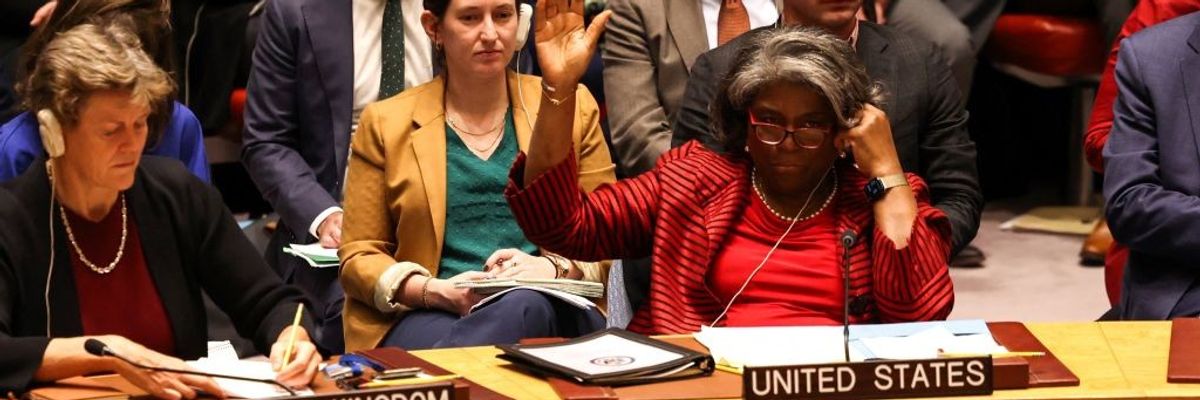
US ambassador to the United Nations Linda Thomas-Greenfield abstains during a vote to approve a resolution that “demands” all sides in the Israel-Hamas conflict allow the “safe and unhindered delivery of humanitarian assistance at scale” at UN headquarters in New York on December 22, 2023.
(Photo by Charly Triballeau / AFP via Getty Images)
The $1.5 trillion in military outlays each year is the scam that keeps on giving—to the military-industrial complex and the Washington insiders—even as it impoverishes and endangers America and the world.
On the surface, US foreign policy seems to be utterly irrational. The US gets into one disastrous war after another — Afghanistan, Iraq, Syria, Libya, Ukraine, and Gaza. In recent days, the US stands globally isolated in its support of Israel’s genocidal actions against the Palestinians, voting against a UN General Assembly resolution for a Gaza ceasefire backed by 153 countries with 89% of the world population, and opposed by just the US and 9 small countries with less than 1% of the world population.
In the past 20 years, every major US foreign policy objective has failed. The Taliban returned to power after 20 years of US occupation of Afghanistan. Post-Saddam Iraq became dependent on Iran. Syria’s President Bashar al-Assad stayed in power despite a CIA effort to overthrow him. Libya fell into a protracted civil war after a US-led NATO mission overthrew Muammar Gaddafi. Ukraine was bludgeoned on the battlefield by Russia in 2023 after the US secretly scuttled a peace agreement between Russia and Ukraine in 2022.
To understand the foreign-policy scam, think of today’s federal government as a multi-division racket controlled by the highest bidders.
Despite these remarkable and costly debacles, one following the other, the same cast of characters has remained at the helm of US foreign policy for decades, including Joe Biden, Victoria Nuland, Jake Sullivan, Chuck Schumer, Mitch McConnell, and Hillary Clinton.
What gives?
The puzzle is solved by recognizing that American foreign policy is not at all about the interests of the American people. It is about the interests of the Washington insiders, as they chase campaign contributions and lucrative jobs for themselves, staff, and family members. In short, US foreign policy has been hacked by big money.
As a result, the American people are losing big. The failed wars since 2000 have cost them around $5 trillion in direct outlays, or around $40,000 per household. Another $2 trillion or so will be spent in the coming decades on veterans’ care. Beyond the costs directly incurred by Americans, we should also recognize the horrendously high costs suffered abroad, in millions of lives lost and trillions of dollars of destruction to property and nature in the war zones.
The costs continue to mount. US Military-linked outlays in 2024 will come to around $1.5 trillion, or roughly $12,000 per household, if we add the direct Pentagon spending, the budgets of the CIA and other intelligence agencies, the budget of the Veteran’s Administration, the Department of Energy nuclear weapons program, the State Department’s military-linked “foreign aid” (such as to Israel), and other security-related budget lines. Hundreds of billions of dollars are money down the drain, squandered in useless wars, overseas military bases, and a wholly unnecessary arms build-up that brings the world closer to WWIII.
Yet to describe these gargantuan costs is also to explain the twisted “rationality” of US foreign policy. The $1.5 trillion in military outlays is the scam that keeps on giving—to the military-industrial complex and the Washington insiders—even as it impoverishes and endangers America and the world.
To understand the foreign-policy scam, think of today’s federal government as a multi-division racket controlled by the highest bidders. The Wall Street division is run out of the Treasury. The Health Industry division is run out of the Department of Health and Human Services. The Big Oil and Coal division is run out of the Departments of Energy and Interior. And the Foreign Policy division is run out of the White House, Pentagon and CIA.
Each division uses public power for private gain through insider dealing, greased by corporate campaign contributions and lobbying outlays. Interestingly, the Health Industry division rivals the Foreign Policy division as a remarkable financial scam. America’s health outlays totaled an astounding $4.5 trillion in 2022, or roughly $36,000 per household, by far the highest health costs in the world, while America ranked roughly 40th in the world among nations in life expectancy. A failed health policy translates into very big bucks for the health industry, just as a failed foreign policy translates into mega-revenues of the military-industrial complex.
The more wars, of course, the more business.
The Foreign Policy division is run by a small, secretive and tight-knit coterie, including the top brass of the White House, the CIA, the State Department, the Pentagon, the Armed Services Committees of the House and Senate, and the major military firms including Boeing, Lockheed Martin, General Dynamics, Northrop Grumman, and Raytheon. There are perhaps a thousand key individuals involved in setting policy. The public interest plays little role.
The key foreign policy makers run the operations of 800 US overseas military bases, hundreds of billions of dollars of military contracts, and the war operations where the equipment is deployed. The more wars, of course, the more business. The privatization of foreign policy has been greatly amplified by the privatization of the war business itself, as more and more “core” military functions are handed out to the arms manufacturers and to contractors such as Haliburton, Booz Allen Hamilton, and CACI.
In addition to the hundreds of billions of dollars of military contracts, there are important business spillovers from the military and CIA operations. With military bases in 80 countries around the world, and CIA operations in many more, the US plays a large, though mostly covert role, in determining who rules in those countries, and thereby on policies that shape lucrative deals involving minerals, hydrocarbons, pipelines, and farm and forest land. The US has aimed to overthrow at least 80 governments since 1947, typically led by the CIA through the instigation of coups, assassinations, insurrections, civil unrest, election tampering, economic sanctions, and overt wars. (For a superb study of US regime-change operations from 1947 to 1989, see Lindsey O’Rourke’s Covert Regime Change, 2018).
In addition to business interests, there are of course ideologues who truly believe in America’s right to rule the world. The ever-warmongering Kagan family is the most famous case, though their financial interests are also deeply intertwined with the war industry. The point about ideology is this. The ideologists have been wrong on nearly every occasion and long ago would have lost their bully pulpits in Washington but for their usefulness as warmongers. Wittingly or not, they serve as paid performers for the military-industrial complex.
There is one persistent inconvenience for this ongoing business scam. In theory, foreign policy is carried out in the interest of the American people, though the opposite is the truth. (A similar contradiction of course applies to overpriced healthcare, government bailouts of Wall Street, oil-industry perks, and other scams). The American people rarely support the machinations of US foreign policy when they occasionally hear the truth. America’s wars are not waged by popular demand but by decisions from on high. Special measures are needed to keep the people away from decision making.
In theory, foreign policy is carried out in the interest of the American people, though the opposite is the truth.
The first such measure is unrelenting propaganda. George Orwell nailed it in 1984 when “the Party” suddenly switched the foreign enemy from Eurasia to Eastasia without a word of explanation. The US essentially does the same. Who is the US gravest enemy? Take your pick, according to the season. Saddam Hussein, the Taliban, Hugo Chavez, Bashar al-Assad, ISIS, al-Qaeda, Gaddafi, Vladimir Putin, Hamas, have all played the role of “Hitler” in US propaganda. White House spokesman John Kirby delivers the propaganda with a smirk on his face, signaling that he too knows that what he is saying is ludicrous, albeit mildly entertaining.
The propaganda is amplified by the Washington think tanks that live off of donations by military contractors and occasionally foreign governments that are part of the US scam operations. Think of the Atlantic Council, CSIS, and of course the ever-popular Institute for the Study of War, brought to you by the major military contractors.
The second is to hide the costs of the foreign policy operations. In the 1960s, the US Government made the mistake of forcing the American people to bear the costs of the military-industrial complex by drafting young people to fight in Vietnam and by raising taxes to pay for the war. The public erupted in opposition.
From the 1970s onward the government has been far more clever. The government ended the draft, and made military service a job for hire rather than a public service, backed by Pentagon outlays to recruit soldiers from lower economic strata. It also abandoned the quaint idea that government outlays should be funded by taxes, and instead shifted the military budget to deficit spending which protects it from popular opposition that would be triggered if it were tax-funded.
It has also suckered client states such as Ukraine to fight America’s wars on the ground, so that no American body bags would spoil the US propaganda machine. Needless to say, US masters of war such as Sullivan, Blinken, Nuland, Schumer, and McConnell remain thousands of miles away from the frontlines. The dying is reserved for Ukrainians. Sen. Richard Blumenthal (D-Conn.) defended American military aid to Ukraine as money well spent because it is “without a single American service woman or man injured or lost,” somehow not dawning on the good Senator to spare the lives of Ukrainians, who have died by the hundreds of thousands in a US-provoked war over NATO enlargement.
This system is underpinned by the complete subordination of the U.S. Congress to the war business, to avoid any questioning of the over-the-top Pentagon budgets and the wars instigated by the Executive Branch. The subordination of Congress works as follows. First, the Congressional oversight of war and peace is largely assigned to the House and Senate Armed Services Committees, which largely frame the overall Congressional policy (and the Pentagon budget). Second, the military industry (Boeing, Raytheon, and the rest) funds the campaigns of the Armed Services Committee members of both parties. The military industries also spend vast sums on lobbying in order to provide lucrative salaries to retiring members of Congress, their staffs, and families, either directly in military businesses or in Washington lobbying firms.
It is the urgent task of the American people to overhaul a foreign policy that is so broken, corrupted, and deceitful that it is burying the government in debt while pushing the world closer to nuclear Armageddon.
The hacking of Congressional foreign policy is not only by the US military-industrial complex. The Israel lobby long ago mastered the art of buying the Congress. America’s complicity in Israel’s apartheid state and war crimes in Gaza makes no sense for US national security and diplomacy, not to speak of human decency. They are the fruits of Israel lobby investments that reached $30 million in campaign contributions in 2022, and that will vastly top that in 2024.
When Congress reassembles in January, Biden, Kirby, Sullivan, Blinken, Nuland, Schumer, McConnell, Blumenthal and their ilk will tell us that we absolutely must fund the losing, cruel, and deceitful war in Ukraine and the ongoing massacre and ethnic cleansing in Gaza, lest we and Europe and the free world, and perhaps the solar system itself, succumb to the Russian bear, the Iranian mullahs, and the Chinese Communist Party. The purveyors of foreign policy disasters are not being irrational in this fear-mongering. They are being deceitful and extraordinarily greedy, pursuing narrow interests over those of the American people.
It is the urgent task of the American people to overhaul a foreign policy that is so broken, corrupted, and deceitful that it is burying the government in debt while pushing the world closer to nuclear Armageddon. This overhaul should start in 2024 by rejecting any more funding for the disastrous Ukraine War and Israel’s war crimes in Gaza. Peacemaking, and diplomacy, not military spending, is the path to a US foreign policy in the public interest.
Our work is licensed under Creative Commons (CC BY-NC-ND 3.0). Feel free to republish and share widely.
Jeffrey D. Sachs is a University Professor and Director of the Center for Sustainable Development at Columbia University, where he directed The Earth Institute from 2002 until 2016. He is also President of the UN Sustainable Development Solutions Network and a commissioner of the UN Broadband Commission for Development. He has been advisor to three United Nations Secretaries-General, and currently serves as an SDG Advocate under Secretary-General Antonio Guterres. Sachs is the author, most recently, of “A New Foreign Policy: Beyond American Exceptionalism” (2020). Other books include: “Building the New American Economy: Smart, Fair, and Sustainable” (2017) and “The Age of Sustainable Development,” (2015) with Ban Ki-moon.
The news of John Pilger’s death is a sad event in the history of progressive and critical journalism. His work throughout his career was a glorious example of a dynamic trailblazer who stood for truth, justice, human rights and for oppressed and marginalised people. The world has lost a courageous son who fought against imperialism, neo-fascism, and the oppression of Palestinians by a colonial-settler state and its imperial patrons.
May you rest in peace, dear friend of the oppressed and victims of imperialism and colonialism.
In addition to killing thousands of Palestinians in Gaza, Israel has been routinely attacking at least four other nations in the region: Iran, Yemen, Syria, and Lebanon. Why does the U.S. media keeps the American public in the dark?
For years, this site has warned that Israel, especially Benjamin Netanyahu, have tried to instigate the U.S. into a wider war in the Mideast, particularly with Iran. We’ve also regularly indicted the U.S. mainstream media for ignoring this danger.
Today, the threat is greater than ever. And, true to form, the New York Times, National Public Radio, and the others continue to cover it up, instead treating Netanyahu as the embattled but honest leader of an Israel that is only trying to defend itself.
For more than a decade, Netanyahu’s main aim was to destroy Iran’s alleged (and unproven) program to build nuclear weapons. He openly tried to sabotage the Obama administration’s successful nuclear deal in 2015, and then vigorously encouraged Donald Trump’s abrupt decision to end the agreement 3 years later. Secretly, Israel conducted a long campaign of sabotage against Iran, which included cyber warfare, and actual assassinations inside the country, including the November 2020 killing of an Iranian scientist, Mohsen Fakhrizadeh. Netanyahu wanted to provoke Iranian retaliation, which would draw in the U.S., and — he hoped — trigger an American attack that that would set back or even destroy Tehran’s nuclear program.
Since October 7, the stakes for Netanyahu are much higher. Israelis blame him for the Hamas attack, and the opinion polls show his popularity has never been lower. A number of Israeli commentators have called him the worst leader in the country’s history. If just a handful of members from his own coalition in the Knesset abandon him, his government will fall, and he will be trounced in new elections. Even worse, the pending court cases against him for corruption will then revive, and he could well end up in prison.
Luring the U.S. into a conflict with Iran will distract from his own troubles, and give him time to maneuver. So:
On December 24, an Israeli air strike assassinated Iran’s top commander in Syria, Razi Mousavi. The always valuable Iranian/American expert Trita Parsi, asked: “Did Israel kill Iranian commander to provoke a wider war?”
Also last week, a cyber attack “caused two-thirds of Iran’s gas stations to suddenly stop working,” yet another sabotage effort with Israel’s fingerprints all over it. No country will be able to endlessly ignore such provocations.
(Netanyahu is not the only Israeli leader who wants the U.S. to attack Iran. Former prime minister Naftali Bennett just published an opinion article in the Wall Street Journal headlined: “The U.S. and Israel Need to Take Iran On Directly.” He disclosed 2 secret Israeli attacks inside Iran during his 2021-2022 tenure as prime minister: the destruction of a drone base and the killing of an Iranian military commander. After the article appeared, some Israeli officials criticized Bennett “for revealing classified information. . . saying that he was potentially putting the country in danger.”)
The New York Times did run a brief report on the December 24 air strike that killed Ravi Mousavi in Syria. But the article was a model of dishonesty. The paper feigned ignorance in the report’s opening sentence: “Iran accused Israel on Monday of killing a high-level military figure in a missile strike in Syria at a time when concerns are growing that the war in Gaza could escalate into a regional conflict.” Nowhere do we learn that many observers, including some Israelis, believe that Netanyahu may actually want a wider conflict, as long as he can embroil the U.S. in it.
National Public Radio was even worse. In recent days, the network ran three on-air reports, including one from a correspondent in the region. The broadcasts were uniformly inept. They barely mentioned Israel’s provocative killing of Mousavi. In one, host Leila Fadel asked: “Does the U.S. or Iran really want this to become a regional war?” Somehow, she forgot to add Israel or Netanyahu to her question, although anyone who follows the story using a range of non-U.S. mainstream sources, even including some in Israel itself, would have known to broaden the inquiry.
The Washington Postreport has a single throwaway sentence about how an “airstrike” by an unnamed air force killed a “senior [Iranian] officer” in Syria. That was it.
Of course, the situation in the region is complicated. Ansar Allah, Iran’s allies (commonly referred to as the Houthis) who control much of Yemen, have been attacking shipping in the Red Sea, and Hezbollah, the political/military movement in southern Lebanon that is also allied with Iran, has been clashing with Israel across their mutual border. (This site’s estimable Mitchell Plitnick has explained at length how the Biden administration’s flawed response to the Red Sea shipping crisis could also trigger a broader conflict.) It is doubtful that even Benjamin Netanyahu would want to widen the conflict to bring in either of these other two actors.
But what makes Israel’s provocative killing of General Mousavi and its latest cyberattack even more dangerous that it also raises the risk of a lethal accident. Let’s go back to July 1988, when tensions in the region were similarly high. A U.S. Navy warship in the Strait of Hormuz accidentally shot down a civilian Iranian jetliner, killing all 290 people on board. Iran did show restraint, and so the conflict thankfully did not escalate further.
Today, the danger is arguably even higher. Israel continues to murder thousands of Palestinian civilians in Gaza and attack at least four other nations in the region: Iran, Yemen, Syria, and Lebanon. Israel’s desperate leader is rolling the dice for his last time, and the Biden administration is letting him get away with it — while the U.S. media keeps the American public in the dark. The chances for a greater tragedy are high.
Editor’s remarks: Dr. Philip Giraldi in his latest article articulates with such precision and eloquence what is on the minds of many anti-war and antifascist people in America, Europe and the rest of the world. He identifies the reasons why US President Joe Biden obediently follows what the ultra-right Israeli manipulator Netanyahu decides.
Vital US interests are sacrificed to avoid offending Israel and its Lobby
by Philip Giraldi
I don’t have anyone whom I would consider a friend who supports the genocide being carried out by Israel in Gaza. But my occasional interaction with the psychopaths who infest the US government and media and who are intimately connected by virtue of their political instincts as well as their personal interests in campaign donations and/or elevated salaries derived from Israel and its powerful lobby have plenty of sound bites to throw out to demonstrate their love of the Jewish state in all its manifestations. They mouth the Pelosi-Schumer-Biden assertion that “Israel has a right to defend itself” and that Israel is “America’s closest ally” and “best friend,” all of which can readily be exposed as a series of self-serving lies and deliberate misinterpretations of international law. Beyond that, they inevitably cite their view that critics of Israel are fully responsible for what they choose to refer to as the ultimate evil of “surging anti-semitism.” In so doing they conveniently ignore the obvious fact that anger towards Jews collectively speaking is nearly always derived from the crimes against humanity committed by the Zionist political entity that now legally defines itself as Jewish.
I sometimes ask the friends of Israel what interest the United States has that would warrant our country becoming complicit in committing war crimes that, collectively speaking, amount to precursors for the complete expulsion or killing of millions of Palestinians from what remains of their homes. They try to weasel word their way avoiding the implications of that question by observing that the United States is not directly engaged in the conflict, an evasion that I belittle by pointing out that Washington is providing funding, arming and political cover for the more powerful and lethal party engaged in the conflict while also blocking attempts to bring about a ceasefire to comply with orders from that same party, which sure looks like direct involvement to me. I also point out that Israel is working hard to get the US military engaged against Hezbollah in Lebanon and also against Iran and is likely to be able to maneuver the stoneheads in and around the White House to do its bidding vis-à-vis both objectives.
So the big question has to be “Why does the United States engage in a conflict that inter alia has utterly ruined our country’s reputation worldwide and for which there is no real compelling national interest?” The answer is, of course unpalatable to many, but has to be that the US government is in many respects and vis-à-vis some of its designated national policies completely under the control of Israel and its powerful domestic as well as international lobby. This habitual bowing to force majeure has warped the thinking of the ambitious scallywags who seem to be present wherever one turns in places like Washington. How else does one explain the infamous and quite frankly ridiculous comment delivered at the 2018 Israeli American Council meeting by leading politician Nancy Pelosi, who said that “I have said to people when they ask me if this Capitol crumbled to the ground, the one thing that would remain is our commitment to our aid…and I don’t even call it aid…our cooperation with Israel. That’s fundamental to who we are.”
The delusional Pelosi, who appears to have no “fundamental” attachment to the interests of the American people whom she represents, is unfortunately not unique in the halls of Congress, even less so in the Joe Biden White House, which might be regarded as the illustration of what happens when you appoint Zionists to nearly all key positions running your foreign, economic and national security policies. The degree of direct Zionist/Israeli control over the hapless Biden can best be illustrated by reviewing the course of the recent redrafting of a UN Security Council resolution authored by the United Arab Emirates that sought to bring about a suspension of the fighting and the urgent resumption of humanitarian supplies for Gaza. The US forced the revisions after coordination with Israel to permit the Israelis to continue to attack civilian targets and avoid entering into anything like a ceasefire, changing the word “suspension” in the original draft to the less demanding creation of “conditions for a sustainable cessation of hostilities.” Language authorizing the lead UN role in monitoring and delivering the assistance to the Gazans was also expunged leaving to belligerent Israel the task of completely controlling the distribution of any supplies allowed entry into the areas inside Gaza, which it is also simultaneously continuing to bomb, thereby slowing the stream of urgently needed supplies to a trickle while also killing hundreds more civilians.
To be sure, it was the United States blindly supporting Israel that rendered what was a promising proposal to put an end to the multiplying civilian deaths toothless. Israel demonstrated just how high it regarded Joe Biden when it contradicted what the president said about the US being able to moderate some Israeli offensive action in Gaza. Netanyahu denied that, saying that he and his war cabinet were continuing to make all relevant decisions based on Israel’s own interests. Israel Defense Force (IDF) Chief of the General Staff General Herzi Halevi followed on with his own assessment that finishing the job in Gaza, i.e. totally destroying Hamas by whatever means it requires, will take “many more months.” The Israeli military has indeed visibly increased its efforts by opening up new “battle zones” inside Gaza, to include directly targeting the crowded and starving refugee camps outside the cities. The civilians are paying the price while a grinning Joe Biden is spending his New Year’s holiday in the American Virgin Islands.
Allowing Israeli Prime Minister Benjamin Netanyahu, a known liar and habitual war criminal to tell the US government what to do is about as low as it gets, Mr. Biden! You should not only be ashamed, but more than that, humiliated, compelled to do ghastly things in support of your own fear of possible Jewish/Israeli reaction if you do not bow down before King Netanyahu. He and the band of inhuman monsters he has assembled in his cabinet have made no secret of their intention to remove the Palestinians from Palestine, either by forced emigration or by killing them if necessary. On Christmas Day, Prime Minister Netanyahu told a meeting of his Likud bloc “that he was still working on the ‘voluntary’ immigration of Gaza’s inhabitants to other countries.” His associates Itamar Ben-Gvir and Bezalel Smotrich have made it clear that the ethnic cleansing process will proceed even if it is not in any way voluntary. As Israel is the occupying power in the former Palestine, what is taking place is, as defined by the Geneva Conventions, the Genocide Convention and the UN Charter, a crime against humanity and the United States is completely complicit in it not to mention actually enabling the slaughter through its supplying of arms and money to the Israelis. It has recently been reported in the Israeli media that the United States has delivered an astonishing “10,000 tons of armaments and military equipment on 244 cargo planes and 20 ships” to sustain the Israeli homicidal assault against the people of Gaza. And to demonstrate its gratitude for the flood of weapons, America’s “best friend” and “closest ally” Israel has nevertheless complained “about a delay in the delivery of munitions.”
The total support of the Israeli genocide of the Palestinians by Washington and the media is not only shameful, it is lacking any context for a crime against humanity that has been going on with US connivance for the past 76 years. Under international law, an occupied people has a right to use force to resist occupation, but even given that, the majority of Israeli deaths on October 7th should probably be attributed to so-called “friendly fire” from the Israeli army not from Hamas. The occupied and woefully abused Palestinians rising-up and seeking both freedom and sovereignty in the land that was once completely theirs is fully justified and should be respected. Israel’s killing women and children through deliberate starvation or even by execution style is indisputably a war crime. Bombing hospitals or leaving newborn incubator babies abandoned to die is a crime against humanity. Arresting innocent Palestinians before parading them naked and even desecrating their dead bodies by harvesting organs that you then sell is unspeakable and almost unimaginable evil as is deliberately targeting and bombing schools and churches where people are trying to find shelter.
The genocide and destruction in Gaza is the worst crime committed in modern history and the man who could have stopped it, Joe Biden, sits on his hands and grins. No one should remain silent when confronted by this horror but the silence and the deliberate distortion of what is taking place is a tribute to Jewish power in America and elsewhere. I am including some recent commentary from the illustrious Australian Journalist Caitlin Johnstone which demonstrates perfectly the hypocrisy and inhumanity of both Biden and the leaders of Britain, France, Canada, and Germany: “Sometimes Israel’s crimes are so horrific that at first you don’t even understand what you’re looking at. You just stare at it trying to make sense of what you’re seeing for a bit, like you would if you suddenly saw a space alien or a leprechaun or something… It’s so incredibly obvious what we’re looking at here. The only thing putting a wobble on people’s perception is the immense amount of propaganda distortion the media is churning out on this issue, plus the fact that the demographics look a bit different from what history has conditioned people to watch out for. If there were two million Jewish people trapped by Christians in a giant concentration camp and placed under total siege, being told that half of them had 24 hours to relocate into the other half or be killed, nobody would have any confusion about what they were witnessing.”
And a leading American journalist Daniel Larison must have the last word of advice from his site on Eunomia: “We are witnessing one of the gravest crimes of our time. Our government is aiding and abetting the perpetrators. It is up to people in this country to make our government cut off all support for this war and to press for an end to the war itself.” Amen, Daniel!






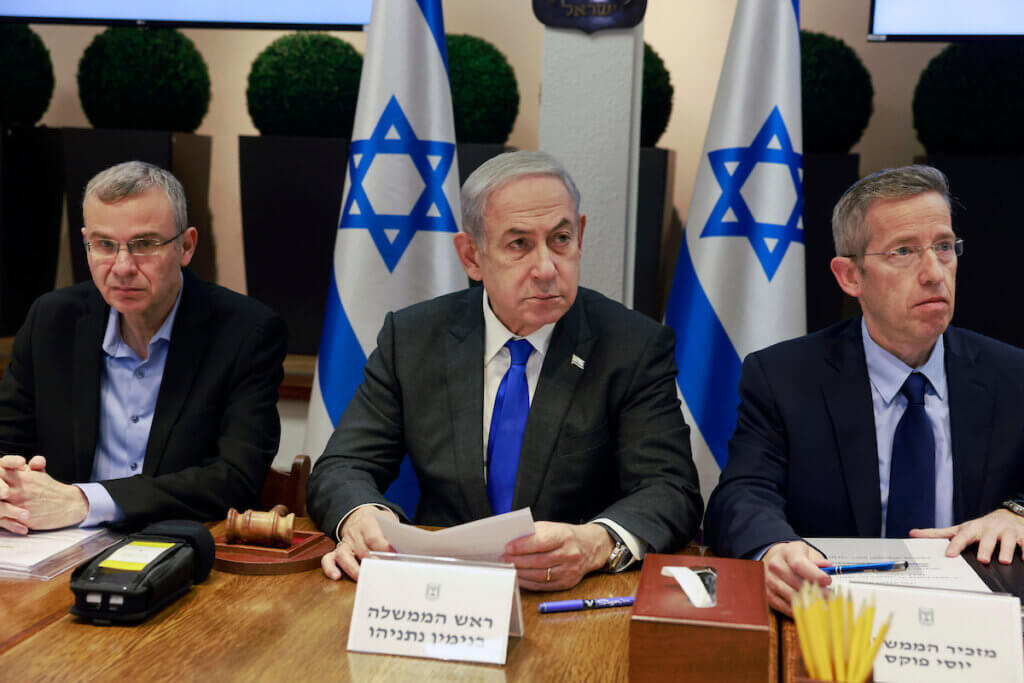 Israeli Prime Minister Benjamin Netanyahu chairs a Cabinet meeting at the Israeli Ministry of Defense, in Tel Aviv, Israel, 17 December 2023. (Photo: © Menahem Kahana/EFE via ZUMA Press APAimages)
 Peace and Justice Post
You must be logged in to post a comment.