The reality of war in Afghanistan

October 16, 2008
By Stephen Kinzer |  The Boston Globe, October 15, 2008

Despite their differences over how to pursue the US war in Iraq, Senators John McCain and Barack Obama both want to send more American troops to Afghanistan. Both are wrong. History cries out to them, but they are not listening.

Both candidates would do well to gaze for a moment on a painting by the British artist Elizabeth Butler called “Remnants of an Army.” It depicts the lone survivor of a 15,000-strong British column that sought to march through 150 kilometers of hostile Afghan territory in 1842. His gaunt, defeated figure is a timeless reminder of what happens to foreign armies that try to subdue Afghanistan.

The McCain-Obama approach to Afghanistan, like much of US policy toward the Middle East and Central Asia, is based on emotion rather than realism. Emotion leads many Americans to want to punish perpetrators of the Sept. 11, 2001 attacks. They see war against the Taliban as a way to do it. Suggesting that victory over the Taliban is impossible, and that the United States can only hope for peace in Afghanistan through compromise with Taliban leaders, has been taken as near-treason.

This knee-jerk response ignores the pattern of fluid loyalties that has been part of Afghan tribal life for centuries. Alliances shift as interests change. Warlords who support the Taliban are not necessarily enemies of the United States. If they are today, they need not be tomorrow.

In recent weeks, this elemental truth has begun to reshape debate over Western policy toward Afghanistan. Warlords on both sides met quietly in Saudi Arabia. The Afghan defense minister called for a “political settlement with the Taliban.” Secretary of Defense Robert Gates would not go that far, but said he might ultimately be open to “reconciliation as part of the political outcome.”

Gates, however, struck a delusionary note of “can-do” cheeriness by repeating the McCain-Obama mantra: More US troops can pacify Afghanistan. Speaking days after a National Intelligence Estimate concluded that the United States was caught in a “downward spiral” there, Gates asserted that there is “no reason to be defeatist or underestimate the opportunity to be successful in the long run.”

In fact, long-run success in Afghanistan – defined as an acceptable level of violence and assurance that Afghan territory will not be used for attacks against other countries – will only be possible with fewer foreign troops on the ground, not more.

A relentless series of US attacks in Afghanistan has produced “collateral damage” in the form of hundreds of civilian deaths, which alienate the very Afghans the West needs. As long as the campaign continues, recruits will pour into Taliban ranks. It is no accident that the Taliban has mushroomed since the current bombing campaign began. It allows the Taliban to claim the mantle of resistance to a foreign occupier. In Afghanistan, there is none more sacred.

The US war in Afghanistan also serves as a recruiting tool for Al Qaeda. It is attracting a new stream of foreign fighters into the region. A few years ago, these jihadists went to Iraq to fight the Great Satan. Now they see the United States escalating its war in Afghanistan and neighboring regions of Pakistan, and are flocking there instead.

Even if the United States de-escalates its war in Afghanistan, the country will not be stable as long as the poppy trade provides huge sums of money for violent militants. Eradicating poppies is like eradicating the Taliban: a great idea but not achievable. Instead of waging endless spray-and-burn campaigns that alienate ordinary Afghans, the United States should allow planting to proceed unmolested, and then buy the entire crop. Some could be turned into morphine for medical use, and the rest destroyed. The Afghan poppy crop is worth an estimated $4 billion per year. That sum would be better spent putting cash into the pockets of Afghan peasants than firing missiles into their villages.

Deploying more US troops in Afghanistan will intensify this highly dangerous conflict, not calm it. Compromise with Al Qaeda would be both unimaginable and morally repugnant, but the Taliban is a different force. Skillful negotiation among clan leaders, based on a genuine willingness to compromise, holds the best hope for Afghanistan. It is an approach based on reality, not emotion.

Stephen Kinzer is author of “A Thousand Hills: Rwanda’s Rebirth and the Man Who Dreamed It.”

The Question To Be Asked: “Where Will the Money Come From?”

October 16, 2008

In India, it didn’t hurt when the farmers were dying. Over 200,000 farmers have committed suicide in the past 15 years, and more than 40 percent of India’s 600 million farmers want to quit agriculture to look for menial jobs in the cities.

The national media kept quiet.

Now that the markets are crashing, the media is up in arms. “Act fast, go big. It is not only about bulls and bears anymore. It’s about India. And it’s hurting,” says a lead story in a national daily. But it didn’t hurt when the farmers were dying.

There is blood on Dalal Street (India’s Wall Street). Yet throughout all these years we refused to acknowledge that farmers were dying, and agriculture was bleeding. Farmers are children of a lesser God, it seemed, who do not belong to India. They only live in Bharat, the countryside.

Just a few months back, when the day Finance Minister P Chidambaram in his budget speech announced a Rs 60,000-crore* loan waiver for the beleaguered farming community, there was an orchestrated outcry: “Where will this money come from?” Television anchors were visibly angry at this supposed ‘windfall’ for the farmers, the print media was outraged at this ‘political and not economic’ decision just before the ensuing elections, and the industry leaders were seen sulking.

Six months later, no one is asking the same question. With the global financial crisis failing to work itself out, the Reserve Bank of India (RBI) is under pressure to intervene. Soon after the Wall Street mayhem, the RBI had pumped in Rs 84,000-crore in the domestic banking system through liquidity facility adjustment. An additional Rs 20,000-crore has been released through a 0.5 percent reduction in a cash reserve ration (CRR), to be further slashed by 100 basis points. It took RBI five years to make the first cut in CRR on Monday, and the next cut comes five days later. That sure is some urgency.

Sounds technical, but let me simplify. Liquidity in layman terms means ‘fund availability’ or, in simple words, making available more cash. All over the industrialized world, governments are stepping in to provide more cash in the hands of the private banks, and India is no exception.

Despite the Finance Minister saying that the fundamentals are strong, the banks are on a massive borrowing spree. In the first week of October alone, they borrowed Rs 90,075-crore every day from RBI through liquid facility adjustment. In the days to come, the RBI is under pressure to release another Rs 30,000-crore through the CRR, and also to cut the repo rate — the rate at which it lends to banks. And thanks to the loan waiver, the banks will receive another Rs 50,000-crore in the coming weeks as part reimbursement for the farm loan waiver and fertilizer loan.

Isn’t it a fact that Rs 60,000-crore loan waiver (later enhanced to Rs 71,000-crore) was actually a relief to the banks? What seemed to be a ‘political’ decision in the name of pulling out the indebted farmers was actually meant to maintain and sustain the health of the banking system. If the government had not provided the loan waiver, banks would have been in a terrible liquidity crisis. With farmers unable to repay, these banks would have been saddled with massive non-performing assets (or a shortfall in liquidity) or non-availability of Rs 71,000-crore in cash.

In other words, the loan waiver was a partial bailout for the banks. Now no one is asking: “Where will this money come from?” On the contrary, most analysts are asking for more ‘speed and sagacity’ to tide over the crisis. The industry has already demanded a bailout package of Rs 100,000-crore.

If only such ‘speed and sagacity’ was shown to tide over the terrible agrarian crisis sweeping throughout the country for over a decade now, thousands of farmers would have been saved from committing suicide. If only the RBI had stepped in to make more cash (or liquidity) available, the nation could have easily provided an assured employment to each and every Indian, not only for 100 days but for all the 365 days in a year. The National Rural Employment Guarantee Programme (NREGA) can be easily extended to bring every unemployed Indian under its gambit.

It is here that I fail to understand the sagacious logic of keeping the poor hungry, and then expecting a higher economic growth trajectory; of paying a multi-million dollar salary (in addition to lucrative perks) to the bosses of the banks and corporate houses, and then to make the man on the street pay for the losses; in other words, the logic behind privatizing the profits and socializing the losses.

Take the case of the bankrupt Lehman Brothers. While the shareholders in the company have been wiped out, Richard Fuld, its chief executive, walked away with US $480 million as his personal remuneration over eight years, which includes a $14 million ocean-front villa in Florida, and a home in an exclusive ski resort. Lawmakers investigating the bailed out insurance company AIG were shocked to learn that days after the government rescued the company, it unashamedly spent US $44,000 on a posh California retreat for its executives, complete with spa, banquets and golf outings.

Why blame the American corporate leaders when US president George Bush himself had given them a free rope: “Government should not decide the compensation for America’s corporate executives.” What he probably meant was that come what may, the US government will continue to provide funds to meet obscene corporate salaries and perks.

Prime Minister Manmohan Singh had also removed the upper ceiling on corporate salaries. According to Merrill-Lynch and Capgemini, driven by impressive economic gains and robust market capitalism growth in 2007, India led the world in high net worth individual (HNWI) population growth at 22.7 per cent. Two year earlier in 2005, there were 83,000 high net worth individuals with a wealth of at least $1 million (without including immovable property). And you guessed right – the number of millionaires has gone up quite considerably in the meantime.

This brings me back to the same question. How long will the world go on encouraging an economic system that makes the rich richer and the poor poorer? While 36 billionaires in India have a collective economic wealth equivalent to one third of the country’s GDP, the country’s 600 million farmers collectively account for only a 17 percent share. With every passing year, the share of agriculture in GDP continues to slide down even further.

The average monthly income of a farm household (which includes five members of a family and two cattle) does not exceed Rs 2,400 (US $60). The value erosion in real farm income over the past few decades has never been discussed, but the erosion in paper wealth of shareholders is being projected as a national disaster.

Bailing out the farmers from a distressing situation is always considered to be bad economics. It is branded as a political compulsion, and the sooner politicians emerge out of it the better it is supposed to be for economic growth and development. This economic prescription, which every economist worth his title is willing to endorse, is invariably given for the farming community, the landless workers and the marginalized communities. They need to learn to be enterprising, is the assumption, and therefore must stop living on government subsidies.

But when it comes to the enterprising millionaires — corporates and leading bankers — government bailouts are not only a must, but should be done speedily. ‘Where will the money come from?’ is not a question to be asked when you are subsidizing the rich and the elite. That, we must understand, is their birthright.

* one crore = 10 million

Devinder Sharma is a New Delhi-based food and trade policy analyst. He is a regular contributor to Share the World’s Resources (STWR), where this article originally appeared, and can be reached at hunger55@gmail.com. Read other articles by Devinder, or visit Devinder’s website.

Poison stalks trial of murdered Putin critic

October 16, 2008

By Miriam Elder in Moscow | The Independent, Thursday, 16 October 2008

Protesters mark the anniversary of Anna Politkovskaya's murder

AFP/GETTY IMAGES

Protesters mark the anniversary of Anna Politkovskaya’s murder

Change font size: A | A | A

A lawyer representing the family of investigative journalist Anna Politkovskaya has apparently been targeted by poisoners as the trial of three men accused of involvement in her murder was about to begin.

French police confirmed the discovery of mercury pellets in the car of Karinna Moskalenko, who suffered headaches, dizziness and nausea after getting into the vehicle.

Ms Moskalenko was taken to hospital for tests in Strasbourg on Tuesday, which prevented her from flying to Moscow for the Politkovskaya trial. The preliminary hearing opened almost exactly two years after the crusading reporter died in a hail of bullets in the entrance to her apartment block.

The three men, including a former police officer, are on trial in connection with the murder of Ms Politkovskaya, who made her name challenging Vladimir Putin’s regime. Friends and colleagues believe her killers may never be found.

Lawyers for the defendants and Ms Politkovskaya’s family have called for an open trial to provide transparency in a case charged with politics and cloaked in conspiracy. “It was made clear to us all that the hearing will likely take place behind closed doors, as the case contains secret materials,” said defence lawyer Murat Musayev.

Ms Moskalenko is a leading defender of the Kremlin’s critics, including the jailed former oil tycoon and ex-chief executive of Yukos, Mikhail Khodorkovsky and the chess-champion-turned opposition politician Garry Kasparov. She said that she believed the poisoning was a warning. “When we got to the car, we realised something was not normal. My husband is a chemist and the substance looked like mercury. I’m worried for my family,” she said.

Another lawyer for Mr Khodorkovsky, Robert Amsterdam, said the timing was suspicious. “This type of event gives us all pause to consider what it takes now in Russia to defend human rights. There are ongoing attacks on lawyers and journalists.”

Kremlin critics have often been the targets of poisoners. Ms Politkovskaya herself fell ill after drinking a cup of tea while on her way to cover the aftermath of the Beslan school siege in which more than 300 people died, while the former KGB agent Alexander Litvinenko died in London from radiation poisoning. Scotland Yard wants to extradite his fellow ex-KGB operative, Andrei Lugovoi, to be tried for his murder. Another case of alleged mercury poisoning was reported two years ago, involving the wife of an ex-director of Yukos, Alexei Golubovich. Mr Amsterdam said: “What matters is not if it’s related to Yukos or Politkovskaya but that it’s another human rights defender that’s in this situation.”

Sergei Sokolov, the deputy editor of Ms Politkovskaya’s newspaper, Novaya Gazeta, said that Ms Moskalenko “takes part in a lot of prominent cases. It’s not necessarily directly linked to this case.” Ms Moskalenko helps Russians press claims against the government at the European Court of Human Rights in Strasbourg.

The trial judge reportedly refused to postpone yesterday’s preliminary hearing, which involved two ethnic Chechen brothers, Dzhabrail and Ibragim Makhmudov, and Sergei Khadzhikurbanov, a former police officer. All stand accused of aiding the killer, who remains on the run. Investigators suspect him to be Rustam Makhmudov, although investigators d do not know who ordered the murder.

Ms Politkovskaya won countless enemies through her articles and books chronicling human rights abuses and the fall of democracy in modern Russia, particularly through her scrutiny of Moscow’s brutal wars in Chechnya.

She was killed on 7 October 2006 – the then President Vladimir Putin’s birthday. He denied any Kremlin link to the killing but failed for days to comment on the death, before dismissing it as “insignificant”. Last week, hundreds commemorated the second anniversary of Ms Politkovskaya’s death. “It’s sad we don’t know, two years after the murder, who did it, who ordered it,” Vladimir Milov, a former deputy energy minister turned Putin critic, said at the rally.

The military court is due to meet again on 17 November to decide if the trial will be open to the public and the media, and to assemble a jury.

The settlers’ war with Israel

October 16, 2008

In any peace deal with the Palestinians, Israel will also have to tackle the problem of militant Jewish settlers

Paul Raymond | guardian.co.uk, Thursday October 16 2008 08.00 BST

While it is not unusual for events on the Temple Mount to trigger renewed Israeli-Palestinian conflict – the second Palestinian intifada (uprising) was triggered in 2001 by then Israeli defence minister Ariel Sharon’s controversial visit to the site – the latest events also have much to say about the current political situation in Israel itself. A growing current of hardline neo-Zionist militancy is terrorising Palestinians, leftwing Israelis and state authorities alike. As the Israeli government desperately tries to come to an agreement with the Palestinian Authority and undermine Hamas, the problem of evacuating settlements inhabited by violent ultra-nationalists will be near the top of a list of thorny challenges for the next Israeli administration.

There is plenty of evidence that the right wing radical fringe is growing. In mid-September, over 200 vigilantes from the illegal West Bank settlement of Yitzhar invaded the nearby Palestinian village of Asira al-Qibliyyah with guns and slingshots, in response to the stabbing of a Jewish boy from the settlement.

But settler violence is not limited to attacks against Palestinians. Two weeks after the assault on Asira, leftwing Israeli professor Ze’ev Sternhell, a staunch critic of the settlement movement, was injured by a pipe bomb on his doorstep. It was widely assumed that rightwing activists placed it there, although the settlers’ supporters were quick to accuse Israeli intelligence forces of launching a sinister leftwing conspiracy to discredit them. Later, prominent settler leader Daniela Weiss was arrested for attacking Israeli police officers during the evacuation of the illegal settlement of Shvut Ami, giving a further indication of the gulf between Israeli state authorities and the radical right.

It is clear that the rift has implications for the current round of talks with the Palestinians. Ehud Olmert, the outgoing Israeli prime minister, has argued that Israelis should abandon the Zionist utopia of the Greater Land of Israel, resorting instead to a territorial compromise in order to achieve peace with the Palestinians. After the events of September 13, Yitzhar’s rabbi, David Dudkevich, who claims that the Arabs should emigrate from the “Land of Israel”, launched a public tirade against the idea. Among other things, he endorsed the proposal of a separate state, Judea, which would be established alongside Israel should the latter decide to abandon the Zionist dream.

“It’s obvious that a great many people who are secure in their Judaism feel emotionally distant from the state, which is in another place altogether,” he told Haaretz newspaper. “The state of Israel is not the be-all and end-all. If it decides it does not want to be in the hereditary lands of our forefathers, then other Jews have the right to organise themselves in order to live there, even without a link to the state. When there’s talk about another expulsion, then on the ideological level, the ‘State of Judea’ is no worse than expulsion.”

The irony is that settler radicalism was nurtured by the Israeli state in the first place. Over the years, Likud governments in particular encouraged non-ideological Israelis to settle in the West Bank in the hope that they would adopt views that fitted the rightwing agenda of that party. It was also an effective strategy for gaining control of the Occupied Territories and guaranteeing that the maximum possible territory would be ceded to Israel should the US force her into a deal with the Palestinians.

However, the 2005 Israeli withdrawal from Gaza placed the state authorities charged with implementing government policy – namely the police – at loggerheads with those settlers. The image of Israeli police forcibly evicting Jews from their homes created a wound in Israeli society that has been festering ever since. Several thousand young people who lived their entire childhoods in Gaza settlements now feel abandoned by the state and are willing to take out their frustration, often violently, against both Palestinians and the Israeli authorities.

Thus the Israeli government now faces huge dilemmas in the context of the current round of Israeli-Palestinian talks and also in how it deals with its own citizens. If the implication of Olmert’s comments is that more settlement evacuations are on the cards, and forcing that past a group of armed, radical settlers who have sworn their enmity to the state will be every bit as hard as negotiating an agreement with the Palestinians.

No religious festival in Jerusalem would be complete without a controversial political incident, and this year’s Yom Kippur was no exception. A group of nearly a hundred rightwing radicals forced their way on to the plaza of the Dome of the Rock, one of the most sacred sites in Islam. Entering the precinct on Yom Kippur was a symbolic way of claiming Jewish sovereignty over the site many consider to be the location of the second temple, destroyed by the Romans in AD 70.

Waterboarding Got White House Nod

October 15, 2008

CIA Tactics Endorsed In Secret Memos

Joby Warrick
Washington Post Staff Writer
Wednesday, October 15, 2008; Page A01

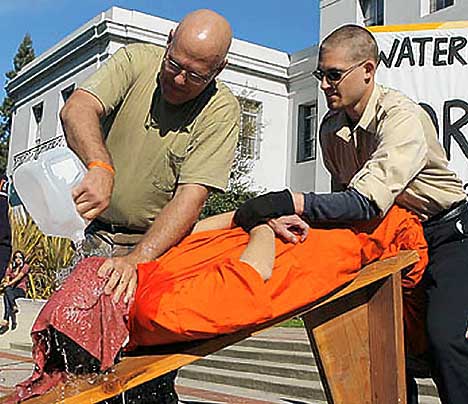
The Bush administration issued a pair of secret memos to the CIA in 2003 and 2004 that explicitly endorsed the agency’s use of interrogation techniques such as waterboarding against al-Qaeda suspects — documents prompted by worries among intelligence officials about a possible backlash if details of the program became public.

The classified memos, which have not been previously disclosed, were requested by then-CIA Director George J. Tenet more than a year after the start of the secret interrogations, according to four administration and intelligence officials familiar with the documents. Although Justice Department lawyers, beginning in 2002, had signed off on the agency’s interrogation methods, senior CIA officials were troubled that White House policymakers had never endorsed the program in writing.

The memos were the first — and, for years, the only — tangible expressions of the administration’s consent for the CIA’s use of harsh measures to extract information from captured al-Qaeda leaders, the sources said. As early as the spring of 2002, several White House officials, including then-national security adviser Condoleezza Rice and Vice President Cheney, were given individual briefings by Tenet and his deputies, the officials said. Rice, in a statement to congressional investigators last month, confirmed the briefings and acknowledged that the CIA director had pressed the White House for “policy approval.”

The repeated requests for a paper trail reflected growing worries within the CIA that the administration might later distance itself from key decisions about the handling of captured al-Qaeda leaders, former intelligence officials said. The concerns grew more pronounced after the revelations of mistreatment of detainees at the Abu Ghraib prison in Iraq, and further still as tensions grew between the administration and its intelligence advisers over the conduct of the Iraq war.

Continued . . .

UN: Nearly 190,000 flee Pakistan battles

October 15, 2008

UN says nearly 190,000 flee Pakistan offensive against Islamic militants

ASIF SHAHZAD | AP News, Oct 14, 2008 11:13 EST

Nearly 190,000 people are reported to have fled fighting between Pakistani troops and militants near the border with Afghanistan, the United Nations said Tuesday as fresh clashes in the area killed 17 militants.

Meanwhile, police in the frontier region released a man of dual American-Pakistani citizenship they had arrested Monday in the volatile border region.

Authorities originally described the 20-year-old as a U.S. citizen traveling without the permission foreigners need to enter the region, which has seen of months of fighting between militants and security forces and is considered a possible hiding place for al-Qaida leader Osama bin Laden.

“After interrogation we found out he holds dual nationality,” Charsadda district police chief Waqif Khan. “He was roaming in that area just due to his lack of knowledge about the sensitivity there.”

Fighting is spreading across Pakistan’s rugged northwest as the government tries to crack down on insurgents blamed for soaring attacks on U.S. and NATO forces in Afghanistan and a bloody campaign of suicide bombings against military and western targets within Pakistan.

Most of the clashes are taking place in Bajur, where the Pakistani military launched a major offensive in early August.

The U.N.’s refugee agency said at least 20,000 Pakistanis and Afghans have fled from Bajur into eastern Afghanistan’s Kunar province since the fighting began.

Citing Pakistani statistics, the U.N. High Commissioner for Refugees said in a statement that 168,463 other people had fled to other parts of northwestern Pakistan during the offensive. The agency said it was not able to independently confirm the figure.

It said most refugees, on both sides of the border, were staying with host families. But the agency said it was helping those who are staying in several temporary camps in Pakistan.

In the latest violence in Bajur, Pakistani fighter jets pounded militant trenches on Tuesday, killing five suspected insurgents, while overnight artillery and mortar attacks left 12 extremists dead, said government official Muhammad Jamil Khan. Two pro-government tribesmen also died in the fighting, he said.

Pakistan’s secular, pro-Western government says it is trying to forge a national consensus on how to combat terrorism. However, many Pakistanis blame the violence on their country’s support for U.S. policy in its pursuit of al-Qaida and the Taliban.

On Tuesday, a small group of Islamic political parties announced that suicide bombings were not permitted under Islam, a declaration likely to please the government. Pakistan has been plagued by such attacks, including one that killed former Prime Minister Benazir Bhutto and 20 other people in December 2007 and a blast at the Marriott Hotel last month in which more than 50 died.

“We, the religious scholars, believe that the suicide bombings in Pakistan are illegitimate. Islam does not allow it,” said a leader of the alliance, Dr. Sarfraz Naeemi.

But Naeemi also called on the government to halt its military operations in the border region and allow a fact-finding mission of religious scholars to visit there.

Source: AP News

Licence to kill

October 15, 2008
Jewish settler fanatics continue to kill and steal from Palestinians without censure from Israel, writes Khaled Amayreh in the West Bank

Al- Ahram Weekly, 9-15 October 2008

Israeli security circles have warned recently that “organised Jewish terror” against Palestinians (and also against peace-oriented Jews) is on the rise and that steps must be taken to “nip that terror in the bud”.

However, Israeli officials, including Defence Minister Ehud Barak, have admitted that “confronting the settlers” is an uphill struggle, given the wide support they receive in Israeli-Jewish society and the strong political backing they enjoy from powerful government circles.

Barak also alluded to the shocking laxity shown by the Israeli justice system towards the settlers, which effectively allows them to commit acts of murder and vandalism, especially against unprotected and near helpless Palestinian villagers, with virtual impunity.

The ultimate goal of the settler terrorists is to intimidate and terrorise indigenous Palestinians into leaving their land so that more settlers can take it over. However, despite years of permanent terror and harassment, very few Palestinians if any have left their villages and land, prompting the mostly religious terrorists to intensify their attacks against Palestinians and their property.

In recent days, armed settler terrorists have stepped up acts of arson and vandalism targeting Palestinian olive groves throughout the West Bank. In the Nablus and Salfit region, settlers set fire to olive groves, destroying large swathes of the crop upon which the livelihood of numerous impoverished Palestinian families depends.

In one incident, the head of a settlement council took part in an arson attack that Palestinians contend happened in full view of Israeli army troops.

“I think there is a sort of collusion between the army and the settlers. Do you believe that the mighty Israeli army can’t control a few thugs who are terrorising Palestinian communities here?” asked Ibrahim Ahmed of Salem near Nablus.

“The world is often under the false impression that the settlers are a few unruly fanatics in an otherwise civilised society,” Ahmed continued. “The truth of the matter, however, is that the settlers are a key tool of the Israeli state and army to terrorise and torment the Palestinians. It is the state and the army that give them money, housing, weapons and protection. So it is naïve to buy the claim that the settlers are acting against the will of the Israeli state and army.”

Last week, a young Palestinian shepherd was found murdered next to a Jewish colony, also in the Nablus region. Eyewitnesses reported that they saw a white van chasing the 19-year-old man. The Israeli army denied that the boy was murdered by settlers, saying it was more likely that he was killed by unexploded ordnance left by the Israeli army.

Last month, dozens of armed Jewish settler terrorists committed a virtual pogrom at the Palestinian village of Asira Al-Qibliya south of Nablus, shooting into Palestinian homes and vandalising property. Ten Palestinians were injured, including one sustaining serious gunshot wounds. A videotape of the wild rampage showed Israeli soldiers looking on and doing virtually nothing to stop the settlers. When the “story” died down, the settlers resumed their violence and vandalism.

In recent years, settlers have resorted to stealing Palestinian olive crops in broad daylight. Settlers have also begun to bring in foreign workers to harvest Palestinian groves in the vicinity of their settlements. In doing so, settlers act on religious edits issued by local and national rabbis allowing them to steal crops in the West Bank, which the settlers call Judea and Samaria, believing that the land belongs to the Jews by a divine decree.

Until recently, rabbis issued their edicts publicly, drawing bad publicity from the press. Now, however, the edicts are issued and circulated quietly through local synagogues in the settlements.

In addition, the Israeli army seems to always find new ways to make life more difficult for Palestinian farmers. Many olive groves surrounding illegal Jewish settlements are declared closed military zones (only for non-Jews), which in effect is a green light for settlers to come and to steal Palestinian olives.

Last week, the Israeli army said it would provide “protection” to Palestinian olive-pickers from settler violence. However, the army said the duration of protection would only last three days.

The Israeli army claims it is unable to rein in terrorist settlers. This claim, however, is starkly mendacious and hypocritical. The truth is that the army lacks the will and inclination to confront the settlers.

The Israeli newspaper Haaretz this week commented: “Military jails are packed with young Palestinians convicted of far less serious crimes than the violent acts of which the settlers are accused.” Yet generally speaking, the Israeli public is indifferent to the terror, murder and harassment wreaked by army-backed Jewish settlers in the West Bank.

Now, however, settler terror is boomeranging back on Israeli-Jewish society. Last month, suspected Jewish terrorists placed a bomb at the doorstep of 73-year-old Zeev Sternhell, a political science professor at Hebrew University in West Jerusalem. Sternhell, an expert on the evolution of European fascism, was slightly injured in the incident that sent shockwaves across the Israeli political establishment and public.

Sternhell, a prominent supporter of the centre-left group “Peace Now”, warned that the attempt on his life might mark the “collapse of democracy” in Israel. However, it is unlikely that the attempted assassination of Sternhell will introduce a qualitative change into the way the Israeli army and public relate to settler terrorists. Something much more would be required to break down the institutionalised, studied racism and violence at the core of the state of Israel.

Behind the Panic: Financial Warfare and the Future of Global Bank Power

October 15, 2008

By F. William Engdahl | AxisofLogic, Oct 10, 2008, 11:28

What’s clear from the behavior of European financial markets over the past two weeks is that the dramatic stories of financial meltdown and panic are deliberately being used by certain influential factions in and outside the EU to shape the future face of global banking in the wake of the US sub-prime and Asset-Backed Security (ABS) debacle. The most interesting development in recent days has been the unified and strong position of the German Chancellor, Finance Minister, Bundesbank and coalition Government, all opposing an American-style EU Superfund bank bailout. Meanwhile Treasury Secretary Henry Paulson pursues his Crony Capitalism to the detriment of the nation and benefit of his cronies in the financial world. It’s an explosive cocktail that need not have been.

“There is serious ground to believe that [Henry Paulson] is actually moving according to a well-thought-out long-term strategy.”

Stock market falls of 7 to 10% a day make for dramatic news headlines and serve to foster a broad sense of unease bordering on panic among ordinary citizens. The events of the last two weeks among EU banks since the dramatic state rescues of Hypo Real Estate, Dexia and Fortis banks, and the announcement by UK Chancellor of the Exchequer, Alistair Darling of a radical shift in policy in dealing with troubled UK banks, have begun to reveal the outline of a distinctly different European response to what in effect is a crisis ‘Made in USA.’

There is serious ground to believe that US Goldman Sachs ex CEO Henry Paulson, as Treasury Secretary, is not stupid. There is also serious ground to believe that he is actually moving according to a well-thought-out long-term strategy. Events as they are now unfolding in the EU tend to confirm that. As one senior European banker put it to me in private discussion, ‘There is an all-out war going on between the United States and the EU to define the future face of European banking.’

In this banker’s view, the ongoing attempt of Italian Prime Minister Silvio Berlusconi and France’s Nicholas Sarkosy to get an EU common ‘fund’, with perhaps upwards of $300 billion to rescue troubled banks, would de facto play directly into Paulson and the US establishment’s long-term strategy, by in effect weakening the banks and repaying US-originated Asset Backed Securities held by EU banks.

Using panic to centralize power

As I document in my forthcoming book, Power of Money: The Rise and Decline of the American Century, in every major US financial panic since at least the Panic of 1835, the titans of Wall Street—most especially until 1929, the House of JP Morgan—have deliberately triggered bank panics behind the scenes in order to consolidate their grip on US banking. The private banks used the panics to control Washington policy including the exact definition of the private ownership of the new Federal Reserve in 1913, and to consolidate their control over industry such as US Steel, Caterpillar, Westinghouse and the like. They are, in short, old hands at such financial warfare to increase their power.

Now they must do something similar on a global scale to be able to continue to dominate global finance, the heart of the power of the American Century.

That process of using panics to centralize their private power created an extremely powerful, concentration of financial and economic power in a few private hands, the same hands which created the influential US foreign policy think-tank, the New York Council on Foreign Relations in 1919 to guide the ascent of the American Century, as Time founder Henry Luce called it in a pivotal 1941 essay.

It’s becoming increasingly obvious that people like Henry Paulson, who by the way was one of the most aggressive practitioners of the ABS revolution on Wall Street before becoming Treasury Secretary, are operating on motives beyond their over-proportional sense of greed. Paulson’s own background is interesting in that context. Back in the early 1970’s Paulson started his career working for a rather notorious man named John Erlichman, Nixon’s ruthless adviser who created the Plumbers’ Unit during the Watergate era to silence opponents of the President, and was left by Nixon to ‘twist in the wind’ for it in prison.

Paulson seems to have learned from his White House mentor. As co-chairman of Goldman Sachs according to a New York Times account, in 1998 he forced out his co-chairman, Jon Corzine ‘in what amounted to a coup’ according to the Times.

Continued . . .

A Billion Hungry People Need Rescue Plan Too

October 15, 2008

By Wolfgang Kerler | Inter-Press Service


UNITED NATIONS, Oct 14  – Relief for the world’s hungry remains a distant prospect, with this year’s “Global Hunger Index” (GHI) attesting that even before the ongoing food crisis, 33 countries had “alarming” or “extremely alarming” levels of hunger.

India, home to the world’s largest food insecure population, launched its own India State Hunger Index Tuesday.

“Although we found several success stories, there was no across-the-board success,” Marion Aberle, a spokesperson for Welthungerhilfe (formerly known as German Agro-Action), told IPS about the recent GHI.

She added that “it is simply a scandal that almost one billion people worldwide are still suffering from hunger.”

Together with the International Food Policy Research Institute (IFPRI) and Concern Worldwide, on Tuesday Welthungerhilfe launched GHI 2008, an index ranking 88 developing and transitional countries using the most recent available data from 2001 to 2006.

“The rankings do not reflect the current crisis of rising food prices, but they do highlight which countries could be most vulnerable to the crisis,” IFPRI said in a statement released simultaneously with the GHI.

The dramatic rise of food prices since 2006 has marked a major setback in the fight against malnutrition, as the countries most severely affected by hunger overwhelmingly are net-importers of cereals and other food.

“Although their agricultural sectors have the potential to feed their population,” Aberle added.

She stressed that “the only way to effectively eradicate hunger is to boost agricultural production in developing countries”. Additionally, an increase in food aid was needed for those who are currently hungry.

Three leading indicators — the proportion of undernourished, the prevalence of underweight children under five, and the under-five mortality rate — are combined into the GHI with a 100-point scale, 0 and 100 being best and worse, respectively.

Overall, the GHI fell by almost a fifth from 18.7 in 1990 to 15.2 in 2008, mostly due to progress in children’s nutrition. Improvement was scant in under-five mortality and the proportion of undernourished.

“The world has made only slow progress in reducing hunger in past decades, with dramatic differences among countries and regions,” said Joachim von Braun, IFPRI director general.

While the GHI decreased by almost 40 percent in Latin America, by about 30 percent in Southeast Asia and about 25 percent in South Asia, it shrunk by only 11 percent in Sub-Saharan Africa.

“Deterioration has been most dramatic in the Democratic Republic of Congo (DRC),” Aberle said. With a GHI of 42.7 — up from 25.5 in 1990 — the country is now scoring worst.

In DRC, all common characteristics for states heavily affected by hunger can be found: war, violent conflict and political instability, high prevalence of HIV/AIDS, inequality and a lack of general freedom.

Other countries with “extremely alarming” levels of hunger (a GHI over 30 points) are Eritrea, Burundi, Niger, Sierra Leone, Liberia and Ethiopia.

With the exception of Haiti, the 26 countries with an “alarming” level of hunger — described as a GHI between 20 and 29.9 — are all located in Sub-Saharan Africa, South and Southeast Asia.

As regions, Sub-Saharan Africa and South Asia are scoring worst on the 2008 GHI, with 23.3 and 23.0 respectively.

The most success could be seen in Kuwait and Peru: Both countries have managed to decrease their GHI by about 70 percent — “examples showing that progress is possible”, said Aberle.

Since 1990, only a handful of countries made significant progress. About a third of the countries made modest progress — defined as a reduction of GHI between 25 and 50 percent.

Among those countries is India, whose GHI declined from 32.5 in 1990 to 23.7 in 2008 — ranking 66 on the GHI. With more than 200 million people, India is home to over one-fifth of the world’s hungry — hence, IFPRI decided to produce an India State Hunger Index (ISHI).

“We felt it was time to develop an India-specific index, but also one that would be comparable with the GHI,” Purnima Menon, a research fellow at IFPRI, told IPS.

The ISHI 2008 scores for the 17 major states in India whose hunger levels were calculated range from 13.6 for Punjab to 30.9 for Madhya Pradesh — showing that not a single state falls in the “low hunger” or “moderate hunger” categories, and representing the substantial differences between the regions.

In almost all the states, underweight children contribute most to the ISHI — but there are some where calorie deficiency has the largest contribution.

“The other interesting comparisons are the links between economic indicators and the hunger index,” Menon said. “Not all states that have high economic growth are doing well on hunger.”

To eradicate hunger in India, similar actions are needed: strengthening of agriculture, social protection, poverty reduction and the distribution of essential nutrition and health interventions to women and children in the period of pregnancy and the first two years of life.

Referring to the hundreds of billions of dollars being spent to solve the current financial crisis, Aberle from Welthungerhilfe said: “We would love to see similarly strong-willed action to fight the world food crisis.”

Pentagon Challenge: Ask Iraqis How Many Have Died

October 15, 2008

by Robert Naiman | CommonDreams.org, Oct 14, 2008

The U.S. military is planning a large polling operation in Iraq over the next three years to help “build robust and positive relations with the people of Iraq and to assist the Iraqi people in forming a new government,” Walter Pincus reports in the Washington Post.

This provides an excellent opportunity to revisit an important question:

How many Iraqis have died since the U.S. invasion?

The $15 million-a-year initiative will supplement the military’s $100 million-a-year strategic communications operation, which aims to produce content for Iraqi media that will “engage and inspire” the population, Pincus notes.

The size and scope of the program “will provide an extraordinary amount of data,” said a former government official. Another former official noted that $15 million is far more than the State Department allocates annually for its polling activities worldwide.

Pincus notes that the larger Pentagon project of which this polling is a part has been controversial in Congress. In particular, Senator Webb has asked for suspension of the new Army contracts to produce print, radio and television news stories as well as entertainment programs in Iraq.

While I support Senator Webb’s very reasonable proposal, I would also like to suggest a different approach to the proposed polling project.

Use it.

In particular, I think Congress should require the Pentagon to ask Iraqis the following questions:

“How many members of your household have died since March, 2003? How many members of your household have died since March, 2003 due to violence?”

Inclusion of these questions would allow the U.S. government to estimate how many Iraqis have been killed since the U.S. invasion.

Not only should Congress require the Pentagon to ask these questions, but Congress should require the Pentagon to use the data so gathered to create estimates of Iraqi deaths since 2003, and of how many of those deaths were due to violence. And Congress should require that those numbers be reported to Congress.

When the “Lancet study” (that is, the Johns Hopkins study) estimated two years ago that 600,000 Iraqis had died, President Bush dismissed the study as “not credible,” without offering his own estimate, or explaining why that estimate was “not credible.”

Much ink has been spilled since then in the dispute over estimates of Iraqi casualties (relatively little, however, of that ink has been spilled in our corporate media in the United States.)

Just Foreign Policy publishes an extrapolation of the Lancet study, using the trend which can be inferred from the Iraq Body Count tally. If the Lancet study estimate was roughly correct, and if Iraq Body Count gives a roughly accurate trend, that would suggest more than a million deaths due to violence in Iraq since March 2003, over and above what would have occurred had there been no U.S. invasion.

Now, the Bush Administration has the opportunity to set the record straight. The Pentagon is, apparently, going to be polling Iraqis anyway, so there would be no additional cost. And if the Pentagon is going to be polling Iraqis on a regular basis, then the question could be repeated, so as to arrive at a more accurate estimate.

I double dare the Pentagon to ask Iraqis this question. If the Pentagon is brave, it will agree.

Of course, it could well be that, facing the prospect of being required to come up with its own estimate of Iraqi deaths, the Pentagon would lose interest in polling Iraqis. So be it. But if the Pentagon is going to poll Iraqis, then this simple question should be among the questions that they ask.

Just Foreign Policy Iraqi Death Estimator

Robert Naiman is Senior Policy Analyst at Just Foreign Policy