Three of the women who were attacked, in their house in Rahat, on Sunday.Credit: Eliyahu Hershkovitz
Editorial of Israeli Newspaper Haaretz, Aug 13, 2024 12:23 am IDT
In the land of the “wild weeds” of the West Bank, the Jews are above the law and Arabs may be killed with impunity. Four Bedouin women and a 2-year-old girl – Israeli citizens from the city of Rahat – entered the Givat Ronen settlement outpost by mistake on Friday evening. A navigational error nearly cost them their lives. They were beaten, their car was torched and according to one of the women, one of the assailants put a rifle to the toddler’s head.
We must look squarely at the dangerous ultranationalist violence from the breeding ground of the Jewish supremacy enterprise. “We wanted to go toward Nablus, and [the navigation app] Waze misled us,” one of the women related. “We accidentally entered some place and then people started running after the vehicle, throwing rocks from the hill. After they broke all the windows, they sprayed tear gas. What they threw wasn’t stones, but rather [concrete] blocks, big rocks. They all had weapons, there were a lot of them,” she said. “They told us to get out of the car. We told them that we were Israeli citizens, that we didn’t do anything, we just got confused with Waze – and they didn’t even hear us.”
They got out of the car and fled for their lives as the settlers set their car on fire. The women called the police, which was slow to arrive, and it was the army that eventually rescued them. They were admitted to Beilinson Hospital in Petah Tikva and discharged about two hours later; two of the women had rib and shoulder fractures.
Two suspects in the attack were arrested by the Shin Bet security service and the police on Monday. We must hope that this time, by virtue of the victims being Israeli, the hateful criminals from the territories will be brought to justice. But we must not be deluded into thinking that this will solve the problem of violence in the territories. After all, there are lawmakers who justify it. MK Limor Son Har-Melech did exactly that, claiming that the settlers feared “an incident of espionage, intelligence-gathering.” This is the same Knesset member who, two weeks ago, demonstrated alongside members of the far right who broke into the Sde Teiman base and who attacked and threatened the military advocate general.
“Violence eats away at the foundations of democracy. It must be condemned, denounced, isolated,” Prime Minister Yitzhak Rabin said just moments before he was murdered for political reasons. We must not turn a blind eye to the winds of lynches and pogroms blowing here. The denial mechanism must not be allowed to label this case as an exception that proves the rule. It’s not just a “handful” of people, they aren’t “wild weeds” and it’s not that settlers occasionally slip up and lynch someone. Enough with this lie.
In the absence of a government that wants to deal with this menace, law enforcement and the courts must treat settler violence with the utmost severity. At the same time, the Israeli public must awaken from its moral coma regarding the barbarization of Jewish ultranationalism, which has long since crossed the Green Line into Israel proper.
The above article is Haaretz’s lead editorial, as published in the Hebrew and English newspapers in Israel
The decision by the United States to supply arms worth $20 billion to Israel one day after announcing the deployment of a second aircraft carrier strike group to the region marks a further step towards a Middle East war. Backed by the entire ruling class, the Biden administration is determined to wage a catastrophic conflict targeting Iran, which it views as one front in a global eruption of imperialist violence against its rivals, which can only be stopped by the independent political mobilisation of the international working class.
With destroyed buildings in the Gaza Strip behind him, an Israeli soldier waves from a tank, near the Israel-Gaza border in southern Israel, Thursday, Aug. 1, 2024. [AP Photo/Tsafrir Abayov]
This is the inescapable conclusion that must be drawn from a review of the contents of the arms sale. After facilitating Israel’s genocide in Gaza for over 10 months, the Biden administration plans to deliver over 50 F-15 fighter jets, advanced medium-range air-to-air missiles, 120mm tank ammunition, high explosive mortars and tactical vehicles. The delivery of the full fleet of jets is anticipated to take five years to complete.
From the purely military point of view, there is no conceivable use for such a vast arsenal in Gaza, which has already been bombed to smithereens and where Hamas fighters possess at most rudimentary short-range rockets that rarely endanger any target inside Israel. Israel’s urgent need for such weaponry only makes sense in the context of advanced preparations against more sophisticated opponents, such as the Hezbollah militia in Lebanon and Iran itself, which have the capacity to shoot down Israeli aircraft and strike the country directly with long-range missiles.
As Socialist Equality Party (SEP) presidential candidate Joseph Kishore explained in a statement condemning the arms sale,
There is a sinister subtext to the Pentagon announcement. Israel already has unquestioned air superiority in the region. The sole purpose of this weapons sale is to replace anticipated losses in a war with Iran and its allies, which could erupt at any moment. The Biden-Harris administration wants to ensure that Israel can continue pulverizing the people of the Middle East without missing a beat.
The latest arms sale was preceded by unmistakable signs that Washington wants a region-wide war. From the outset of Israel’s genocide last October, US government officials have made clear that their endorsement of the “final solution” of the Palestinian question is bound up with plans to fight Iran, a key ally of Russia and China in the Middle East.
After Israel bombed Iran’s consulate in Damascus in April, killing seven senior Iranian Revolutionary Guard Corps members, American and other NATO military assets helped ward off Iran’s retaliatory attack on Israel with drones and missiles. Israel’s latest outrageous provocation, the assassination of Hezbollah commander Fuad Shukr in Beirut and Hamas political leader Ismail Haniyeh in Tehran within hours of each other in late July, prompted Washington to announce the $20 billion arms deal and grant Israel $3.5 billion from the $14 billion aid package passed by Congress in April to purchase US-made weaponry immediately. In addition, the Biden administration lifted a three-year arms embargo on Saudi Arabia, Iran’s arch rival in the region.
With Iranian officials, including Supreme Leader Ali Khamenei, having reaffirmed their right to retaliate against Israel’s assassination of Haniyeh, the Biden administration is goading Tehran into launching a strike that can then be used to justify further escalation.
American and Israeli politicians no longer make any secret about the fact that Iran is a target for attack. During his address to a joint session of Congress in July, Netanyahu openly proclaimed his intention to wage war in alliance with US imperialism against Iran, for which he received bipartisan standing ovations. “If you remember one thing, one thing from this speech, remember this: Our enemies are your enemies, our fight is your fight, and our victory will be your victory,” he declared to rousing cheers. “Iran understands that to truly challenge America, it must first conquer the Middle East … Yet in the heart of the Middle East, standing in Iran’s way, is … the State of Israel.”
Netanyahu discussed a war throughout the Middle East in a closed-door meeting the following day with Vice President and Democratic presidential candidate Kamala Harris, who opened her briefing to the press afterward with the statement, “So, I just had a frank and constructive meeting with Prime Minister Netanyahu. I told him that I will always ensure that Israel is able to defend itself, including from Iran and Iran-backed militias, such as Hamas and Hezbollah.”
American imperialist strategists hope through war to fundamentally restructure the Middle East in Washington’s interests at the expense of its rivals. Eliminating Tehran-aligned Hezbollah in Lebanon and Pushing Iranian forces out of neighbouring Syria would undermine the pro-Iranian Assad regime and open up Russian forces at their only Mediterranean naval base in Tartus to direct attack. Washington also hopes through war to undermine China’s increasing influence in the region, as shown by its brokering of a truce between Iran and Saudi Arabia last year, and its growing economic presence.
But these hopes are delusional. American imperialism has already killed millions of people across the Middle East and Central Asia during three decades of uninterrupted war, and laid waste to entire societies. The devastation of Iraq, Afghanistan, Libya, and Syria did nothing to reverse American imperialism’s precipitous economic decline vis-a-vis its competitors but exacerbated great power conflicts. A new war would therefore quickly spiral into a direct clash between the major powers on a global scale.
These past disasters act as an accelerant rather than a brake on American imperialism’s unleashing of new military adventures. Washington’s determination to provoke all-out war with Iran is inseparable from its global strategy of world war, which it views as the only viable means to retain its hegemony against rivals and nominal “allies” alike.
In addition to the Middle East, which is seen as a critical front in this war due to the region’s high concentration of energy resources and its geostrategic significance for control over Europe and Asia, Washington is at war with Russia in Ukraine and preparing for one with China in the Indo-Pacific.
Explaining at an earlier stage in this process that “no part of the globe is outside the interest of American capitalism,” the International Committee of the Fourth International wrote in its 2016 statement Socialism and the Fight against War, “Every continent and every country is viewed through the prism of US imperialism’s economic and geopolitical interests. The American ruling class is focused on developing a strategy to counter every real and potential challenge.”
This redivision of the world involves all of the imperialist powers of North America, Europe, and Japan. It arises from the intractable contradictions of world capitalism: between globalised production and the division of the world into antagonistic nation states, and between the mass social character of production and its concentration in a few private hands. The only resolution open to the imperialists is to plunge humanity into the barbarism of a global conflagration, even though this raises the prospect of nuclear armageddon.
The same capitalist contradictions are propelling the working class into revolutionary struggle. Workers around the world are outraged by the barbarism of the Gaza genocide and the hypocrisy of its imperialist defenders, and by the drive of the ruling class to place the full weight of militarism and war on the backs of workers through wage cuts and austerity. The urgent task is to unify these struggles into a global anti-war movement led by the working class on the basis of the programme of world socialist revolution since imperialist war can only be stopped by ending the capitalist system in which it is rooted.
This necessitates the construction of a mass socialist and internationalist party of the working class. That party is the Socialist Equality Party in the US and other national sections of the ICFI throughout the world.
American academic Prof. Bruce Robbins has done some good work by presenting his view on war crimes by using some historical data in his article. He refers to the destruction of German cities and the indiscriminate killing of German civilians by the Allied armies during WWII, which are mostly ignored by or not given much attention by Americans. He asks whether atrocities can be justified for a noble cause, such as the war against German fascism during the war. Those events can be contrasted with the ongoing Israeli war on Gaza.
The writer refers to the Hamas attack of October 7 as ‘unforgivable,’ but without considering the historical context of the control and siege of Gaza by Israel. To enhance his perspective, he could have presented the historical evidence of the ethnic cleansing of Palestinians from their land in 1948 and the appropriation of additional Palestinian land in violation of international law and flagrant disregard of UN resolutions. He could have added more relevant information to put the narrative in a proper historical context.
The destruction of Gaza and the genocide of its non-combatants did not start on October 7. Since Israel relinquished its direct occupation of Gaza, it has kept Gaza under total siege since 2007. It unleashed many destructive military attacks on the enclave in the last 17 years. For example, the Israeli war on Gaza in 2014 and 2021 turned Gaza into a scene of savage destruction. The colonisers aimed to turn the enclave into a desolate area from which it could never again arise, and thus keep it under the virtual domination of Israeli power, with the full support of Washington. It is no secret that Israel, with the help of the United States, wanted to keep a firm lid on the besieged and ostracized people of Gaza and thus maintain a status quo by reducing the enclave to the largest prison on earth. In this way, the preparation for the final solution to the Palestinian problem was not a distant possibility. It was all part of the Zionist plans for the occupied Palestinian land and its people to create Greater Israel. As a last resort against these imperial schemes, the resistance movement of Palestinians, led by Hamas, initiated a move to challenge the present situation. Its militants attacked the occupiers of their land.
The issue of dealing with the history of colonized people by some simple generalities does not advance the truth or the behaviour of a criminal entity and its military power in the Middle East. However, I appreciate the general discussion that the author has undertaken, which is positive and informative for American readers. His views on ending Israel’s bombing of Gaza with American weapons and support are positive and meritorious.
On Sunday, Hamas released a statement calling for the implementation of a hostage and ceasefire deal with Israel that was previously unveiled by President Biden.
President Biden unveiled the proposal on May 31, and it was backed by the UN Security Council in a resolution passed on June 10. The proposal is for a three-phase deal that, if fully implemented, would permanently end Israeli military operations in Gaza.
Biden claimed the proposal was approved by Israel, but Prime Minister Benjamin Netanyahu rejected the idea of a permanent ceasefire and Israeli withdrawal from Gaza. He later added new demands as a way to sabotage the chances of a deal being reached.
Hamas said that it wanted to implement the deal instead of restarting hostage negotiations to discuss new proposals, which the Palestinian group said would “provide cover for the occupation’s aggression.”
Hamas said that it “demands that the mediators present a plan to implement what they proposed to the movement… based on Biden’s vision and the UN Security Council resolution, and compel the occupation to comply.”
The demand from Hamas came after the US, and the mediating countries — Qatar and Egypt — released a statement calling for Israel and Hamas to resume negotiations. The talks had been suspended since Israel killed Hamas’s political chief, Ismail Haniyeh, in Tehran. Haniyeh has been replaced by Yahya Sinwar, the group’s leader in Gaza.
Qatar and Egypt believe that Israel won’t agree to a ceasefire deal unless there is real pressure from the US, which has refused to use its significant leverage over Israel. The US has not publicly blamed Netanyahu for the lack of an agreement, even though Israeli officials and media outlets have widely acknowledged that his demands were thwarting a deal.
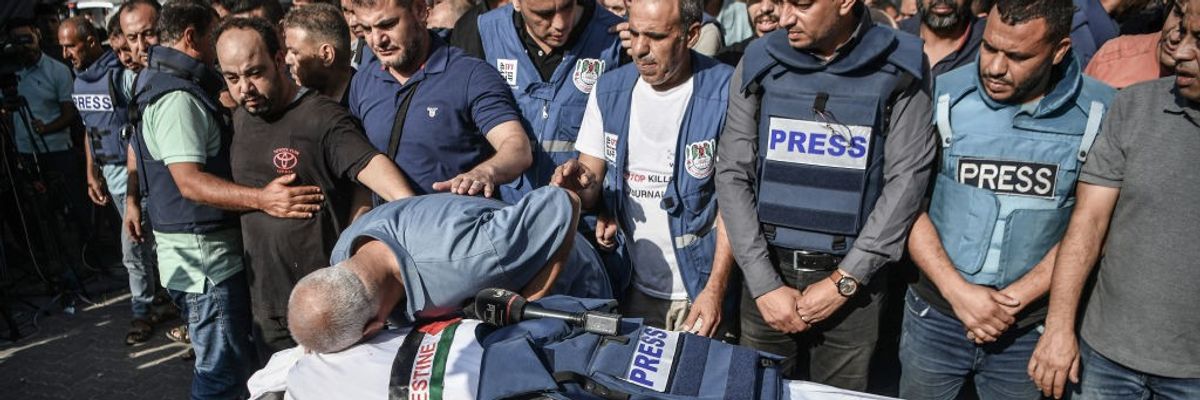
A funeral ceremony is held for Palestine TV correspondent Mohammed Abu Hatab, who was killed, along with his family members, in an airstrike on his home in Khan Yunis, Gaza on November 3, 2023.
(Photo: Abed Zagout/Anadolu via Getty Images)
“The only thing that can explain the shocking silence of American and international media professionals about the mass killing of their Palestinian colleagues is the decadeslong and systematic dehumanization of the Palestinian people.”
The largest U.S. Muslim advocacy group on Friday implored American and international media outlets to speak out against Israel’s killing of more than 100 journalists, almost all of them Palestinians, during the ongoing assault on Gaza.
The Council on American-Islamic Relations (CAIR) renewed its plea following Israeli airstrikes on the homes of Palestine TV journalist Tamim Ma’mmar and Al-Aqsa TV‘s Abdullah Al-Sousi. Ma’mmar was killed along with his wife and two of their children, while the other attack killed Al-Sousi and two of his nephews, according toQuds News Network.
“The only thing that can explain the shocking silence of American and international media professionals about the mass killing of their Palestinian colleagues is the decadeslong and systematic dehumanization of the Palestinian people, in which the lives of Palestinians have lesser or no value,” CAIR national communications director Ibrahim Cooper said in a statement.
“Journalists worldwide must begin to speak out about these killings and about the Israeli genocide in Gaza,” he added.
Israel is on trial for genocide at the International Court of Justice in The Hague. Its 308-day assault on Gaza has left more than 142,000 Palestinians dead, wounded, or missing, according to local and international officials.
Preliminary investigations by the New York-based Committee to Protect Journalists found that at least 113 media professionals—including 108 Palestinians, three Lebanese, and two Israelis—have been killed during the war, “making it the deadliest period for journalists since CPJ began gathering data in 1992.”
CPJ has condemned what it called an “apparent pattern of targeting journalists and their families,” noting cases in which media workers were killed while wearing press insignia and after being threatened by Israeli officials.
Gaza’s Government Media Office said this week that Israeli forces have killed 166 journalists since October.
In May, the Paris-based press freedom group Reporters Without Borders (RSF) filed a third complaint at the International Criminal Court alleging “war crimes against journalists in Gaza.”
RSF said it had “reasonable grounds for thinking that some of these journalists were deliberately killed and that the others were the victims of deliberate IDF attacks against civilians” and accused Israel of “an eradication of the Palestinian media.”
The following month, the Gaza Project—led by the Paris-based nonprofit Forbidden Stories—published a report detailing a “chilling pattern” of Israeli forces apparently targeting journalists during the war.
Human Rights Watch and Amnesty International have called for official investigations into Israeli killing of journalists including an October 13 attack that killed 37-year-old Lebanese Reuters videographer Issam Abdallah and wounded half a dozen other journalists who were covering cross-border clashes between Israeli troops and Hezbollah fighters in southern Lebanon.
Dylan Collins, an American deputy editor at Al Jazeera English, was wounded while administering first aid to Christina Assi, an Agence-France Presse journalist who was seriously wounded in the attack. Assi-one of whose legs was amputated—recently carried the Olympic torch in Paris.
CPJ president Jodie Ginsburg recently toldAl Jazeera that the killing of journalists by Israeli forces “appears to be part of a broader strategy that aims to stifle the information coming out of Gaza.”
John J. Mearsheimer: On 7 August 2024, I spoke at length with Lt. Col. (ret.) Danny Davis on his podcast — “Deep Dive” — about the profound influence of the Israel lobby on US Middle East policy.
From undermining Iran’s new reformist leader to killing off Gaza ceasefire talks, the Hamas leader’s assassination strengthens Israel’s hand
Israeli Prime Minister Benjamin Netanyahu speaks to a joint meeting of Congress at the US Capitol in Washington, DC, 24 July 2024 (Roberto Schmidt/AFP)
919 Shares
Last week’s assassinations by Israel of Hezbollah’s top military commander, Fuad Shukr, and Hamas political leader Ismail Haniyeh have brought the region to the precipice of all-out war.
Actually, the region is already at war. But so far it has been a controlled, carefully calibrated conflict – tit-for-tat, cat-and-mouse.
These institutions were founded to prevent a repetition of the Nazi Holocaust. Instead, they have failed to prevent the genocide in Gaza.
Stay informed with MEE’s newsletters
Sign up to get the latest alerts, insights and analysis, starting with Turkey Unpacked
They have failed because those western nations which established these protocols have abandoned them.
The US, Germany, the UK and others have armed Israel. They have lent political and moral support to the killing. They have done virtually nothing to stop it. The collapse of this international order is their fault.
Escalation of conflict
The New York Times, citing unspecified “Middle Eastern” sources, recently reported that Haniyeh was killed by a bomb smuggled months earlier into the Tehran guesthouse where he was staying.
I believe it is likely that this information came via the Mossad, as one of the reporters on the piece, Ronen Bergman, is known to have close ties with the Israeli intelligence agency – and only the Mossad would have such granular, detailed knowledge of the assassination scheme.
The NYT does not say how the device purportedly entered the guest house, nor how it was placed in the room. If correct, the type of access this operation demanded seems to indicate that the Mossad had a highly placed and trusted mole in Iran’s Islamic Revolutionary Guard Corps (IRGC) apparatus.
IRGC officials have vehemently denied the Times’ account. They claim that an Israeli missile or drone was used.
Haniyeh killing: What will Hamas look like after the political leader’s death?
They also raise the possibility that Israel was able to pinpoint Haniyeh’s location by installing spyware on his mobile phone, which offered GPS data enabling the attack. A senior Hamas official present in the building also refuted the Times’ account.
This Israeli assassination was directed at its chief regional adversary, Iran. It may also have been intended to undermine the political standing of its newly inaugurated reformist president, Masoud Pezeshkian.
Israel prefers hardline leadership, as its interests dictate regional instability and the escalation of conflict.
The killing is also an affront to the Biden administration’s attempts to negotiate a Gaza ceasefire. For months, Israeli Prime Minister Benjamin Netanyahu has been sabotaging repeated proposals put forward by Qatari mediators and US officials. He did so because he needs the war to retain power.
A former US intelligence officer who resigned in protest over US policy towards Gaza says Israel is seeking a war against Hezbollah for “political purposes”. This too would advance the prime minister’s political interests.
Killing Haniyeh kills the ceasefire talks. Hamas may never return to the table. This is precisely what Netanyahu wants – a war without end.
Consummate timing
The Biden administration has embarrassed itself in the aftermath of the killing, claiming it was neither involved in, nor even aware of, the assassination.
Secretary of State Antony Blinken later offered a bromide which refused to acknowledge the disastrous impact Haniyeh’s murder would have on prospects of a ceasefire.
“It’s urgent that all parties make the right choices in the days ahead, because those choices are the difference between staying on this path of violence, of insecurity, of suffering, or moving to something… much better for all parties concerned,” Blinken said.
“A ceasefire is… in the interests of Israelis; it’s in the interests of Palestinians. It’s in the interests of the region. So as long as everyone is focused on what their core interests actually are… we will reach a deal.”
Clearly, Netanyahu doesn’t agree with this assessment of Israel’s interests.
Netanyahu timed the assassination with consummate precision: just after his grand address to the joint session of US Congress, where he sang his own and Israel’s praises.
He also exploited political turmoil in Washington, where a weak US leader has recently been forced to drop out of the presidential race.
The Israeli premier banked on the administration being unable or unwilling to mount opposition to, or criticise, the deed (which was the case). Democratic presidential candidate Kamala Harris has no policy-making authority, even if she wished to set out a different approach.
The Israeli premier has given the Democrats a black eye, despite their robust support for Israel’s attacks on Gaza and Lebanon.
Insult to national honour
Iran’s Grand Ayatollah Khamenei convened an emergency national security meeting within five hours of the killing. He ordered Iranian retaliation, although it’s unclear what that entails.
Clearly, Tehran intends to land a powerful blow to avenge this insult to its national honour. That could entail Iran’s closest regional ally, Hezbollah, striking Israel as well. Once this happens, Israel can be expected to launch its own retaliatory response.
Israel has sought a war with Hezbollah since 7 October 2023. In fact, its defence minister, Yoav Gallant, urged a pre-emptive strike against the Lebanese militia before attacking Hamas. But this plan was abandoned in the face of US opposition.
He did so because Hezbollah is a far more powerful adversary than Hamas. It can rain tens of thousands of advanced missiles down on Israel’s major cities, including Tel Aviv (where the Israeli military’s headquarters are located) and Haifa.
Ismail Haniyeh killing: A moment of truth for the Middle East
These attacks and counter-attacks could lead to an all-out regional war. If Israel launched direct air attacks on Iranian soil, Iran would likely take this as a casus belli. Then we would face a conflict over which no one would have control. The physical damage and death toll would be enormous.
Nor would it be confined to Israel and Iran. All of the latter’s allies in Syria, Lebanon, Iraq and Yemen would be drawn in too.
On the other side, the US promises to become a direct combatant in the first Middle East regional conflict since the 1973 Arab-Israeli war, with Axios reporting that Blinken held a conference call on 4 August with G7 foreign ministers, in which he told them to expect an Iranian-Hezbollah attack in the next 24 hours.
Biden has assured Netanyahu of military support against such an attack and promised to increase the US military presence. The US defence secretary, Lloyd Austin, expanded on the naval and air force resources to be sent to the region: “The US is sending a carrier strike group, a fighter squadron and additional warships to the Middle East as the region braces for an Iranian retaliation,” noted a CNN report.
The American administration’s policy flies in the face of US public opinion, which opposes Biden’s and Israel’s approaches to the conflict.
Americans don’t want to be dragged into yet another Middle East war – one the president is promoting, knowingly or unknowingly.
The views expressed in this article belong to the author and do not necessarily reflect the editorial policy of Middle East Eye.
Richard Silverstein writes the Tikun Olam blog, devoted to exposing the excesses of the Israeli national security state. His work has appeared in Haaretz, the Forward, the Seattle Times and the Los Angeles Times. He contributed to the essay collection devoted to the 2006 Lebanon war, A Time to Speak Out (Verso) and has another essay in the collection, Israel and Palestine: Alternate Perspectives on Statehood (Rowman & Littlefield) Photo of RS by: (Erika Schultz/Seattle Times)
After failing to achieve his military objectives, the indicted war criminal travelled to the US to incite a war against Iran and prolong his genocidal campaign in Gaza
The first US response to the double assassinations this week in Beirut and Tehran came from Secretary of Defence Lloyd Austin on 31 July.
In the wake of Israel’s targeted killing of Hamas political bureau head Ismail Haniyeh in Iran and Hezbollah’s top military commander Fuad Shukr in Lebanon, Austin reiterated the US’s “unwavering support” for Israel and pledged to come to its defence if attacked.
As Israel ramps up its military provocations, it is now more apparent than ever that Prime Minister Benjamin Netanyahu’s bellicose address in Congress last week was the opening salvo of a wider regional war – to the rapturous applause of US lawmakers.
Indeed, in the days before and after Netanyahu’s visit to Washington, the Israeli regime attacked and killed scores of civilians in Hodeidah port in Yemen, Majdal Shams in the Israeli-occupied Syrian Golan Heights and the southern Dahiya neighbourhood of Beirut in Lebanon, and crossed a new threshold by assassinating Haniyeh in Tehran.
Stay informed with MEE’s newsletters
Sign up to get the latest alerts, insights and analysis, starting with Turkey Unpacked
This escalation has taken place as Palestinians mark 300 days of Israel’s genocidal war on Gaza, in which at least 50,000 people were killed or buried beneath the rubble and more than 100,000 injured.
Over the past week, many observers have speculated that Netanyahu’s congressional address and his subsequent meetings with President Joe Biden, Vice President Kamala Harris, Donald Trump and other US officials gave him the green light to continue Israel’s rampage unabated.
In Congress, Netanyahu stated his objectives for an all-out war in no uncertain terms
Regardless, however, of what was spoken behind closed doors, Netanyahu stated his objectives for an all-out war in no uncertain terms.
The indicted war criminal, who has failed to achieve his military objectives in Gaza, arrived in Washington to drum up war against Iran and prolong his genocidal campaign against the Palestinians.
So if Netanyahu took advantage of his visit to expand the war – the disastrous results of which the world had already seen this week – then why was he invited to Washington in the first place?
What lies did the aspiring regional hegemon tell Congress to sell his devious plans, and how did he get away with it?
Saving face
The congressional address on 24 July was Netanyahu’s first international trip since he waged his genocidal campaign in Gaza last October.
Even though the Israeli prime minister was indicted on several corruption charges by his own Zionist regime and is facing arrest for war crimes and crimes against humanity by the International Criminal Court (ICC), US congressional leaders extended an invitation to him anyway.
Netanyahu spoke before a joint session of Congress for an unprecedented fourth time.
Only a failing US empire would be so blind as to cheer Netanyahu and his genocide
This was an “honour” not even afforded to the British imperialist statesman and one of the iconic leaders of World War Two, Winston Churchill, who addressed the US Congress three times during his tenure (in 1941, 1943 and 1952).
Remarkably, all of the invitations to the belligerent Israeli prime minister were extended by Republican House Speakers during the terms of Democratic presidents, namely Bill Clinton in 1996, Barack Obama in 2011 and 2015 and Joe Biden in 2024.
Each occasion was a sinister Republican attempt to showcase their pro-Israel fidelity for political gain against their Democratic rivals.
During his last address at the United Nations General Assembly in September 2023, Netanyahu boasted about Israel’s perceived invincibility and its pivotal role as the anchor for the region’s security, stability and economic prosperity.
In the UN speech, he had entirely erased Palestinians and their plight as he held up a map in which Israel was drawn up to include all of the territories of historic Palestine.
A line was drawn that extended from India through the Persian Gulf, the UAE, Saudi Arabia and Jordan to the port of Haifa in Israel and from there to Europe. Dubbing it the India-Middle East-Europe Economic Corridor (Imec), Netanyahu bragged that Israel would play a central role in this new geopolitical structure. But the whole scheme may unravel in the aftermath of the Hamas October attacks.
Unable to achieve any of his military and political objectives after waging an all-out genocidal war in Gaza, Netanyahu is in trouble not only at home but also internationally because of his conduct in the war. The world is no longer able to look away. As the mass murder reaches unprecedented numbers, as some estimates say, the total number of victims could reach as many as a staggering 186,000 dead.
That’s almost eight percent of Gaza’s population, with over 70 percent of the victims being women and children.
By comparison, one of the worst civilian atrocities during the Second World War was carried out by the Allies against the German city of Dresden in 1945. It resulted in about 30,000 dead out of 1.2 million, or less than three percent of its population.
In the 55-minute speech, Netanyahu was applauded almost 80 times by some servile members of Congress, who seemed to be hanging on his every word (exceeding the previous record of 58 applauds in 2015).
While half of the Democratic members of both chambers of Congress boycotted the speech, including prominent congressional leaders (131 boycotting versus 128 attending), only one Republican congressman shunned the event, Representative Thomas Massie of Kentucky (out of 268 Republican House members and senators).
Iranians hold portraits of late Hamas leader Ismail Haniyeh during his funeral procession, in Tehran, on 1 August ahead of his burial in Qatar (AFP)
Netanyahu’s performance was pathetic and full of flagrant lies and hubris on many levels. It was not lost that he was trying to resemble what US presidents usually do during their annual State of the Union addresses. He flaunted several Israeli soldiers and former hostages, sharing fabricated tales of valour amid one of the most humiliating and humbling days in the history of the Zionist regime.
He claimed to have freed or reclaimed 135 captives and dead bodies, disguising the fact that only five were freed through military operations. Many more, in fact, were killed either by Israel’s bombing of Gaza or by Israeli soldiers during failed rescue attempts.
Meanwhile, 110 of the captives were released last November through a negotiated deal, which had been offered by the Palestinian resistance in the early days of the conflict.
Needless to say, had Netanyahu been serious about a deal to free the captives, he would not have killed the chief Palestinian negotiator this week.
He did not acknowledge the fact that no other deal to free the remaining Israeli captives has been reached due to his continuous refusal to end the war or withdraw from Gaza as demanded not only by the Palestinians but also by UN Security Council resolution 2728 of last March, as well as the UN General Assembly resolution of last December.
Doing so could result in him being held accountable for the 7 October attacks, triggering new elections and his possible ouster in disgrace as prime minister.
Netanyahu has also vehemently rejected all rulings by the International Court of Justice (ICJ), issued in January, March and May, to stop the genocidal war, as well as the ICJ advisory opinion issued in July regarding the illegality of the Israeli occupation of Gaza, the West Bank and East Jerusalem, and the demand to end it.
Third-rate con artist
Netanyahu tried to demonstrate strength and resolve by declaring that he would not stop the war unless achieving what he called “total victory.”
He defined that term as total Hamas surrendering in defeat, supplanting their rule in Gaza with collaborators or compliant Palestinians, and freeing all the Israeli captives without any prisoner exchange.
These demands did not take into account the realities on the ground, where his army has failed miserably to achieve a military victory after 10 months of wreaking havoc on Gaza’s civilian population and causing massive destruction to the strip.
Netanyahu used bait-and-switch tactics before riveted members of Congress who acted like extras in a poorly scripted play featuring a third-rate con artist
In fact, Netanyahu used bait-and-switch tactics before riveted members of Congress who acted like extras in a poorly scripted play featuring a third-rate con artist.
He started his speech by invoking the 9/11 tragedy, saying what happened on 7 October was the equivalent of 29 9/11s when adjusted to the US population. What went unsaid is that what has happened to Palestinians in Gaza since October is equivalent to 2,900 9/11s when adjusting to the population. In other words, what Netanyahu and his army have done in Gaza is equivalent to killing 7.5 million Americans, injuring 22 million Americans, and destroying all American civilian life and infrastructure.
Perhaps one of his most blatant lies was to assert that his invasion of Rafah last May, while killing “1,203” resistance fighters, “accidentally” caused a few civilian casualties.
Ordinary observers would have to suspend their mental faculties or live in an alternate universe to believe such nonsense.
As the images of thousands of women, children and civilian body parts are shown every day before the whole world, only puppets and stooges masquerading as members of Congress would enable an unhinged certified liar to make fools out of them as they applaud him in unison.
One of the most pathetic moments of this spectacle was when Netanyahu stopped them from applauding until he reached his punch line. They acquiesced immediately.
Debunked lies
The racism and ethnosupremacy that this Israeli sociopath displayed during his congressional appearance was incredible.
Ismail Haniyeh killing: Netanyahu’s only goal is to set the region on fire
Netanyahu had the audacity to talk about the “sanctity of life” upheld by the Israelis and the “culture of death” by Muslims.
Such proclamations come from a genocidal maniac who is prosecuting a war that UN Secretary-General Antonio Guterres said has caused suffering on an “unprecedented” level – the worst he’s seen in his seven-year tenure – which has claimed tens of thousands of lives in the tiny enclave, displaced 85 percent of its population and rendered Gaza uninhabitable.
For months, Netanyahu prevented all aid from entering the Gaza Strip, including food and medicine to over two million people, prompting famine, starvation and communicable diseases.
He claimed, against uncontroverted evidence, that Israel never prevented essential aid of food and medicine from entering the doomed Gaza Strip and that 40,000 aid trucks have entered Gaza since last October.
But what he failed to mention was that, according to the United Nations, the number of trucks that used to enter Gaza before he imposed his total blockade was 500 per day, which were less than the needed supplies for a land-locked strip blockaded by the Zionist regime since 2007.
This means that out of a minimum of 150,000 truckloads that should have been allowed since Israel waged its war on Gaza, less than 27 percent of the needs had been delivered.
Adding to this is the loss of the entire agricultural and industrial production and the cutting off of electricity and energy supplies, creating a situation in Gaza that is nothing short of catastrophic.
All of these facts were omitted in the fairytale Netanyahu presented. He also continued to peddle the lie that Hamas was stealing the humanitarian aid, a charge that UN officials have already rejected. And, of course, his own army and extremist settlers have been blocking supply trucks and attacking aid workers for months.
Political theatre
Netanyahu’s congressional address was an act of shameless theatre set up by the Israeli leader himself and his cronies in the US, who are backed by the Israel lobby, primarily the American Israel Public Affairs Committee (Aipac).
Its main goal was to send an image of a strong and defiant leader to a sceptical and shaken Israeli public.
If anything, the havoc and hell Netanyahu has been inflicting on Gaza over the past 10 months could not have happened without unprecedented US support
With no political and military achievements in Gaza to his name or any willingness to change course, Netanyahu instead has been trying to escalate the conflict and drag the US into a regional war.
However, the US has repeatedly claimed that it is trying to avoid this Middle East conflagration at all costs since it would disrupt its global responsibilities and derail its geopolitical strategies. It could also result in an overwhelming Democratic defeat in the November elections.
Netanyahu claimed that the US needs to give Israel the “tools needed to finish the job”, insinuating that the US administration has been withholding the arms that Israel seeks. It is, of course, a false charge designed to divert blame for his lack of victory, let alone the “total victory” he’s been advocating.
If anything, the havoc and hell he has been inflicting on Gaza over the past 10 months could not have happened without unprecedented American support.
Such aid by the US and its western allies for Israel’s war against defenceless Palestinians included massive armaments that exceeded in total the destructive value of five Hiroshima-size bombs – including “smart” bombs, artillery shells, missiles, fighter jets – in addition to intelligence services, massive economic aid, diplomatic protection, political cover and the support of a compliant mainstream media and elite political class.
A man carries children as people inspect the damage following Israeli bombardment at al-Bureij refugee camp in the central Gaza Strip on 23 July (Eyad Baba/AFP)
Citing the US arming its allies during World War Two as an example, Netanyahu claimed that the faster the Zionist regime could receive arms, the faster it could finish the job.
What he didn’t say was that the Allies could not finish the job with US weapons alone. They needed the massive US army to fight alongside them, resulting in the eventual loss of more than 400,000 American soldiers.
Beating the war drums
Netanyahu spent about a third of his speech beating the drums of war against Iran.
Ismail Haniyeh killing: A moment of truth for the Middle East
He claimed that Iran was responsible for all of Israel’s troubles – not its occupation of Palestine, its denial of Palestinian rights or its construction of illegal settlements on stolen Palestinian lands. Israel’s policies of dehumanisation and dispossession of the Palestinians, the Judaisation of Muslim holy sanctuaries and daily incursions of Palestinian towns, villages and camps, assassinating hundreds and detaining thousands of Palestinians are also not to blame.
This record, detailed in the recent ICJ ruling a few weeks ago, was expediently dismissed in Netanyahu’s speech as he condemned the ICJ and ICC rulings to yet more cheers from his audience.
Such condemnations not only ignore facts that are overwhelmingly recognised globally but also significantly undermine the rules-based order the US has been allegedly trying to enforce for decades.
Netanyahu brazenly carried on with his lies by claiming that the Israeli army was the most moral army in history. In fact, his army has been perpetrating the worst war crimes record since World War Two, according to the top European diplomat Josep Borrell.
In fact, because of the conduct of this most immoral army in decades, the ICC prosecutor has called for his indictment and arrest along with his partner in crime, Defence Minister Yoav Gallant.
“Israel’s enemies are the US’s enemies,” Netanyahu asserted, making his objective very clear: to incite against Iran and implore American policymakers to support or even wage a US war against Iran. He also called for the creation of a regional coalition that he dubbed the “Abraham Alliance”. It would include America’s Arab allies that would join Israel’s dangerous war against Iran and its allies in the resistance axis.
If the US lost thousands of lives, trillions of dollars, and suffered a tarnished reputation and a geopolitical setback in Iraq, how much will it lose to an even more devastating war with Iran?
This agitation was reminiscent of the rhetoric used over two decades ago against Saddam Hussein’s Iraq, now resurrected to drum a war against Iran.
Given Israel’s recent attacks on Yemen, Syria, Lebanon and Iran, it seems that Netanyahu’s plan has already been set in motion.
In contradiction to its own stated interest of not expanding the war into a wider conflict, the US continues to be dragged further into Israel’s war.
Following the assassinations and expected retaliation by Hezbollah and Iran, the US deployed 12 warships in the Mediterranean and the Persian Gulf on Thursday. It also follows the US and its western and Arab allies bailing out Israel during Iran’s retaliatory strikes in April.
If the US lost thousands of lives, trillions of dollars and suffered a tarnished reputation and a geopolitical setback in Iraq, how much will it lose to an even more devastating war with Iran?
The degree of such Zionist hubris is breathtaking.
‘Useful idiots’
For many Americans, perhaps the most insulting claim in a stream of falsehoods was Netanyahu’s sensationalist and totally baseless assertion that the massive anti-genocide protests across US cities and college campuses were instigated and paid for by Iran.
Despite there being no evidence to support this outrageous charge, members of Congress applauded him, while making a mockery of the sacred First Amendment protections, constitutional rights and rich tradition of campus anti-war activism and dissent.
In 2007, American academics John Mearsheimer and Stephen Walt argued in their book, The Israel Lobby and American Foreign Policy, that the only plausible explanation for the US’s calamitous policy in the Middle East and the submission of many American politicians to Israeli policies and interests, which often contravene America’s strategic interests and stated principles, is the grip the Israel lobby, led by Aipac, has over US politicians.
Why blaming the Israel lobby for western Middle East policies is misguided
Years earlier, in 1992, American author and former presidential candidate Pat Buchanan condemned “Israel and its Amen Corner” as he referred to American politicians under Aipac’s influence. He further described Congress as “Israeli-occupied territories”.
After more than 30 years, the circus displayed last Wednesday afternoon had all but confirmed those strong words. The physical military Israeli occupation may be in Palestine, but there is arguably one of a different nature on Capitol Hill as well.
While the US’s imperialist designs and other military interests contribute to this support, the blind enthusiastic reception of a war criminal and one of the most hawkish Israeli leaders by US politicians signals the impact of the lobby, which has also long advocated for war against Iran.
Within a week of Netanyahu’s address, some US politicians are openly calling for US involvement in Netanyahu’s hegemonic war.
During a phone call with the Israeli prime minister, Biden once again reaffirmed his support for Israel while pledging to continue to support and defend the Zionist regime. Meanwhile, Republican Senator Lindsey Graham introduced a war powers bill on Thursday that called for a direct US attack on Iran while further urging Israel to bomb Iranian oil refineries during a Fox News appearance.
While Netanyahu insulted countless Americans who are vehemently protesting his war of genocide and ethnic cleansing in Gaza – and his attempt at regional supremacy – as “useful idiots”, it turned out that the useful idiots were not outside the halls of Congress but enthusiastically celebrating their master in the People’s House.
The views expressed in this article belong to the author and do not necessarily reflect the editorial policy of Middle East Eye.
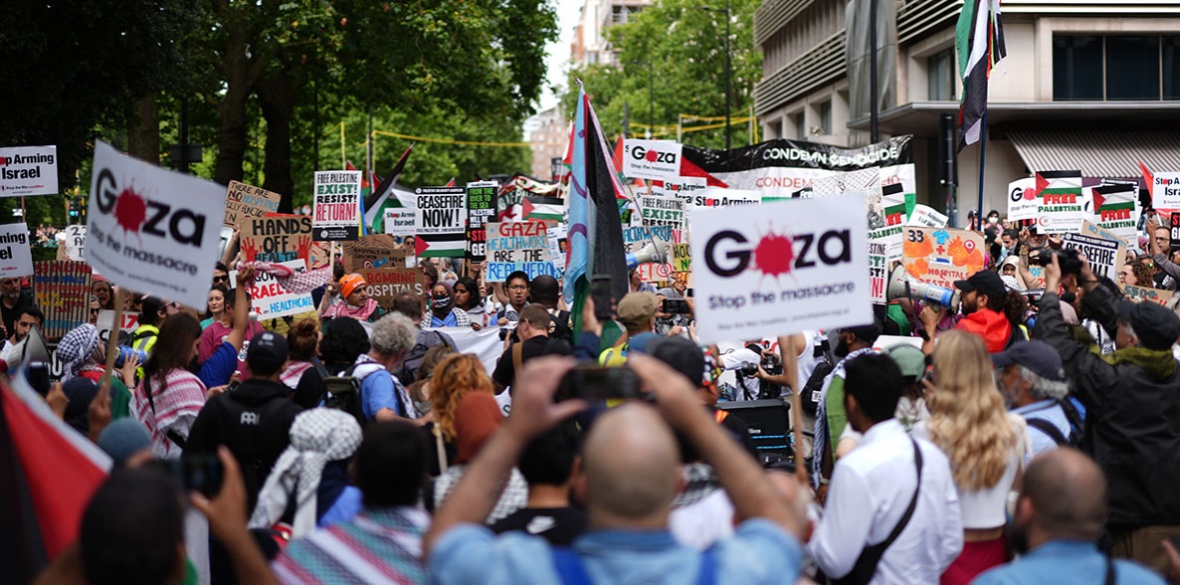
People take part in the National march for Palestine in central London organised by the Palestine Solidarity Campaign, August 3, 2024
TENS of thousands of Palestine supporters marched in towns and cities across Britain on Saturday in defiance of threats of continuing far-right violence.
In London an estimated 100,000 marched as the Palestine Solidarity Campaign (PSC) staged its 17th national demonstration in the capital since Israel began its invasion of Gaza in October last year.
Hundreds turned out in Manchester marking the 300th day of Israel’s genocide in which more than 40,000 Palestinians have been killed including 20,000 children.
Norma Turner, chair of Greater Manchester Friends of Palestine which brings together a dozen Palestine campaign groups in north-west England, said: “Three hundred days — 60 children killed by Israel every day — and we demand our government stops arming Israel.
“We grieve for three children randomly killed in Southport.
“We condemn the fascist thugs trying to cause discord on the back of people’s grief. And we mourn the 40,000 martyrs in Gaza — we will continue to protest and take action until Palestine is free.”
In London PSC coupled its demands for a ceasefire in Gaza and an end to British arms sales to Israel with an appeal for funds to maintain the protests nationwide.
“Saturday’s march cost us over £40,000 to organise. We need to raise more funds to meet this cost and escalate our campaign to end Israel’s genocide in Gaza and system of apartheid across Palestine,” the group said.
PSC also highlighted Israel’s shocking treatment of more than 10,000 Palestinian political prisoners held in its jails.
“Since October Israel has rounded up, detained, stopped and tortured thousands of Palestinians, over 10,000 held in the West Bank alone,” said PSC.
“Last week the UN produced a report which documented the systemic torture and abuse, including rape, of these detainees.
“We also saw a member of the Israeli Knesset claiming that Israeli forces were entitled to use rape against Palestinian detainees and that no action should be taken against those who do. This is the true face of Israel’s genocidal regime.”
PSC will draw up plans to step up its Boycott, Divestment and Sanctions campaign against Israel at a conference in Westminster Central Hall on Saturday August 10.
Prominent Israeli human rights group denounces decision to place victim in a situation where he could face his abusers
Soldiers lock a gate at Sde Teiman detention facility, after Israeli military police arrived as part of an investigation into the suspected abuse of a Palestinian detainee on 29 July (Reuters)
A Palestinian detainee hospitalised in Beersheba after allegedly being raped by Israeli soldiers in Sde Teiman detention centre has been returned to the notorious facility, according to the Israeli news outlet Haaretz.
The prisoner was discharged to a field hospital at Sde Teiman.
He suffered from “a ruptured bowel, a severe injury to his anus, lung damage and broken ribs”, according to Haaretz and Arab48.
On Monday, nine Israeli soldiers at Sde Teiman were arrested on suspicion of raping a Palestinian detainee, sparking a riot when far-right activists and MPs stormed the facility.
The reservists, who are members of Force 100, a unit tasked with guarding the prisoners in Sde Teiman, were brought to the military court at the Beid Lid base for a bail hearing.
They claimed the prisoner attacked them during the search process, according to Haaretz.
Israeli NGO Physicians for Human Rights denounced the prisoner’s return to the facility where he was allegedly abused.
‘Serious ethical and professional failure’
“The return of the detainee to the clinic at Sde Teiman, the facility where he was subjected to torture, is a serious ethical and professional failure of the medical officials and hospital management who were involved in his medical care,” the organisation was quoted as saying in Haaretz.
“Through this decision, the medical teams exposed the detainee to the possibility that he would once again meet the soldiers suspected of raping him, thereby putting his life in danger.”
Yoel Donchin, a doctor at Sde Teiman who has attended the prisoner, was also quoted as saying that he “couldn’t believe an Israeli prison guard could do such a thing”.
He said: “If the state and Knesset [parliament] members think there’s no limit to how much you can abuse prisoners, they should kill them themselves, like the Nazis did, or close the hospitals… If they maintain a hospital only for the sake of defending ourselves at [the International Criminal Court] the Hague, that’s no good.”
About 4,000 Palestinians have been detained from Gaza in Israel since October 2023. Most are detained and interrogated in the enclave but many are brought to Sde Teiman, even if they are a non-combatant.
Torture, rape and murder have all been reported as rife at the facility, one of several facilities where Palestinians have been mistreated for decades.
On 15 July, Israel’s High Court issued a conditional order seeking to close Sde Teiman in response to the reports of abuse there.
The court’s order seeks an explanation as to “why the Sde Teiman detention facility is not operated in accordance with the conditions set forth in the law governing internment of unlawful combatants”.







 Peace and Justice Post