The president previously said he wouldn’t support strikes on nuclear facilities
by Dave DeCamp, Antiwar. com, October 3, 2024
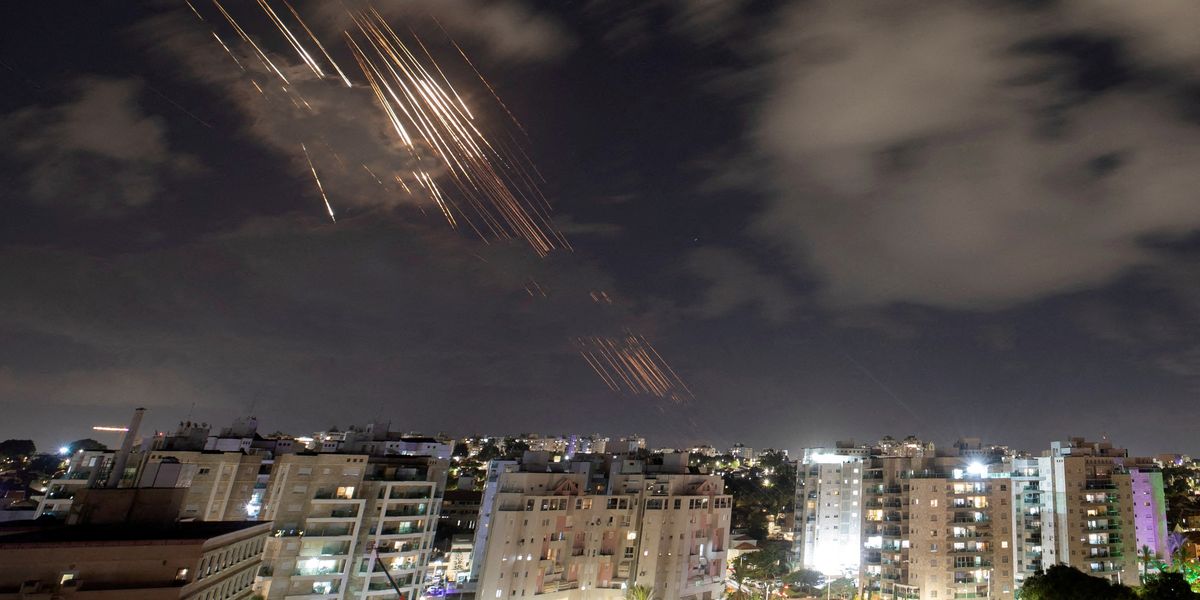
President Biden said Thursday that the US and Israel were discussing the possibility of striking Iran’s oil facilities in retaliation for the Iranian missile barrage that targeted Israel on Tuesday, which was a response to multiple Israeli escalations.
When asked by a reporter if he would support Israeli strikes on Iranian oil sites, Biden said, “We’re discussing that. I think that would be a little… anyway.” The comments sent oil prices spiking.
Striking Iran’s oil facilities is supported by the ultra-hawkish Sen. Lindsey Graham (R-SC). “These oil refineries need to be hit and hit hard because that is the source of cash for the regime to perpetrate their terror,” Graham said in a statement on Tuesday.
On Wednesday, Biden said he wouldn’t support Israeli strikes on Iranian nuclear sites, but the US is vowing to ensure Tehran faces “severe consequences.” Israeli officials have told Axios that they plan to hit Iran hard and believe their attack could lead to a major regional war.
Options being considered besides striking oil facilities are targeting Iran’s air defenses or carrying out a targeted assassination inside Iran. Israeli officials have said that if Iran responds to their next attack, then any option is on the table, including strikes on nuclear facilities.
Israel is coordinating its plans to attack Iran with the US because it wants the US to come to its defense in the event of another significant Iranian attack. If Israel wants to carry out a significant strike inside Iran, it may also need support from the US military.
Iran fired about 180 ballistic missiles at Israel in response to the Israeli assassination of Hamas political chief Ismail Haniyeh in Tehran and the Israeli killing of Hezbollah Secretary-General Hassan Nasrallah and Abbas Nilforoushan, an IRGC commander who was killed alongside Nasrallah.
Today, Iran launched a massive missile attack against Israel, which Tehran billed as a response to Israel’s recent assassinations of leaders of the IRGC, Hezbollah and Hamas. Israel now appears to be mulling a retaliation in turn that could push the sides into all-out war.
When Israel and Iran narrowly avoided a full-blown conflict in April, I warned that we shouldn’t let Biden’s help in averting escalation overshadow his broader, strategic failure to prevent such a dangerous moment from ever arising. Had the U.S. used its considerable leverage with Israel to end its war in Gaza, the region would not have found itself on the edge of a disastrous war in April; six months later, the Middle East is back at the brink of disaster.
Iran has made it clear that it does not want a regional conflict; Tehran doesn’t seem to believe it can afford such a war. But Netanyahu clearly thinks it’s in his interest to ramp up conflict right now, as Washington stands frozen — a month out from an election and with a lame duck president who seems incapable of telling Israel “no,” no matter the costs for American security.
One must hope that somehow, further escalation is avoided. But the risk of just such an outcome is enormous, and if the U.S. finds itself in a new forever war in the Middle East, the buck will stop with Biden. This White House has repeatedly chosen to keep the U.S. on the precipice of war, rather than restrain Israel’s military as its expanding wars killed more and more civilians in Gaza and now Lebanon. The Biden administration has helped bring about this extraordinarily dangerous moment by providing Israel with the weapons, political protection, diplomatic support, and money it requires to pursue the exact escalation that the Biden administration professes it does not want.
Subscribe now to our weekly round-up and don’t miss a beat with your favorite RS contributors and reporters, as well as staff analysis, opinion, and news promoting a positive, non-partisan vision of U.S. foreign policy.
Biden’s strategy has been to put enormous effort into deterring Iran and its partners from retaliating against Israel, while doing virtually nothing to discourage Israel from escalating in the first place. This lopsided approach has in fact been a recipe for escalation, repeatedly proving to Netanyahu that Washington has no intention of bringing pressure to bear on Israel, no matter its actions.
If Biden enables further escalation from Israel, this could very well lead to a direct U.S.-Iran military confrontation that would be profoundly destabilizing in the region. The consequences for U.S. national security of such a war are hard to quantify — but it’s easy to imagine consequences on par with the disastrous military adventurism that George W. Bush’s administration pursued in the Middle East.
If U.S. service members find themselves in the line of fire in an expanding Iran-Israel conflict, it will be a direct result of this administration’s failure to use U.S. leverage to pursue America’s most core security interest here — avoiding war.
Joe Biden came into office promising to end the era of forever wars and the quixotic, costly efforts to transform the Middle East. Now, Biden appears to have fallen into the trap of thinking that U.S. military force will transform the region for good. It is stunning that Washington appears not to have learned this lesson yet.
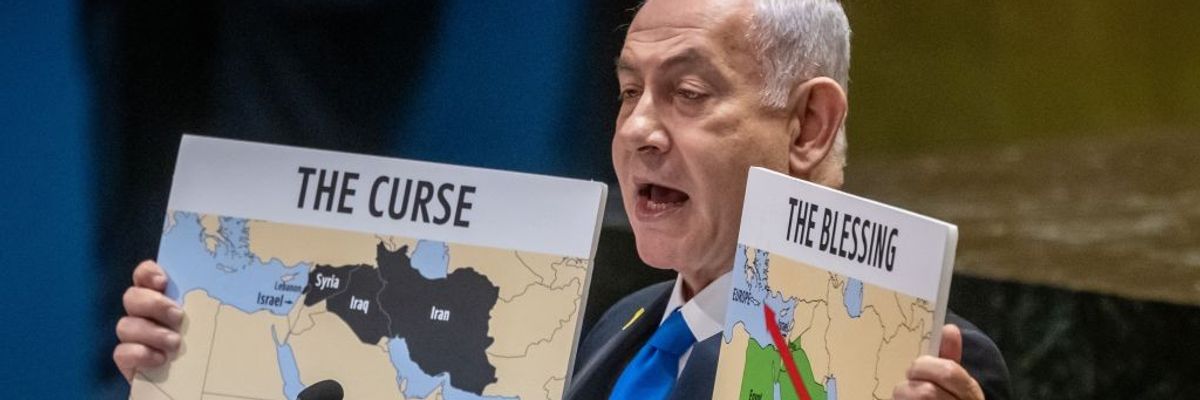
Israeli Prime Minister Benjamin Netanyahu speaks at the United General Assembly and shows maps of the Middle East on September 27, 2023.
(Photo: Michael Kappeler/picture alliance via Getty Images)
Israel’s violent extremists now in control of its government believe that Israel has the Biblical license, indeed a religious mandate, to destroy the Palestinian people.
When Israel’s Prime Minister Benjamin Netanyahu took the podium at the U.N. General Assembly last week, dozens of governments walked out of the chamber. The global opprobrium of Netanyahu and his government is due to Israel’s depraved violence against its Arab neighbors. Netanyahu purveys a fundamentalist ideology that has turned Israel into the most violent nation in the world.
Israel’s fundamentalist credo holds that Palestinians have no right whatsoever to their own nation. The Israeli Knesset recently passed a declaration rejecting a Palestinian State in what the Knesset calls The Land of Israel, meaning the land west of the Jordan River.
The Knesset of Israel firmly opposes the establishment of a Palestinian state west of Jordan. The establishment of a Palestinian state in the heart of the Land of Israel will pose an existential danger to the State of Israel and its citizens, perpetuate the Israeli-Palestinian conflict and destabilize the region.
To call the land west of the Jordan the “heart of the Land of Israel” is breathtaking. Israel is one part of the land west of the Jordan, not the entire land. The International Court of Justice has recently ruled that Israel’s occupation of the Palestinian lands (those outside of Israel’s borders as of June 4, 1967, before the June 1967 war) is plainly illegal. The U.N. General Assembly has recently voted overwhelmingly to back the ICJ ruling and called on Israel to withdraw from Palestinian territories within one year.
There are many sources of this Israeli brazenness, the most important being the backing of Israel by U.S. military power.
It is worth recalling that when the British empire promised a Jewish homeland in Ottoman Palestine in 1917, the Palestinian Arabs constituted around 90% of the population. At the time of the 1947 U.N. partition plan, the Palestinian Arab population was approximately 67% of the population, though the partition plan proposed to give the Arabs only 44% of the land. Now Israel asserts the claim to 100% of the land.
There are many sources of this Israeli brazenness, the most important being the backing of Israel by U.S. military power. Without the U.S. military backing, Israel could not possibly rule over an Apartheid regime in which Palestinian Arabs constitute nearly one half of the population yet hold none of the political power. Future generations will look back in amazement at the success of the Israel Lobby in manipulating the U.S. military to the severe detriment of U.S. national security and global peace.
Yet in addition to the U.S. military, there is another source of Israel’s profound injustice to the Palestinian people, and that is the religious fundamentalism purveyed fanatics such as the self-proclaimed fascist Bezalel Smotrich, Israel’s Minister of Finance, and Minister of National Defense Itamar Ben-Gvir. These fanatics hold fast to the biblical Book of Joshua, according to which God promised the Israelites the land “from the Negev wilderness in the south to the Lebanon mountains in the north, from the Euphrates River in the east to the Mediterranean Sea in the west.” (Joshua 1:4).
At the U.N. last week, Netanyahu once again staked Israel’s claim to the land on Biblical grounds: “When I spoke here last year, I said we face the same timeless choice that Moses put before the people of Israel thousands of years ago, as we were about to enter the Promised Land. Moses told us that our actions would determine whether we bequeath to future generations a blessing or a curse.”
What Netanyahu did not tell his fellow leaders (most of whom had in any event vacated the hall), was that Moses laid out a genocidal path to the Promised Land (Deuteronomy 31):
[The LORD] will destroy these nations before you, and you shall dispossess them. Joshua is the one who will cross ahead of you, just as the LORD has spoken. “The LORD will do to them just as He did to Sihon and Og, the kings of the Amorites, and to their land, when He destroyed them. “The LORD will deliver them up before you, and you shall do to them according to all the commandments which I have commanded you.”
Israel’s violent extremists believe that Israel has the Biblical license, indeed a religious mandate, to destroy the Palestinian people. Their Biblical hero is Joshua, the Israelite commander who succeeded Moses, and who led the Israelites’ genocidal conquests. (Netanyahu has also referred to the Amalekites, another case of a God-ordained genocide of foes of the Israelites, in a clear “dog-whistle” to his fundamentalist followers.) Here is the Biblical account of Joshua’s conquest of Hebron (Joshua 10):
Then Joshua and all Israel with him went up from Eglon to Hebron, and they fought against it. They captured it and struck it and its king and all its cities and all the persons who were in it with the edge of the sword. He left no survivor, according to all that he had done to Eglon. And he utterly destroyed it and every person who was in it.
There is a deep irony to this genocidal account. It almost surely is not historically accurate. There is no evidence that the Jewish kingdoms arose from genocides. Most likely they arose from local Canaanite communities adopting early forms of Judaism. Jewish fundamentalists adhere to a 6th century BCE text that is most likely a mythical reconstruction of purported events several centuries earlier, and a form of political bravado that was common in ancient Near Eastern politics. The problem is 21st century Israeli politicians, illegal settlers, and other fundamentalists who propose to live by—and kill by—6th century BCE political propaganda.
Israel’s violent fundamentalists are some 2,600 years out of step with today’s acceptable forms of statecraft and international law. Israel is duty bound to the UN Charter and the Geneva Conventions, not to the Book of Joshua. According to the recent ICJ ruling and UN General Assembly resolution backing it up, Israel must withdraw in the coming twelve months from the occupied Palestinian lands. According to international law, Israel’s borders are those of June 4, 1967, not the Euphrates to the Mediterranean Sea.
Israel’s violent fundamentalists are some 2,600 years out of step with today’s acceptable forms of statecraft and international law.
The ICJ ruling and U.N. General Assembly vote is not a ruling against the state of Israel per se. It is a ruling only against extremism, indeed against extremism and malevolence on both sides of the divide. There are two peoples, each with roughly half the overall population (and with no shortage of internal social, political, and ideological divisions within the two communities). International law calls for two states, living side by side, in peace.
The best solution, which we should strive for and hope for sooner rather than later, is that the two states, and the two peoples, get along, and actually draw strength from each other. Until then, however, the practical solution will be peacekeepers and fortified borders to protect each side from the animosity of the other, but with each having the chance to prosper. The utterly intolerable and illegal situation is the status quo, in which Israel rules brutally over the Palestinian people.
Hopefully, there will soon be a State of Palestine, sovereign and independent, whether the Knesset wants it or not. This is not Israel’s choice, but the mandate of the world community and of international law. The sooner the State of Palestine is welcomed as member state of the U.N., with the security of both Israel and Palestine backed by U.N. peacekeepers, the sooner will peace come to the region.
Common Dreams is powered by optimists who believe in the power of informed and engaged citizens to ignite and enact change to make the world a better place.
We’re hundreds of thousands strong, but every single supporter makes the difference.
Your contribution supports this bold media model—free, independent, and dedicated to reporting the facts every day. Stand with us in the fight for economic equality, social justice, human rights, and a more sustainable future. As a people-powered nonprofit news outlet, we cover the issues the corporate media never will.
about:blank
about:blank
Our work is licensed under Creative Commons (CC BY-NC-ND 3.0). Feel free to republish and share widely.
Jeffrey D. Sachs is a University Professor and Director of the Center for Sustainable Development at Columbia University, where he directed The Earth Institute from 2002 until 2016. He is also President of the UN Sustainable Development Solutions Network and a commissioner of the UN Broadband Commission for Development. He has been advisor to three United Nations Secretaries-General, and currently serves as an SDG Advocate under Secretary-General Antonio Guterres. Sachs is the author, most recently, of “A New Foreign Policy: Beyond American Exceptionalism” (2020). Other books include: “Building the New American Economy: Smart, Fair, and Sustainable” (2017) and “The Age of Sustainable Development,” (2015) with Ban Ki-moon.
The deployment includes multiple fighter jet squadrons and personnel to support them
by Dave DeCamp, Antiwar. com, September 30, 2024
The Pentagon said Monday that the US is sending a “few thousand” additional troops to the Middle East to bolster security and prepare to defend Israel if needed, The Associated Press has reported.
The deployment will include squadrons of F-15, F-16, F-22, and A-10 fighter jets and the personnel needed to support them. The squadrons were initially set to deploy to the Middle East so that other fighter jets could rotate out, but now they will all stay to increase US air power.
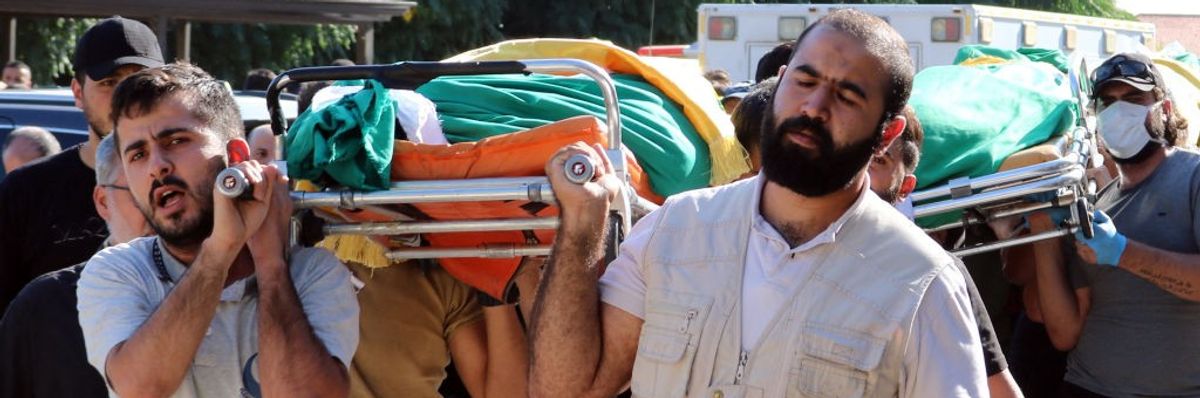
The deployment comes after the Israeli killing of Hassan Nasrallah and the Israeli slaughter of hundreds of Lebanese civilians since Israel dramatically escalated its bombing campaign in Lebanon last week. The US support for Israel’s attacks on Lebanon could provoke attacks on US forces in the region, or the US could directly intervene to defend Israel.
Pentagon spokeswoman Sabrina Singh said the deployment is for “the protection of US forces,” not to assist in evacuations. Last week, Singh said the US was bolstering its forces in the region “should we need to come to the defense of Israel.”
On Sunday, the Pentagon announced Secretary of Defense Lloyd Austin ordered an aircraft carrier strike group and an amphibious assault group to stay in the region. The Pentagon also issued a warning to Iran on Sunday, saying Secretary of Defense Lloyd Austin “made clear that should Iran, its partners, or its proxies use this moment to target American personnel or interests in the region, the United States will take every necessary measure to defend our people.”
Mourners carry the bodies of people killed in Israeli airstrikes on el-Karak in Lebanon’s eastern Bekaa valley, during their funeral on September 27, 2024.
(Photo: Hassan Jarrah/AFP via Getty Images)
“The U.S. government are conspirators to the war criminal Netanyahu’s genocidal plan,” said the Michigan Democrat.
U.S. President Joe Biden and Congresswoman Rashida Tlaib on Saturday had notably different responses to Israel’s intense bombing campaign in Lebanon over the past 24 hours, which killed hundreds of people including key Hezbollah leaders.
“Our country is funding this bloodbath,” Tlaib (D-Mich.) said on social media Saturday morning, sharing a post from Zeteo‘s Prem Thakker with videos of the Israeli assault on Lebanon that began Friday, as Israeli Prime Minister Benjamin Netanyahu was in New York City to address the United Nations General Assembly.
“Sending more of our troops and bombs to the region is not advancing peace,” added Tlaib, the only Palestinian American in Congress and a leading critic of Israel’s yearlong genocide in the Gaza Strip. “The U.S. government are conspirators to the war criminal Netanyahu’s genocidal plan.”
In the post shared by Tlaib, Thakker noted that “the U.S. was reportedly informed of this mass Israeli attack on Beirut in Lebanon shortly beforehand,” which “comes just one day after [the] U.S. released $8.7 billion more in aid to Israel.”
Tlaib also shared that her office is fielding “desperate calls” from U.S. citizens who are struggling to leave Lebanon. She declared that “the mission of the U.S. Department of State is to protect Americans, and they are failing AGAIN.”
Biden, meanwhile, began his Saturday afternoon statement by noting that Israel killed Hezbollah leader Hassan Nasrallah, which the Iran-backed Lebanese political and paramilitary group confirmed earlier in the day—a development that elevated fears of a broader regional war.
“Hassan Nasrallah and the terrorist group he led, Hezbollah, were responsible for killing hundreds of Americans over a four-decade reign of terror,” Biden said. “His death from an Israeli airstrike is a measure of justice for his many victims, including thousands of Americans, Israelis, and Lebanese civilians.”
The president continued:
The strike that killed Nasrallah took place in the broader context of the conflict that began with Hamas’ massacre on October 7, 2023. Nasrallah, the next day, made the fateful decision to join hands with Hamas and open what he called a “northern front” against Israel.
The United States fully supports Israel’s right to defend itself against Hezbollah, Hamas, the Houthis, and any other Iranian-supported terrorist groups. Just yesterday, I directed my secretary of defense to further enhance the defense posture of U.S. military forces in the Middle East region to deter aggression and reduce the risk of a broader regional war.
Ultimately, our aim is to de-escalate the ongoing conflicts in both Gaza and Lebanon through diplomatic means. In Gaza, we have been pursuing a deal backed by the U.N. Security Council for a ceasefire and the release of hostages. In Lebanon, we have been negotiating a deal that would return people safely to their homes in Israel and southern Lebanon. It is time for these deals to close, for the threats to Israel to be removed, and for the broader Middle East region to gain greater stability.
While the American Israel Public Affairs Committee (AIPAC) thanked Biden “for standing with our democratic ally Israel,” journalists from around the world and other critics highlighted that his statement “has not a word on civilian casualties.”
Ali Abunimah, director of The Electronic Intifada, was among those who pointed out that Biden said the “assassination of Nasrallah, in an Israeli massacre that killed hundreds, ‘is a measure of justice for his many victims.'”
“Utterly depraved, and by this twisted, criminal Biden logic, those who tried to assassinate Trump were also instruments of ‘justice,” Abunimah said, referring to former U.S. President Donald Trump, Republican nominee for the November election.
Middle East expert Assal Rad said: “Biden calls massive bombs in a densely-populated area that leveled six apartment buildings in Lebanon ‘a measure of justice.’ The torching of international law and the precedent that is being set should terrify us all.”
Rad also slammed Biden’s cease-fire call, saying: “This is nonsense. You can’t provide the funding and weapons to continue the conflict *without* conditions, twist humanitarian law to give Israel total impunity, and reject every international institution that seeks accountability, and then say your ‘aim is to de-escalate.'”
Others recalled Israel’s 2004 assassination of Hamas leader Ahmed Yassin, which also killed seven other people. The administration of former Republican U.S. President George W. Bush—who launched the global War on Terror in the wake of the September 11, 2001 attacks—didn’t issue a forceful condemnation like some European leaders, but a spokesperson for the State Department said at the time that “we are deeply troubled” by the attack.
As’ad Abukhalil, a Lebanese American professor at California State University, Stanislus, declared Saturday that “there has been no U.S. president EVER who has unconditionally allowed unrestrained Israeli savagery in the Middle East as Biden has done.”
Abukhalil warned that “the U.S. will suffer for years to come from the policies of Biden in the Middle East,” which he described as “more far-reaching [than] Bush’s.”
Biden, a Democrat, was initially seeking reelection in November, but after a disastrous summer debate performance against Trump, he passed the torch to Vice President Kamala Harris. After putting out Biden’s Saturday statement, the White House released a similar one from Harris—which was also lauded by AIPAC.
“Hassan Nasrallah was a terrorist with American blood on his hands. Across decades, his leadership of Hezbollah destabilized the Middle East and led to the killing of countless innocent people in Lebanon, Israel, Syria, and around the world. Today, Hezbollah’s victims have a measure of justice,” Harris said. “I have an unwavering commitment to the security of Israel. I will always support Israel’s right to defend itself against Iran and Iran-backed terrorist groups such as Hezbollah, Hamas, and the Houthis.”
“President Biden and I do not want to see conflict in the Middle East escalate into a broader regional war,” she added. “We have been working on a diplomatic solution along the Israel-Lebanon border so that people can safely return home on both sides of that border. Diplomacy remains the best path forward to protect civilians and achieve lasting stability in the region.”
In response, Margaret Zaknoen DeReus, executive director at the California-based Institute for Middle East Understanding, said: “Like Biden, not a word from the VP , from the candidate of joy & freedom, about the 1,000+ Lebanese men, women and children Israel obliterated. Not a word about hundreds of thousands of Lebanese displaced, entire city blocks destroyed. We don’t exist as human beings to this [administration].”
Responding to both statements on social media, the anti-war group CodePink said that the Biden-Harris administration “believes flattening a residential area with… bombs is ‘justice.'”
Julian Assange on board a flight to Bangkok, Thailand, following his release from prison, June 25, 2024
JULIAN ASSANGE will address the Council of Europe next week to give evidence following a report highlighting the implications of his detention on human rights and the freedom of journalism.
The Pace inquiry report found that the WikiLeaks founder qualified as a political prisoner and called on Britain to conduct an independent review into whether he was exposed to inhuman or degrading treatment while incarcerated.
Thorhildur Sunna Avarsdottir, report author and general rapporteur for political prisoners, emphasises how Mr Assange’s case is a high-profile example of transnational repression.
The report discusses how governments employ legal and extra-legal measures to suppress dissent across borders, posing significant threats to press freedom and human rights.
Mr Assange will give testimony before the Committee on Legal Affairs and Human Rights on October 1, making it his first since before his imprisonment in 2019.
Campaigners have said that his appearance before Europe’s foremost human rights and treaty-setting body emphasises the broader implications of his case.
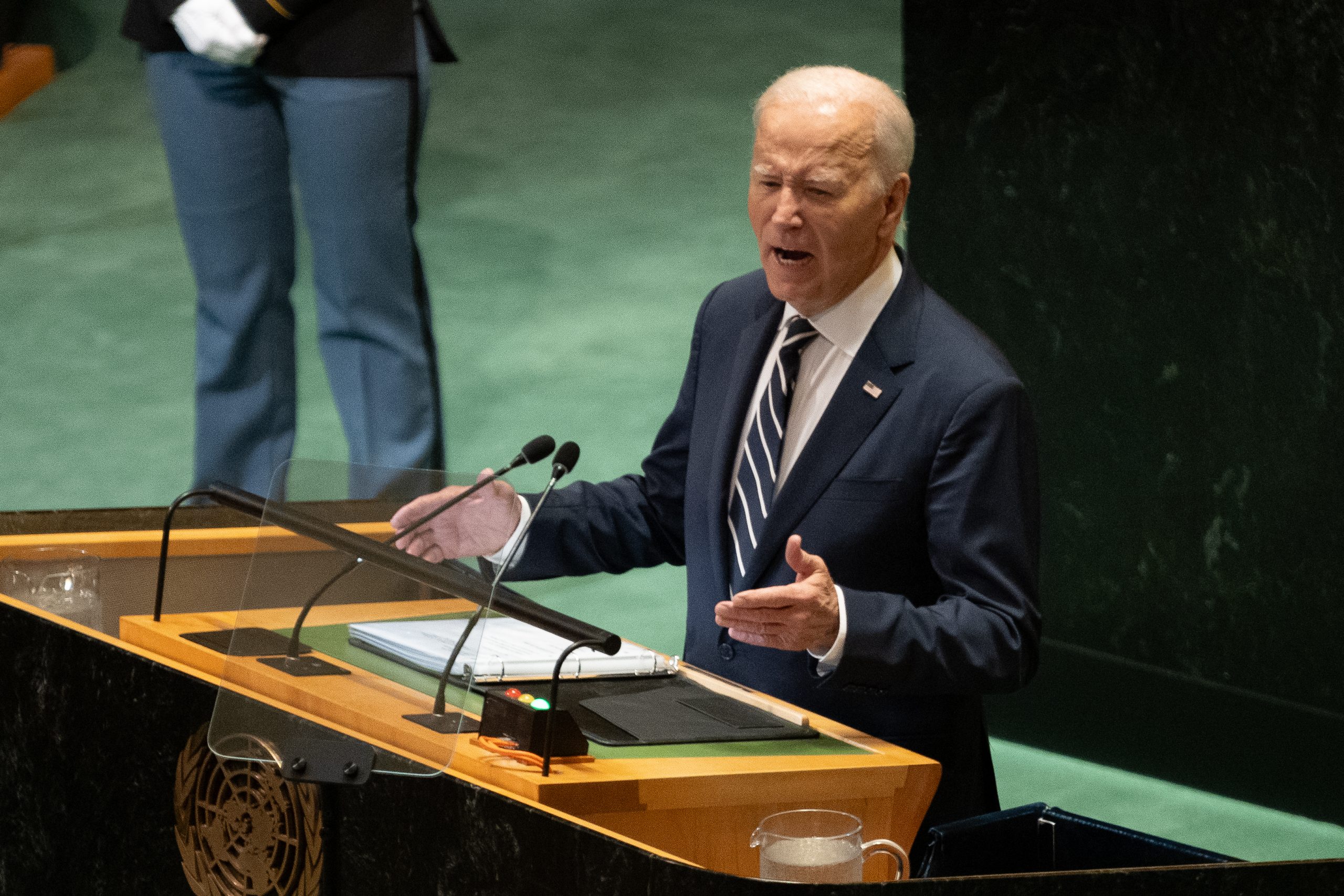
President Biden delivered a speech to the UN General Assembly in New York on Tuesday and claimed that he was working to bring a “greater measure of peace and stability to the Middle East” even though his administration continues to provide full-throated support for Israel’s genocidal war in Gaza and its escalations in Lebanon.
Biden acknowledged that “innocent civilians” in Gaza are “going through hell,” a situation he helped create by providing a constant flow of weapons to Israel since October 7, 2023. An Israeli Air Force official recently said that without US support, Israel could only sustain military operations in Gaza for a few months.
The president said it was time for Hamas and Israel to finalize the terms of a hostage and ceasefire deal, but US officials have admitted that there’s no chance of an agreement before Biden’s term ends on January 20, 2025. Biden could force Israel to accept a deal by withholding military aid, but there’s no sign he’s willing to take that step.
US President Joe Biden delivered remarks at the United Nations (John Wong/EYEPRESS)
Discussing the situation between Israel and Hezbollah, Biden said, “Full-scale war is not in anyone’s interest. Even as the situation has escalated, a diplomatic solution is still possible.” His comments came a day after Israel launched a massive bombardment against southern and eastern Lebanon, killing over 500 people, mostly civilians.
Biden claimed that his administration is “working tirelessly” to achieve a diplomatic solution between Israel and Hezbollah. But the US backed the latest Israeli escalation and is deploying more troops to the Middle East as a show of support. US military aid and promises to defend Israel in the event of a major regional war have emboldened Israel to escalate in Lebanon and elsewhere in the Middle East.
Lebanese Foreign Minister Abdallah Bou Habib expressed disappointment with Biden’s comments about Lebanon and said the US was the only country that could stop the escalations. “It was not strong. It is not promising and it would not solve this problem,” Bou Habib said. “I (am) still hoping. The United States is the only country that can really make a difference in the Middle East and with regard to Lebanon.”
In his address, Biden also called for countries to stop arming the opposing sides in the war in Sudan. “The world needs to stop arming the generals, to speak with one voice and tell them: Stop tearing your country apart. Stop blocking aid to the Sudanese people. End this war now,” he said.
A day earlier, the Biden administration named the UAE a “major defense partner” as Abu Dhabi is funneling weapons into Sudan to arm the Rapid Support Forces and fuel the war. The designation will give the UAE access to more sophisticated US weapons and military technology.
Lebanese Health Minister Dr. Firass Abiad told The New York Times on Tuesday that the “overwhelming majority, if not all,” of the people killed and wounded by Israel’s bombardment in Lebanon on Monday were civilians.
The latest health toll from Lebanon’s Health Ministry puts the number of killed by the Monday bombing at 558, which includes 50 children and 94 women. Nearly 2,000 were wounded in the attack.
The Times notes that Lebanon’s Health Ministry’s figures have historically been viewed as reliable. The ministry is not run by Hezbollah but is overseen by the Lebanese government and collects its data using an emergency operations center that gathers casualty figures from private and state-run hospitals.
Israel targeted residential areas of southern and eastern Lebanon on Monday, claiming Hezbollah missiles were being hidden inside houses. The Israeli military said that it hit more than 1,600 targets, and experts say it’s one of the heaviest single-day bombings in modern warfare. The toll in Israel’s bombardment is about half of the toll for the entire 2006 Lebanon War, which lasted 34 days.
“Prior to the Gaza war, munitions deployed with this intensity and with this frequency would have been almost unheard-of,” Emily Tripp, director of the monitoring group Airwars, told the Times. “There is no comparison in terms of death toll or munitions use with previous 21st-century air campaigns of this nature, as far as we know.”
The US supported the Israeli bombardment despite previously claiming it opposed escalation and is sending more troops to the region as a show of support. Israeli strikes continue to hit Lebanon on Tuesday, and Hezbollah has fired hundreds of rockets into Israel in response.
Israel plans to humiliate Iran and its allies to an extent that a full-on regional war, in which the United States will fight alongside them, becomes inevitable.
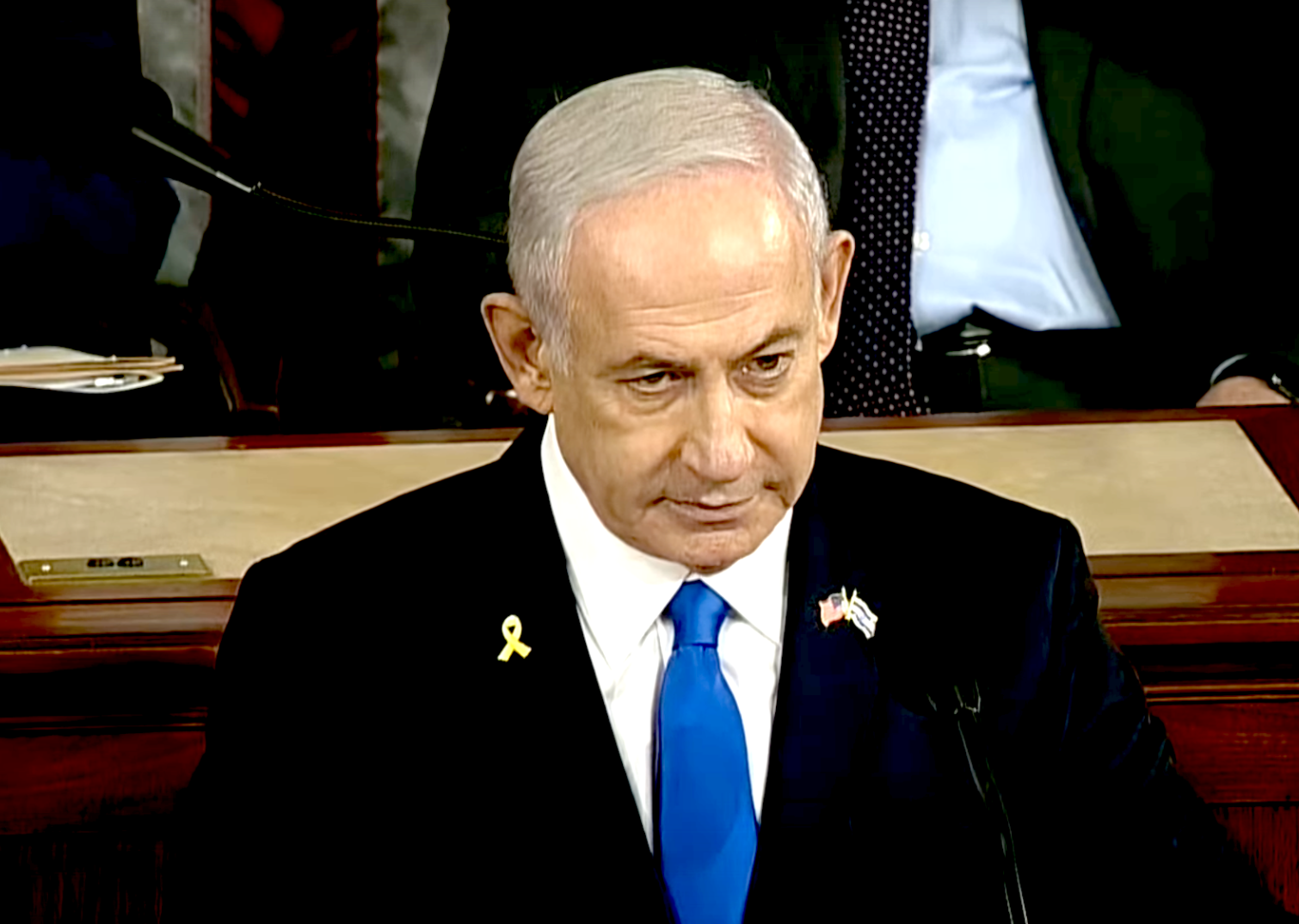
Israeli Prime Minister Benjamin Netanyahu addressing a joint session of U.S. Congress on July 24. (C-Span screen shot)
Israeli Prime Minister Benjamin Netanyahu is desperate to keep war simmering along and to draw the U.S. closer and closer to him. At the same time he cannot send ground forces into South Lebanon where they will take massive casualties.
Israel can assassinate, it can employ indiscriminate terrorism and it can bombard from the air, and it has done all these things against Lebanon, Syria, Iraq and Iran. But Israel cannot destroy Hamas or Hezbollah, cannot get back its hostages from Gaza and cannot make Northern Israel safe for its colonialists.
Nothing Israel is doing in any way advances those declared objectives and in fact makes all of them increasingly unlikely ever to be attained.
But as U.S. President Joe Biden and his vice president, Kamala Harris, accept and reinforce every single escalation and every single illegality, Israel’s stranglehold on its Western vassal politicians gets ever stronger.
Those have now all (including both U.K. Labour and Conservative ministers) supported illegality well beyond the stage where there is any going back. They have now to hope that they will be “justified” by military victory.
The Iraq war shows that however illegal the war, if you win you get to write — or at least interpret — the rules of international law. I wish I could come up with good counter-examples. “Justice” is visited only upon losers.
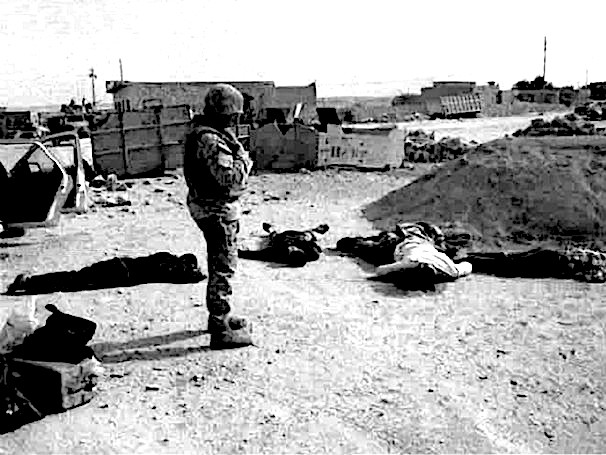
A U.S. Marine inspecting a roadside scene near Haditha, Iraq, where five unarmed civilians were killed on Nov. 19, 2005. (Unknown U.S. Marines and the Naval Criminal Investigative Service via the Washington Post, Wikimedia Commons, Public domain)
But the problem for Netanyahu, former British Prime Minister Rishi Sunak, current Prime Minister Keir Starmer, European Commission President Ursula von der Leyen, et al., is that just what victory looks like, nobody seems in the least clear.
We appear to be locked into a hideous distortion of existentialism, where the killing of Arabs of any age and sex is in itself the path of virtue and a reason for living.
Israel’s TikTok army of child-killers, rapists and lingerie-flaunters will take heavy casualties if it advances into Lebanon. It is currently launching intense air attacks, but it cannot destroy Hezbollah that way, not even were it to triple the colossal amount of explosive it has dropped on Gaza.
Netanyahu’s strategy of assassinations and deadly stunts appears to be an attempt to goad Hezbollah out of their own territory into a suicidal advance into Israel. But Hezbollah’s leader Hassan Nasrallah is not falling for it.
It is worth stressing that, contrary to the propaganda, in the last year Israel has hit Lebanon with five missiles for every one sent by Hezbollah.
Meantime the United Kingdom’s claims to respect international law are exposed as an utter sham as it failed to vote for the UNGA Resolution giving effect to the International Court of Justice’s Advisory Opinion on Israel’s occupation of Palestinian Territory.
The ICJ’s ruling that the occupation is itself an illegal act, and that states must do nothing which can assist Israel to maintain it, sets out a clear legal status quo which the U.K. is equally clearly breaking.
When the ICJ decision came out on July 19, the U.K. Foreign, Commonwealth and Development Office statement was as follows:
“We have received the Advisory Opinion issued by the International Court of Justice on Friday 19 July and are considering it carefully before responding. The UK respects the independence of the ICJ.”
The promised response has never come; unless you take the failure to vote at the U.N. General Assembly for the implementation of the ICJ ruling as the response.
The decision to suspend 8 percent of arms export licenses for Israel was framed not in terms of this ICJ ruling — which logically can only require the cessation of all arms sales to Israel — but more broadly in terms of unspecified possible breaches of international humanitarian law.
In its “explanation of vote” at the U.N. General Assembly, the U.K. deliberately ignored a key tenet of the ICJ Opinion. The U.K. stated:
“… our abstention reflects our unwavering determination to focus on efforts to bring about a peaceful and negotiated two-state solution… ,”
This ignores the ICJ ruling that Israel must leave the occupied territories before any negotiations. An occupied people cannot negotiate with, in effect, a gun held at their head. That is explicitly why the ICJ did not accept that the Oslo Accords alienated any Palestinian rights in international law.
The U.K. is still — directly contrary to the ICJ — attempting to maintain that Palestine’s right not to be occupied was signed away at Oslo.
British military flights, weapons supplies and intelligence cooperation with the Israel occupation continue unabated. Starmer’s total support for Israel is now a fixed part of the governing landscape, as the failure to condemn the terrorist device attacks on Lebanon makes clear.
The U.S. and U.K. are now hopelessly yoked to a Netanyahu nihilist strategy of which the primary aim is to retain his own power and immunity from prosecution by permanent conflict, of a kind which makes his allies ever more complicit and which will rope them into active military support.
That requires constant Israeli aggression against an axis of resistance that has so far refused to be provoked into major conflict. Israel’s plan is to humiliate Iran and its allies to an extent that a full-on regional war becomes inevitable, in which the United States will fight alongside them – and very probably the Sunni Arab regimes too, I am extremely sorry to say.
This is plainly madness that is entirely against the interests of the Western powers themselves. But their politicians, including very directly Biden and Starmer, are so compromised by Zionist-lobby money that there appears to be no escape, short of popular revolt in the West.
The West is bound to Israel by the simple, unalloyed mechanism of cash paid to politicians. That is the truth.
Craig Murray is an author, broadcaster and human rights activist. He was British ambassador to Uzbekistan from August 2002 to October 2004 and rector of the University of Dundee from 2007 to 2010. His coverage is entirely dependent on reader support. Subscriptions to keep this blog going are gratefully received.
We need to look at the Palestinian cause as a fundamental cornerstone to our struggles against US-led imperialism and global fossil capitalism, argues Hamza Hamouchene
Red Pepper, 30 August 2024
6 to 7 minute read
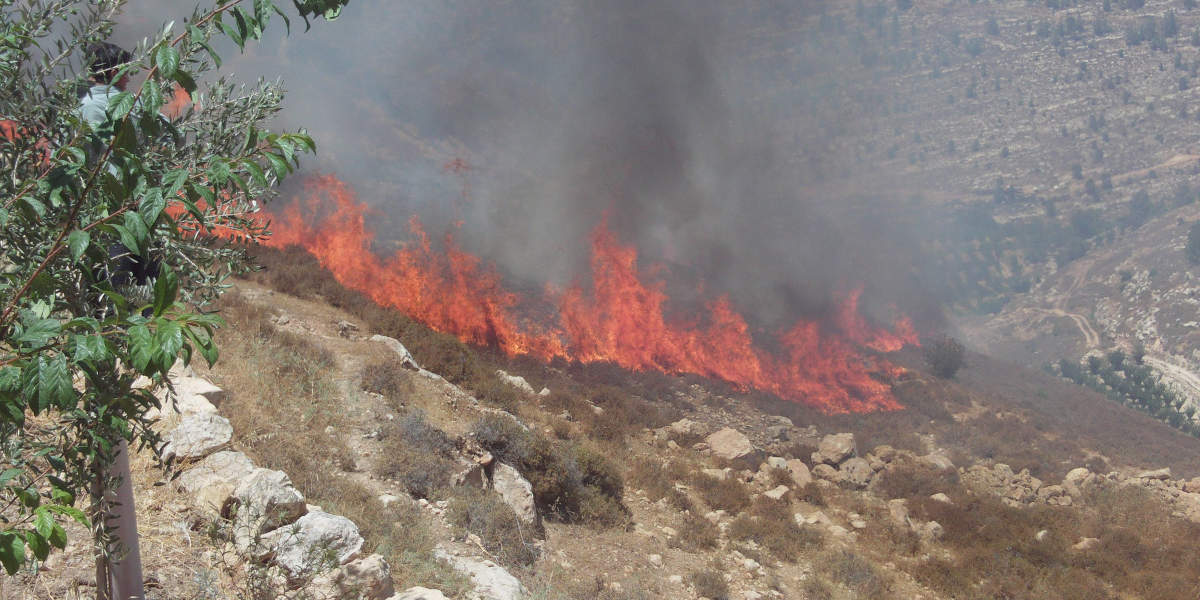
Settlers setting Palestinian land and olive trees on fire in Beit Ummar, West Bank in 2009 CREDIT: PALESTINIAN SOLIDARITY PROJECT
At the climate Summit, COP 28, held in Dubai in December 2023, Colombian President Gustavo Petro declared that ‘Genocide and barbaric acts unleashed against the Palestinian people is what await those who are fleeing the south because of the Climate Crisis…What we see in Gaza is the is the rehearsal of the future’.
I think he is right. The genocide in Gaza can be a harbinger of worse things to come if we don’t organize and fight back vigorously. The empire and its global ruling classes would be willing to sacrifice millions of black and brown bodies as well as white working-class people so they can continue accumulating capital, amassing wealth, and maintaining their domination.
Shifting costs to nature
Capitalism has always been a system of unpaid costs. The costs are systematically externalised and shifted somewhere else: a) to women and carers in terms of social reproduction that is largely unpaid, b) from urban to rural areas, c) from North to South where sacrifice zones are created, a dynamic facilitated through dehumanisation, othering and racism; and d) externalising costs to nature and treating it for centuries as an entity to dominate and plunder, if not to commodify but also considering it as a waste sink. This led to the ecological and climate crisis.
The impacts of the global climate crisis we are going through are differentiated through class, gender, and racial lines, as well as between urban and rural areas, North/imperial cores vs South/peripheries. They are also distinguishable through coloniser-colonised lines.
Palestinians and Israelis inhabit the same terrain but there is a huge disparity in impact and vulnerability because Israel settler-colonialism has grabbed, plundered and controlled most resources from land to water to energy and has developed, on the backs of Palestinians and with the active support of imperialist powers the technology that will help to relieve some of the impacts of the climate crisis.
The impacts of the global climate crisis are differentiated and distinguishable through coloniser-colonised lines
Global climate justice and Palestinian liberation
It may feel misplaced or even not appropriate to talk about climate and ecological issues in the context of genocide in Gaza, but I would argue that there are important intersections between the climate crisis and the Palestinian struggle for liberation. In fact, I would say that there will be no global climate justice without the liberation of Palestine and that the Palestinian liberation is also a struggle to save the earth and humanity. This is not mere sloganeering, and I will explain in the paragraphs below.
First, Palestine today perfectly demonstrates the ugliness of the current system and concentrates its deadly contradictions. It also shows its tendency to be moving towards the usage of cruel outright violence on a large scale. Gramsci once said: ‘The crisis consists precisely in the fact that the old is dying and the new cannot be born…In this interregnum, a great variety of morbid symptoms appear’.
Second, what is taking place today in Gaza is not just genocide. I am not sure we have the right terminology to describe all the destruction and death unleashed today on Palestinians. Notwithstanding this observation, what is also happening is an ecocide or what some described as a holocide, which is the annihilation of an entire social and ecological fabric
Third, the genocidal war in Gaza as well as other wars also highlight the role of war and the military-industrial complex in exacerbating the ecological and climate crisis. The US army on its own is the single largest institutional emitter in the world, larger than whole Western countries such as Denmark, and Portugal. In the first two months of the war in Gaza, Israel’s emissions were higher than the annual emissions of at least twenty countries. About half of these were due to weapons transportation by the US to Israel. The US is not only an active player in the genocide but also a significant contributor to the ecocide taking place in Palestine.
Fourth and this is my main argument (based on the work of Adam Hanieh and Andreas Malm): we cannot dissociate the struggle against fossil capitalism and US-led imperialism from the struggle to liberate Palestine. Israel as a Euro-American settler-colony in the Middle East is an imperial advanced outpost. Alexander Haig, US secretary of state under Richard Nixon once Put it bluntly: ‘Israel is the largest American aircraft carrier in the world that cannot be sunk, does not even have one American soldier and is located in a critical region for American national security’.
The Middle East and the global fossil regime
The importance of the Middle East in the global capitalist economy cannot be overstated. Not only does the region today play a major role in mediating new global networks of trade, logistics, infrastructure, and finance, it is also a key nodal point in the global fossil fuel regime and plays an integral role in keeping fossil capitalism intact through its oil and gas supplies. In fact, the region remains the central axis of world hydrocarbon markets, with a total share of global oil production standing at around 35 percent in 2022. Israel has also been seeking to play a role as an energy hub in the East Mediterranean (through newly discovered gas fields such as Tamar and Leviathan), an aspiration bolstered by the EU’s attempts to diversify its energy sources away from Russia in the context of the War in Ukraine. The genocide that Israel is carrying out wasn’t an obstacle for granting licences to various fossil fuel companies to explore for more gas in the first weeks of the genocidal war.
Two main pillars today form edifice of US hegemony in the region: Israel and the oil-rich Gulf monarchies. Israel as the number one ally in the region plays a fundamental role in maintaining the domination of the US-led empire in the region (and beyond) as well as its control of its vast fossil fuel resources, mainly in the Gulf and Iraq. It is within this framework that we need to understand the US’ and its allies’ efforts in politically and economically integrating Israel in the region from a dominant position: pioneering technology, weaponry and surveillance material but also water desalination, food production through agribusiness, energy, etc.
The normalisation deals between Israel and other Arab countries go back to the Camp David Accords of 1978 between Israel and Egypt and to the peace treaty between Jordan and Israel in 1994. A second wave of normalisation, the Trump-brokered Abraham Accords, took place in 2020 with the United Arab Emirates (UAE), Bahrain, Sudan, and Morocco.
The Palestine liberation struggle is not merely a moral and human rights issue but is a struggle against US-led imperialism and global fossil capitalism
Before the 7th October attacks, it was expected that Saudi Arabia and Israel, under the patronage of the US, would sign a similar deal cementing the US imperial designs for the region. This would have liquidated, once and for all, the Palestinian cause. Hamas, an integral part of Palestinian resistance, disrupted these plans through its 7th October attacks.
The Palestine liberation struggle is thus not merely a moral and human rights issue but is fundamentally and essentially a struggle against US-led imperialism and global fossil capitalism. There will be no climate justice without the dismantling of the deeply racist Zionist settler colony of Israel and without the overthrow of the reactionary Arab regimes, chiefly the gulf monarchies.
Palestine is a global front against colonialism, imperialism, fossil capitalism, and white supremacy. It is incumbent on all of us from climate justice activists to anti-racist organizations and anti-imperialist agitators to actively support Palestinians in their liberation struggle and uphold their undeniable right to resist by any means necessary!
The task in front of us is very challenging but as Fanon once exhorted us to do, we must, out of relative obscurity, discover our mission, fulfil it, and not betray it.
This is a lightly edited version of a speech that Hamza Hamouchene gave in a panel at the Black Lives Matter Liberation Festival, held on 13 July 2024 in London



 Peace and Justice Post
You must be logged in to post a comment.