Pakistan: Allow Pardon for Blasphemy Victim

December 4, 2010
High Court Overreaches in Barring Presidential Pardon
Human Rights Watch, December 2, 2010
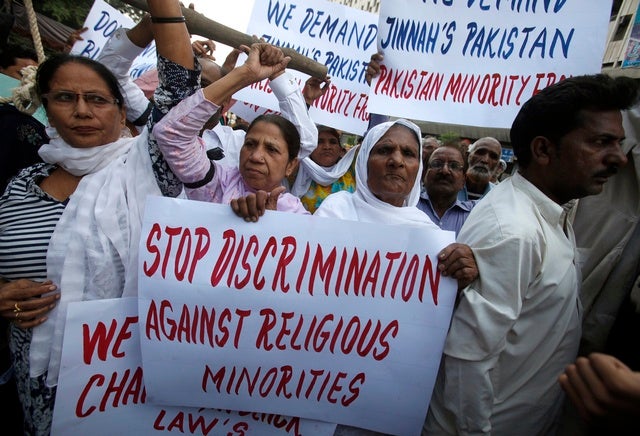
2010_Pakistan_Protest2.jpg

Protesters demand the release of Aasia Bibi, a Pakistani Christian woman sentenced to death for blasphemy, at a rally in Karachi on November 25, 2010.

© 2010 Reuters

The Lahore high court has overstepped its constitutional authority by preventing President Zardari from pardoning Aasia Bibi, who was unjustly convicted under a discriminatory law.

Ali Dayan Hasan, senior South Asia researcher at Human Rights Watch
(New York) – A Pakistani court’s order to bar President Asif Ali Zardari from pardoning a woman sentenced to death for blasphemy contravenes Pakistan’s constitution and should be withdrawn immediately, Human Rights Watch said today.

The Lahore High Court in Punjab province issued an order on November 29, 2010, barring Zardari from exercising his constitutional authority to pardon Aasia Bibi, an illiterate farmhand who had been convicted by the Sheikhupura District Court of blasphemy and sentenced to death. Zardari had ordered a review of the case in mid-November, after domestic and international outrage over the sentence. A ministerial inquiry concluded on November 25 that the district court verdict was legally unsound.

US fails to secure new Israeli settlement freeze

December 4, 2010
Palestinian official: US administration will continue its efforts to freeze illegal Israeli settlements.
Middle East Online, Dec 2, 2010

The ‘incentives’ aren’t working

RAMALLAH, West Bank – The United States has admitted it failed to secure a new Israeli settlement freeze to allow the resumption of peace talks, a Palestinian official told AFP on Thursday.

“The US administration has informed us that the Israeli government did not agree to a new settlement freeze,” said the official, who spoke on condition of anonymity.

“The US administration will continue its efforts,” the official added.

The United States has for weeks been trying to convince Israeli Prime Minister Benjamin Netanyahu to impose a new moratorium on settlement construction in the West Bank.

A previous 10-month freeze expired on September 26, shortly after the launch of new direct peace talks between Israel and the Palestinians.

Palestinian president Mahmud Abbas has said he will not return to the negotiating table without a ban on construction on land the Palestinians want for their future state.

The United States had reportedly offered Israel a package of incentives, including fighter jets and diplomatic support, in exchange for a new three-month freeze on settlement building.

Video: US widens use of drones in Pakistan

December 3, 2010

Al Jazeera, December 2, 2010

US steps up alleged drone strikes saying Pakistan’s not dealing with armed groups in North Waziristan.

(/IDEM] The US has stepped up a campaign of alleged drone strikes in Pakistan, despite the Pakistani military refusing calls for an operation in the North Waziristan region. The US defence department says Pakistan is not acting swiftly enough against armed groups in the region, and officials say it is hurting US efforts to reverse the Taliban’s momentum in the Afghan War. Al Jazeera’s Zeina Khodr reports from the Pakistani capital, Islamabad.

Vietnam: The Last Battle

December 3, 2010
by John Pilger, Antiwar.com,  December 03, 2010

SAIGON – The rain sheeted down, time washed away. I looked down from the rooftop in Saigon where, more than a generation ago, in the wake of the longest war of modern times, I had watched silent, sullen streets awash. The foreigners were gone, at last. Through the mist, like little phantoms, four children ran into view, their arms outstretched. They circled and weaved and dived; and one of them fell down, feigning death. They were bombers.

This was not unusual, for there is no place like Vietnam. Within my lifetime, Ho Chi Minh’s nationalists had fought and expelled the French, whose tree-lined boulevards, pink-washed villas and scaled-down replica of the Paris Opera, were facades for plunder and cruelty; then the Japanese, with whom the French colons collaborated; then the British who sought to reinstall the French; then the Americans, with whom Ho had repeatedly tried to forge an alliance against China; then Pol Pot’s Khmer Rouge, who attacked from the west; and finally the Chinese who, with a vengeful nod from Washington, came down from the north. All of them were seen off at immeasurable cost.

Continues >>

WikiLeaks is holding US global power to account

December 3, 2010

The WikiLeaks avalanche has exposed floundering imperial rule to scrutiny – and its reliance on dictatorship and deceit

Seumas Milne, The Guardian, Dec 1, 2010

WikiLeaks under the magnifying glass

WikiLeaks under the magnifying glass

WikiLeaks’ disclosure of 250,000 US embassy cables have exposed an overstretched imperial system at work. Photograph: WikiLeaks

Official America’s reaction to the largest leak of confidential government files in history is tipping over towards derangement. What the White House initially denounced as a life-threatening “criminal” act and Hillary Clinton branded an “attack on the international community” has been taken a menacing stage further by the newly emboldened Republican right.

WikiLeaks’ release of 250,000 United States embassy cables – shared with the Guardian and other international newspapers – was an act of terrorism, congressman Peter King declared. Sarah Palin called for its founder Julian Assange to be hunted down as an “anti-American operative with blood on his hands“, while former presidential candidate Mike Huckabee has demanded that whoever leaked the files should be executed for treason.

Not much truck with freedom of information, then, in the land of the free. In reality, most of the leaked material is fairly low-level diplomatic gossip, which naturally reflects the US government’s view of the world, and crucially doesn’t include reports with the highest security classification.

When it comes to actual criminality and blood, nothing quite matches WikiLeaks’ earlier revelations about the wars in Iraq and Afghanistan, with their chilling records of US collusion with industrial-scale torture and death squads, and killings of Afghan civilians by rampaging Nato troops.

Continues >>

Obama and GOPers Worked Together to Kill Bush Torture Probe

December 2, 2010
— Zuma/Paul Morse

A WikiLeaks cable shows that when Spain considered a criminal case against ex-Bush officials, the Obama White House and Republicans got really bipartisan.

— By David Corn, Mother Jones, Dec 1, 2010

In its first months in office, the Obama administration sought to protect Bush administration officials facing criminal investigation overseas for their involvement in establishing policies the that governed interrogations of detained terrorist suspects. A “confidential” April 17, 2009, cable sent from the US embassy in Madrid to the State Department—one of the 251,287 cables obtained by WikiLeaks—details how the Obama administration, working with Republicans, leaned on Spain to derail this potential prosecution.The previous month, a Spanish human rights group called the Association for the Dignity of Spanish Prisoners had requested that Spain’s National Court indict six former Bush officials for, as the cable describes it, “creating a legal framework that allegedly permitted torture.” The six were former Attorney General Alberto Gonzales; David Addington, former chief of staff and legal adviser to Vice President Dick Cheney; William Haynes, the Pentagon’s former general counsel; Douglas Feith, former undersecretary of defense for policy; Jay Bybee, former head of the Justice Department’s Office of Legal Counsel; and John Yoo, a former official in the Office of Legal Counsel. The human rights group contended that Spain had a duty to open an investigation under the nation’s “universal jurisdiction” law, which permits its legal system to prosecute overseas human rights crimes involving Spanish citizens and residents. Five Guantanamo detainees, the group maintained, fit that criteria.

Soon after the request was made, the US embassy in Madrid began tracking the matter. On April 1, embassy officials spoke with chief prosecutor Javier Zaragoza, who indicated that he was not pleased to have been handed this case, but he believed that the complaint appeared to be well-documented and he’d have to pursue it. Around that time, the acting deputy chief of the US embassy talked to the chief of staff for Spain’s foreign minister and a senior official in the Spanish Ministry of Justice to convey, as the cable says, “that this was a very serious matter for the USG.” The two Spaniards “expressed their concern at the case but stressed the independence of the Spanish judiciary.”

Continues >>

Kashmir: Obama and the Vale of Tears

December 2, 2010

By Conn Hallinan, Foreign Policy In Focus, November 30, 2010

Conn HallinanThere are lots of dangerous places in this world: Afghanistan, Iraq, Lebanon, Bolivia, Iran, Palestine, Yemen, and Somalia to name a few. But there is only one that could destabilize a large part of the globe and end up killing tens of millions of people. And yet for reasons of state that is the one place the Obama administration will not talk about: Kashmir.

And yet this region has sparked three wars between nuclear-armed India and Pakistan. It is currently in the midst of serious political upheaval. And it is central to reducing tensions in Central and South Asia.

None of these facts should surprise Obama. While running for office in 2008 he explicitly called for a solution to Kashmir.  “It won’t be easy, but it is important,” he told Joe Klein of Time magazine.

Kashmir’s Importance

Given that India and Pakistan came within a hair’s breath of a full-scale nuclear confrontation during the 1999 Kargil incident, the importance seems obvious. According to a recent study in Scientific American, such an exchange would kill and maim untold millions, flood the surrounding region with nuclear fallout, and create a “nuclear winter” for part of the globe.

Kashmir also fuels extremists in the region—both Hindu and Islamic—which in turn destabilizes Pakistan and Afghanistan. The conflict has already killed between 50,000 and 80,000 people, “disappeared” several thousand others, seen thousands imprisoned and tortured, and subjected millions of Kashmiris to an onerous regime of occupation, with laws drawn straight from Britain’s colonial past.

Why then would President Obama remain silent on the subject, particularly since the outlines of a solution have been in place since 2007?

Continues >>

Leon Trotsky’s 1908 tribute to Leo Tolstoy

December 2, 2010

One hundred years since the death of the great Russian novelist

wsws.org, 2 December 2010

The great Russian novelist Leo Tolstoy died one hundred years ago on November 20, 1910. Although eulogized by many writers, one of the best tributes to Tolstoy came two years before his death when Leon Trotsky wrote this article on Tolstoy’s eightieth birthday. It was first published in German in Die Neue Zeit on September 18, 1908; then in a Russian translation in Volume 20 of Trotsky’s Works in 1926; and finally in an English translation by John G. Wright in the journal Fourth International in May-June 1951 under the title, “Tolstoy, Poet and Rebel.” Minor revisions have been made to the original English translation. Several of the endnotes have been adapted from the 1926 Russian edition.

Ilya Repin’s portrait of Tolstoy

Tolstoy has passed his eightieth birthday and now stands before us like an enormous jagged cliff, moss-covered and from a different historical world.

A remarkable thing! Not only Karl Marx but―to cite a name from a field closer to Tolstoy’s―Heinrich Heine as well appear to be contemporaries of ours. But from our great contemporary of Yasnaya Polyana we are already separated by the irreversible flow of time which differentiates all things.

This man was 33 years old when serfdom was abolished in Russia. As the descendant of “ten generations untouched by labor,” he matured and was shaped in an atmosphere of the old nobility, among inherited acres, in a spacious manorial home and in the shade of linden-tree alleys, so tranquil and patrician.

The traditions of landlord rule, its romanticism, its poetry, its whole style of living were irresistibly imbibed by Tolstoy and became an organic part of his spiritual makeup. From the first years of his consciousness he was, as he remains to this very day, an aristocrat, in the deepest and most secret recesses of his creativeness; and this, despite all his subsequent spiritual crises.

Continues >>

P.C. Roberts: Who Precisely Is Attacking The World?

December 1, 2010

    Paul Craig Roberts, Prisonplanet.com, Dec 1, 2010

    The stuck pigs are squealing. To shift the onus from the US State Department, Hillary Clinton paints Wikileaks’ release of the “diplomatic cables” as an “attack on the international community.” To reveal truth is equivalent in the eyes of the US government to an attack on the world.

    It is Wikileaks’ fault that all those US diplomats wrote a quarter of a million undiplomatic messages about America’s allies, a.k.a., puppet states. It is also Wikileaks’ fault that a member of the US government could no longer stomach the cynical ways in which the US government manipulates foreign governments to serve, not their own people, but American interests, and delivered the incriminating evidence to Wikileaks.

    The US government actually thinks that it was Wikileaks patriotic duty to return the evidence and to identify the leaker. After all, we mustn’t let the rest of the world find out what we are up to. They might stop believing our lies.

    The influential German magazine, Der Spiegel, writes: “It is nothing short of a political meltdown for US foreign policy.”

    This might be more a hope than a reality. The “Soviet threat” during the second half of the 20th century enabled US governments to create institutions that subordinated the interests of other countries to those of the US government. After decades of following US leadership, European “leaders” know no other way to act. Finding out that the boss badmouths and deceives them is unlikely to light a spirit of independence. At least not until America’s economic collapse becomes more noticeable.

    Continues >>

    The Conflict in Chechnya: Confronting the Threat of State Disintegration and the Right to Self-Determination

    November 30, 2010

    Shavkat Kasymov, Foreign  Policy Journal, November 28, 2010

    Abstract

    This essay focuses on the right of the Chechen people to self-determination. I examine the legitimacy of the Chechens’ claim to self-determination and assess the policies of the Russian government toward the minority populations of the Caucasus. I also assess various aspects related to the legitimacy of the movements that fight for self-determination in the context of the global war on terror as well as the problem of violations of minority group rights. In this essay, I argue that current policies of the Russian government in the Caucasus do not lay the foundation for the long-lasting peace and stability in the region and are, in large part, conducive to the continuation of separatist tendencies.

    Human Rights and Nation Building Policies

    The right to self-determination is intimately linked to the right to free association as well as a guaranteed protection of cultural rights under universal UN conventions, whereas the concept of state sovereignty is the foundational framework on which the global peace and security are built in the modern world. Today, the conflict of principles of state sovereignty and identity group rights continues to generate and fuel a number of local wars and conflicts in many parts of the world. Moreover, some localized conflicts have been extended to other countries owing to the ideological factors that fuel them.

    Continues >>