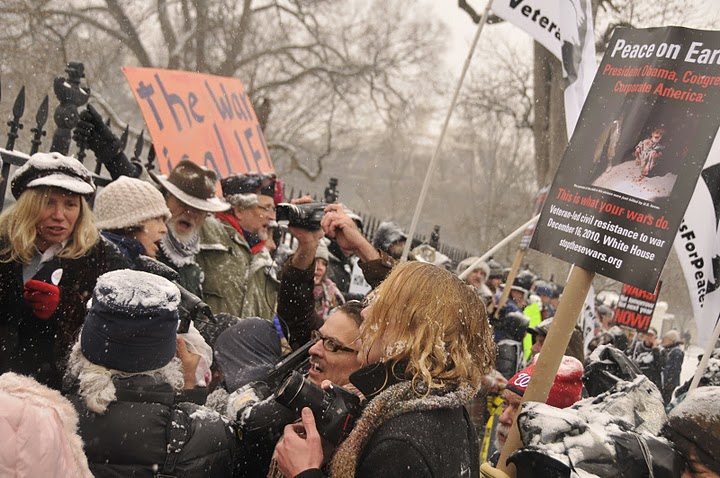
What Are They Hiding? Obama Administration Defending Black Site Prison at Bagram Airbase

October 28, 2010
By Dave Lindorff, This Can’t Be Happening, Oct 26, 2010

A victory for the government in a federal court in New York City Monday marks another slide deeper into Dick Cheney’s “dark side” for the Obama Administration.

In a lawsuit filed by the American Civil Liberties Union, which has been seeking to force the Pentagon to provide information about all captives it is holding at its huge prison facility at Bagram Airbase outside Kabul in Afghanistan, Federal District Judge Barbara Jones of the Southern District of New York has issued a summary judgement saying that the government may keep that information secret.

The lingering question is: Why does the US government so adamantly want to hide information about where captives were first taken into military custody, their citizenship, the length of their captivity, and the circumstances under which they were captured?

 Torture USAParwan Prison at Bagram Airbase, Afghanistan: Torture USA

Says Melissa Goodman, staff attorney with the ACLU’s National Security Project, “The military says that they can’t release the information because it would be a threat to national security, but they provided that information for the prisoners at Guantanamo.”

And of course, as our leaders informed us repeatedly, those captives at Guantanamo, who hailed from all over the globe, including Afghanistan, were allegedly “the worst of the worst”–at least until it turned out that many of them were wholly innocent of anything. had been framed and turned in for a bounty, or were mere children when picked up, like Omar Khadr, the 24-year old Canadian man who just copped a guilty plea to avoid a sham tribunal before 7 officers and potential life imprisonment, after being captured at 15, tortured at Bagram, and held for nine years at Guantanamo (on a charge of killing an American soldier in battle).

Continues >>

Arundhati Roy: Kashmir Interview

October 28, 2010

By Arundhati Roy, ZNet, Oct 28, 2010

Source: DN!

Arundhati Roy’s ZSpace Page

AMY GOODMAN: We turn to the award-winning Indian author Arundhati Roy, facing possible arrest in Indian on sedition charges after recent comments she made about Kashmir.

Earlier today, an Indian politician from the right-wing BJP party filed a written complaint against Roy after she publicly advocated for Kashmir independence and challenged India’s claim that Kashmir is a, quote, “integral part of India.” The area of Kashmir has been at the center of a decades-long dispute between India and Pakistan. Arundhati Roy made the comment at a conference organized to call on India to formally admit that Kashmir is an internationally recognized dispute. If charged and convicted of sedition, Arundhati Roy could face up to life in prison.

On Tuesday, she defended her statements made at the conference. She wrote, quote, “I said what millions of people here say every day…I spoke about justice for the people of Kashmir who live under one of the most brutal military occupations in the world.”

Roy went on to write, quote, “Pity the nation that has to silence its writers for speaking their minds. Pity the nation that needs to jail those who ask for justice, while communal killers, mass murderers, corporate scamsters, looters, rapists, and those who prey on the poorest of the poor, roam free.”

Well, last month, I had a chance to interview the author of The God of Small Things, Arundhati Roy, about Kashmir. We spoke in London. She began by describing how Kashmir is the unfinished business of the partition of India in 1947.

ARUNDHATI ROY: Since the 1990s, which is when—you know, at the same time that the war in Afghanistan, the American one, its jihad in Afghanistan, and India realigned itself and became, you know, what it is now, sort of completely aligned with the US. And, you know, the whole problem in Kashmir, the militant armed struggle for independence—I mean, there was always a struggle for independence. It’s not independence. It’s not ever been really a part of India, which is why it’s ridiculous for the Indian government to keep saying it’s an integral part of India. But that armed struggle claimed the lives of 68,000 people, because India today has 500,000 troops manning that little valley. It’s the highest, most militarized zone in the world.

India has done everything wrong there. Apart from a military occupation, it has completely rigged elections. It has changed that valley into a little sort of puddle, a little pool of spies and informers and intelligence networks and torture chambers. And today, you know, it’s come to a stage where people have just had enough. Now you don’t even know who the rulers are—I mean, who the leaders of the uprising are, because it’s just people who cannot take it anymore. But the government still is quite busy trying to manage the crisis. You know, there’s are all sorts of shady things going on. Cleaning mobs are setting business—buildings on fire, when it does look very much as though the intelligence agencies are doing that themselves in order to, you know, paint—once again paint this uprising in a different light.

Continues >>

Eminences of the Bench

October 28, 2010

Ponderous But Vulnerable

By Badri Raina, ZNet, Oct 26, 2010
Badri Raina’s ZSpace Page

I

There is that vignette in  Marquez’s  Autumn of the Patriarch where the protagonist looks idly out of the window at the bay below and seems to see an array of ships lined there, not all the same but their make and model spanning the centuries gone by.

“Magical Realism” everybody said.  Including the best and brightest of teachers in the universities of the world.  All except the author himself.

Same was the pedagogic fate that befell the opening fare of A Hundred Years of Solitude—two Latino rampagers visiting an Indian village  (Indian as in South America), and beguiling the natives with the mysteries of a magnet and a compass.  “Magical Realism” yet again.

Till Marquez in an elaborate interview confessed to doing or meaning nothing magical but being squarely within the realms of the mimetic/realist tradition of fiction-writing.  But just how?

On the first count, the composite image of ships spanning the centuries meant to suggest how in Latin American history, accreted layers of colonial oppression were ever embedded in the political semi-consciousness of the average perceiver as one historical whole—the gone-by never quite gone-by.

And on the second count, how the colonizing metropolitan West took hegemony to the hinterlands through technologies (magnet/compass) by claiming magical powers of redress for them, whereas at bottom meant to be deployed as mere instruments of domination.  Nostromo, Nostromo?

Most instructive both these contexts, methinks, for those of us who seek to unravel the qualities of change and the complex of perceptions accompanying them now here in India.

Continues >>

Iraq war logs: These crimes were not secret, they were tolerated

October 27, 2010

Why did we not investigate allegations of murder and torture in Iraq at the time, when it was well known what was going on?

Peter Beaumont, The Guardian, Oct 25, 2010

Iraqi soldiers guard a blindfolded detainee during an operation outside Baquba, north of Baghdad
Iraqi soldiers guard a blindfolded detainee during an operation outside Baquba, north of Baghdad. Photograph: AFP/Getty Images

The most shocking of the revelations in the current batch of leaked Iraq war logs is that most of the acts of torture and murder were committed in the open. They weren’t secret. They were tolerated, sanitised – justified, even. Take the Wolf Brigade, the 2nd battalion of the interior ministry’s special commandos. Everybody knew about them. You would see them in their pick-up trucks wearing balaclavas. When there was a sectarian murder people would talk about the wolves, until they became a shorthand to describe a certain kind of cruel violence. The wolf commandos became killers in the uniform of the Iraqi police.

I recall speaking to UN human rights investigators, western police advisers, diplomats and army officers about what was going on. In 2005 an Iraqi government official confirmed a list of places where she believed torture and murder were taking place. A British police mentor described entering the office of a notorious figure at the interior ministry and found a man with a bag over his head standing in the corner of the office.

Some of us who covered Iraq wrote about what we found. In summer 2005, I described the operation of the torture squads. Human rights organisations prepared their own reports. But nothing very much happened, except excuses.

When the bodies started turning up in western Baghdad in 2004, the official line was that it was former Ba’athists who were being killed. Like the looting that occurred in the aftermath of the fall of Iraq, it was “understood.” The victims probably deserved it, was the unspoken intimation. Officials, British and American, were really not that bothered.

Continues >>

Pack Assange off to Guantanamo, US conservatives tell Obama

October 27, 2010

By David Usborne in New York, The Independent, Oct 27, 2010

Julian Assange, the WikiLeaks founder, has been described in the US media as a 'threat to national security' GETTY IMAGES

Julian Assange, the WikiLeaks founder, has been described in the US media as a ‘threat to national security’

The White House and the Pentagon have failed to confront and contain the threat to national security posed by WikiLeaks and its founder Julian Assange who should be arrested as an “enemy combatant”, voices on the US conservative right insisted yesterday.

Frustration with the failure of President Barack Obama to combat WikiLeaks has grown since the release of almost 400,000 secret documents that exposed the extent of abuse of prisoners in Iraq by US and Iraqi personnel.

One Fox commentator went so far as to call for the WikiLeaks figurehead to be treated as a prisoner of war. Christian Whiton,a former State Department official, demanded that America seize Mr Assange and deal with him and other WikiLeaks staff as “enemy combatants”. Calling for “non-judicial action” against them, he implied that they should be in Guantanamo Bay with Taliban inmates.

Nor was Whiton alone in his stance. “The government also should be waging war on the WikiLeaks web presence,” an editorial in the conservative Washington Times railed this week. Other infuriated conservative commentators made similar demands on websites of such august institutions as the neoconservative thinktank the American Enterprise Institute (AEI).

Continues >>

UN General Assembly Calls for End to US Embargo on Cuba

October 27, 2010

CommonDreams.org, Oct 27, 2010

Agence-France Presse

UNITED NATIONS — The UN General Assembly overwhelmingly voted Tuesday for a resolution calling on the United States to end its five-decade old embargo of Cuba.

[The 19th straight annual condemnation of the embargo was supported by 187 countries, with only the United States and Israel against and three smaller US allies abstaining.]The 19th straight annual condemnation of the embargo was supported by 187 countries, with only the United States and Israel against and three smaller US allies abstaining.

The 19th straight annual condemnation of the embargo was supported by 187 countries, with only the United States and Israel against and three smaller US allies abstaining.The embargo was first partially imposed in 1960, just after Fidel Castro staged his revolution, turned into law in 1962 and is now the biggest remaining hangover from the Cold War. The United States bans trade with and most travel to Cuba.

US President Barack Obama last year called for a “new beginning” with communist Cuba. But the island’s Foreign Minister Bruno Rodriguez told the UN assembly the blockade has been “tightened” this year and that the US government did not want to end the measures.

“There is not even a sign showing that its government is willing to dismantle the most irrational aspects of what is already the most comprehensive and long-lasting set of sanctions and coercive measures ever applied against any country,” he added.

“Its everyday impact continues to be visible in all aspects of Cuban life,” the minister said, listing medicines that Cuban children get no access to, which Havana claims is due to the sanctions.

Rodriguez estimated that the blockade had cost Cuba more than 750 billion dollars at current values. He called the blockade “an act of economic warfare and genocide.”

Washington wants “a pro-Yankee government but that is not going to happen.”

Continues >>

Israeli flotilla probe ‘a sham’

October 27, 2010
By Sherine Tadros, AlJazeera, Oct 26, 2010


Photo by GALLO/GETTY

Turkel Schmerkel.

For the past few days I’ve had the delightful task of hanging around the Yitzhak Rabin Guest House in West Jerusalem. I was covering the latest round of questioning by (Israeli) judges, appointed by the (Israeli) government to examine the legality of their deadly raid on the Gaza-bound aid ship last May. The inquiry is called the Turkel Commission, named after retired Justice Turkel – the big chief.

Now, I could tell you how, at various points, I saw every member of the panel fall asleep during the testimonies.

Or, I could describe the humiliating and condescending way in which the panelists spoke to the Arab-Israeli passengers who came to testify (compared to the respect they showed whilst interviewing Opposition leader Tzipi Livni and military chief Gabi Ashkenazi).

I could even explain how for 45 minutes I watched the panelists argue with the Arab passenger about how being that “he seemed like a reasonable man” he could breach Israeli law (as an Israeli citizen) and decide to get on a ship to Gaza. Indeed – a Palestinian going to a Palestinian territory seemed more absurd to these judges than the actual policy that stops him getting there (and by extension anyone getting out).

Every step of the way it was obvious that this commission, which was tasked with determining whether Israel is in breach of international law in blockading Gaza, had made up their minds long before they stepped into the Rabin Guest House.

But put all that aside, here are five simple reasons why this Commission is a sham.

1) The average age of the five original panelists is 84. They have all spent their careers defending the state of Israel and between them have very little expertise in international law…

2) …Except for one of the panelists – Proff Rosenne  – but sadly he died a few weeks ago. He was 93-years-old and he was not replaced, so the panel has now gone down to four.

3) The panelists were all hand picked by Binyamin Netanyahu, the Israeli prime minister, and Ehud Barak, the defence minister. The two token international observers on the panel are also widely known as sympathetic to Israel.

4) The coverage of the Turkel Commission in the Israeli papers is virtually non existent. Apart from a local TV channel, Al Jazeera English was the only channel broadcasting from outside the proceedings the last two days.

5) Turkel said two weeks ago, during proceedings, that “the people of Gaza have brought this hardship on themselves”. Another panelist stated, despite the mass of data provided to the Commission by Israeli human rights groups on the situation in Gaza, “there is no humanitarian crisis in Gaza”.

Case closed.

Age of permanent war?

October 27, 2010
Morning Star Online,  October 27, 2010
By Steven Schofield

The defence spending review represents a total victory for the military-industrial complex and its campaign of fear.

Raising the terror alert to “severe,” the “secret” briefings that air force cuts would leave the country totally vulnerable, the lobbying by the great and the good on why Britain needs a blue-water navy to maintain its status as a world power and finally the US demand that Britain continues to play its full role within Nato, have had the desired effect.

After all the leaks and speculation that the MoD faced meltdown from savage Treasury-led cuts, the outcome is a very modest 8 per cent reduction.

As a result, the overall investment of the armed forces will be smaller, there will be fewer surface vessels and fighter aircraft ordered and delays to some contracts – all quite traditional methods of dealing with a spending squeeze.

But the really significant outcome was the continuation of every major procurement programme, notably Trident, conventional nuclear submarines and aircraft carriers.

Continues >>


Replacing One Set of Thugs With Another

October 27, 2010

by Abby Zimet, CommonDreams.org, Oct 25, 2010

A stunningly cogent editorial from the Guardian on Wikileaks’ Iraq War Logs, the brutality they exposed and the legal and moral obligation to investigate U.S. forces’ complicity in it. How appalling that no U.S. official – or mainstream paper – has yet to make such a demand.

    Every time WikiLeaks puts facts into the public domain, first about the war in Afghanistan and now about Iraq, it is accused of partisanship and irresponsibility. The US defence secretary, Robert Gates, said on 29 July that the release of 90,000 classified documents about the war in Afghanistan endangered Afghan lives. Little more than two weeks later, Gates admitted in a letter to Carl Levin, chairman of the Senate armed services committee, that the disclosures did not reveal any significant national intelligence secrets. The Pentagon’s review had not to date “revealed any sensitive intelligence sources and methods compromised by this disclosure”. This does not stop the same charge being made now about the release of almost 400,000 US documents on Iraq. 

    Many attempts were made to justify the invasion of Iraq, but one of the most frequently and cynically used was that, irrespective of the absence of weapons of mass destruction, putting an end to the barbarities of Saddam Hussein’s regime was a moral imperative. Well, now there is chapter and verse, from ringside seats, on the systematic use of torture by the Iraqi government that the US installed in Saddam’s place. The worst practices of Saddam’s regime did not apparently die with him, and whereas numerous logs show members of the coalition making genuine attempts to stop torture in Iraqi custody, it is clear their efforts were both patchy and half-hearted. In the worst incidents, one can only reasonably conclude that one set of torturers and thugs has been replaced by another.

    Continues >>

Palestinians Have Right to Resist Occupation by Any Means, Even Non-violent Ones

October 26, 2010

The Violence Debate

by Agustín Velloso, Dissident Voice,  October 26th, 2010

As a Western supporter (non Muslim/Arab) of the Palestinian cause, I have always find it rather difficult to talk (let alone to advocate) about how best Palestinians can resist occupation, especially when this occupation is usually extremely violent and genocidal at times.

Ramzy Baroud’s restrained criticism of Western and some other willing peace teachers, has prompted me to introduce a different point of view, which probably is much more common amongst Westerners than the Palestinians themselves would believe, although the mainstream media, as it happens with many other issues, have successfully managed to keep under a lid.

War in Iraq and Afghanistan are just two outstanding examples. It does not matter how many Westerners speak out and demonstrate against Western intervention (read aggression) in those countries. It does not matter that international law (let alone pure and humble common sense and humanity) prohibits wars of aggression and occupation. The fact is that Western presidents and parliaments “democratically” invade and withdraw as they see fit, “democratically” they are not held accountable in court for these crimes, and their victims are either dead of left to their own devices, also “democratically”.

Continues >>