Arab Voices Matter

February 18, 2011

By JAMES ZOGBY, Counterpunch, Feb 17, 2011

If one lesson is to be learned from the remarkable events unfolding in Egypt, it is that Arab public opinion matters. For too long Arab voices have not been listened to, nor have Arab sensibilities or aspirations been respected. The Egyptian people have not only risen up, demanding to be heard, they have also challenged other Arabs and the West to pay attention to what they are saying.

Last Thursday night, I watched a remarkable scene unfolding on television. As my dinner partner, Patrick Seale, and I sat transfixed watching the BBC, there, on one half of a split screen, was president Hosni Mubarak making a last ditch effort to save his rule. On the other half screen were throngs in Tahrir Square.

The disconnect was real. Mubarak was talking, but he simply wasn’t listening. He played every card at his disposal: the caring father, the patriot, the xenophobe, the reformer and more. Maybe, I thought, he was reaching out beyond the square to those he thought might also be listening. But if his imagined and hoped-for audience was there, they were not responding. The crowd in the square was listening, and his lack of responsiveness to their concerns only served to inflame them and deepen their resolve.

Continues >>

Where’s the American Outrage against U.S. Support of Dictatorships?

February 18, 2011

by Jacob G. Hornberge, The Future of Freedom Foundation, Feb 16, 2011

Once it became clear that Egypt’s dictator Hosni Mubarak was on the way out, U.S. officials quickly shifted gears and took the side of the demonstrators, the people who had suffered for 30 years under the brutal Mubarak dictatorship. U.S. officials even offered their guidance for moving Egypt toward a democratic political system.

Of course, all this pro-democracy hoopla was designed to disguise the fact that the U.S. government has been the prime partner and enabler of this brutal dictatorship for the entire 30 years under which the Egyptian people have suffered. It has been the U.S. government that has been providing the $60 billion in U.S. taxpayer money to Mubarak and his henchmen in the Egyptian military and secret police. It has been the U.S. government that has been paying the salaries of Egypt’s jailors and torturers for the past three decades. It is the U.S. military that has been training the Egyptian military.

Continues >>

Gaza scholars ask Egypt to end siege

February 15, 2011
Ma’an News Agency, Feb 14, 2011

GAZA CITY (Ma’an) — A group of well respected religious scholars in Gaza City congratulated the Egyptian people on “ending the tyranny and injustice” of the nation’s former president, and called on the new leadership to continue the trend by opening the Rafah crossing.

Calling themselves the Palestinian Scholars Association, the group issued a statement on Sunday, two days after former Egyptian President Hosni Mubarak announced his stepping down from power.

“The scholars of Palestine have followed closely the developments of the Egyptian revolution,” the statement said, adding that the group believed the new Egyptian cabinet and the military council could make “serious changes for the better,” and said they hoped that one of the changes would be to the policy of closure at the Rafah crossing.

Closed in 2006 after the Palestinian Authority was ousted from power, the crossing remained sealed for two years, after which it was opened for four days every four months to allow students, patients and international passport holders in and out of the coastal enclave. In June, the crossing was opened permanently, but travelers still had to have officials permission to leave the Strip.

The closure of Rafah followed only a few months after Israel began imposing restrictions at its crossing points with Gaza, in the wake of the capture of an Israeli soldier by resistance factions.

Closures and openings at Rafah have been seen to be coordinated with Israel, and accusations against the Mubarak regime for collaboration have frequently been launched.

With a new leadership barely in Place, the association of scholars urged a quick reconsideration of the crossings closure policy.

Recalling the Slaughter of Innocents

February 15, 2011

By Ray McGovern, Consortium News, February 14, 2011

Twenty years ago, as Americans were celebrating Valentine’s Day, Iraqi husbands and fathers in the Amiriyah section of Baghdad were peeling the remains of their wives and children off the walls and floor of a large neighborhood bomb shelter.

Share this article
ShareThis 

emailEmail
printPrinter friendly

The men had left the shelter the evening before, so their wives would have some measure of privacy as they sought refuge from the U.S.-led coalition bombing campaign, which was at its most intense pre-ground war stage.

All of the more than 400 women and children were incinerated or boiled to death at 4:30 a.m. on Feb. 13, 1991, when two F-117 stealth fighter-bombers each dropped a 2,000-pound laser-guided “smart bomb” on the civilian shelter at Amiriyah.

It was one of those highly accurate “surgical strikes.” The first bomb sliced through 10 feet of reinforced concrete before a time-delayed fuse exploded, destroying propane and water tanks for heating water and food.

Minutes later the second bomb flew precisely through the opening that had been cut by the first and exploded deeper in the shelter creating an inferno.
Fire rose from the lower level to the area where the women and children were seeking shelter – and so did the boiling water. Those who did not burn to death immediately or die from the bombs’ impact were boiled or steamed to death in the intense heat.

Continues >>

A False Peace: Egypt’s Relationship with Israel — and Ours

February 15, 2011

When the tumult in Tunisia and Egypt shattered the deep freeze that has afflicted Arabs for almost four decades, countries fond of touting democracy should have been leading the celebrations. Instead, the reigning mood among elites in the United States, and especially in Israel, was one of fear and trepidation.

Though the Obama administration sounded a supportive note for the popular rebellion near its beginning — and later, when Mubarak’s ouster was a foregone conclusion — it has also issued nervous caveats, citing the dangers of rapid change and the merits of Mubarak’s intelligence chief, torturer Omar Suleiman. The reversal came on the back of pressure exerted by America’s other clients in the Arab world and Israeli leaders, who both dread the prospect of region-wide revolt.

Accompanied by a chorus of spineless pundits, America and its allies began mouthing the rationales of the dictator himself: stability is good; change is bad; horrors will befall us if the Muslim Brotherhood wins a share of power.

The hand-wringing of other Arab autocrats should not be discounted, but it is the potential disruption to the Egypt-Israel relationship that animates American concern. The Israelis have made known their fear that change in Egypt will leave them bereft of friends “in the neighborhood” — a serious predicament for a state founded, through ethnic cleansing, on top of the neighborhood.

Continues >>

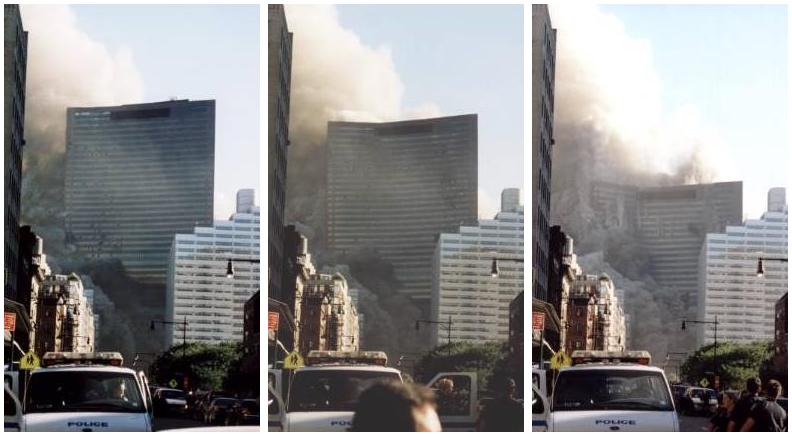
The Mysterious Collapse of World Trade Center 7: Case Far From Closed

February 15, 2011

Jeremy R. Hammond, Foreign Policy Journal, February 15, 2011

According to the National Institute of Standards and Technology (NIST), videos of the collapse of the 47-story World Trade Center 7 on September 11, 2001 show the building succumbing to a fire-induced progressive collapse. Many independent researchers and scientists, however, including over 1,400 professional architects and engineers who have signed a petition calling for a new investigation, disagree, pointing to evidence that it was deliberately brought down in a controlled demolition.

Despite the dramatically different conclusions drawn, there does exist widespread agreement on both sides on a number of important questions. Proponents of both hypotheses agree that the damage to WTC 7 sustained from the impact of debris from the collapse of the north tower (WTC 1) was not an initiating or determinative factor in the collapse. Both sides also agree that the system of transfer trusses and girders in the building that allowed it to be constructed above the Consolidated Edison New York electric power substation played no role in the collapse, that hypothetical fuel oil fires from tanks stored in the building for emergency generators was not a causal factor, and that the office fires did not result in any significant loss of strength of the building’s load-bearing steel columns.

Continues >>

Can the Egyptian People Sustain Their Momentum to Continue to Push for Deeper Change?

February 15, 2011
by Danny Schechter, CommonDreams.org, Feb 14, 2011

The Revolution Came and The Revolution Went; Unrest Turned Back Into Discontent” –Marat Sade

It is now the long morning after, as protesters returned to Tahrir Square to clean it up and savor their victory. There were even some initial scuffles with the military that may be overanxious to assert control and show that it is in charge.

In all the joy of the moment—the type of joy we see so rarely these days in the news—in all the electrifying coverage, and congratulations in the capitals of the West that stood by Mubarak for decades, there is still vast uncertainty.

The Egyptian military, now nominally in charge, has no culture of democracy much less any history of fostering real change. Funded with support from abroad, it is subject to influences from all its many new found friends of “democracy,” especially its patrons in Washington.

It has already sounded the trumpet of reassurance that it will live up to its promises to assure new elections while keeping the country’s foreign commitments intact including the peace treaty with a nervous Israel, and likely is loyalty to the war on terror as well.

It has now dissolved the parliament and suspended the constitution, meeting two key demands of pro-democracy protesters. At the same time, It has also, so far, committed itself to keep the structure of the Mubarak regime in place.

How will this sit with a euphoric public?

So far, we have seen a takeover, but not yet the makings of a transformation. When millions of people were in the streets, they had power. When they are not, power reverts to institutions and a bureaucracy considered the most stifling in the world,

Egypt has been a police state with more than a million informers. That will not change easily.

Already a CIA assistance team has been dispatched, all in the name of guaranteeing democracy, of course. The Mossad’s role has been more low key but you can assume it’s there.

Almost every revolution is menaced by the threat of a counter-revolution and this one is no exception.

On the American right, the big fear stoked by Fox Fuhrer Glenn Beck is from the Islamic boogieman. “This isn’t about Egypt, this is the story of everyone who has ever plotted, or wanted, to fundamentally change or destroy the Western way of life,” he and his cronies warn.

On the left, the worry is that the movement for change is not organized enough to insure change, or even clear about what it wants now. Its leaderless momentum won Mubarak’s ouster, but can it win its desire for a real democracy and economic justice?

Continues >>

Mass protests spread in Middle East as Washington reassures Israel, Arab dictators

February 15, 2011

By Bill Van Auken, wsws.org, 15 February 2011

Inspired by the Egyptian people’s overthrow of Hosni Mubarak, protests continued to spread in the Middle East on Monday, as Washington scrambled to reassure Israel and pro-US regimes in the region of its continued support.


For a fourth straight day, demonstrators in cities throughout Yemen clashed with security forces and mobs of plainclothes policemen and hired thugs posing as supporters of the US-backed government of President Ali Abdullah Saleh.

In the capital city of Sana’a, the anti-government demonstrations grew in size on Monday. The AFP news agency said that over 3,000 people attempted to march towards the city’s Tahrir (Liberation) Square to demand the ouster of President Saleh, who has ruled the country for more than 32 years.

As they neared the square, they were attacked by riot police using batons, rifle butts and electric cattle prods. Mobs of plainclothes police thugs then attacked demonstrators with daggers and broken bottles.

Among those demonstrating were the country’s lawyers dressed in black robes. The protesters chanted, “The people want the regime to step down,” “leave Saleh” and “After Mubarak, Ali.”

Continues >>

A Scientific Theory of the WTC 7 Collapse

February 14, 2011

by Micael Fullerton, Foreign Policy Journal, Feb 14, 2011

This year will mark the 10th anniversary of the September 11, 2001 disaster. In these 10 years, not only have extremely important scientific questions about this tragedy gone unanswered, but they have even been ridiculed to the point of deranged absurdity. We owe a valid scientific explanation to the 3000 victims on that day, the steadily dying health-stricken first responders, the dead and wounded soldiers, and the untold thousands upon thousands of dead and injured Afghans and Iraqis resulting from the terrifying never-ending “war on terror”. Critics of those skeptical of the official story of 9/11 have often objected that an alternative theory has never been put forth. To that end, this article will put forth a scientific theory for one important aspect of the 9/11 event, the Building 7 collapse.

On September 11, 2001 a third building came down. This building was 7 World Trade Center (WTC 7), a 47-story building about the width and length of a football field. NIST, the National Institute of Standards and Technology, was tasked with officially explaining how WTC 7 fell. Their theory is documented in the report entitled Final Report of the Collapse of Building 7[1]. Many people are under the mistaken impression that NIST’s theory of how WTC 7 fell down is a valid scientific theory. In science however, a valid theory must be the simplest theory available that best explains all the available empirical data.[2] This article will show that the NIST theory is a highly convoluted theory that cannot explain important observations.

Continues >>

The Kashmir Issue and the Republic of India

February 14, 2011

Rupinder  Brar, Feb 14, 2011

In 1947 when the British left India they left behind two nation states; India and Pakistan. The founding father of Pakistan negotiated for a separate state for the Muslims of the Indian subcontinent, basing his demand on the principle that the Muslims community, bound by a common faith, constituted a separate nation in the traditional European sense.

However such a homogenous state had never existed before within the Indian subcontinent. From the days of the earliest days of the Mauryan Empire all the way to the Sikh kingdom in the 19th century, the native Indian political states had always existed politically as administrative units but populated by people who were intensely conscious of multiple sub identities that were based not only on the traditional sub identities of faith, language and ethnicity but also of castes, customs and sub cultures. Moreover these sub identities were hopelessly mixed together in all regions which meant that people within each political unit loosely shared some but never all the features of sub identity even as they shared other aspects of sub identity with other people outside their own particular unit.

Because of this it was impossible to fashion a nation state in traditional sense in the remaining land that was to become Independent India the Indian founding fathers wisely devised their own particular definition of a nation state; one that was bound not by a common Faith but a faith in shared ideals, that of 19th century European enlightenment; individual liberty, secularism and universal franchise; a civic state. Using this framework, they hoped to provide Indians of all regions and religions an equal stake in the new state; the Republic of India.

Today sixty years, later it is clear that faith alone was an insufficient glue to keep the disparate elements of the Pakistani state together. Twenty four years after its founding, the Eastern and Western halves of Pakistan, united only by faith but otherwise divided by history, geography, language and culture, underwent another partition. Ironically one of these, Bangladesh, made up mostly of Bengali speaking Muslims of East Bengal is the closest that any state in South Asia has come to becoming a nation state in the traditional sense.

The score card is mixed for India; while it has survived as a secular democracy barring a few unfortunate lapses it is still a place where social, economic and sometimes even political justice is denied to many. Nevertheless today most of India is ‘integrated’ into the Republic that tends to emphasize its unique ‘unity in diversity’ theme.

One notable exception has been Kashmir thanks in large part to its messy mode of accession. That its hasty accession to India would disputed by Pakistan could be anticipated; what compounded the problem was the shortsighted petty politicking by successive Indian governments that effective turned the hesitant Kashmiris of the valley into reluctant and often cantankerous citizens.

While lately many Indians in the establishment have woken up to the tragedy of the Union government’s broken promises with the people of Kashmir, Indians nevertheless insist that Kashmir’s accession to India is final. Thus India refuses to consider a plebiscite in Kashmir as called by UN resolutions by arguing that since a plebiscite was supposed to be held in the entire princely state of Kashmir which now lies partition in three parts under the control of India, Pakistan and China respectively, a plebiscite is no longer possible.

It is a legalistic argument that sounds like a fig leaf for the Indian state. However such an argument is a trap because it distracts one from a more serious moral argument against changing the status quo there for the reasons listed below:

The last time things were decided by such a method was in 946-47. Then the Muslims electorate of the united India voted overwhelmingly in favor of the All India Muslim League (AIML) thus endorsing its demand for Pakistan. Based on this plebiscite like mandate, an independent Pakistan was carved out of Muslim majority North Western and Eastern provinces of India. Ironically though, while such a division was in principal a fulfillment of the democratic wishes of the majority, in reality its effects were quite undemocratic because while the Muslims of the United Provinces, who had overwhelmingly voted for a Pakistan remained in India, those who had opposed it initially; the Muslims of the Punjab and NWFP ended up in Pakistan! Moreover the partition also divided the provinces of Punjab and Bengal which no one had wanted, complete with ruthlessly efficient ethnic cleansing and a population exchange on a scale that the world had never before seen!

A plebiscite in Jammu and Kashmir is likely to result in a similar partition complete with a man-made tragedy on a similar scale while satisfying no one. The reason is that while many liberal minded non-Kashmiris may be intuitively sympathetic to the demand for ‘Azadi’ many of them may not appreciate what that may mean.

Unlike most ‘nations’ Jammu and Kashmir is not a single nation in the traditional sense and it never was. It is a historical accident; a remnant of an older Sikh Kingdom, which was actually an Empire made up of several different peoples regions and cultures. Thus the territory that makes up Jammu and Kashmir is a microcosm of India. Even if we leave out the POK itself more Punjabi than the rest, the peoples living in the three regions of J&K are quite different from each.

Take the Eastern region of Ladakh; though sparsely populated it makes up the largest part in term of territory. The Laddakhis are distinct ethnic group, closely associated with the Tibetans. Like them they follow Buddhism and are strongly pro-India. The smallest region by area is the valley proper yet it is the most populated. It’s overwhelmingly majority Sunni Muslims are the driving force behind ‘Azadi’. Till recently the valley was also the home of a small distinct Kashmiri pundit community who were all but ethnically cleansed by the Islamists who took over the recent uprising. Today they have become refugees in their own land in contravention of all human rights proposed in the UN charter. The third and final region that makes up the J and K is Jammu; second both in terms of area and population; it is more than 60 percent Hindu, and majority is again fiercely pro-India. Then there are some other ethnic groups for example the Gujjars who live in the valley yet are not considered ‘Kashmiri’ in the ethnic sense and have no geographical area of their own.

Due to this racial, cultural and religious mix in the state, if by an accident J&K were to become Azad tomorrow, it will first result in an ethnic cleansing and population exchanges like that seen in 1947. And also because of it, quite possibly one may soon witness demonstrators on the streets of Jammu and Leh asking for their own version of Azaadi from Srinagar!!

It does not mean that the only choice is a status quo; of course not. Genuine political Freedom and Peace are both quite possible in Kashmir within the framework of the Indian constitution; but to achieve it both sides will have to make pragmatic choices.

No one disagrees that the Union government must see to it that like all Indians, the Kashmiri civil society too functions free from the yoke of the Indian security forces. Local government in Kashmir too should be by the people, of the people and for the people. Yet the Kashmiri political establishment must also be pragmatic and work towards the welfare of the ordinary people. Kashmiri separatists often claim that the ‘Indians’ don’t understand them or that they are often misrepresented; I think it works both ways.

Unlike how they are characterized by the separatist propaganda, most ‘Indians’ are not all agents of ‘Brahaminvad’; most of them are not even Brahmins. They are students and teachers, reporters and academics, farmers and traders; laborers and peasants; in effect ordinary people. Most of them who are politically conscious oppose further division of India because first and foremost they are fearful of a replay of 1947; bloodshed, population exchanges and a fearful strain on India’s fragile communal amity.

Secondly most secular Indians find the demand for ‘Azaadi’ like the demand for Pakistan before, an emotionally-driven one. It is hard to reconcile such a demand with secular humanism because it cannot explain how the life of an ordinary citizen will be different if Kashmir achieves ‘Azaadi’ from the Indian Union; which is even now a democratic union of states that are equal in every way and enjoy a great degree of local autonomy.

Under the Indian constitution, even today a Kashmiri enjoys everything that all ‘other Indians’ enjoy; a representative government; one man one vote, equality for all in the eyes of the law and in public sphere regardless of religion, region or ethnicity.

If in spite of all of the above, the Kashmiri separatists insist on sticking to an uncompromising demand for an ‘Azaadi’ they run the risk of being misunderstood themselves; as closet Islamists and bigots for who the term Azaadi is but a codeword for the right to discriminate against others on the basis of religion and ethnicity; a freedom to have state sanctioned discrimination like the type one sees against the Ahmediyas and other minorities next door….

Like I said, they have to make some pragmatic choices too.