| Crowds mass in major cities calling for President Mubarak to step down, as death toll from protests crosses 50. | |||||||||||||||||||
|
Al Jazeera, 29 Jan 2011
|
|||||||||||||||||||
Protesters are returning to the streets of Egypt, following violent overnight demonstrations across the country staged in defiance of a curfew. Demonstrators gathered in Tahrir Square in the Egyptian capital, Cairo, on Saturday morning, shouting “Go away, go away!”, the Reuters news agency said. Similar crowds were gathering in the cities of Alexandria and Suez, Al Jazeera’s correspondents reported. In Alexandria, our correspondent Rawya Rageh reported that dozens of marchers were calling on Egyptian president Hosni Mubarak to step down. “They are calling for regime change, not cabinet change,” Rageh said. In Suez, Al Jazeera’s Jamal ElShayyal reported that protesters were gathering, and that the military was not confronting them. ElShayyal quoted a military officer as saying that troops would “not fire a single bullet on Egyptians”, regardless of where the orders to do so come from. The latest protests reflected popular discontent with Mubarak’s midnight address, where he announced that he was dismissing his government but remaining in power.
The several hundred protesters in Tahrir Square demonstrated in full view of the army, which had been deployed in the city to quell the popular unrest sweeping the Middle East’s most populous Muslim country since January 25. They also repeatedly shouted that their intentions were peaceful. Reuters reported that the police “fired shots” on the protesters in Cairo. An independent confirmation of that report is awaited. The road leading from Tahrir Square to the parliament and cabinet buildings has been blocked by the military, the Associated Press news agency reported. Al Jazeera’s Jane Dutton, reporting from Cairo, said the normally bustling city looked more like a warzone early on Saturday morning. Tanks have been patrolling the streets of the capital since early in the morning. Rising death toll Cities across Egypt witnessed unprecedented protests on Friday, with tens of thousands of protesters taking to the streets after noon prayers calling for an end to Mubarak’s 30-year rule. The number of people killed in protests is reported to be in the scores, with at least 23 deaths confirmed in Alexandria, and at least 15 confirmed in Suez, with a further 15 deaths in Cairo. Al Jazeera’s Rageh in Alexandria said that the bodies of 23 protesters had been received at the local morgue, some of them brutally disfigured. ElShayyal, our correspondent in Suez confirmed 15 bodies were received at the morgue in Suez, while Dan Nolan, our correspondent in Cairo, confirmed that 15 bodies were present at a morgue in Cairo. More than 1,000 were also wounded in Friday’s violent protests, which occurred in Cairo and Suez, in addition to Alexandria. |
|||||||||||||||||||
Archive for the ‘Uncategorized’ Category
Protesters back on Egypt streets
January 29, 2011


Imran Khan in Davos Criticizes War in Afghanistan
January 28, 2011By Amy Kellogg, FoxNews.com, January 27, 2011

Former cricket star turned Pakistani politician Imran Khan.
DAVOS, Switzerland — Former cricket star turned Pakistani politician Imran Khan has been working the corridors of the World Economic Forum in Davos, with a message about the war in Afghanistan, which has spilled over into Pakistan.
“This war on terror is a disaster for the people of the U.S. It’s a bigger disaster for the people of Pakistan. It is causing more radicalization, more polarization in the society. The war is perceived by the vast majority as a war against Islam and because it is perceived as a war against Islam there is no shortage of people willing to die for it.”
Khan is the leader of the Tehreek-e-Insaf party in Pakistan, which is trying to make inroads on the political scene, and eventually take power. Pessimistic about the prospects for the war in Afghanistan to succeed, he says the situation in his own country has become worse in the past few years. He points to the recent assassination of provincial Governor Salman Taseer, who was shot by a bodyguard opposed to his relatively liberal views. Taseer had called for leniency in the case of a Christian mother sentenced to death under the blasphemy ban. He was outspoken against the blasphemy law. In the wake of his assassination, people have come out and staged protests in support of his confessed killer.
WikiLeaks Cables Detail Egyptian Repression, Torture
January 28, 2011Obama Administration Fully Aware, Reluctant to Press Mubarak
With the eyes of the world already on Egypt, WikiLeaks released a massive collection of cables related to Egypt today, detailing broad-based repression of political dissident and indeed even those officials conceivably could see as undermining their rule.
 Egyptian officials moved against journalists, novelists, bloggers, even amateur poets, for criticism of the government and detailing the levels of police brutality around the world.
But the Obama Administration didn’t need those outlets detailing the level of brutality in the Mubarak regime, cables show that they were fully aware of it from the start. NGOs described torture as “endemic” and said hundreds of cases of torture against petty criminals, political dissidents, even random bystanders, were occurring daily in Cairo alone.
The Obama Administration continues to insist they have been pushing for “reforms” but the cables reveal that it isn’t the case, and that even broaching the subject of police brutality was considered a touchy issue for many, and led to harsh rebukes by Egypt that the US would be supporting “Communists.” The official US response was to increase funding for the police in hopes that more money and better training would lead them to torture less. Even then, officials confirmed Egypt “has not begun serious work on trying to transform the police and security service.”
One US Corporation’s Role in Egypt’s Brutal Crackdown
January 28, 2011Timothy Karr, The Huffington Post, Jan 28, 2011
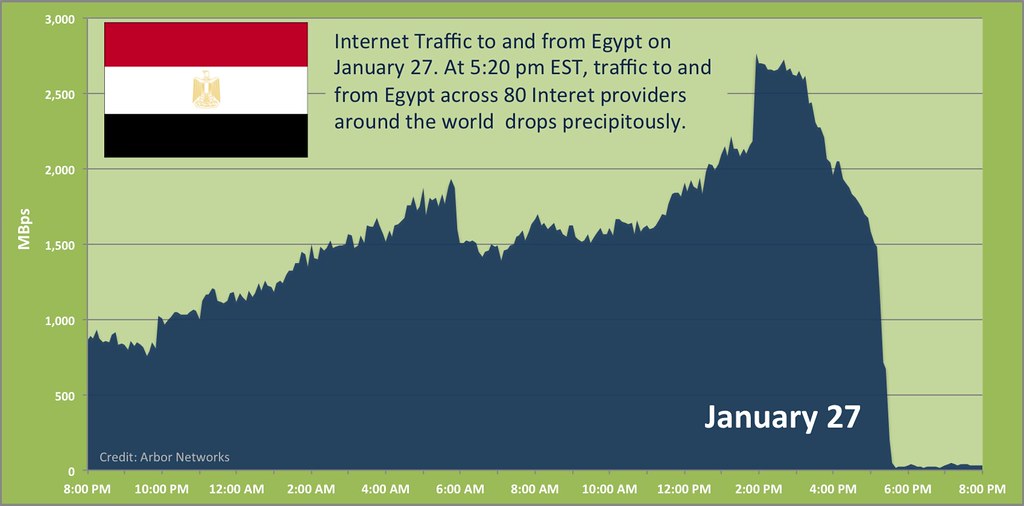
The open Internet’s role in popular uprising is now undisputed. Look no further than Egypt, where the Mubarak regime today reportedly shut down Internet and cell phone communications — a troubling predictor of the fierce crackdown that has followed.
What’s even more troubling is news that one American company is aiding Egypt’s harsh response through sales of technology that makes this repression possible.
The power of open networks is clear. The Internet’s favorite offspring — Twitter, Facebook and YouTube — are now heralded on CNN, BBC and Fox News as flag-bearers for a new era of citizen journalism and activism. (More and more these same news organizations have abandoned their own, more traditional means of newsgathering to troll social media for breaking information.)
But the open Internet’s power cuts both ways: The tools that connect, organize and empower protesters can also be used to hunt them down.
Telecom Egypt, the nation’s dominant phone and Internet service provider, is a state-run enterprise, which made it easy on Friday morning for authorities to pull the plug and plunge much of the nation into digital darkness.
Moreover, Egypt also has the ability to spy on Internet and cell phone users, by opening their communication packets and reading their contents. Iran used similar methods during the 2009 unrest to track, imprison and in some cases, “disappear” truckloads of cyber-dissidents.
Egypt, Tunisia, and the fight against US imperialism
January 28, 2011Bill Van Auken, wsws.org, Jan 28, 2011
Two weeks after US Secretary of State Hillary Clinton warned Arab leaders that their region’s “foundations are sinking into the sand”, the growing revolutionary upsurge of the masses has revealed that the pillars of Washington’s own policy in the Middle East are rotten and crumbling.
The mass uprising that toppled the 23-year rule of Tunisian dictator Zine al-Abidine Ben Ali has now been followed by tens of thousands of young demonstrators in Egypt taking to the streets, defying security forces, and in increasing numbers giving their lives, to demand the downfall of Hosni Mubarak and his nearly three-decade-old regime. Thousands more demonstrated Thursday in the Yemeni capital of Sanaa, calling for the ouster of Ali Abdullah Saleh, who has ruled the country for more than 30 years.
In every case, masses of youth and workers have risen up against regimes that are synonymous with social inequality, corruption, political repression and torture and which have been firmly aligned with and largely financed by US imperialism. They have been driven to act by the same conditions of unemployment, rising prices and government abuse that led the young Tunisian Mohamed Bouazizi to set himself ablaze in protest, inspiring the demonstrations that swept his homeland.
Cow Most Sacred: Why Military Spending Remains Untouchable
January 27, 2011By Andrew J. Bacevich, TomDispatch.com, Jan 27, 2011
In defense circles, “cutting” the Pentagon budget has once again become a topic of conversation. Americans should not confuse that talk with reality. Any cuts exacted will at most reduce the rate of growth. The essential facts remain: U.S. military outlays today equal that of every other nation on the planet combined, a situation without precedent in modern history.
The Pentagon presently spends more in constant dollars than it did at any time during the Cold War — this despite the absence of anything remotely approximating what national security experts like to call a “peer competitor.” Evil Empire? It exists only in the fevered imaginations of those who quiver at the prospect of China adding a rust-bucket Russian aircraft carrier to its fleet or who take seriously the ravings of radical Islamists promising from deep inside their caves to unite the Umma in a new caliphate.
What are Americans getting for their money? Sadly, not much. Despite extraordinary expenditures (not to mention exertions and sacrifices by U.S. forces), the return on investment is, to be generous, unimpressive. The chief lesson to emerge from the battlefields of the post-9/11 era is this: the Pentagon possesses next to no ability to translate “military supremacy” into meaningful victory.
Washington knows how to start wars and how to prolong them, but is clueless when it comes to ending them. Iraq, the latest addition to the roster of America’s forgotten wars, stands as exhibit A. Each bomb that blows up in Baghdad or some other Iraqi city, splattering blood all over the streets, testifies to the manifest absurdity of judging “the surge” as the epic feat of arms celebrated by the Petraeus lobby.
Afghanistan: War Without End In A World Without Conscience
January 27, 2011
The largest foreign military force ever deployed in Afghanistan is now well into the tenth year of the longest and what has become the deadliest war of the 21st century.
Some 154,000 occupation troops, almost two-thirds American and the rest from fifty other nations, are waging an armed conflict that has become more lethal with each succeeding year.
At the beginning of this month Agence France-Presse calculated that over 10,000 people had been killed in Afghanistan in 2010. Based on official Afghan government figures and those from the icasualties website, record-level fatalities were documented in every category:
The U.S., its North Atlantic Treaty Organization allies and assorted NATO partnership nations lost 711 soldiers, a substantial increase from the preceding year when the death toll was 521. The remaining 9,370 killed were Afghans. According to AFP they were:
810 government troops, 1,292 police, 2,043 civilians and 5,225 people referred to as “militants.” It is uncertain how many dead in the last category properly belong in the one preceding it. The United Nations, for example, said 2,412 civilians were killed and 3,803 wounded in the first ten months of last year, a 20 percent increase over 2009.
PA stonewalled the Goldstone vote
January 27, 2011| PA, with US encouragement, delayed a UN vote on the Goldstone Report into war crimes committed during Israel’s Gaza war. |
|
S. Farhan Mustafa, Al Jazeera , 26 Jan 2011
|
 The Palestine Papers reveal the conversations between US and PA officials in the days before the vote [EPA] On October 2, 2009, the UN Human Rights Council was widely expected to pass a resolution supporting the Goldstone Report, the UN’s probe of war crimes committed during Israel’s war in Gaza in December 2008 and January 2009. The Council instead agreed to delay a vote on the report until March 2010, following major reservations expressed by the Palestinian Authority, the United States and Israel. A UNHRC endorsement of the report would have brought Israeli officials one step closer to prosecution before a war crimes tribunal, an event many Palestinians were anxious to see. But, as The Palestine Papers reveal, the Palestinian Authority apparently sacrificed a potential victory for Palestinian victims in exchange for favorable assurances on negotiations from the United States and, they hoped, from Israel. Quid pro quoThe Goldstone Report, formally known as the Report of the United Nations Fact Finding Mission on the Gaza Conflict, was released in mid-September 2009 amid calls for a review of Israel’s wartime practices. The probe was led by Richard Goldstone, a former South African judge; it identified war crimes committed overwhelmingly by Israeli forces, but also by Hamas, during Israel’s war on Gaza. “Bad faith”Both the United States and Israel were outspoken in their criticism of the report, claiming that any UN endorsement would endanger the peace process and future Palestinian-Israeli negotiations. Palestinian president Mahmoud Abbas has already admitted that the PA asked for the postponement; he said at the time it was to secure more international support before the vote. “Since we felt we would not be able to gather enough support we asked for the postponement,” Abbas said in October 2009. “We wanted to reach mechanisms that would ensure the implementation of the decision and punish the perpetrators of crimes against our people.” What The Palestine Papers demonstrate is that, in the weeks preceding the vote, the United States apparently urged the PA to stall the report as a means of restarting negotiations with Israel. Continues >> |


Hosni Mubarak, our man in Cairo: Egypt’s protesters have grown impatient with U.S. realism
January 27, 2011By Eric Trager, NY Daily News, Thursday, January 27th 2011

Obama meets with Egyptian President Hosni Mubarak at the White House in August, 2009.
CAIRO – Last night, as the second day of popular demonstrations that have gripped huge chunks of downtown Cairo and beyond continued past dusk, a hundreds-strong crowd outside the Lawyers Syndicate suddenly swapped slogans.
After hours of chanting, “usqut, usqut ya Mubarak!” – “Fall, fall Mubarak!” – they turned their tongues toward another target: “Mubarak ‘ameel American!” – “Mubarak is an American agent!”
It remains unclear where these demonstrations are heading and what their long-term implications will be. But there remains one long-term certainty: Someday, President Hosni Mubarak will either retire or die. And when this happens, he will leave behind approximately 80 million constituents, many of whom will blame the United States for backing his brutal rule even in its most unsympathetic moments.
And the blame game is already starting.
This is not to say that the United States tops the demonstrators’ grievance list – the regime, which has ruled the country for 29 years, does, along with the many facets of its domestic repression. But in conversations, demonstrators routinely express their disapproval of the United States’ longtime financial support for the very security forces that stand in the way of their freedom. They call the U.S. “arrogant,” “disrespectful” and “hypocritical.”
Pakistan flood crisis as bad as African famines, UN says
January 27, 2011Unicef survey shows almost a quarter of people malnourished in Sindh province six months after floods
Declan Walsh in Islamabad, The Guardian, Jan 27, 2011
 Pakistanis wave to an army helicopter dropping food aid to a village in Sindh after the floods. A survey found 6% of people in the province are severely underfed. Photograph: Declan Walsh for the Guardian
A “humanitarian crisis of epic proportions” is unfolding in flood-hit areas of southern Pakistan where malnutrition rates rival those of African countries affected by famine, according to the United Nations.
In Sindh province, where some villages are still under water six months after the floods, almost one quarter of people are malnourished while 6% are severely underfed, a Unicef survey has found.
“I haven’t seen malnutrition this bad since the worst of the famine in Ethiopia, Darfur and Chad. It’s shockingly bad,” said Karen Allen, deputy head of Unicef in Pakistan.
The survey reflects the continuing impact of the massive August floods, which affected 20 million people across an area the size of England, sweeping away 2.2m hectares of farmland.
The figures were alarming, Neva Khan, of Oxfam, said.