 |
|
Jonathan Cook, uruknet.info, July 18, 2011
It was an Arab legislator who made the most telling comment to the Israeli parliament last week as it passed the boycott law, which outlaws calls to boycott Israel or its settlements in the occupied territories. Ahmed Tibi asked: “What is a peace activist or Palestinian allowed to do to oppose the occupation? Is there anything you agree to?” The boycott law is the latest in a series of ever-more draconian laws being introduced by the far-right. The legislation’s goal is to intimidate those Israelis who have yet to bow down before the majority-rule mob. Look out in coming days for a bill to block the work of Israeli organisations trying to protect Palestinian rights; and another draft law investing a parliamentary committee, headed by the far-right, with the power to appoint supreme court judges. The court is the only, and already enfeebled, bulwark against the right’s ascendancy. |
Archive for the ‘Uncategorized’ Category
Do not speak, do not resist – Israel rules out non-violence
July 19, 2011Opinion: Norway’s secret weapon
July 19, 2011No country in the world has been more in the forefront in trying to facilitate peace and settle conflicts than Norway
HDS Greenway, Global Post, July 17, 2011

OSLO, Norway — No country in the world has been more in the forefront in trying to facilitate peace and settle conflicts than Norway. Being a small Scandinavian country with no ax to grind, and no colonial history, Norway is ideally positioned in its chosen task.
Strong civil society and labor movements in Norway have “traditionally emphasized international solidarity, which joined forces with Christian movements that underscore compassion,” says Jan Egeland, a former diplomat and now director of the Norwegian Institute of International Affairs.
Egeland spent a long career trying to facilitate peace among combatants. He recently summed up his thoughts in a paper delivered last month at a cultural biennale in Venice.
Bloodshed in Syria’s Homs
July 19, 2011Middle East Online, July 18, 2011
|
||
 |

DAMASCUS – At least 30 people were killed in 24 hours in the central Syrian city of Homs in clashes between supporters and opponents of President Bashar al-Assad’s regime, a human rights activist said on Sunday.
The deaths came as the army moved in on two border towns in the east and west seeking to quell anti-regime protest.
“More than 30 civilians have been killed over the past 24 hours in Homs in clashes that broke out late on Saturday between the opposition and supporters of the regime,” said Rami Abdel Rahman of the London-based Syrian Observatory for Human Rights.
Predator Drones and the International Mafia
July 18, 2011by Dr. Reza Pankhurst, Foreign Policy Journal, July 18, 2011
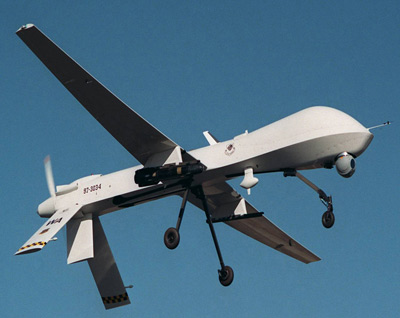
Arbitrary extrajudicial executions, carried out at the press of a button from CIA locations in California, with no transparency or accountability, are undoubtedly a violation of international law possibly constituting war crimes. And yet in 2009 alone, American predator drone attacks killed a reported 708 people in Pakistan —a clear violation of the norms of international sovereignty, especially given the fact that the Pakistani government has spoken out against them (at least in public).
According to the Brooking Institution more than 90 percent of those killed have been civilians. Noor Behram, who has been documenting the aftermath of drone strikes in Waziristan on-site for the last three years concurs that “for every 10 to 15 people killed, maybe they get one militant”.
US drone strikes in Pakistan claiming many civilian victims, says campaigner
July 18, 2011One man in Waziristan is documenting casualties – and says destruction has been radicalising locals
Saeed Shah in Islamabad and Peter Beaumont, Guardian, July 17, 2011

For the past three years, Noor Behram has hurried to the site of drone strikes in his native Waziristan. His purpose: to photograph and document the impact of missiles controlled by a joystick thousands of miles away, on US air force bases in Nevada and elsewhere. The drones are America’s only weapon for hunting al-Qaida and the Taliban in what is supposed to be the most dangerous place in the world.
Sometimes arriving on the scene just minutes after the explosion, he first has to put his camera aside and start digging through the debris to see if there are any survivors. It’s dangerous, unpleasant work. The drones frequently hit the same place again, a few minutes after the first strike, so looking for the injured is risky. . . .
Ending Gaza’s Isolation: Siege Must Be Broken
July 17, 2011|
By Steve Fake, uruknet.info, July 16, 2011 The Israeli closure imposed upon the Gaza Strip is approaching its fifth year, ‘choking off any real possibility of economic development,’ in the words of the International Committee of the Red Cross (ICRC). Contrary to attempts to whitewash the humanitarian situation in the Gaza Strip, the blockade has created rampant unemployment, poverty, and unparalleled degradation of the medical system. The stated rationale for the Israeli siege is to prevent the importation of goods that would provide support for the ruling Hamas party. The reality has prompted the ICRC, not known for overstatement, to call it “collective punishment” – a war crime under the Fourth Geneva Convention. The recent halting and partial opening of the Rafah Crossing, while welcome, only applies to the (still restricted) movement of people, rather than supplies, and will not ease the humanitarian situation. |
PAKISTAN: Trafficking of women is a fast growing crime
July 17, 2011Trafficking in people for prostitution and forced labour is one of the fastest growing areas of international criminal activity and the overwhelming majority of victims are women and children. More than 700,000 people are believed to be trafficked each year worldwide. Trafficking is now considered the third largest source of profit for organised crime, behind only drugs and weapons, generating billions of dollars annually.
Trafficking affects virtually every country around the world. The largest number of victims come from Asia, with over 225,000 victims each year from Southeast Asia and over 150,000 from South Asia. The former Soviet Union is now believed to be the largest new source of trafficking with over 100,000 trafficked each year from that region alone. An additional 75,000 or more are trafficked from Central and Eastern Europe. Over 100,000 come from Latin America and the Caribbean, and over 50,000 victims are from Africa. Most of the victims are sent to Asia, the Middle East, Western Europe and North America.
Crackdowns, Torture and Intimidation in Bahrain
July 17, 2011Stephen Lendman, MWC News, July 16, 2011
 Largely ignored by Washington, Western governments, and America’s media, the ruling Al Khalifa monarchy continues cracking down brutally against nonviolent protesters since civil resistance began last February.
On July 14, UK Telegraph writer Richard Spencer headlined, “Bahraini woman poet tells of torture while in custody,” saying:
Incarcerated after reciting a poem critical of government policies, “Ayat al-Qurmezi (age 20) became one of the symbols of the (ongoing) protests….After she was arrested….she was beaten, electro(shocked) and threatened with sexual assault while in custody.”
The fight to rescue the Arab spring
July 17, 2011Across the Arab world, protesters show fury at the resistance to change shown by interim authorities as well as old regimes
Ghaith Abdul-Ahad, Jack Shenker, Nour Ali, Martin Chulov and Ian Black
The Guardian, July 15, 2011

The historic revolutions that have rippled through the Arab world this year were in danger of eclipse on Friday night as protesters returned to the streets to profess their disgust at how the movement is being stymied by regimes old and new.
Six months after the Arab spring claimed its first dictator, the main squares of Cairo and Tunis were again alive with protest, teargas and fury at the resistance to change shown by interim authorities. In Syria activists said at least 19 people had been killed in the latest crackdown against protests that have convulsed the country for more than four months. At least seven people were killed in Yemen amid a political limbo that appears no closer to resolution. And in Jordan a heavy security presence policed pro- and anti-reform demonstrations which turned violent.
Where are the Palestinians?
July 16, 2011|
Mairav Zonszein, uruknet.info, July 15, 2011
|
|
Have international solidarity mobilizations drowned out Palestinian voices? EI, July 15, 2011 Over the last few weeks, media in this region was filled with images of people from all over the Western world holding up Palestinian flags and chanting “Free Palestine.” We’ve heard from the likes of Americans, like prize-winning author Alice Walker and former CIA official Ray McGovern (both passengers on the US boat to Gaza) about the importance of standing up for Palestinians in Gaza; we’ve heard about hunger strikes by Spanish and American citizens stuck in Greece after their boats were not allowed to sail; and we’ve seen videos of activists landing in Ben Gurion airport, declaring their intention to visit the occupied West Bank, being accosted by an Israeli mob and then detained and deported, all while chanting “Free Palestine.” |


