Archive for the ‘Human rights’ Category

Saudi Arabia: Free Political Prisoners

October 16, 2008

Many Criminals Granted Amnesty, but Activists Remain in Prison

Source: Human Rights Watch

New York, October 3, 2008) – The Saudi government should free unlawfully detained political activists, including Professor Matrook al-Faleh, one of Saudi Arabia’s leading advocates of reform, Human Rights Watch said today. Although Saudi prison officials said that they had amnestied 1,000 convicted criminals during Ramadan in September, dozens of political activists remain behind bars or are subject to arbitrary travel bans.

" Peaceful dissidents continue to be locked up for speaking out, while convicted criminals get amnesty. Apparently the government considers reform advocates a greater danger to their authority. "
Sarah Leah Whitson, Middle East director at Human Rights Watch
Contribute

Also Available in

arabic

“Peaceful dissidents continue to be locked up for speaking out, while convicted criminals get amnesty,” said Sarah Leah Whitson, Middle East director at Human Rights Watch. “Apparently the government considers reform advocates a greater danger to their authority.”

Saudi secret police arrested al-Faleh, a professor of political science at King Saud University in Riyadh, on May 19, 2008 at the university. The arrest came two days after he publicly criticized conditions in Buraida prison following a visit to two fellow human rights activists being held there.

For six days, the secret police denied holding him, and even after they acknowledged that he was in detention, officials allowed his family just one visit during the first 60 days.

Saudi officials have not charged al-Faleh with a crime, though the criminal procedure code adopted in 2002 requires the authorities to charge detained suspects and take their statement within 48 hours. Officials have not interrogated him during his five months in prison, and al-Faleh has not been allowed to see the evidence, if any exists, on which the Investigation and Public Prosecutions Bureau is holding him. He is being held in solitary confinement next to suspected militants at the secret police’s al-Ha’ir prison.

Al-Faleh, denied the right to see his lawyers, started a hunger strike. During that time, prison guards taunted him with food and also shined a bright light in his cell around the clock. He has since broken off his hunger strike. His lawyers, Ibrahim Mubaraki and Khalid al-Mutairi, still have not been allowed to visit him.

Officials said they released at least 1,000 prisoners during the holy month of Ramadan, Saudi newspapers Al-Riyadh, Okaz, and Al-Sharq al-Awsat reported between September 14 and 29. In November 2007, 1,500 suspected militants held in separate prisons run by the secret police were released after undergoing a reeducation program in prison. These detainees had never faced charge or trial.

In February 2007, Saudi secret police arrested nine dissidents in Jeddah, who remain in prison without charge or trial. In December 2007, the secret police detained for almost five months without charge or trial Fu’ad Farhan, a blogger who had written in support of the release of the Jeddah group. Mansur al-‘Awdha, a reform activist from Jawf, has been in al-Ha’ir prison without charge since December 2007.

The Universal Declaration of Human Rights spells out the rights to free expression and freedom from arbitrary arrest. Closely mirroring the International Convention on Civil and Political Rights (ICCPR), articles 14 and 32 of the Arab Charter of Human Rights, which the Saudi Shura Council (an appointed parliament) ratified in March 2008, guarantee freedom from arbitrary arrest and freedom of expression. Saudi Arabia has not signed the ICCPR.

The kingdom has no penal code, and there are only a few statutory offenses, such as drug smuggling and embezzlement. Saudi Arabia implemented a Criminal Procedure Code safeguarding due process rights in 2002; articles 34 and 116 oblige the authorities to charge detained suspects within 48 hours.

Poison stalks trial of murdered Putin critic

October 16, 2008

By Miriam Elder in Moscow | The Independent, Thursday, 16 October 2008

Protesters mark the anniversary of Anna Politkovskaya's murder

AFP/GETTY IMAGES

Protesters mark the anniversary of Anna Politkovskaya’s murder

Change font size: A | A | A

A lawyer representing the family of investigative journalist Anna Politkovskaya has apparently been targeted by poisoners as the trial of three men accused of involvement in her murder was about to begin.

French police confirmed the discovery of mercury pellets in the car of Karinna Moskalenko, who suffered headaches, dizziness and nausea after getting into the vehicle.

Ms Moskalenko was taken to hospital for tests in Strasbourg on Tuesday, which prevented her from flying to Moscow for the Politkovskaya trial. The preliminary hearing opened almost exactly two years after the crusading reporter died in a hail of bullets in the entrance to her apartment block.

The three men, including a former police officer, are on trial in connection with the murder of Ms Politkovskaya, who made her name challenging Vladimir Putin’s regime. Friends and colleagues believe her killers may never be found.

Lawyers for the defendants and Ms Politkovskaya’s family have called for an open trial to provide transparency in a case charged with politics and cloaked in conspiracy. “It was made clear to us all that the hearing will likely take place behind closed doors, as the case contains secret materials,” said defence lawyer Murat Musayev.

Ms Moskalenko is a leading defender of the Kremlin’s critics, including the jailed former oil tycoon and ex-chief executive of Yukos, Mikhail Khodorkovsky and the chess-champion-turned opposition politician Garry Kasparov. She said that she believed the poisoning was a warning. “When we got to the car, we realised something was not normal. My husband is a chemist and the substance looked like mercury. I’m worried for my family,” she said.

Another lawyer for Mr Khodorkovsky, Robert Amsterdam, said the timing was suspicious. “This type of event gives us all pause to consider what it takes now in Russia to defend human rights. There are ongoing attacks on lawyers and journalists.”

Kremlin critics have often been the targets of poisoners. Ms Politkovskaya herself fell ill after drinking a cup of tea while on her way to cover the aftermath of the Beslan school siege in which more than 300 people died, while the former KGB agent Alexander Litvinenko died in London from radiation poisoning. Scotland Yard wants to extradite his fellow ex-KGB operative, Andrei Lugovoi, to be tried for his murder. Another case of alleged mercury poisoning was reported two years ago, involving the wife of an ex-director of Yukos, Alexei Golubovich. Mr Amsterdam said: “What matters is not if it’s related to Yukos or Politkovskaya but that it’s another human rights defender that’s in this situation.”

Sergei Sokolov, the deputy editor of Ms Politkovskaya’s newspaper, Novaya Gazeta, said that Ms Moskalenko “takes part in a lot of prominent cases. It’s not necessarily directly linked to this case.” Ms Moskalenko helps Russians press claims against the government at the European Court of Human Rights in Strasbourg.

The trial judge reportedly refused to postpone yesterday’s preliminary hearing, which involved two ethnic Chechen brothers, Dzhabrail and Ibragim Makhmudov, and Sergei Khadzhikurbanov, a former police officer. All stand accused of aiding the killer, who remains on the run. Investigators suspect him to be Rustam Makhmudov, although investigators d do not know who ordered the murder.

Ms Politkovskaya won countless enemies through her articles and books chronicling human rights abuses and the fall of democracy in modern Russia, particularly through her scrutiny of Moscow’s brutal wars in Chechnya.

She was killed on 7 October 2006 – the then President Vladimir Putin’s birthday. He denied any Kremlin link to the killing but failed for days to comment on the death, before dismissing it as “insignificant”. Last week, hundreds commemorated the second anniversary of Ms Politkovskaya’s death. “It’s sad we don’t know, two years after the murder, who did it, who ordered it,” Vladimir Milov, a former deputy energy minister turned Putin critic, said at the rally.

The military court is due to meet again on 17 November to decide if the trial will be open to the public and the media, and to assemble a jury.
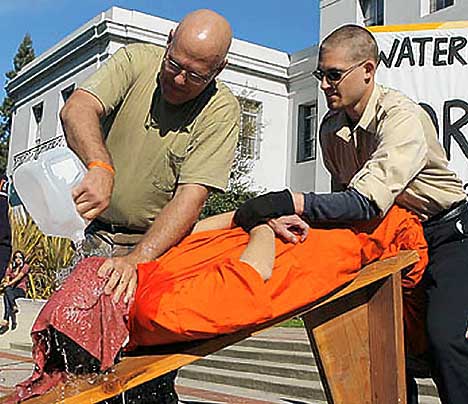
Waterboarding Got White House Nod

October 15, 2008

CIA Tactics Endorsed In Secret Memos

Joby Warrick
Washington Post Staff Writer
Wednesday, October 15, 2008; Page A01

The Bush administration issued a pair of secret memos to the CIA in 2003 and 2004 that explicitly endorsed the agency’s use of interrogation techniques such as waterboarding against al-Qaeda suspects — documents prompted by worries among intelligence officials about a possible backlash if details of the program became public.

The classified memos, which have not been previously disclosed, were requested by then-CIA Director George J. Tenet more than a year after the start of the secret interrogations, according to four administration and intelligence officials familiar with the documents. Although Justice Department lawyers, beginning in 2002, had signed off on the agency’s interrogation methods, senior CIA officials were troubled that White House policymakers had never endorsed the program in writing.

The memos were the first — and, for years, the only — tangible expressions of the administration’s consent for the CIA’s use of harsh measures to extract information from captured al-Qaeda leaders, the sources said. As early as the spring of 2002, several White House officials, including then-national security adviser Condoleezza Rice and Vice President Cheney, were given individual briefings by Tenet and his deputies, the officials said. Rice, in a statement to congressional investigators last month, confirmed the briefings and acknowledged that the CIA director had pressed the White House for “policy approval.”

The repeated requests for a paper trail reflected growing worries within the CIA that the administration might later distance itself from key decisions about the handling of captured al-Qaeda leaders, former intelligence officials said. The concerns grew more pronounced after the revelations of mistreatment of detainees at the Abu Ghraib prison in Iraq, and further still as tensions grew between the administration and its intelligence advisers over the conduct of the Iraq war.

Continued . . .

On 42 days, their lordships were glorious

October 15, 2008

The rejection of Labour’s proposal for detention without charge was a victory for human rights and common sense in parliament


Politics actually works. That’s the message from Liberty Central, in the aftermath of the long hard slog that was our Charge or Release campaign and the government’s sensible decision to drop 42-day pre-charge detention from its counter-terror bill. Our thanks go to Guardian readers and writers but also to those of almost every other daily newspaper in this country. The coalition of those willing to stand for the right of suspects to hear the charges against them before six weeks (or over 1,000 hours) of incarceration spanned democratic politics, civil society, trade union and religious groups, the literary community and human rights’ campaigners around the globe.

Ultimately however, this was a victory for human rights and common sense in the parliament chamber. From Diane Abbott and Frank Dobson on the left to David Davis and Dominic Grieve on the right, democratic politicians came together to say “enough is enough”. Let the misnamed, misguided “war on terror” that replaced law and ethics with permanent exceptionalism be over. Let a new anti-terror effort begin, based on the values that bind our society together and distinguish it from those where tyranny and terrorism are rife. Make no mistake: their lordships were glorious – the cross-bench independents in particular. The home secretary’s statement last night seemed to revive the discredited yah-boo of which party is really “serious” about public protection. Lord West knew better than to try such nonsense in the Upper House where any suggestion that the likes of Lady Manningham Buller or Lord Dear might be soft on terror would be met with the derision it deserves.

To those who feel ambivalent about “unelected peers” trumping the “will of the Commons”, let me offer two thoughts.

First, all democracies survive because of the healthy tension between election and independence. Think of a piece of machinery that requires both fixed and moving parts to function. In other constitutions the senior judiciary sitting in a supreme court have the final word on matters of fundamental rights and powers to strike down unconstitutional legislation. Not so here, where even the much maligned Human Rights Act preserves the doctrine of parliamentary sovereignty so that the ultimate sanction of our highest courts is only a polite request that parliament thinks again.

Instead our arrangements bolster the independent limbs of the constitution by way of independent legislators in a reviewing chamber that can ultimately only delay abhorrent laws, not defeat them.

Which brings me to my second point and the fiction that the government was defeated by the Lords alone. Yes, the Lords defeated the measure – perfectly predictable if not on such grand scale. But what was to stop a government so dug in on this policy from going back to the Commons for some “ping pong”, with the eventual threat of the Parliament Act? After all, Mr Blair got his pernicious control orders through by such brinkmanship. The truth is that notwithstanding the nine-vote triumph last summer, the argument was lost in the Commons as well. A number of Labour MPs who loyally bailed out the government last time would not have done so again and made this clear.

The dramatic events of recent weeks have reminded the world that like lunch there is no such thing as an absolutely free market. Without a fair bit of law, ethics and regulation, the market will literally eat itself at devastating cost. Democracy is no different. It isn’t a game in which the executive takes all at the expense of free speech, fair trials and other core values which we abandon at our peril. In the oldest unbroken democracy on Earth, parliamentarians finally remembered this and so politics worked.

Indian democracy fallen flat in Kashmir: HR Group

October 14, 2008

Source:  Kashmir Watch

Srinagar, Oct 13 (PBI): Stating that New Delhi’s claim of being the largest democracy in the world having “fallen flat” in Kashmir, a human rights group comprising  educationists came up with a list of demands on Monday which  included stopping of “military might” against peaceful protesters in Kashmir.

Revealing details to media persons, of their nine-day long ‘fact-findings’ visit to the valley starting from October 4, a member of the team, Syed Abdul Rehman Geelani, lecturer at Delhi university, who was acquitted in parliament attack case, said that the claims of India to be the largest democracy in the world have ended in fiasco in view of the present scenario in Kashmir.

“The most disturbing sight during the whole fact finding mission was the over-bearing presence of the army, paramilitary, police and the SOG personnel. This has become part and parcel of the everyday life of the people of Jammu and Kashmir. The blanket powers given to the army, paramilitary, SOG and police under the garb of fighting militancy has only increased the cruelty of the state forces.”

Geelani, flanked by two other members, Prof. Amit Bhattacharyya and Rona Wilson V. lbrahim told reporters at a hotel here.  “The display of this power is visible in the way, the forces have been dealing with the recent rallies in the valley.”

“The accounts of the doctors of Baramulla District Hospital as well as the testimonies from the injured confirm that the peaceful demonstrators were fired in the abdomen, chest or head. This shows a clear intention of shooting to kill.”

The team expressed concern over ‘implication in false cases’ of the people who participated in the rallies.

“False cases have been framed against many people who have participated in peaceful protests. Most of them have been booked under PSA. The draconian laws such as the PSA, DM, AFSPA have been used in the most arbitrary manner, so much so that even when someone who has been charged under PSA gets that quashed in the court, soon after he or she is charged afresh under the same act. Even those acquitted of PSA charges will have to endure an unending wait for the security forces to release them,” he said.

The team comprised Prof Amit Bhattacharyya (Jadavpur University, Kolkata), S. A. R. Geelani, (Delhi University), Prof. A. Marx (Chennai), Advocate Sugumaran (Pondicherry), Prof. Pranab Nayak (Kolkata), V. M. Ibrahim (Executive Editor, Madhyamam, Kerala), Rona Wilson (Research Scholar, JNU), Raja Sarkhel (Kolkata), Sitangshu Chakraborty (Film maker, Kolkata), Maitreyee Nayak (Student, Rabindra Bharati University,Kolkata) visited various areas of the valley to ascertain the facts.

Visiting medical stores in the valley, he said, proved beyond doubt the impact of the economic blockade and the total failure of the government to provide relief to the people.

“The Government of India’s effort to deny the economic blockade only brought to the fore the silent sanction of the establishment for such an inhuman. Life saving drugs, baby food and other drugs were in terrible shortage. Despite the letter written by the Divisional Commissioner, Multinational Pharmaceutical Companies such like Cipla, Cadilla, Glaxo, FDC, Emcure, Sun Pharmaceuticals have stopped their operations.”

The group called for repealing of all the draconian laws including ULPA, AFSPA, DAA and PSA. “Ensure life saving drugs, baby food and other medicines.  Stop the use of military might on the peaceful demonstrations, Withdraw troops, Stop all efforts to foment communal hatred against the people, release all political prisoners unconditionally, initiate steps to address issue of right to self determination per the norms set by the UN and other International bodies” the group demanded.

India PM warns on religious hatred

October 14, 2008
Al Jazeera, Oct 14, 2008

Singh lamented “the assault on our composite culture” [Reuters]

India’s prime minister has said that increased religious and ethnic tensions are threatening the country’s social stability and blamed those “encouraging” hatred and violence.

“There are clashes between Hindus, Christians, Muslims and tribal groups. An atmosphere of hatred and violence is being artificially generated. There are forces deliberately encouraging such tendencies,” Manmohan Singh said on Monday.

Against a backdrop of religious unrest in eastern Orissa and tribal clashes in southern Karnataka, Singh said the violence threatened India’s proud “inheritance” of a multi-ethnic, multi-religious and multi-caste society.

“Perhaps the most disturbing and dangerous aspect today is the assault on our composite culture … we see fault-lines developing between, and among, communities,” he told a conference of chief state ministers in the capital, New Delhi.

In August, at least 35 people were killed in Orissa after the death of a hardline Hindu priest and four of his followers sparked violence between Hindus and Christians.

Indian Maoists claimed responsibility for killing Swami Laxmananda Saraswati, saying he was forcing tribal people to reconvert to Hinduism.

They also claimed that the state government had “made it look like Christian groups [were] responsible for the attack”.

But Hindu hardline groups rejected the Maoist claim, saying Saraswati opposed conversions to Christianity and his elimination could only benefit Christian missionaries active in the area.

In India’s northeastern Assam state, 50 people were killed in clashes between Muslim migrants and tribal groups earlier this month.

Curfew imposed

Violence between different religious groups have flared in several states [EPA]

The prime minister’s warning came as police imposed a curfew in the southern Indian state of Andhra Pradesh two days after the latest clash between Muslims and Hindus which left three people dead.The country has also been rocked by a series of bomb blasts targeting major cities this year which killed more than 100 people killed.

A home-grown Islamic group, the Indian Mujahideen, claimed responsibility for the attacks in Jaipur, Bangalore, Ahmedabad and New Delhi, saying they were in revenge for attacks on Muslims across India.

Singh said in his speech that “there can be no compromise with terrorism, and terrorists have to be dealt with firmly”.

“We need to meet today’s mindless violence with the requisite amount of force but must also ensure that this is tempered by reason and justice which is the normal order of governance,” he added.

India, which is majority Hindu with a large Muslim minority, is officially secular.

Brown abandons 42-day detention after Lords defeat

October 14, 2008

Gordon Brown tonight abandoned his parliamentary battle to allow police to detain terror suspects without charge for up to 42 days, after the Lords overwhelmingly rejected the proposal by 191 votes. In an emergency statement to MPs tonight, Jacqui Smith, the home secretary, said that the counter-terrorism bill would continue its journey through parliament without the 42 day measure.

But in a face saving gesture, the government will publish a bill containing the 42 day plan; this bill will be held in reserve to be introduced should there be a terrorist emergency. Ministers said they had decided to follow this course because the introduction of the counter-terrorism bill would have been delayed by a year if the government had embarked on a lengthy battle with the Lords.

“I do not believe, as some Hon Members clearly do, that it is enough to simply cross our fingers and hope for the best,” Smith told parliament. “Mr Speaker, that is not good enough. Because when it comes to national security, there are certain risks I’m not prepared to take.

Smith’s announcement came after the former lord chancellor, Lord Falconer, dismissed the government’s arguments as “fanciful”. His comments came in a lengthy debate which ended in peers rejecting the 42 day plan by 309 to 118.

Government sources said Brown’s hand was forced because whips in the Commons told Downing Street that they would struggle to muster a majority in favour of the proposal. The 42 day plan was only passed by MPs in June by nine votes after the prime minister won the support of the nine Democratic Unionist MPs.

If ministers had insisted on keeping the 42 day plan in the counter terrorism bill, Brown would have to have held a series of votes in the commons to overturn the Lords’ rejection. The overwhelming opposition in the lords would have resulted in a game of parliamentary “ping pong” in which the bill would have been passed from chamber to chamber. Brown would then have had to use the parliament act to force the bill through next year.

The announcement by the government came after Falconer told peers how he had changed his mind after supporting Tony Blair’s plan to detain terror suspects without charge for 90 days in 2005.

He had done so because police could now detain terror suspects by using the so-called “threshold test”, an option under which they can charge a suspect on a lower threshold if they have a reasonable suspicion that evidence will be compiled in a reasonable time.

“It has changed in practice the basis upon which it operates,” Falconer said. “The idea that extending [the detention period] from 28 days to 42 days is going to make a difference is utterly fanciful.”

Lord West, the home office minister, warned peers of the dangers of voting against the plan. “If we get it wrong we could all live to regret it. When the need for more than 28 days arrives — and it will — we can either have a well considered and debated back-pocket measure in place ready to make available to prosecutors, or we will be forced to release terrorists on to the streets unless some hurried legislation is passed. And we all know hurried legislation in a period of emergency is bad legislation. Whoever is in power will find it a very uncomfortable moment.”

Shami Chakrabarti, director of Liberty, welcomed the government’s climb- down. “Liberty has been overwhelmed by public and parliamentary support for our campaign against the extension. Rest assured that if any government tries again we will be ready,” she said.

Unchecked Arms Trade Fuelling Conflict, Poverty

October 13, 2008

UNITED NATIONS – With 1.3 trillion dollars spent every year on the world’s militaries, countries enmeshed in conflict are often flooded by weapons which are then turned against helpless civilian populations, say human rights organisations pushing for an international treaty to closely regulate arms sales.

[With 1.3 trillion dollars spent every year on the world's militaries, countries enmeshed in conflict are often flooded by weapons which are then turned against helpless civilian populations, say human rights organisations pushing for an international treaty to closely regulate arms sales.]With 1.3 trillion dollars spent every year on the world’s militaries, countries enmeshed in conflict are often flooded by weapons which are then turned against helpless civilian populations, say human rights organisations pushing for an international treaty to closely regulate arms sales.

“If a country is likely to be involved in warfare, then it is unjustifiable to sell arms. There must be regulation or control of arms — especially when the countries that are buying them are involved in a conflict,” Valentino Deng told IPS in an interview.Deng’s experiences formed the basis of Dave Eggers’s recent novel “What is the What”, which fictionalises the story of his life as a refugee of the Sudanese civil war. When Deng’s village was attacked and burnt down, he was separated from his family and fled on foot with a group of other young boys. On the journey to a refugee camp in Kenya, they encountered great danger and terrible hardships.

“I saw people being killed by aerial bombings and I saw villages burnt to ashes,” he told IPS. “I witnessed one of the incidents when a mother was killed and her young child was trying to breastfeed on the dead mother. At that time, I was wondering about one thing: who was supplying all these arms for war and conflict?”

The U.N. peacekeeping force’s former commander in the Democratic Republic of Congo, General Patrick Cammaert, saw firsthand the futility of disarmament without controlling the supply of arms at the same time. “You had the feeling,” he said last year, “that you were mopping up the floor when the tap was open. One moment you disarm a group, and then a week later the same group has fresh arms and ammunition.”

A new report by Oxfam International reveals how irresponsible arms transfers undermine many developing countries’ chances of achieveing their development goals. Either these transfers are draining the governments’ resources or fuelling armed conflict, or both.

The international arms trade is also considered to be one of the three most corrupt businesses in the world, according to Transparency International, the leading global organisation monitoring corruption.

“What is clear is that if you want to achieve the development goals, with poverty reduction, improved health care and education, you need to control arms transfers, ” said Katherine Nightingale, author of the Oxfam report.

At least 22 of the 34 countries least likely to achieve the U.N.’s Millennium Development Goals are in the midst of, or emerging from conflict, according to U.N. statistics. Oxfam notes that between 1990 and 2005, 23 African countries together lost an estimated 284 billion dollars as a result of armed conflicts, fuelled by transfers of ammunition and arms — 95 percent of which came from outside Africa.

An investigative report by Amnesty International last month found that clandestine gun suppliers, funded by the U.S. and Iraqi governments, have flooded Iraq with a million weapons since 2003.

Because of faulty or non-existent government tracking systems, many of those guns have gone missing, and some have turned up in the hands of insurgents, Amnesty said.

According to the Oxfam report, a comprehensive and effective international arms trade treaty must be agreed to ensure more responsibility and transparency. Existing international initiatives like the Geneva Declaration to address armed violence are simply insufficient, it says.

“In parts of Africa there are strong regional agreements. But this is not enough. Arms trade is a global industry. We want a global arms trade treaty to ensure that states are hold accountable for the processes of procuring arms. International regulations are far behind in this aspect, ” Nightingale told IPS.

Worldwide support for a global Arms Trade Treaty (ATT) was reflected when 153 states voted in favour during the United Nations General Assembly in December 2006. And later this month, U.N. member states will meet again to consider further steps to move towards negotiations on an ATT.

In the run-up to these discussions, a few states, including China, India, Egypt, Pakistan, Russia and the United States, have been attempting to block, delay and water down proposals, advocates say. This could kill the treaty before real negotiations even begin and allow continued unchecked trade in arms, human rights organisations fear.

Amnesty International, Oxfam, and others are now calling for the General Assembly to start a negotiating process during 2009 so that the international community can benefit from a legally-binding and universal Arms Trade Treaty by the end of 2010.

© 2008 Inter Press Service

Amnesty accuses Spain of allowing CIA flights to Guantanamo

October 12, 2008

RINF.COM, Wednesday, October 8th, 2008

Madrid – The human rights group Amnesty International (AI) on Wednesday accused the Spanish government of not having tried to prevent US flights transporting terrorist suspects to illegal detention centres across Spanish airspace.

At least 90 flights linked to the Central Intelligence Agency (CIA) made stopovers at 15 Spanish airports, mainly on the Canary Islands, between 2002 and 2007, the Spanish section of AI said in a report.

About 200 people were taken to the US prison camp in Guantanamo, Cuba, on flights that took off from US military bases in Spain or crossed the Spanish airspace, AI charged.

The group urged the government to cooperate with an ongoing judicial investigation into the flights.

Other European countries allowed similar flights, AI conceded.

Uzbekistan: Journalist Sentenced to 10 Years

October 11, 2008

With Repression Continuing, EU Should Not Drop Sanctions

Human Rights Watch

(Moscow, October 11, 2008) – Uzbek authorities should immediately and unconditionally release an independent journalist sentenced on October 10 on politically motivated charges, Human Rights Watch said today. Solijon Abdurakhmanov, a journalist known for his critical reporting, was sentenced to 10 years in prison for selling drugs, an offense he did not commit.

" Abdurakhmanov’s conviction is an affront to human rights and free speech in Uzbekistan. He often criticized local authorities, including law enforcement. It is clear that he is being punished for his work. Once again, the Uzbek government is showing that it will not tolerate dissent. "
Igor Vorontsov, Uzbekistan researcher for Human Rights Watch
Contribute

Related Material

Uzbekistan: On Media Freedom, Talk Is Cheap
Written Statement, October 6, 2008

Uzbekistan: Free Human Rights Activist
Press Release, September 16, 2008

Uzbekistan: Release Independent Journalist
Press Release, September 12, 2008

More of Human Rights Watch’s work on Uzbekistn
Press Release

“Abdurakhmanov’s conviction is an affront to human rights and free speech in Uzbekistan,” said Igor Vorontsov, Uzbekistan researcher for Human Rights Watch. “He often criticized local authorities, including law enforcement. It is clear that he is being punished for his work. Once again, the Uzbek government is showing that it will not tolerate dissent.”

On October 13 and 14, the European Union is slated to review Uzbekistan’s human rights record to determine whether to continue the sanctions regime adopted in the aftermath of the 2005 Andijan massacre, when government forces shot hundreds of protesters, most of them unarmed (http://hrw.org/reports/2008/uzbekistan0508/ ). Among the assessment criteria established by the European Union for reviewing the sanctions are for the Uzbek government to stop the harassment of civil society and to release imprisoned rights defenders and dissidents.

Police in Nukus, 1,100 kilometers west of Tashkent, arrested Abdurakhmanov on June 7 after claiming that they had found 114.18 g of marijuana and 5.89 g of opium on the underside of his car. Abdurakhmanov denies knowing about or having anything to do with the drugs and his brother, Bakhrom, a lawyer who represented him at this trial, believes that the police planted the drugs. A few days before his arrest, Abdurakhmanov left his car in a local repair shop. He told his brother that the police monitored him closely after he picked up his car and until his arrest. The investigators failed to carry out basic investigative steps, such as checking the drugs for fingerprints despite repeated requests by Abdurakhmanov and his lawyer.

Abdurakhmanov is an outspoken journalist who has written on issues that are sensitive in Uzbekistan, such as social and economic justice, human rights, corruption, and the legal status of Karakalpakstan, an autonomous republic of which Nukus is the capital. He worked closely with UzNews, an independent online news agency, and also did freelance work for Radio Free Europe/Radio Liberty, Voice of America, and the Institute for War and Peace Reporting.

Abdurakhmanov’s sentence comes just one week after a forum on the “Liberalization of the Mass Media,” co-sponsored by the EU and the Uzbek government, concluded in Tashkent. A group of independent organizations from EU member states that participated in the forum had warned that it should not be considered evidence of any improvement in Uzbekistan’s policy of suppressing free speech.

“Abdurakhmanov’s sentence is yet another blatant failure to meet the EU sanctions criteria,” said Vorontsov. “Any easing of the sanctions in the face if this travesty would be wholly unconscionable. It would send a signal that the EU stands by while Uzbekistan locks up its critics.”

Human Rights Watch urged EU governments and the United States to raise the case of Abdurakhmanov urgently with the Uzbek government and to demand his immediate release.

In the latest episode of a longstanding effort to obstruct Human Rights Watch’s work in Uzbekistan, the Uzbek government first denied work accreditation to Human Rights Watch’s researcher in Tashkent, then proceeded to outright ban him from entering the country. As a result, Human Rights Watch has been unable to maintain its presence in Uzbekistan since mid-July 2008.

In a September 29, 2008 letter to EU foreign ministers, Human Rights Watch urged the EU to uphold the sanctions against Uzbekistan and make clear they will not be lifted until all the assessment criteria have been met.