Archive for September, 2023

𝐅𝐨𝐫𝐦𝐞𝐫 𝐒𝐒 𝐬𝐨𝐥𝐝𝐢𝐞𝐫 𝐘𝐚𝐫𝐨𝐬𝐥𝐚𝐯 𝐇𝐮𝐧𝐤𝐚 𝐰𝐚𝐬 𝐠𝐢𝐯𝐞𝐧 𝐬𝐡𝐞𝐥𝐭𝐞𝐫 𝐢𝐧 𝐁𝐫𝐢𝐭𝐚𝐢𝐧 𝐚𝐟𝐭𝐞𝐫 𝐖𝐖𝐈𝐈

September 29, 2023

Andrew Murray, Morning Star, Sept 28, 2023

FORMER SS soldier Yaroslav Hunka, whose standing ovation in the Canadian parliament this week scandalised the world, was given refuge in Britain after World War II, the Morning Star can reveal.

Despite having served in the Galician division of the Waffen-SS, a unit associated with massacres of Jews, Poles and other civilians during the war, Mr Hunka was allowed to settle in Britain.

He emigrated to Canada in 1954 and was presented to that country’s House of Commons as a hero this week, receiving an enthusiastic reception from, among others, visiting Ukrainian President Volodomyr Zelensky and Canadian Prime Minister Justin Trudeau.

Commons Speaker Anthony Rota was forced to resign amid a firestorm of global protest once Mr Hunka’s Nazi-aligned past had been revealed. The Polish government has pledged to seek his extradition.

During his time in this country, Mr Hunka worked as an aircraft fitter, lived in Northamptonshire and was an active member of the Association of Ukrainians in Great Britain (AUGB).

He was one of many Ukrainian Waffen-SS veterans allowed to live in Britain after the war. Whitehall decided to regard them as “stateless,” meaning that they could not be returned to face justice in the countries in which their atrocities had been committed.

There were so many anti-Soviet Ukrainian ex-soldiers living in Britain that a separate organisation, the Association of Ukrainian Former Combatants in Great Britain (AUFC), was formed in London on July 30 1949.

At its peak, the AUFC had 5,800 members, of which an estimated 84 per cent had served in the Waffen-SS Galicia division. The AUFC no longer appears to function.

Responding to the Star’s investigation, a spokeswoman for the AUGB stressed that Mr Hunka and those like him “were allowed by the British government to come to Britain. He was allowed in legally.

“People use the word ‘nazi’,” she added, asking: “What is behind that? At that time, people in western Ukraine were against the communist regime.”

When asked about the Galicia division’s record of slaughter of civilians, the spokeswoman responded: “It doesn’t mean that they all did that.”

Other Ukrainian Nazi fighters may still be at large in Britain.

Last year, the Manchester Evening News interviewed a 98-year-old Ukrainian named Iwan Kluka, who boasted of having “fought against Stalin’s Red Army.”

The newspaper deleted the article online after outraged readers pointed out that Mr Kluka had clearly fought alongside the Nazi invaders from Germany.

𝐈𝐬𝐥𝐚𝐦𝐢𝐬𝐭𝐬 𝐚𝐧𝐝 𝐭𝐡𝐞𝐢𝐫 𝐯𝐞𝐫𝐬𝐢𝐨𝐧𝐬 𝐨𝐟 𝐈𝐬𝐥𝐚𝐦

September 26, 2023

Many people equate Islamist with Islamic and Islam with Muslims. It happens everywhere. But these words need to be differentiated.

— Nasir Khan

For the last three decades, the term ‘Islamist’ has frequently been used in political discourse about political Islam. It stands for those misguided and indoctrinated ignorant people whose aim is to impose their fanatical versions of Islam on others.

But we should keep in mind that Islam as a world religion is followed by people with different world outlooks who are divided into numerous sects. Furthermore, these followers have varying interpretations of the role of political power, about the leaders of the Islamic community (Ummah) and the rights and obligations of the rulers and the ruled, etc. etc. These views of Islamic law, Sharia, cover civil and criminal law that again are subject to four main schools of jurisprudence within Sunni Islam while the Shias have their own jurisprudence. There is little chance of any unity of ideas among them.

What is most alarming about Islamists’ general worldview is their negation of the universal dimension and inherent tolerance of this world religion. Instead, they put forward a narrow and anti-social version that goes against all principles of democracy, respect for religious minorities and inculcates bigotry against the followers of other faiths. The whole process can be termed as creating mental and religious ghettos, absolutely closed to rational thought but hell-bent on myopic divisions and conflicts. In such a suffocating universe, there is no room for mutual accommodation, or acceptance of secularism in a multi-religious and multi-cultural world in which we live in Europe, some parts of America or Australia.

Islamists’ misuse of Islam is a dangerous phenomenon for democracy and common social and political values of the present age.

𝐀𝐛𝐨𝐮𝐭 𝐆𝐚𝐮𝐭𝐚𝐦𝐚 𝐁𝐮𝐝𝐝𝐡𝐚

September 25, 2023

— Nasir Khan

The original teachings of the Buddha (The Enlightened One) had only one aim: To end human suffering. His thought expressed in the “Four Noble Truths” in his first sermon at Benares dealt with the problem. He did not ask people to search for any solution to their worldly problems in any outside source or any heavenly power but only in themselves.

There were too many gods in a society where he was born and lived. But he showed no interest to dabble into the mysteries of such supernatural beings. For him the cause of human suffering was in human desires, temptations and greed. Was a solution possible? Yes. There was a solution. That was the message of the Buddha to humanity.

Incidentally, what the Buddha had taught and how the coming generations of his followers transformed him and his teachings are two different things. The Enlightened One was made into a universal god, the Universal Buddha, towards whom his followers directed their prayers. In this way, a unique thinker in human history, a humanist par excellence, who had nothing to do with any supernatural beings at all, was himself made a god!

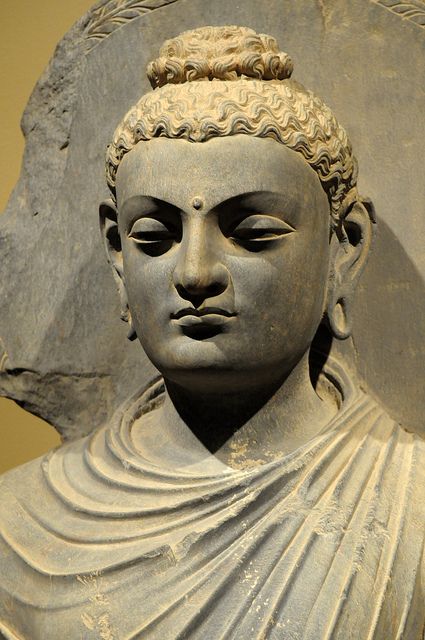
A statue of Buddha from Gandhara, now in Pakistan

NATO Chief Says Weakening Russia Will Help US Focus on Challenging China

September 22, 2023

By Tom O’Connor, Newsweek, Sep. 21, 2023

The head of NATO asserted today that weakening Russia in Ukraine could allow the United States to intensify its efforts in countering China.

Speaking at an event hosted by the Council on Foreign Relations on the sidelines of the United Nations General Assembly in New York, NATO Secretary-General Jens Stoltenberg said Thursday that the primary goal of his visit “is to mobilize support for Ukraine.” A victory for Kyiv in resisting the war launched by Moscow more than a year and a half ago is “in our security interest,” Stoltenberg said.

The consequences of such a loss, he warned, would be felt beyond Europe and extend into Asia as well, where Chinese President Xi Jinping has vowed to retake the disputed island of Taiwan.

“It will be a tragedy for Ukraine if President [Vladimir] Putin wins, but it will also be extremely dangerous for us,” Stoltenberg said. “It will make the world more dangerous and more vulnerable, because then the message to President Putin and also to President Xi is that when they use military force, when they violate the international order, when they invade another country, they get what they want.”

“So, if the United States is concerned about China and wants to pivot towards Asia, then you have to ensure that Putin doesn’t win in in Ukraine,” he added, “because if Ukraine wins, then you will have the second biggest army in Europe, the Ukrainian army, battle-hardened, on our side, and we’ll have a weakened Russian army, and we have also now Europe really stepping up for defense spending.”

Such a scenario, Stoltenberg said, “will make it easier” for the U.S. “to focus also on China,” as Washington can be “less concerned about the situation in Europe.”

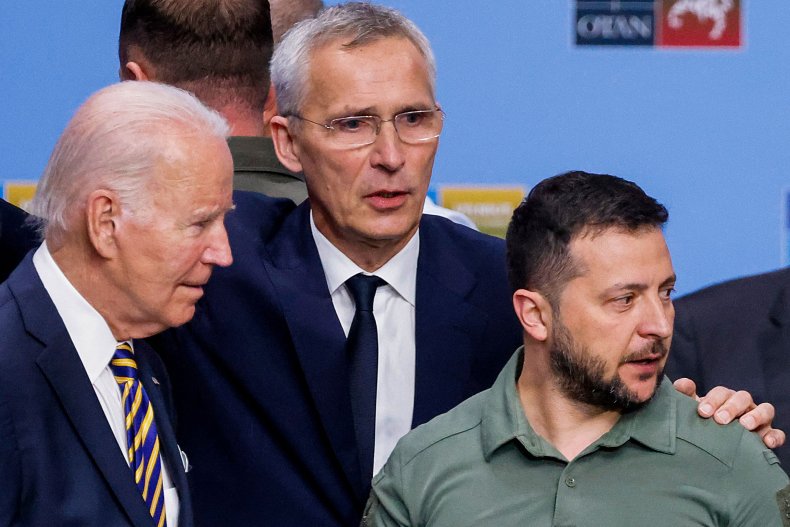
Biden, Stoltenberg, and, Zelensky, at, NATO, summit
(From left) U.S. President Joe Biden, NATO Secretary-General Jens Stoltenberg and Ukrainian President Volodymyr Zelensky talk ahead of a working session on Ukraine during the NATO summit in Vilnius, Lithuania on July 12. LUDOVIC MARIN/AFP/Getty Images

While NATO is a transatlantic alliance, the 31-member bloc has increasingly expanded its presence in the Asia-Pacific region, engaging with partners such as Australia, Japan and New Zealand. Under Stoltenberg, who will have presided over the coalition for at least a decade after his term was extended through next October, NATO has also enhanced its focus on China, whose diplomatic, economic and military power has accelerated rapidly throughout Xi’s own past decade in power.

Stoltenberg made numerous mentions of China throughout his comments at the event Wednesday, including references to Beijing’s robust partnership with Moscow. He dismissed the notion that security issues in Europe and Asia could be completely separated as “wrong, for many reasons, not least because we see Beijing and Moscow are coming more and more closely together.”

The NATO chief noted the “no-limits” partnership declared by Putin and Xi just two weeks before Russia invaded Ukraine and the increasingly frequent joint aerial and naval patrols conducted by Chinese and Russian forces in the Asia-Pacific. He also took aim at China’s position on the war in Ukraine, on which Beijing has remained officially neutral but has at times echoed Moscow’s criticisms of NATO’s post-Cold War expansion into Eastern Europe, viewed by the Kremlin as justification for the conflict.

“The reality is that China is supporting the Russian war effort by propping up the economy and also by spreading the Russian false narrative of what this war is about, this war of aggression against Ukraine,” Stoltenberg said. “So, what happens in Europe, that matters for Asia, what happens in Asia matters for Europe.”

“And that’s one reason why countries like South Korea and Japan are extremely concerned about the war in Ukraine,” he added, “because they know that if President Putin wins, it lowers the threshold for President Xi to use force.”

Newsweek has reached out to Stoltenberg via the Council on Foreign Relations for comment.

Contacted for comment, Chinese Embassy to the United Nations spokesperson Liu Pengyu told Newsweek that Stoltenberg’s remarks demonstrate that “more than 30 years after the Cold War ended” NATO’s “legacy remains trapped in a zero-sum mindset and views the world as opposing blocs.”

“Despite the global community’s call for peace, development, and common progress, NATO continues to act against the prevailing trend and seek to turn back the wheel of history,” he added.

Liu argued that, rather than the potential aggressor described by the NATO secretary-general, “China is a force for world peace, a contributor to global development, a defender of the international order, and a source of public good.” Liu said that “China is committed to the international system with the UN at its core, the international order underpinned by international law and the basic norms governing international relations that stem from the purposes and principles of the UN Charter.”

And “on the question of Ukraine,” Liu argued, “we have worked actively to encourage all parties to seek a political solution.”

“It is time that NATO should leave behind the outdated Cold War and zero-sum mentality. Instead of placing single-minded belief in military force for absolute security, NATO needs to reflect on its role in the Ukraine crisis and what responsibilities it should take,” Liu said. “Instead of underscoring ideological differences and bloc confrontation, NATO needs to act truly constructively for world peace and stability.”

Earlier this month, China’s ambassador to Canada, Cong Peiwu, criticized NATO’s decision to include language critical of China in its latest communique as well as the alliance’s overtures in the Asia-Pacific region.

“NATO not only attacked and defamed China in their Communiqué, but the Alliance members also constantly reached beyond their geographical scope as laid down in its treaty to accelerate NATO’s eastward expansion into the Asia-Pacific region,” Cong wrote in a September 11 op-ed published in Canada’s Esprit de Corps magazine. “After stirring up turmoil in Europe, NATO is now attempting to disrupt the Asia-Pacific region and the entire globe.”

Cong added that “at the behest of the U.S., NATO is attempting to start a New Cold War in the Asia-Pacific region.”

The Real History of the War in Ukraine

September 20, 2023

by Jeffrey D. Sachs. Antiwar. com, posted on Sep 20, 2023

The American people urgently need to know the true history of the war in Ukraine and its current prospects. Unfortunately, the mainstream media – The New York Times, Wall Street Journal, Washington Post, MSNBC, and CNN – have become mere mouthpieces of the government, repeating US President Joe Biden’s lies and hiding history from the public.

Biden is again denigrating Russian President Vladimir Putin, this time accusing Putin of a “craven lust for land and power,” after declaring last year that “For God’s sake, that man [Putin] cannot stay in power.”  Yet Biden is the one who is trapping Ukraine in an open-ended war by continuing to push NATO enlargement to Ukraine.  He is afraid to tell the truth to the American and Ukrainian people, rejecting diplomacy, and opting instead for perpetual war.

Expanding NATO to Ukraine, which Biden has long promoted, is a U.S. gambit that has failed.  The neocons, including Biden, thought from the late 1990s onward that the US could expand NATO to Ukraine (and Georgia) despite Russia’s vociferous and long-standing opposition.  They didn’t believe that Putin would actually go to war over NATO expansion.

Yet for Russia, NATO enlargement to Ukraine (and Georgia) is viewed as an existential threat to Russia’s national security, notably given Russia’s 2,000-km border with Ukraine, and Georgia’s strategic position on the eastern edge of the Black Sea.  U.S. diplomats have explained this basic reality to U.S. politicians and generals for decades, but the politicians and generals have arrogantly and crudely persisted in pushing NATO enlargement nonetheless.

At this point, Biden knows full well that NATO enlargement to Ukraine would trigger World War III.  That’s why behind the scenes Biden put NATO enlargement into low gear at the Vilnius NATO Summit.  Yet rather than admit the truth – that Ukraine will not be part of NATO – Biden prevaricates, promising Ukraine’s eventual membership.  In reality, he is committing Ukraine to ongoing bloodletting for no reason other than U.S. domestic politics, specifically Biden’s fear of looking weak to his political foes.  (A half-century ago, Presidents Johnson and Nixon sustained the Vietnam War for essentially the same pathetic reason, and with the same lying, as the late Daniel Ellsberg brilliantly explained.)

Ukraine can’t win.  Russia is more likely than not to prevail on the battlefield, as it seems now to be doing. Yet even if Ukraine were to break through with conventional forces and NATO weaponry, Russia would escalate to nuclear war if necessary to prevent NATO in Ukraine.

Throughout his entire career, Biden has served the military-industrial complex. He has relentlessly promoted NATO enlargement and supported America’s deeply destabilizing wars of choice in Afghanistan, Serbia, Iraq, Syria, Libya, and now Ukraine. He defers to generals who want more war and more “surges,” and who predict imminent victory just ahead to keep the gullible public onside.

Moreover, Biden and his team (Antony Blinken, Jake Sullivan, Victoria Nuland) seem to have believed their own propaganda that Western sanctions would strangle the Russian economy, while miracle weapons such as HIMARS would defeat Russia.  And all the while, they have been telling Americans to pay no attention to Russia’s 6,000 nuclear weapons.

Ukrainian leaders have gone along with the US deception for reasons that are hard to fathom. Perhaps they believe the US, or are afraid of the US, or fear their own extremists, or simply are extremists, ready to sacrifice hundreds of thousands of Ukrainians to death and injury in the naïve belief that Ukraine can defeat a nuclear superpower that regards the war as existential. Or possibly some of the Ukrainian leaders are making fortunes by skimming from the tens of billions of dollars of Western aid and arms.

The only way to save Ukraine is a negotiated peace. In a negotiated settlement, the US would agree that NATO will not enlarge to Ukraine while Russia would agree to withdraw its troops.  Remaining issues – Crimea, the Donbas, US and European sanctions, the future of European security arrangements – would be handled politically, not by endless war.

Russia has repeatedly tried negotiations: to try to forestall the eastward enlargement of NATO; to try to find suitable security arrangements with the US and Europe; to try to settle inter-ethnic issues in Ukraine after 2014 (the Minsk I and Minsk II agreements); to try to sustain limits on anti-ballistic missiles; and to try to end the Ukraine war in 2022 via direct negotiations with Ukraine. In all cases, the US government disdained, ignored, or blocked these attempts, often putting forward the big lie that Russia rather than the US rejects negotiations. JFK said it exactly right in 1961: “Let us never negotiate out of fear, but let us never fear to negotiate.”  If only Biden would heed JFK’s enduring wisdom.

To help the public move beyond the simplistic narrative of Biden and the mainstream media, I offer a brief chronology of some key events leading to the ongoing war.

January 31, 1990.  German Foreign Minister Hans Dietrich-Genscher pledges to Soviet President Mikhail Gorbachev that in the context of German reunification and disbanding of the Soviet Warsaw Pact military alliance, NATO will rule out an “expansion of its territory to the East, i.e., moving it closer to the Soviet borders.”

February 9, 1990.  U.S. Secretary of State James Baker III agrees with Soviet President Mikhail Gorbachev that “NATO expansion is unacceptable.”

June 29 – July 2, 1990.  NATO Secretary-General Manfred Woerner tells a high-level Russian delegation that “the NATO Council and he [Woerner] are against the expansion of NATO.”

July 1, 1990.  Ukrainian Rada (parliament) adopts the Declaration of State Sovereignty, in which “The Ukrainian SSR solemnly declares its intention of becoming a permanently neutral state that does not participate in military blocs and adheres to three nuclear free principles: to accept, to produce and to purchase no nuclear weapons.”

August 24, 1991.  Ukraine declares independence on the basis of the 1990 Declaration of State Sovereignty, which includes the pledge of neutrality.

Mid-1992.  Bush Administration policymakers reach a secret internal consensus to expand NATO, contrary to commitments recently made to the Soviet Union and the Russian Federation.

July 8, 1997.  At the Madrid NATO Summit, Poland, Hungary, and Czech Republic are invited to begin NATO accession talks.

September-October, 1997.  In Foreign Affairs (Sept/Oct, 1997) former U.S. National Security Advisor Zbigniew Brzezinski details the timeline for NATO enlargement, with Ukraine’s negotiations provisionally to begin during 2005-2010.

March 24 – June 10, 1999.  NATO bombs Serbia.  Russia terms the NATO bombing “a flagrant violation of the United Nations Charter.”

March 2000.  Ukrainian President Kuchma declares that “there is no question of Ukraine joining NATO today since this issue is extremely complex and has many angles to it.”

June 13, 2002.  The US unilaterally withdraws from the Anti-Ballistic Weapons Treaty, an action which the Vice-Chair of the Russian Duma Defense Committee characterizes as an “extremely negative event of historical scale.”

November-December 2004.  The “Orange Revolution” occurs in Ukraine, events that the West characterizes as a democratic revolution and the Russian government characterizes as a Western-manufactured grab for power with overt and covert US support.

February 10, 2007.  Putin strongly criticizes the U.S. attempt to create a unipolar world, backed by NATO enlargement, in a speech to the Munich Security Conference, declaring: “I think it is obvious that NATO expansion … represents a serious provocation that reduces the level of mutual trust. And we have the right to ask: against whom is this expansion intended? And what happened to the assurances our western partners made after the dissolution of the Warsaw Pact?”

February 1, 2008.  US Ambassador to Russia William Burns sends a confidential cable to U.S. National Security Advisor Condoleezza Rice, entitled “Nyet means Nyet: Russia’s NATO Enlargement Redlines,” emphasizing that “Ukraine and Georgia’s NATO aspirations not only touch a raw nerve in Russia, they engender serious concerns about the consequences for stability in the region.”

February 18, 2008.  The US recognizes Kosovo independence over heated Russian objections.  The Russian Government declares that Kosovo independence violates “the sovereignty of the Republic of Serbia, the Charter of the United Nations, UNSCR 1244, the principles of the Helsinki Final Act, Kosovo’s Constitutional Framework and the high-level Contact Group accords.”

April 3, 2008.  NATO declares that Ukraine and Georgia “will become members of NATO.” Russia declares that “Georgia’s and Ukraine’s membership in the alliance is a huge strategic mistake which would have most serious consequences for pan-European security.”

August 20, 2008.  The US announces that it will deploy ballistic missile defense (BMD) systems in Poland, to be followed later by Romania.  Russia expresses strenuous opposition to the BMD systems.

January 28, 2014.  Assistant Secretary of State Victoria Nuland and US Ambassador Geoffrey Pyatt plot regime change in Ukraine in a call that is intercepted and posted on YouTube on February 7, in which Nuland notes that “[Vice President] Biden’s willing” to help close the deal.

February 21, 2014.  Governments of Ukraine, Poland, France, and Germany reach an Agreement on settlement of political crisis in Ukraine, calling for new elections later in the year.  The far-right Right Sector and other armed groups instead demand Yanukovych’s immediate resignation, and take over government buildings.  Yanukovych flees.  The Parliament immediately strips the President of his powers without an impeachment process.

February 22, 2014.  The US immediately endorses the regime change.

March 16, 2014.  Russia holds a referendum in Crimea that according to the Russian Government results in a large majority vote for Russian rule.  On March 21, the Russian Duma votes to admit Crimea to the Russian Federation. The Russian Government draws the analogy to the Kosovo referendum.  The US rejects the Crimea referendum as illegitimate.

March 18, 2014.  President Putin characterizes the regime change as a coup, stating: “those who stood behind the latest events in Ukraine had a different agenda: they were preparing yet another government takeover; they wanted to seize power and would stop short of nothing. They resorted to terror, murder and riots.”

March 25, 2014.  President Barack Obama mocks Russia “as a regional power that is threatening some of its immediate neighbors – not out of strength but out of weakness,”

February 12, 2015.  Signing of Minsk II agreement.  The agreement is unanimously backed by the UN Security Council Resolution 2202 on February 17, 2015.  Former Chancellor Angela Merkel later acknowledges that the Minsk II agreement was designed to give time for Ukraine to strengthen its military.  It was not implemented by Ukraine, and President Volodymyr Zelensky acknowledged that he had no intention to implement the agreement.

February 1, 2019.  The U.S. unilaterally withdraws from the Intermediate Nuclear Force (INF) Treaty.  Russia harshly criticizes the INF withdrawal as a “destructive” act that stoked security risks.

June 14, 2021.  At the 2021 NATO Summit in Brussels, NATO reconfirms NATO’s intention to enlarge and include Ukraine: “We reiterate the decision made at the 2008 Bucharest Summit that Ukraine will become a member of the Alliance.”

September 1, 2021.  The US reiterates support for Ukraine’s NATO aspirations in the “Joint Statement on the U.S.-Ukraine Strategic Partnership.”

December 17, 2021.  Putin puts forward a draft “Treaty between the United States of America and the Russian Federation on Security Guarantees,” based on non-enlargement of NATO and limitations on the deployment of intermediate-range and shorter-range missiles.

January 26, 2022.  The U.S. formally replies to Russia that the US and NATO will not negotiate with Russia over issues of NATO enlargement, slamming the door on a negotiated path to avoid an expansion of the war in Ukraine.  The U.S. invokes NATO policy that “Any decision to invite a country to join the Alliance is taken by the North Atlantic Council on the basis of consensus among all Allies. No third country has a say in such deliberations.”  In short, the US asserts that NATO enlargement to Ukraine is none of Russia’s business.

February 21, 2022.  At a meeting of the Russian Security Council, Foreign Minister Sergei Lavrov details the U.S. refusal to negotiate:

“We received their response in late January. The assessment of this response shows that our Western colleagues are not prepared to take up our major proposals, primarily those on NATO’s eastward non-expansion. This demand was rejected with reference to the bloc’s so-called open-door policy and the freedom of each state to choose its own way of ensuring security. Neither the United States, nor the North Atlantic Alliance proposed an alternative to this key provision.”

The United States is doing everything it can to avoid the principle of indivisibility of security that we consider of fundamental importance and to which we have made many references. Deriving from it the only element that suits them – the freedom to choose alliances – they completely ignore everything else, including the key condition that reads that nobody – either in choosing alliances or regardless of them – is allowed to enhance their security at the expense of the security of others.”

February 24, 2022.  In an address to the nation, President Putin declares: “It is a fact that over the past 30 years we have been patiently trying to come to an agreement with the leading NATO countries regarding the principles of equal and indivisible security in Europe. In response to our proposals, we invariably faced either cynical deception and lies or attempts at pressure and blackmail, while the North Atlantic alliance continued to expand despite our protests and concerns. Its military machine is moving and, as I said, is approaching our very border.”

March 16, 2022.  Russia and Ukraine announce significant progress towards a peace agreement mediated by Turkey and Israeli Prime Minister Naftali Bennett.  As reported in the press, the basis of the agreement includes: “a ceasefire and Russian withdrawal if Kyiv declares neutrality and accepts limits on its armed forces.”

March 28, 2022.  President Zelensky publicly declares that Ukraine is ready for neutrality combined with security guarantees as part of a peace agreement with Russia.  “Security guarantees and neutrality, the non-nuclear status of our state – we’re ready to do that. That’s the most important point … they started the war because of it.”

April 7, 2022.  Russian Foreign Minister Lavrov accuses the West of trying to derail the peace talks, claiming that Ukraine had gone back on previously agreed proposals.  Prime Minister Naftali Bennett later states (on February 5, 2023) that the U.S. had blocked the pending Russia-Ukraine peace agreement.  When asked if the Western powers blocked the agreement, Bennett answered: “Basically, yes. They blocked it, and I thought they were wrong.”  At some point, says Bennett, the West decided “to crush Putin rather than to negotiate.”

June 4, 2023.  Ukraine launches a major counter-offensive, without achieving any major success as of mid-July 2023.

July 7, 2023.  Biden acknowledges that Ukraine is “running out” of 155mm artillery shells, and that the US is “running low.”

July 11, 2023.  At the NATO Summit in Vilnius, the final communique reaffirms Ukraine’s future in NATO: “We fully support Ukraine’s right to choose its own security arrangements.  Ukraine’s future is in NATO … Ukraine has become increasingly interoperable and politically integrated with the Alliance, and has made substantial progress on its reform path.”

July 13, 2023.  US Secretary of Defense Lloyd Austin reiterates that Ukraine will “no doubt” join NATO when the war ends.

July 13, 2023.  Putin reiterates that “As for Ukraine’s NATO membership, as we have said many times, this obviously creates a threat to Russia’s security. In fact, the threat of Ukraine’s accession to NATO is the reason, or rather one of the reasons for the special military operation. I am certain that this would not enhance Ukraine’s security in any way either. In general, it will make the world much more vulnerable and lead to more tensions in the international arena.  So, I don’t see anything good in this. Our position is well known and has long been formulated.”

Reprinted with permission from David Stockman’s Contra Corner.

Jeffrey D. Sachs is a University Professor and Director of the Center for Sustainable Development at Columbia University, where he directed The Earth Institute from 2002 until 2016. He is also President of the UN Sustainable Development Solutions Network and a commissioner of the UN Broadband Commission for Development. He has been advisor to three United Nations Secretaries-General, and currently serves as an SDG Advocate under Secretary-General Antonio Guterres. Sachs is the author, most recently, of A New Foreign Policy: Beyond American Exceptionalism (2020). Other books include: Building the New American Economy: Smart, Fair, and Sustainable (2017), and The Age of Sustainable Development, (2015) with Ban Ki-moon.
𝐀 𝐜𝐨𝐦𝐦𝐞𝐧𝐭 𝐨𝐧 𝐓𝐫𝐮𝐦𝐩’𝐬 “𝐀𝐛𝐫𝐚𝐡𝐚𝐦 𝐀𝐜𝐜𝐨𝐫𝐝𝐬”

September 19, 2023

– Nasir Khan

The Abraham Accords were a deceptive ploy used by former President Trump and his son-in-law, whereby more Arab despots would accept the apartheid and murderous regime of Zionists by ignoring the legitimate rights of the occupied Palestinians. This was a conspiracy against the people of Palestine. In addition, they were never meant to stop Israeli expansion or curb the settlers’ attacks and violence against the Palestinians. Those who took this fraud as a genuine initiative by Washington live in a make-believe world of buffoons.

A ‘𝐥𝐨𝐧𝐠 𝐰𝐚𝐫’ 𝐢𝐧 𝐔𝐤𝐫𝐚𝐢𝐧𝐞 𝐢𝐬 𝐮𝐧𝐭𝐡𝐢𝐧𝐤𝐚𝐛𝐥𝐞 – 𝐩𝐞𝐚𝐜𝐞 𝐭𝐚𝐥𝐤𝐬 𝐚𝐫𝐞 𝐧𝐞𝐞𝐝𝐞𝐝 𝐧𝐨𝐰

September 18, 2023

Editorial, Morning Star, 19 September, 2023

NATO’S remobilised chief Jens Stoltenberg told us over the weekend to “prepare for a long war in Ukraine.”

This is an admission by the Nato secretary-general that the much-heralded Ukrainian offensive is failing and that even more of Ukraine’s youth must die in what is now commonly described as the “meat grinder” in the south and east of the country.

Stoltenberg said at the alliance’s July summit that Ukraine had “moved closer to Nato.” Whether he grasps the irony of his comment that “when this war ends, we need security guarantees for Ukraine. Otherwise, history could repeat itself,” is an unknown.

It was precisely Russia’s anxiety about its own security that lies at the centre of this conflict.

If Ukraine and the Nato powers had implemented the Minsk agreements Ukraine would have retained its territorial integrity, remained outside of Nato and have benefited from a guaranteed peace in central and eastern Europe and the economic growth that is transforming the central Asian landmass, but from which Europe is isolated because of the sanctions regime against Russia which has sent our energy costs skyrocketing.

In fact, the Nato summit was where the divisions over the alliance’s formal strategy emerged, with Hungary, Turkey and Bulgaria each with their own concerns about the direction of the conflict, with Poland heading a bloc that refuses to allow Ukrainian dumping of its cereal production and Germany insisting on civil society reforms and an end to corruption.

Prominent among French President Emmanuel Macron’s proposals for a larger EU and Nato was a clear recognition that a failure of the Ukraine offensive would necessarily entail both a re-evaluation of support for Ukraine and a negotiated compromise with Vladimir Putin.

That moment, as the Stop the War Coalition, has argued for many months is now nearing.

Stop the War, meeting over the weekend, has been a voice of reason and humanity in a narrative characterised by a pronounced indifference to the human cost of a war fought in the service of the US strategic drive to punish Russia and challenge China’s growing influence and economic power.

According to the UN High Commission for Refugees, as of last week, there are 6,199,700 Ukrainian refugees abroad. Just under three million fled to Russia and over 20,000 to Belarus. Six million economic migrants left Ukraine before the war and the population is greatly reduced.

The country is an economic ruin, with its state budget buttressed by a punishing mixture of subventions and loans that will need to be repaid.

Only 9.5 million Ukrainians have a job — six to seven million if state employees are excluded. These must support the remaining 23m people including pensioners, children, students, the unemployed and dependants. The fertility rate has fallen below 1.0 since the war started.

On highly speculative US figures alone, half-a-million Russian and Ukrainian military personnel have died or been wounded. Neither country gives credible figures and the US estimate that Russian figures dwarf the Ukraine body count seems counterintuitive given that the Russians are currently fighting an artillery war behind minefields and with air superiority.

The US says 70,000 Ukrainian soldiers have died and 120,000 wounded. Who knows? No propaganda estimate, especially the US, can be trusted, but one Ukrainian commander is quoted this week as saying that the recently mobilised troops are suffering 90 per cent losses.

This is a tremendous human tragedy that demands a ceasefire and negotiations.

Those who insist on preconditions for a ceasefire and negotiations — and who thus anticipate an unlikely victory or an unending war to the last Ukrainian — and who say Putin doesn’t want negotiations, need to ask themselves how it is that he is in accord with Nato’s strategy.

Put him on the spot. Offer a ceasefire and talks without preconditions.

.

https://www.morningstaronline.co.uk/article/e/long-war-ukraine-unthinkable-peace-talks-are-needed-now

India’s Hindu children are being radicalised – will the country speak up?

September 17, 2023

It’s happening in schools and homes. And while Modi’s BJP might gain, generations of India’s Hindus will lose.

  • Apoorvanand, Aljazeera, published On 15 Sep 202315 Sep 2023
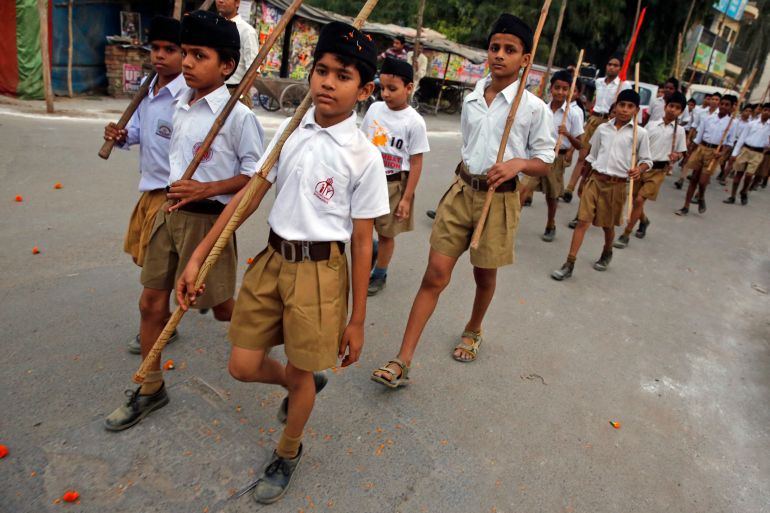
Volunteers of the Hindu nationalist organization Rashtriya Swayamsevak Sangh (RSS) march during Vijay Dashmi festival celebrations in Allahabad, India, Thursday, Oct. 22, 2015. Vijayadashami, also known as Dussehra, commemorates the victory of the Hindu god Rama over Ravana, an evil ruler who had abducted Rama's wife, Sita. The festivity is marked with the burning of effigies of Ravana, signifying the victory of good over evil. (AP Photo/Rajesh Kumar Singh)
Children march in the Hindu nationalist organisation Rashtriya Swayamsevak Sangh’s uniform in Prayagraj, India, Thursday, October 22, 2015 [File: Rajesh Kumar Singh/AP Photo]

A Muslim friend from a town in the central Indian state of Chhattisgarh recently called, seeking counsel.

His young daughter had told him the previous day that her friends refused to play with her any more – after they were warned by other children to stay away from her because of her religion.

Keep reading

This is an experience most Muslims have gone through while growing up in India. They are familiar with anti-Muslim slurs and cuss words used against them. But something new is happening which is radically different from earlier times.

While the Indian media and politicians have long harped on the supposed dangers of radicalisation among Muslim youth, or of the threat of far-left propaganda, we are now witnessing the turbocharged expression of a reality the country has never confronted: the radicalisation of Hindu youth.

It is an everyday radicalisation of young men and women who appear very normal, until they decide to target Indian Muslims and Christians.

They are part of public, over-ground groups like the Akhil Bhartiya Vidyaarthi Parishad (ABVP), the student wing of the Rashtriya Swayamsevak Sangh (RSS); and the Bajrang Dal, the militant youth wing of the RSS. All of them are affiliates of the ruling Bhartiya Janata Party (BJP), which gives them political clout and a veneer of respectability.

Members of the ABVP and the Bajrang Dal have been involved in numerous cases of physical violence against students and teachers, especially Muslims and Christians. Yet earlier this year, when the Congress party – the principal national opposition – declared that it would consider banning the Bajrang Dal if it came to power in the southern state of Karnataka, no less than Prime Minister Narendra Modi raised slogans in defence of the militant outfit.

Recently, a video surfaced in India and went viral in which a young Hindu girl is seen singing “Desh ke gaddaron ko Goli maro …” (shoot the traitors of the country). She is surrounded by elders who are clapping and encouraging her.

This slogan was made popular by a minister in the Modi government who was targeting Muslim women and men for protesting against the controversial new citizenship law passed in 2020 that discriminates against Muslim asylum seekers. The slogan has since been used in rallies and videos to target Muslims.

This video encapsulates a reality that Hindus do not want to talk about. Another video of a school teacher asking her students to slap their Muslim classmate who had not done his homework made national news. Students came up one by one and hit the Muslim boy, as the teacher commented against his religion.

We don’t know what impact this has had on the student who was struck and on his classmates, exposed to bigotry by their teacher at a young age. But we do know that there is an impact, more broadly, on the atmosphere that dominates today’s India.

The principal of a prestigious school in New Delhi told me that some students raised the slogan “Jai Shri Ram” in their class. This slogan is used by the RSS to proclaim Hindu dominance. Their parents were called and counselled.

Some students from another class went out to a park on Valentine’s Day and tried to bully couples sitting there. The celebration of Valentine’s Day is resented by Hindu supremacist groups. They threaten, harass, and beat up couples celebrating the day. It was disturbing for the teachers of this progressive, liberal school to find their students turning into volunteers of this radical ideology.

Talking to teachers and principals, one realises that the radicalisation of young Hindus, while an ongoing process, has acquired dangerous proportions in recent years, fuelled by hate-mongering TV channels, internet platforms and WhatsApp groups that have been relentlessly spreading anti-Muslim propaganda. Sadly, in many cases, what these children hear at home and in their families reinforces the bigotry they are fed by their television and phone screens.

Worried teachers struggle to deal with this phenomenon. For they too are vulnerable.

A fact-finding report released by a recently formed group in Maharashtra called Women Protest For Peace found multiple instances where external groups were intervening in the state’s educational institutions to incite students “to deliberately target teachers on religious grounds”.

Sadly, none of this is a surprise. In the last decade, it has become common to see adolescents, even children, brandishing swords and other weapons, raising hateful slogans targeting Muslims, and even vandalising mosques and Islamic shrines. Teenagers are seen in rallies organised by the Bajrang Dal.

These young Hindus see that violence against Muslims and Christians is often celebrated or at least tolerated, sometimes approvingly, in their families and society. They observe that people who provoke and lead violence gain social and political respectability and get elected to state legislatures and parliament. They see that far from suffering consequences for hate speech and hate crimes, anti-Muslim and anti-Christian acts help those who carry them out.

A major source of this hatred towards Muslims and Christians is the chain of educational institutions run by organisations affiliated with the RSS. Studies have been done examining the curriculum and activities of these institutions, and they reveal that they inculcate ‘nationalism’ in young minds, which is synonymous with anti-Muslim and anti-Christian hatred.

Children are told that India has been the land of Hindus, which was infiltrated by Muslims and Christians. That Hindus have been the best in all aspects; that it was Muslim rule that degraded them and turned them into slaves; that the only way to reclaim the country’s past glory is by teaching Muslims and Christians a lesson.

Tangible tasks are presented to Hindu youth as what they need to do to defend their faith. They are told that they must save cows from the cruelty of Muslims and Christians, establish Hindu dominance over Muslim neighbourhoods, and ‘save’ girls from ‘love jihad’ – a conspiracy theory that claims Muslim men are out to trap Hindu women in relationships with the aim of converting them to Islam.

Scores of vigilante groups have mushroomed all over India, indulging in violence against Muslims under the pretext of protecting cows and Hindu women.

Unfortunately, the radicalisation of Hindu youth often goes unnoticed as it is approved by their families, whom they see indulging in a range of aggressions against Muslims: It could be something as bizarre as protesting against their Muslim neighbours praying in their own houses.

Once hatred is normalised, violence follows naturally.

Yet while the BJP might benefit politically, the long-term consequences of this project will be borne by India’s Hindus, too. With homes and schools as the cradles of this radicalisation, a generation of Hindu children is being turned into unknowing criminals.

The views expressed in this article are the author’s own and do not necessarily reflect Al Jazeera’s editorial stance.


  • ApoorvanandApoorvanand teaches Hindi at the University of Delhi. He writes literary and cultural criticism.

The US Is Fanning the Flames of War With China

September 16, 2023

U.S. actions intensify the danger of nuclear war in the Asia-Pacific.

By Marjorie Cohn , Truthout, Published August 31, 2023

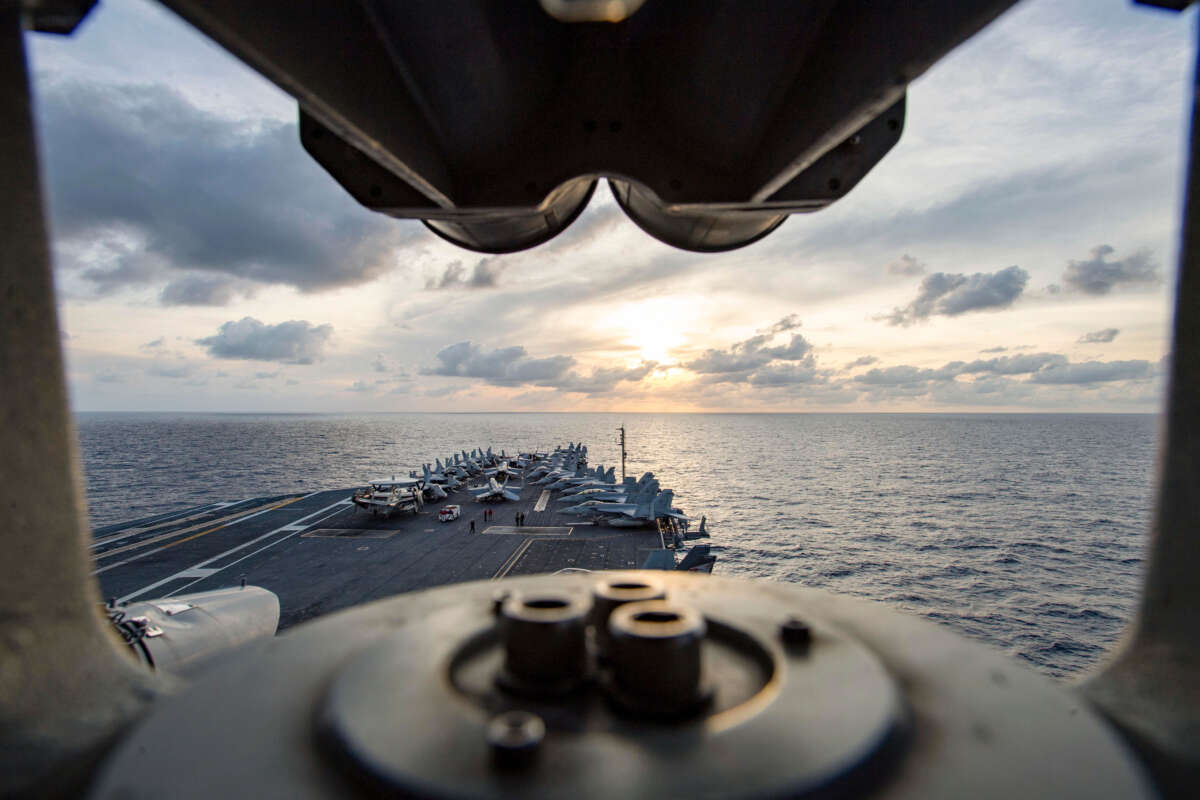
The U.S.S. Nimitz conducts routine operations while transiting the South China Sea on February 4, 2023.

The United States is gunning for war with China. By cozying up to Taiwan and arming it to the teeth, President Joe Biden is undermining the “One China” policy which has been the cornerstone of U.S.-China relations since 1979. The Biden administration is enlisting South Korea and Japan to encircle China. The U.S. military is conducting provocative military maneuvers that exacerbate the conflict in the South China Sea. Biden is escalating tensions with China and intensifying the danger of nuclear war in the Asia-Pacific. And Republican presidential candidates are also fanning the flames of war with China.

In March, U.S. Director of National Intelligence Avril Haines called China the “leading and most consequential threat to U.S. national security.” Chinese President Xi Jinping stated, “Western countries — led by the U.S. — have implemented all-round containment, encirclement and suppression against us.”

The Biden administration has “doubled down on the most insanely bellicose aspects of Trump administration policies, especially over Taiwan, which the U.S. had long recognized as part of China,” Peter Kuznick, professor of history and director of the Nuclear Studies Institute at American University, told Truthout.

More than 90 percent of the most advanced microchips in the world are manufactured in Taiwan. The chips are used to power our smartphones, train artificial intelligence systems and guide missiles. The Trump administration imposed heavy tariffs on Chinese imports to cut off China’s access to the software technology and equipment required to build the advanced chips.

Biden has maintained and dramatically expanded Trump’s coercive economic measures and imposed a blockade on advanced semiconductors. “Official U.S. policy is to make a nation of almost a billion and a half people poorer,” David Brooks wrote in The New York Times.

Related Story

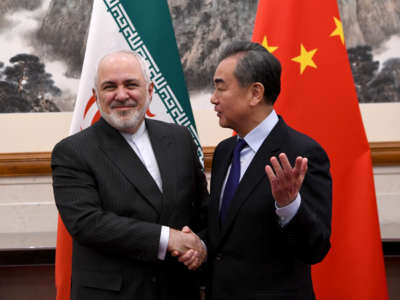
China's Foreign Minister Wang Yi shakes hands with Iran's Foreign Minister Mohammad Javad Zarif during a meeting at the Diaoyutai State Guesthouse on December 31, 2019, in Beijing, China.

News Analysis

|

Politics & Elections

Trump’s Harsh Sanctions Lead to Iran-China Partnership

The new strategic partnership between Iran and China is the result of Trump’s punishing sanctions against Iran. By Marjorie Cohn , Truthout

July 13, 2020

In 1979, the United States declared that the government of the People’s Republic of China (PRC) was “the sole legal Government of China.” That policy was consistent with UN General Assembly Resolution 2758, which recognized the PRC as the only legitimate government of China and one of the five permanent members of the Security Council.

“But now the ‘One China’ policy seems a relic of a foregone era and the U.S. seems hellbent on militarizing the Pacific in order to contain China,” Kuznick, who is coauthor with Oliver Stone of the New York Times best-selling book and documentary film series The Untold History of the United States, said. “This reckless policy will, if we are lucky, lead to a new Cold War. If we are unlucky, it portends a third world war — one that our species might not survive.”

Biden has repeatedly stated that the United States would use military force to defend Taiwan if it is attacked by China. The Biden administration has provided Taiwan with $619 million worth of high-tech arms.

Then-House Speaker Nancy Pelosi visited Taiwan in August 2022, angering China, which staged extensive war games around Taiwan in response.

In April, Taiwanese President Tsai Ing-wen met with a bipartisan U.S. congressional delegation in Simi Valley, California, the most high-profile meeting between U.S. and Taiwanese leaders on U.S. soil since 1979. The Chinese Embassy called the encounter a “serious mistake.” The foreign ministry responded by pledging to “take resolute and forceful measures” to defend its territorial integrity.

At the G20 summit in Indonesia in November 2022, Xi told Biden in no uncertain terms: “The Taiwan question is at the very core of China’s core interests, the bedrock of the political foundation of China-U.S. relations, and the first red line that must not be crossed.”

The U.S. Is the “Most War-Making Country” in the World

Speaking on a panel at the Veterans For Peace (VFP) annual convention on August 25, Kuznick remarked that China has not been at war with any country since 1979. By contrast, the United States has had only 16 years of peace in its 247 years. “The U.S. is the most war-making country” in the world, Kuznick said.

K.J. Noh, an activist scholar who writes about the geopolitics of the Asian continent, also spoke on the VFP panel. Noh described South Korea as key to the U.S.’s escalating war on China. “The United States has operational control over South Korean troops,” Noh said. The U.S. is also “weaponizing Taiwan into an imperial outpost for war.”

The third panelist was Simone Chun, a researcher and activist specializing in inter-Korean relations and U.S. foreign policy on the Korean Peninsula. She echoed Noh’s comments, calling South Korea a “pawn in Washington’s march to war against China.” South Korea, Chun said, is a “subcontractor in the new Cold War.”

In an article for Truthout in March, Chun characterized “[t]he U.S. military encirclement of China” as threatening “to escalate into an Asia-Pacific war, with the Korean Peninsula at the focal point of this dangerous path.” South Korea has 30,000 combat-ready U.S. troops on 73 U.S. military bases in the small country.

Since the Obama administration’s “pivot to Asia” in 2012, 60 percent of U.S. naval forces have been transferred to the Asia-Pacific, and 400 of the 800 U.S. military bases worldwide and 130,000 troops “are now circling China,” Chun wrote. The U.S.’s “goal is to force China’s hand by triggering and escalating a hybrid war on multiple fronts, including military, technology, economy, information and media.”

South Korea and Japan are encircling China from the north, and Australia and Indonesia are surrounding China from the south. South Korea’s right-wing president, Yoon Suk-yeol, welcomes the deployment of U.S. tactical weapons to South Korea and intends to arm his country with nuclear weapons, according to Chun.

The U.S., U.K. and Australia (“AUKUS”) announced in March that Australia would buy three nuclear-powered submarines by the “early 2030s.” The Chinese mission to the UN condemned the deal, tweeting, “The irony of AUKUS is that two nuclear weapons states who claim to uphold the highest nuclear non-proliferation standard are transferring tons of weapons-grade enriched uranium to a non-nuclear-weapon state, clearly violating the object and purpose of the NPT [Non-Proliferation Treaty].”

In October 2022, the U.S. announced it would deploy as many as six nuclear-capable B-52 bombers to northern Australia, within striking range of China.

U.S. Promotes Expansion of NATO Into the Asia-Pacific

The United States is promoting the expansion of NATO into the Asia-Pacific “to close the military circle around China,” Chun writes. The U.S. seeks to extend the influence of NATO to Japan, South Korea, Australia and New Zealand.

Chun identifies three significant aspects of the U.S. strategy: 1) stepped-up remilitarization of Japan; 2) “revitalization of extremist hardline North Korea policies” in Washington and Seoul and 3) escalation of “belligerent wargames targeted at China and North Korea.”

After World War II, the United States imposed a “peace constitution” on Japan but later pushed aggressively for Japanese rearmament to further the U.S.’s strategy to dominate the Asia-Pacific. The United States considers the remilitarization of Japan “the linchpin of U.S. security interests in Asia,” Chun notes.

The U.S. policy on North Korea is aimed at magnifying the purported “North Korea threat” and using it as a pretext to enlist South Korea and Japan in its scheme to contain China. Moreover, the joint military exercises between the U.S. and South Korea are dress rehearsals for an attack on and occupation of North Korea and the “decapitation” of its leadership — a “plan for regime collapse and occupation,” Chun writes.

The South China Sea Is a Flashpoint

There are competing claims of sovereignty over bodies of land and their contiguous waters in the South China Sea. Vietnam, the Philippines, Taiwan, Malaysia and Brunei oppose China’s historical claim to 90 percent of the South China Sea. This has led to tensions that have been exacerbated by U.S. military maneuvers in the sea.

The South China Sea is one of the busiest maritime shipping routes, connecting it with China, Japan, South Korea, Russia, Singapore, the Strait of Malacca and the Pacific Coast of the U.S. In 2016, more than 21 percent of global trade, totaling $3.37 trillion, transited through the South China Sea.

In July 2016, the Arbitral Tribunal in The Hague ruled for the Philippines in its case against China. The tribunal determined that China’s territorial claims in the South China Sea and its actions toward the Philippines did not comply with international law. China refused to abide by the ruling.

“American warships regularly move around the restricted area of China’s major islands under the range of Chinese guns, and at any time, due to some incident, military conflict between the two powerful superpowers could explode,” Professor Dmitri Valentinovic Mosiakov wrote in the International Review of Contemporary Law of the International Association of Democratic Lawyers. “US military expeditions, which are supposed to demonstrate the US commitment to the defense of freedom of navigation in the South China Sea, in fact only reinforce and justify such activities of China’s military preparation.”

Mosiakov added that in July 2022, “the United States decided that it was necessary to remind the People’s Republic of China who was to determine the rules of navigation in the South China Sea. Another US destroyer sailed into waters where China had declared a ban for military ships.”

The U.S. military does not belong in the South China Sea and its provocative actions compound the danger of an already tense situation.

“The greatest threat to peace and stability in northeast Asia is the U.S. Indo-Pacific military encirclement of China,” Chun wrote.

Likewise, Kuznick told Truthout, “U.S. policy makers seem so terrified by China’s extraordinary growth and challenge to U.S. hegemony in the Pacific that they are willing to risk nuclear annihilation to prevent it.”

We must heed Daniel Ellsberg’s admonition shortly before he died. He implored us to pursue “the urgent goal of working with others to avert nuclear war in Ukraine or Taiwan (or anywhere else).”

Tired of reading the same old news from the same old sources?

So are we! That’s why we’re on a mission to shake things up and bring you the stories and perspectives that often go untold in mainstream media. But being a radically, unapologetically independent news site isn’t easy (or cheap), and we rely on reader support to keep the lights on.

If you like what you’re reading, please consider making a tax-deductible donation today. We’re not asking for a handout, we’re asking for an investment: Invest in a nonprofit news site that’s not afraid to ruffle a few feathers, not afraid to stand up for what’s right, and not afraid to tell it like it is.

about:blank Copyright © Truthout. May not be reprinted without permission.

Truthout Logo

Marjorie Cohn

Marjorie Cohn is professor emerita at Thomas Jefferson School of Law, former president of the National Lawyers Guild, and a member of the national advisory boards of Assange Defense and Veterans For Peace, and the bureau of the International Association of Democratic Lawyers. She is founding dean of the People’s Academy of International Law and the U.S. representative to the continental advisory council of the Association of American Jurists. Her books include Drones and Targeted Killing: Legal, Moral and Geopolitical Issues. She is co-host of “Law and Disorder” Radio.

Why are colleges “civil” to Israel?

September 14, 2023

Rod Such The Electronic Intifada 12 July 2023

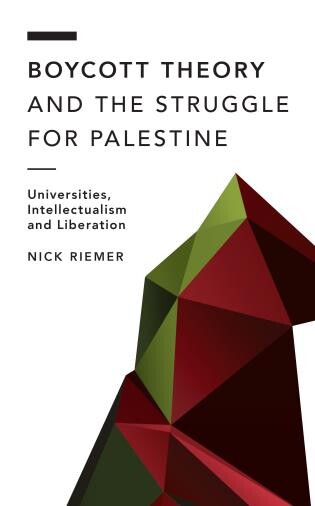
Boycott Theory and the Struggle for Palestine: Universities, Intellectualism and Liberation by Nick Riemer, Rowman & Littlefield (2023)

Australian scholar Nick Riemer explains the focus of his new in-depth study of the academic boycott of Israel by saying that “almost everything in the politics and culture of higher education works against academics boycotting Israel.”

Indeed, the obstacles presented by that culture are what’s mainly addressed in Boycott Theory and the Struggle for Palestine: Universities, Intellectualism and Liberation as he delves into the history of the academic boycott.

Academics, especially in the United States, have been denied work or tenure because of their advocacy for Palestine, a story presented in We Will Not Be Silenced: The Academic Repression of Israel’s Critics – an anthology of testimonials from repressed scholars published in 2017 but still relevant today.

Riemer describes the origins and early successes of the academic boycott, predating the 2005 Palestinian civil society call for BDS with the formation of the Palestinian Campaign for the Academic and Cultural Boycott of Israel (PACBI) a year earlier.

Even earlier, in 2002, Riemer notes, “several hundred European academics and researchers called for a moratorium on European funding of Israeli cultural and research institutions.” By year’s end, the University of Paris 6, now part of the Sorbonne, called for cutting off the European Union’s research agreement with Israel.

Other victories followed, including the University of Johannesburg in South Africa severing ties with Israel’s Ben-Gurion University in 2011. Numerous academic associations adopted pro-BDS resolutions in solidarity with the Palestinian people.

Ideology of the academy

But unlike the BDS movement against apartheid South Africa, which resulted in many US universities actually divesting from companies doing business with the country, nearly all Western universities and colleges have resisted calls from faculty and students to cut ties with Israel.

Riemer locates many of the reasons why, including university links to the military-industrial complex. But he reserves most of his critique for the dominant ideological narrative of “academic freedom” and the “civility” and “collegiality” reasons given for maintaining ties with Israeli academic institutions.

Riemer notes that from its beginning, PACBI called for the boycott of Israeli institutions, not individual Israeli scholars.

This provision, recognizing Israeli academics who oppose the occupation, differed from the academic boycott call issued in 1958 by the African National Congress – a blanket boycott of both institutions and individuals. Objections were rarely raised about the issue of “academic freedom” when it came to boycotting apartheid South Africa.

Riemer documents numerous examples of academic freedom being denied to Palestinian scholars, rarely acknowledged by hypocritical Western academic institutions.

Israeli troops routinely impose checkpoints outside university entrances, raid Palestinian campuses and arrest and imprison students. Movement restrictions prevent many Palestinian students from studying or teaching abroad or even in other parts of Palestine, and international scholars are restricted from teaching in the West Bank and Gaza.

As of 2022, Israel announced that it would vet all applications from foreign academics to teach at West Bank universities after a long history of limiting the number of foreign academics and refusing entry and re-entry. Israel’s numerous bombing campaigns in Gaza have not only disrupted education for long periods but have often targeted university campuses and buildings.

Outside Palestine, examples abound of “academic freedom” being denied to scholars who lost their positions due to their advocacy for Palestinian rights, such as Norman Finkelstein, Steven Salaita and Cornel West, to name only a few.

More recently, the effort by Israel and its proxies to impose the highly flawed IHRA definition of anti-Semitism on campuses – conflating criticism of Israel and Zionism with anti-Jewish bigotry – has resulted in numerous cancellations of scheduled talks, courses and film screenings in direct contradiction to most notions of academic freedom.

Riemer goes beyond the issue of censorship by asking why academic culture values not just civility and collegiality but actually negates the boycott by elevating thinking above acting. In contrast to the famous quote from Karl Marx, Riemer seems to be saying that for most academics, the point is to just interpret the world, not to change it.

The later chapters of Boycott Theory delve into this and related questions, such as those related to free speech and the right, both morally and politically, to disrupt hate speech aimed at reinforcing “the murderous practices of Israeli apartheid.” Riemer also discusses the role of intellectuals, asking can there be theory without practice, and what are the differences between solitary and collective intelligence.

Riemer couches some of these ideas in provocative phrases, such as the need for “groupthink” and “anti-intellectualism.”

Unfortunately, as intriguing as some of his ideas are, the author fails to convey them in an expository way by explaining the concept in detail, presenting the evidence for it and disrupting contrary claims. As a result, the reader is left unconvinced.

Tactic vs. strategy

Is there a need for a “theory of boycott,” as implied by the book’s title?

There is, but the author’s frequent description of the boycott as a tactic neglects its chief importance as a strategy.

The African National Congress regarded boycott, divestment and sanctions as one of the “four pillars” of South Africa’s liberation struggle, giving it a place of importance equal to its other strategic methods: armed struggle, political mass struggle and clandestine underground struggle.

The BDS movement has become a strategic component of the Palestinian liberation struggle not only because it has united Palestinians (polls show that more than 80 percent of Palestinians support BDS), but also because it has given people around the world a way to support that liberation struggle on a global scale.

It has also been the chief vehicle for changing the once-dominant belief that Israel is a democracy deserving of support, to an insurgent narrative that Israel is an apartheid state and that apartheid must end.

It is an idea that has become a material force. After all, ideas – once they’re grasped by a mass of people – can become a force in their own right.

Rod Such is a former editor for World Book and Encarta encyclopedias. He lives in Portland, Oregon, where he is active in the Demilitarize Portland2Palestine campaign.