Archive for December, 2010

Castro: Bill Clinton’s Lies

December 21, 2010

By Fidel Castro, ZNet, December 21, 2010

I am really sorry I have to disprove him. Today, he is nothing but a good-natured looking man, fully devoted to a historical legacy, as if the history of the empire—and what is even much more important, the fate of humankind—were something guaranteed beyond several decades into the future, and as if a nuclear war could not break out in Korea, Iran or any other place in turmoil.

As is well known, the United Nations appointed him as its “special envoy” in Haiti.

Clinton?, who, incidentally, was the President of the United States after George H. W. Bush and before George W. Bush?out of ridiculous political jealousy, prevented former President Carter from taking part in the negotiations on migration with Cuba. He signed the Helms-Burton Act and was an accomplice to the actions perpetrated by the Cuban American Foundation against our homeland.

There are more than enough testimonies that attested to that behavior, but we found no reason to take him too seriously, nor had we any animadversion on his activities related to the mission that, for obvious reasons, the UN had entrusted him.

We had been cooperating with the sister nation of Haiti for many years in several areas, especially in the training of doctors and the provision of services to its population, and Clinton wasn’t bothering us one little bit. If he was ever interested in showing some success, we saw no reason why he should hinder our cooperation with Haiti in such a sensitive field. Then the earthquake hit unexpectedly, bringing much death and destruction and subsequently the epidemic broke out.

Just two days ago, a meeting held in the Dominican Republic capital about reconstruction in Haiti began complicating things. About 80 persons, among them several ambassadors representing donors of more than 100 million dollars, numerous members of the Clinton Foundation and the representatives of both the US and the Haitian governments participated in that meeting.
Continues >>

Afghanistan: Taliban Body Count a Poor Measure of Success

December 21, 2010

For US Review, Security and Justice Are Best Tests of Progress, Not Kill/Capture Rates

Human Rights Watch, December 15, 2010
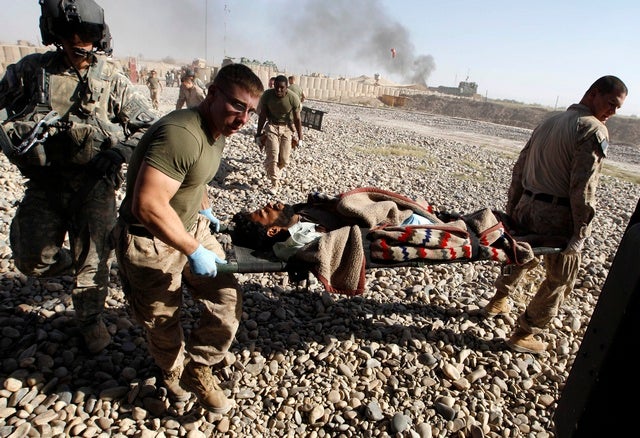
2010_Afghanistan_Wounded.jpg

Soldiers bring an Afghan civilian wounded in a crossfire to a Medevac helicopter near a camp in Helmand Province on November 2, 2010.

© 2010 Reuters

There is a danger that under pressure for ‘results’ the US will revert to Taliban body counts as a benchmark of success. President Obama should make clear that battlefield gains will be short-lived without a military and political strategy that protects rights.

<p> Rachel Reid, Afghanistan researcher at Human Rights Watch </p>

(New York) – The Obama administration should not backtrack on its commitment to make the protection of Afghan civilians a priority as it releases its assessment of the military situation in Afghanistan, Human Rights Watch said today. Strengthening civilian protection requires continued efforts to reduce civilian harm in military operations, improve due process for detainees, and sever US ties with abusive armed groups, Human Rights Watch said.

“There is a danger that under pressure for ‘results’ the US will revert to Taliban body counts as a benchmark of success,” said Rachel Reid, Afghanistan researcher at Human Rights Watch. “President Obama should make clear that battlefield gains will be short-lived without a military and political strategy that protects rights.”

On December 16, 2010, the US government will release an assessment of the impact of an increase of 30,000 troops in Afghanistan over the past year to its current strength of approximately 100,000 troops.

Continues >>

Bitter Memories of War on the Way to Jail

December 21, 2010

By Chris Hedges, TruthDig.com, Dec 20, 2010

AP / Susan Walsh
One hundred thirty-one demonstrators, Chris Hedges among them, were arrested in front of the White House on Thursday.

The speeches were over. There was a mournful harmonica rendition of taps. The 500 protesters in Lafayette Park in front of the White House fell silent. One hundred and thirty-one men and women, many of them military veterans wearing old fatigues, formed a single, silent line. Under a heavy snowfall and to the slow beat of a drum, they walked to the White House fence. They stood there until they were arrested.

The solemnity of that funerary march, the hush, was the hardest and most moving part of Thursday’s protest against the wars in Afghanistan and Iraq. It unwound the bitter memories and images of war I keep wrapped in the thick cotton wool of forgetfulness. I was transported in that short walk to places I do not like to go. Strange and vivid flashes swept over me—the young soldier in El Salvador who had been shot through the back of the head and was, as I crouched next to him, slowly curling up in a fetal position to die; the mutilated corpses of Kosovar Albanians in the back of a flatbed truck; the screams of a woman, her entrails spilling out of her gaping wounds, on the cobblestones of a Sarajevo street. My experience was not unique. Veterans around me were back in the rice paddies and lush undergrowth of Vietnam, the dusty roads of southern Iraq or the mountain passes of Afghanistan. Their tears showed that. There was no need to talk. We spoke the same wordless language. The butchery of war defies, for those who know it, articulation.

What can I tell you about war?

Continues >>

Public opposition can end US wars

December 21, 2010
Despite American officials continuing to disregard public opposition to the wars, the public can still have an impact.
Jason C. Ditz, Al Jazeera,  21 Dec 2010
Secretaries Gates and Clinton discount American opposition to the ongoing wars in Afghanistan and Iraq [Getty]

After President Obama’s Thursday speech praising the illusory progress in Afghanistan, the floor was turned over to Hillary Clinton, the secretary of state, and  Robert Gates, the secretary of defence. When asked about the growing unpopularity of the “long war,” they both replied that the administration’s intention is to ignore all popular opposition.

In fact, both secretaries expressed open contempt for the notion that the public’s war fatigue could possibly have any impact on ending the conflict. But both secretaries were wrong. Despite an official policy of disdain and even mockery toward the public’s will, the American people can end this war.

If the attitude in the White House sounds familiar, it’s because it is. President Bush et al responded to similar complaints about the Iraq War with a determination to see it continue long after they were out of office. The public, it seems, wises up about the reality of wars long before officials care to.

With death tolls rising precipitously and official claims of imminent victory ringing ridiculously hollow after years of repetition, it isn’t hard to understand why public opposition to the Afghan War has swelled to 60%.

Yet so far that opposition is a mile wide and an inch deep. Public resistance to the war may be generally accepted amongst voters, but it is far from a top issue for many, who are convinced the rising budget deficit and crumbling domestic economy must take priority. A reasonable position on first blush, but at some point the public must inevitably realize that these issues are not distinct.

The economy is struggling because of overspending, and it is the rising cost of the unnecessary and unpopular wars that is the driving force. In short it is precisely the administration’s ambivalence toward the public’s desire to see these wars end that is at the root of America’s domestic woes.

For years, that has been the secret to keeping an opposed public largely quiet about the wars that the US military has been engaged in. By sustaining war, the administration guarantees domestic economic problems. So long as those problems are viewed as unrelated to foreign policy, both can continue to go unaddressed, for years.

But the American public cannot be kept in the dark about these policies forever and must inevitably be roused from its disinterest to challenge the administration’s claims that their opinions just don’t matter in the grand scheme of things. Indeed as officials continue to cozy up to the idea of a decades-long war, nothing short of popular demand can be influential.

Several NATO member states have already been driven out of Afghanistan by popular opposition. Britain and Germany are openly discussing withdrawal in the near future primarily because, despite their governments’ official support for the conflict, they cannot maintain this sort of occupation indefinitely when the public is demanding an end.

Are the American people not at least as influential toward their government’s policies as the German people or the Dutch? If their collective will can end the war, why can’t ours?

Secretaries Gates and Clinton may have been attempting to break the spirit of the war’s opponents by dismissing them out of hand, but I would urge you instead to view it as a personal challenge. They don’t believe you can end this war. Let’s prove them wrong.

Cover-Ups, Coups and Drones – A Holiday Sampler of What WikiLeaks Reveals About the US

December 21, 2010

by: Bill Quigley, t r u t h o u t | News Analysis, Dec 20, 2010

Human rights advocates have significant new sources of information to hold the United States accountable. The transparency, which WikiLeaks has brought about, unveils many cover-ups of injustices in US relations with Honduras, Spain, Thailand, UK and Yemen over issues of torture at Guantanamo, civilian casualties from drones and the war in Iraq.

US Government Is Two-Faced Over WikiLeaks

The US government has twisted itself into knots over WikiLeaks. It routinely disregards the privacy of citizens while, at the same time, trying to avoid transparency for itself.

The US claims broad authority to secretly snoop on the lives of individuals inside and outside of the US. It also works tirelessly to prevent citizens from knowing what is going on by expansively naming basic government information “state secrets.” The government says it has to have the right to keep things secret in order to prevent crime.

But when it comes to revealing evidence of illegal acts by the US government it seeks the most severe sanctions against any transparency.

The most glaring example of the twisted logic is on display within the US Department of Justice (DOJ). The DOJ is searching for creative ways to criminally sanction WikiLeaks for publishing US secrets. But the same DOJ solemnly decided it should not prosecute the government officials who brazenly destroyed dozens of tapes of waterboarding and torture by US officials. So, DOJ, destruction of evidence of crimes is O.K. and revealing the evidence of crimes is bad?

Continues >>

The Great Islamophobic Crusade

December 21, 2010

Inside the Bizarre Cabal of Secretive Donors, Demagogic Bloggers, Pseudo-Scholars, European Neo-Fascists, Violent Israeli Settlers, and Republican Presidential Hopefuls Behind the Crusade

By Max Blumenthal, TomDispatch.com,  Dec 21, 2010

Nine years after 9/11, hysteria about Muslims in American life has gripped the country. With it has gone an outburst of arson attacks on mosques, campaigns to stop their construction, and the branding of the Muslim-American community, overwhelmingly moderate, as a hotbed of potential terrorist recruits. The frenzy has raged from rural Tennessee to New York City, while in Oklahoma, voters even overwhelmingly approved a ballot measure banning the implementation of Sharia law in American courts (not that such a prospect existed). This campaign of Islamophobia wounded President Obama politically, as one out of five Americans have bought into a sustained chorus of false rumors about his secret Muslim faith. And it may have tainted views of Muslims in general; an August 2010 Pew Research Center poll revealed that, among Americans, the favorability rating of Muslims had dropped by 11 points since 2005.

Erupting so many years after the September 11th trauma, this spasm of anti-Muslim bigotry might seem oddly timed and unexpectedly spontaneous. But think again: it’s the fruit of an organized, long-term campaign by a tight confederation of right-wing activists and operatives who first focused on Islamophobia soon after the September 11th attacks, but only attained critical mass during the Obama era.  It was then that embittered conservative forces, voted out of power in 2008, sought with remarkable success to leverage cultural resentment into political and partisan gain.

Continues >>

US complicit in India’s systematic use of torture in Kashmir

December 21, 2010
By Deepal Jayasekera, wsws.org, 21 December 2010

US diplomatic cables obtained by WikiLeaks show that Washington has long had evidence of Indian authorities’ systematic use of torture against opponents of Indian rule over Jammu and Kashmir, but has chosen not to speak out against New Delhi’s gross human rights violations.

In a classified cable sent in April 2005, the then-US ambassador to New Delhi, David C. Mulford, reported to the US State Department on a “confidential briefing” embassy officials had received from the International Committee of the Red Cross (ICRC) “on widespread severe torture in Indian prisons in Kashmir between 2002 and 2004.”

“The continued ill-treatment of detainees,” reported Mulford, “despite longstanding ICRC-GOI (Government of India] dialogue, have led the ICRC to conclude” that New Delhi “condones torture.”

In their briefing, the ICRC officials emphasized that those subjected to torture by Indian authorities were generally not anti-Indian insurgents—since Indian security forces have a standard practice of summarily executing suspected insurgents. Rather they were noncombatants, those accused of providing the insurgents support or suspected of having useful information: the “detainees were rarely militants (they are routinely killed), but persons connected to or believed to have information about the insurgency.”

Continues >>

The delusions of the peace process

December 20, 2010

Richard Falk, uruknet.info, Dec 18. 2010

The politics of the peace process have emphatically ensured that the mere prospect for producing peace is nonexistent.

It is astonishing that despite the huge gaps between the maximum that Israel is willing to concede and the minimum that the Palestine Authority could accept as the basis of a final settlement of the conflict, governmental leaders, especially in Washington, continue to pull every available string to restart inter-governmental negotiations.

Is it not enough of a signal that Israel lacks the capacity or will to agree to an extension of the partial settlement freeze for a mere additional 90 days, despite the outrageous inducements from the Obama Administration (20 F-35 fighter jets useful for an attack on Iran; an unprecedented advance promise to veto any initiative in the Security Council acknowledging a Palestinian state; and the assurance that Israel would never again be asked to accept a settlement moratorium) that were offered to suspend partially their unlawful settlement activity.

In effect, a habitual armed robber was being asked to stop robbing a few banks for three months in exchange for a huge financial payoff. Such an arrangement qualifies as a transparently shameless embrace of Israeli lawlessness on behalf of a peace process that has no prospect of producing peace, much less justice.

Continues >>

Wikileaks: India ‘tortured’ Kashmir prisoners

December 19, 2010
Indian policemen patrol near Srinagar, Indian-administered Kashmir, in November 2010
The Wikileaks revelations come at a time of heightened tension in Kashmir

The International Committee of the Red Cross sent evidence to US diplomats about widespread torture by Indian security forces in Kashmir, according to cables obtained by Wikileaks.

Visits to detention centres in the region in 2002-04 revealed cases of beatings, electric shocks, sexual abuse and other types of ill-treatment.

The organisation concluded that India condoned torture in the region.

There has been no comment from the US. The ICRC said it was investigating.

The chief minister of the state of Jammu and Kashmir, Omar Abdullah, told India’s NDTV channel that the allegations related to a period before his government took power and that he did not condone torture.

SM Sohai, inspector general of police in Indian-administered Kashmir, said the reports were baseless “propaganda”.

“I do not how the Red Cross could have accessed that information because, normally they would not have access to these kind of locations, so it’s completely unfounded,” he told the BBC.

“Torture doesn’t happen… Where can it happen?”

Correspondents say the revelations will be embarrassing for Delhi, coming at a time of heightened sensitivity in Kashmir, which is divided between Indian and Pakistani control.

Continues >>

Bolivia recognizes Palestine

December 19, 2010

World Bulletin, Dec 19, 2010

Bolivia has recognized Palestine as an independent state, following the lead of Brazil, Argentina and Uruguay.

Bolivian President Evo Morales on Friday said his government would send a letter to Mahmud Abbas, president of the Palestinian Authority, recognizing Palestine as “an independent and sovereign state.”

He made the statement during the Mercosur summit.

Speaking at a news conference in Paraguay, Morales said Bolivia would officially notify international institutions of its decision next week.

He said, that genocide was being committed in the region and called on the international community to assume responsibility for preventing it.

With the announcement, Bolivia joined the list of Latin American and South American countries consisting of Cuba, Argentina, Brazil, and Venezuela which have all recognized an independent Palestinian state within its pre-1967 borders.

“Bolivia recognizes Palestine as an independent state along 1967 borders, together with Brazil and Argentina,” President Morales said during the Mercosur summit.

Palestinian Authority President Mahmoud Abbas welcomed the move and thanked the support of Morales. Furthermore, Abbas praised the bilateral relationships.

Continues >>