Archive for October, 2010

Israeli flotilla probe ‘a sham’

October 27, 2010
By Sherine Tadros, AlJazeera, Oct 26, 2010


Photo by GALLO/GETTY

Turkel Schmerkel.

For the past few days I’ve had the delightful task of hanging around the Yitzhak Rabin Guest House in West Jerusalem. I was covering the latest round of questioning by (Israeli) judges, appointed by the (Israeli) government to examine the legality of their deadly raid on the Gaza-bound aid ship last May. The inquiry is called the Turkel Commission, named after retired Justice Turkel – the big chief.

Now, I could tell you how, at various points, I saw every member of the panel fall asleep during the testimonies.

Or, I could describe the humiliating and condescending way in which the panelists spoke to the Arab-Israeli passengers who came to testify (compared to the respect they showed whilst interviewing Opposition leader Tzipi Livni and military chief Gabi Ashkenazi).

I could even explain how for 45 minutes I watched the panelists argue with the Arab passenger about how being that “he seemed like a reasonable man” he could breach Israeli law (as an Israeli citizen) and decide to get on a ship to Gaza. Indeed – a Palestinian going to a Palestinian territory seemed more absurd to these judges than the actual policy that stops him getting there (and by extension anyone getting out).

Every step of the way it was obvious that this commission, which was tasked with determining whether Israel is in breach of international law in blockading Gaza, had made up their minds long before they stepped into the Rabin Guest House.

But put all that aside, here are five simple reasons why this Commission is a sham.

1) The average age of the five original panelists is 84. They have all spent their careers defending the state of Israel and between them have very little expertise in international law…

2) …Except for one of the panelists – Proff Rosenne  – but sadly he died a few weeks ago. He was 93-years-old and he was not replaced, so the panel has now gone down to four.

3) The panelists were all hand picked by Binyamin Netanyahu, the Israeli prime minister, and Ehud Barak, the defence minister. The two token international observers on the panel are also widely known as sympathetic to Israel.

4) The coverage of the Turkel Commission in the Israeli papers is virtually non existent. Apart from a local TV channel, Al Jazeera English was the only channel broadcasting from outside the proceedings the last two days.

5) Turkel said two weeks ago, during proceedings, that “the people of Gaza have brought this hardship on themselves”. Another panelist stated, despite the mass of data provided to the Commission by Israeli human rights groups on the situation in Gaza, “there is no humanitarian crisis in Gaza”.

Case closed.

Age of permanent war?

October 27, 2010
Morning Star Online,  October 27, 2010
By Steven Schofield

The defence spending review represents a total victory for the military-industrial complex and its campaign of fear.

Raising the terror alert to “severe,” the “secret” briefings that air force cuts would leave the country totally vulnerable, the lobbying by the great and the good on why Britain needs a blue-water navy to maintain its status as a world power and finally the US demand that Britain continues to play its full role within Nato, have had the desired effect.

After all the leaks and speculation that the MoD faced meltdown from savage Treasury-led cuts, the outcome is a very modest 8 per cent reduction.

As a result, the overall investment of the armed forces will be smaller, there will be fewer surface vessels and fighter aircraft ordered and delays to some contracts – all quite traditional methods of dealing with a spending squeeze.

But the really significant outcome was the continuation of every major procurement programme, notably Trident, conventional nuclear submarines and aircraft carriers.

Continues >>


Replacing One Set of Thugs With Another

October 27, 2010

by Abby Zimet, CommonDreams.org, Oct 25, 2010

A stunningly cogent editorial from the Guardian on Wikileaks’ Iraq War Logs, the brutality they exposed and the legal and moral obligation to investigate U.S. forces’ complicity in it. How appalling that no U.S. official – or mainstream paper – has yet to make such a demand.

    Every time WikiLeaks puts facts into the public domain, first about the war in Afghanistan and now about Iraq, it is accused of partisanship and irresponsibility. The US defence secretary, Robert Gates, said on 29 July that the release of 90,000 classified documents about the war in Afghanistan endangered Afghan lives. Little more than two weeks later, Gates admitted in a letter to Carl Levin, chairman of the Senate armed services committee, that the disclosures did not reveal any significant national intelligence secrets. The Pentagon’s review had not to date “revealed any sensitive intelligence sources and methods compromised by this disclosure”. This does not stop the same charge being made now about the release of almost 400,000 US documents on Iraq. 

    Many attempts were made to justify the invasion of Iraq, but one of the most frequently and cynically used was that, irrespective of the absence of weapons of mass destruction, putting an end to the barbarities of Saddam Hussein’s regime was a moral imperative. Well, now there is chapter and verse, from ringside seats, on the systematic use of torture by the Iraqi government that the US installed in Saddam’s place. The worst practices of Saddam’s regime did not apparently die with him, and whereas numerous logs show members of the coalition making genuine attempts to stop torture in Iraqi custody, it is clear their efforts were both patchy and half-hearted. In the worst incidents, one can only reasonably conclude that one set of torturers and thugs has been replaced by another.

    Continues >>

Palestinians Have Right to Resist Occupation by Any Means, Even Non-violent Ones

October 26, 2010

The Violence Debate

by Agustín Velloso, Dissident Voice,  October 26th, 2010

As a Western supporter (non Muslim/Arab) of the Palestinian cause, I have always find it rather difficult to talk (let alone to advocate) about how best Palestinians can resist occupation, especially when this occupation is usually extremely violent and genocidal at times.

Ramzy Baroud’s restrained criticism of Western and some other willing peace teachers, has prompted me to introduce a different point of view, which probably is much more common amongst Westerners than the Palestinians themselves would believe, although the mainstream media, as it happens with many other issues, have successfully managed to keep under a lid.

War in Iraq and Afghanistan are just two outstanding examples. It does not matter how many Westerners speak out and demonstrate against Western intervention (read aggression) in those countries. It does not matter that international law (let alone pure and humble common sense and humanity) prohibits wars of aggression and occupation. The fact is that Western presidents and parliaments “democratically” invade and withdraw as they see fit, “democratically” they are not held accountable in court for these crimes, and their victims are either dead of left to their own devices, also “democratically”.

Continues >>

Indian human rights champion Arundhati Roy faces arrest over Kashmir remark

October 26, 2010

Booker prize-winner says claim about territory not being an integral part of India was a call for justice in the disputed region

Gethin Chamberlain in Panaji, The Guardian, Oct 26, 2010

Arundhati Roy
Arundhati Roy could face a fine or imprisonment if convicted of sedition. Photograph: Jean-Christian Bourcart/Getty Images

The Booker prize-winning novelist and human rights campaigner Arundhati Roy is facing the threat of arrest after claiming that the disputed territory of Kashmir is not an integral part of India.

India’s home ministry is reported to have told police in Delhi that a case of sedition may be registered against Roy and the Kashmiri separatist leader Syed Ali Shah Geelani for remarks they made at the weekend.

Under Section 124A of the Indian penal code, those convicted of sedition face punishments ranging from a fine to life imprisonment.

Roy – who won the Booker in 1997 for The God of Small Things – is a controversial figure in India for her championing of politically sensitive causes. She has divided opinion by speaking out in support of the Naxalite insurgency and for casting doubt on Pakistan’s involvement in the 2008 Mumbai attacks.

But in a statement the 48-year-old author, who is currently in Srinigar, Kashmir, refused to backtrack. “I said what millions of people here say every day. I said what I, as well as other commentators, have written and said for years. Anybody who cares to read the transcripts of my speeches will see that they were fundamentally a call for justice.

“I spoke about justice for the people of Kashmir who live under one of the most brutal military occupations in the world; for Kashmiri Pandits who live out the tragedy of having been driven out of their homeland; for Dalit soldiers killed in Kashmir whose graves I visited on garbage heaps in their villages in Cuddalore; for the Indian poor who pay the price of this occupation in material ways and who are now learning to live in the terror of what is becoming a police state.”

Continues >>

J.R. Hammond: The Myth of the U.N. Creation of Israel

October 26, 2010

By Jeremy R. Hammond, Foreign Policy Journal, Oct 26, 2010

This essay is available for download in PDF format at the author’s website.

There is a widely accepted belief that United Nations General Assembly Resolution 181 “created” Israel, based upon an understanding that this resolution partitioned Palestine or otherwise conferred legal authority or legitimacy to the declaration of the existence of the state of Israel. However, despite its popularity, this belief has no basis in fact, as a review of the resolution’s history and examination of legal principles demonstrates incontrovertibly.

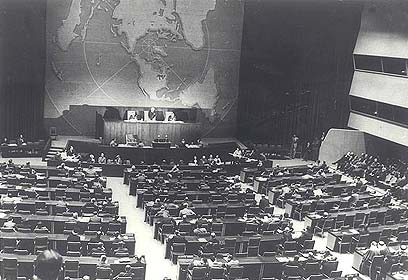
The U.N. General Assembly, November 29, 1947

Great Britain had occupied Palestine during the First World War, and in July 1922, the League of Nations issued its mandate for Palestine, which recognized the British government as the occupying power and effectively conferred to it the color of legal authority to temporarily administrate the territory.[1] On April 2, 1947, seeking to extract itself from the conflict that had arisen in Palestine between Jews and Arabs as a result of the Zionist movement to establish in Palestine a “national home for the Jewish people”,[2] the United Kingdom submitted a letter to the U.N. requesting the Secretary General “to place the question of Palestine on the Agenda of the General Assembly at its next regular Annual Session”, and requesting the Assembly “to make recommendations, under Article 10 of the Charter, concerning the future government of Palestine.”[3] To that end, on May 15, the General Assembly adopted Resolution 106, which established the U.N. Special Committee on Palestine (UNSCOP) to investigate “the question of Palestine”, to “prepare a report to the General Assembly” based upon its findings, and to “submit such proposals as it may consider appropriate for the solution of the problem of Palestine”.[4]

Continues >>

Simon Jenkins: What on Earth Are America’s Friends to Say?

October 25, 2010

Simon Jenkins

Writer for the Guardian and the London Sunday Times, The Huffington Post, Oct 25, 2010

A small band of Brits still try to defend America’s current foreign policy to a sceptical world. When US forces abroad do something cruel or counter-productive, like bombing another wedding party or fighting the wrong country, we point to their nobler values and to past defences of freedom. Surely they at least meant well. The Wikileaks revelations now gleefully headlined across Europe have left us floundering.

The brutality and apparent collapse of front-line discipline is charted in thousands of meticulously filed US government reports, proving only one thing, that any war “among the people” that goes on too long degrades its participants and degenerates into senseless cruelty. Our friends become our victims and our enemies triumphant.

The fact that the leaks are irresponsible and helpful to the enemy is by now immaterial. The enemy, mostly Iran, is riding high on the sheer incompetence of coalition and NATO operations in Iraq, Afghanistan and increasingly Pakistan. Hilary Clinton’s objection to them, that they are leaks, hardly meets the case. These are true records from the side that claims “higher values”, of helicopters shooting innocent individuals in cold blood, of the massacring of 600 civilian drivers, women and children among them, at checkpoints, of the killing of people trying to surrender, of a litany of prisoner torture and maltreatment that shows Abu Ghraib was no exception. The idea that the American invasion liberated Iraqis from kidnap, torture, rape and summary execution is shown to be a sick untruth. Indeed a shocking feature of the leaks is that few Iraqis appeared surprised.

Continues >>


How Paul Wolfowitz Authorized Human Experimentation at Guantánamo

October 25, 2010

Andy Worthington, October 24, 2010

Last week, Truthout published an important article by Jason Leopold, Truthout’s Deputy Managing Editor, and psychologist and blogger Jeffrey Kaye, revealing, for the first time, a secret memorandum dated March 25, 2002, approved by deputy defense secretary Paul Wolfowitz, which authorized human experimentation on detainees in the “War on Terror.” The release of the memo followed some little-noticed maneuvering in Congress in December 2001, when the requirement of “informed consent” in any experimentation by the Defense Department (introduced in 1972) was quietly dropped.

The article — which involved over a year of research, as Leopold and Kaye persuaded former officials to open up to them — not only adds to Leopold’s important work and to Kaye’s formidable track record as a chronicler of the development of human experimentation in the Bush administration’s “War on Terror” torture program (which he has also revealed as part of an obsession with human experimentation reaching back to the 1950s), but also confirms the existence of an important new front in the struggle to raise awareness of the horrors of torture, and the requirement that those who authorized it be held accountable for their crimes.

Leopold and Kaye delivered a presentation about their article the day after its publication, as part of “Berkeley Says No to Torture” Week, and their work on human experimentation added to a compelling catalog of the many reasons why the acceptance of torture must continue to be opposed, which I developed during the week: namely, that it is not only illegal, morally corrosive, counterproductive and unnecessary, but also that, at its heart, the Bush-era torture program continued work in the field of human experimentation that the US took over from the Nazis, and also involved treasonous lies on the part of senior officials, who pretended that the program was designed to prevent future terrorist attacks, when, from the very beginning (in late November 2001, according to Col. Lawrence Wilkerson, Colin Powell’s Chief of Staff), it was actually being used to extract false confessions about connections between al-Qaeda and Saddam Hussein that could be used in an attempt to justify the illegal invasion of Iraq in March 2003.

Continues >>

Officials: Afghan Peace Talks ‘Mostly Hype’

October 25, 2010

Claims of Talks a ‘Misinformation Campaign’

by Jason Ditz, Antiwar.com,  October 24, 2010

The combination of official reports downplaying the Afghanistan peace talks and other official reports, often from the exact same sources, lauding them as making great progress has been quite confusing over the past weeks. Reports in the Guardian appear to explain this however, citing officials saying the claims are being intentionally hyped as “part of a misinformation campaign aimed at the Taliban leadership.”

Which would put a whole new light on Richard Holbrooke’s claims today that a number of new “high-level” Taliban are seeking the talks because “of the growing pressure they’re under from General Petraeus.”

It would also explain the actual Taliban’s surprise at the claims that such talks are ongoing, and the public rejection of those claims. A number of previous talks over the past several years seemed to amount to the same thing, with the reports centered around convincing low ranking Taliban that a deal was imminent and that they should accept offers from the Karzai government.

And even if the “misinformation” is aimed at the Taliban it also has a side-effect of becoming another part of the growing collection of false claims of “progress” by the administration ahead of key conferences on the war. With many of the public comments directed at Western audiences the question of how much of this is really a military strategy and how much is just overt lying remains an open question.

INDIA: Kashmir: A “No-Peace” Political Initiative

October 25, 2010

By Prof. Angana Chatterji, AHRC, October 25, 2010

The 8-point Plan, New Delhis political initiative to address the crises in Kashmir, attests to the parallel and incommensurate realities of the sovereign and the subjugated, the Indian state and the Kashmiris.

The 8-point Plan renders obvious New Delhi’s limited comfort zone. The Plan is not an overture to healing the reality of suffering and outrage inside Kashmir. Rethinking militarization and military governance is not the priority. The ambition is to manage Kashmiris and to keep the disarray concealed from the international gaze.

New Delhi announced its 8-point Plan on September 25, 2010, following the visit to India-ruled Kashmir of a 39-member All Party Delegation from New Delhi led by Union Home Minister Palaniappan Chidambaram, and parallel to the 65th Session of the United Nations General Assembly meetings in New York City. That Defence Minister Arackaparambil Kurian Antony did not accompany the All Party Delegation was indicative of New Delhis mood.

On the part of New Delhi, the will to mend the rupture between India and Kashmir will require a non-deceptive gaze into power and history. India evidences how powerful states are unable and unwilling to act with humility. There is no admission of culpability on the part of the Indian state — no acknowledgement of the violence of militarization, authoritarian government, and crimes against humanity perpetrated on Kashmir since the 1990s.

On the part of New Delhi, there is no cognition of the actual grievances voiced by the people of Kashmir. There is no recognition of the shifts in the peoples struggle for self-determination within Kashmir, or of how the shift from violence to nonviolence within the Kashmir resistance movement offers a rich space for critical engagement and principled dialogue toward resolution.

The 8-Point Plan

The provisions of the 8-point Plan stated that interlocutors from India would be appointed to dialogue with civil society and political leaders in Jammu and Kashmir, even as the terms for dialogue were not defined. The Plan committed to releasing youth who were detained and arrested on charges of stone pelting this summer. This is imperative and urgent. The number of such youth was listed at 245, while various human rights defenders and journalists in Kashmir state the figure to be higher.

The Plan made no commitment to review the conditions in which the youth were detained or arrested, to freeing political prisoners, or to endorsing the right to civil disobedience. The Plan made no mention of holding the perpetrators accountable. Neither did New Delhi intend to negate the Government of Indias tactic of violence used to govern and domesticate Kashmiris.

Continues >>