Archive for June, 2007

The Bandar cover-up: who knew what, and when?

June 11, 2007

Source: The Guardian,

Attorney general urged to clarify role in concealing $1bn payments to prince

David Leigh and Rob Evans
Saturday June 9, 2007

The government was last night fighting to contain the fallout over £1bn in payments to a Saudi prince as the attorney general came under renewed pressure to explain how much he knew about the affair.While in public the government was issuing partial denials about its role in the controversy, in private there were desperate efforts to secure a new BAE £20bn arms deal with Saudi Arabia.

And any hopes that the furore could be halted were dashed last night when the Guardian learned that the world’s anti-corruption organisation, the OECD, was poised to resume its own inquiry into why the British government suddenly abandoned its investigations into the £43bn al-Yamamah arms deal.

The OECD’s anti-bribery panel will meet in Paris on June 19 and is expected to discuss the disclosures. When it travels to London, its inspectors are likely to ask ministers for a full explanation of their conduct.Last night, the Liberal Democrat leader, Menzies Campbell, demanded to know the role of the attorney general in concealing from the OECD the payments of more than £1bn from BAE to Prince Bandar as part of the al-Yamamah contract.

The money was paid from an account at the Bank of England into accounts in Washington controlled by Prince Bandar. Details of the transfers were discovered by the Serious Fraud Office during the marathon investigation into BAE.

However, the SFO inquiry was suddenly halted late last year. Al-Yamamah, Britain’s biggest ever arms deal, which was signed in 1985, involves the sale of Tornado fighter jets and Hawk aircraft.

The Guardian has this week published accusations that £30m a quarter – for at least 10 years – was paid into accounts controlled by Prince Bandar at the Riggs bank in Washington.

The attorney general yesterday categorically denied part of the Guardian story in the affair.

He said that he had not ordered British investigators to conceal the £1bn payments from the OECD.

The director of the SFO took responsibility for the decision to withhold information. In a statement, Robert Wardle said the decision was made by his own organisation “having regard to the need to protect national security”.

The Guardian investigation has revealed that:

· The attorney general became aware of these payments because of the SFO inquiry into BAE corruption allegations.

· He recognised the vulnerability of the government to accusations of complicity over a long period in the secret payments.

· There is no dispute that, as reported by the Guardian, the fact of the payments was concealed from the OECD when it demanded explanations for the dropping of the SFO inquiry.

· UK government officials have been exposed as seeking to undermine the OECD process, and complaining that its Swiss chairman has been too outspoken.

· When, before publication, the Guardian originally asked the attorney general’s office who was responsible for concealing the information from the OECD, the newspaper was told: “The information presented to the OECD bribery working group … was prepared by AGO and SFO”.

The AGO is the attorney general’s office. Both departments report to Lord Goldsmith himself.

Last night, when Lord Goldsmith was asked if the concealment was done with his knowledge, he said he could not respond. His spokesman had previously said that full evidence had not been given to the OECD because of “national security” considerations. He also refused to discuss the allegations concerning the payments. “I am not going into the detail of any of the individual allegations,” he said.

It also emerged yesterday that Des Browne, the defence secretary, held talks this week with the Saudi crown prince, Prince Sultan bin Abdul Aziz – the father of Prince Bandar – to try to secure a £20bn arms deal for BAE Systems.

Sir Menzies said the attorney general had more questions to answer.

“If it is true that information about payments made to Prince Bandar was not given to the OECD, then that is an allegation of the utmost seriousness. It would be unsupportable for Britain to sign up to an international agreement on bribery and then fail to honour its obligations when an investigation comes too close to home.”

The Two State Solution?

June 11, 2007

CounterPunch,

June 6, 2007

Inevitable Truths

The Mirage of the Two State Solution

By GEORGE BISHARAT

Forty years ago this week, Israel conquered the West Bank and Gaza Strip, re-establishing a political system in which one sovereign ruled over all of former Palestine. Unnoticed by the world, this brought about a version of a “single state solution” to the Palestinian-Israeli conflict — albeit one in which Palestinians and Jews do not have equal rights.

Instead, Israel has ruled the West Bank and Gaza Strip through military governments that control the daily lives of millions of Palestinians in every aspect, yet in which they have no say. Although Palestinians now elect representatives to a Palestinian Authority, these officials administer the tiny Gaza Strip, and less than 20 percent of the West Bank. Their powers scarcely exceed those of county supervisors.

Meanwhile, international opinion has steadily solidified behind a “two state solution.” In this scenario, independent Jewish and Palestinian states would divide the land between the Mediterranean coast and the River Jordan. By the mid-1970s, most states in the U.N. General Assembly supported Palestinian nationhood. In 1988, the PLO explicitly recognized Israel within its pre-1967 borders, agreeing to sovereignty over the West Bank and Gaza Strip, together comprising just 22 percent of former Palestine.

The United States finally joined the bandwagon in 2002, when President Bush called for two democratic states living side by side in his “Roadmap to Peace.” Even Israel has signed on, although its conception of what territory and powers a Palestinian state should possess is more constrictive than anyone else’s.

Ironically, this unanimity, so laboriously assembled over decades, upholds a solution that is now impossible to achieve. Israel’s program of colonizing the West Bank has become irreversible, and the land base for a viable Palestinian state has disappeared. Some 450,000 Israeli settlers now occupy more than 140 settlements in East Jerusalem and the West Bank. These Jewish settlements, the security swaths around them, the roads linking them to each other and to Israel, and the “separation wall” that pens Palestinians into discontiguous islands of land, cover more than 40 percent of the West Bank. Much of this is either private Palestinian property, seized without compensation, or state lands in which Palestinians hold traditional use rights that Israel refuses to respect.

Meanwhile, Israel’s colonizing juggernaut rolls ahead. Recently, plans to build 2,500 new homes for Israeli settlers east of Jerusalem were announced, and orders were given to continue construction of the “separation wall” in the Jordan Valley. There appears to be no political force capable of slowing, let alone halting, this movement.

A comforting illusion has been fostered that if Palestinians and Israelis could only be coaxed back into negotiations, the elusive two-state solution would somehow materialize. The interests of leaders on all sides are served by this fiction, although for different reasons. For President Bush, an appearance of progress toward Palestinian-Israeli peace quells hostility toward the United States in the Middle East, and eases policy options elsewhere in the region, including Iraq. The PLO leadership, personified in the hapless Mahmoud Abbas, staked its entire political legitimacy in the Oslo accords and the endless “peace process” it inaugurated. Abandoning negotiations toward a two-state solution would constitute an admission that it had led the Palestinians into a terrible dead-end. Israel mollifies the United States by engaging in the negotiation charade, exploits the continuing indeterminacy to continue colonizing the West Bank, and advances its strategic objective of permanent control over most or all of former Palestine. Like the shimmering waters of a desert mirage, the two-state solution moves just out of reach with every apparent advancing step.

The tragedy is that temporizing in the face of this inevitable truth ultimately serves neither Israeli Jews, nor Palestinian Arabs, nor Americans. Continued conflict in the region hurts the direct parties in obvious ways, and also deeply undermines the status of the United States in the Arab and Muslim worlds. Our reflexive support of Israel, even in its self-destructive policies, is a prime cause of hostility against us.

The number of Israeli Jews and Palestinian Arabs living within the borders of former Palestine are now roughly equivalent, at just more than 5 million each. The question is: Will political power within this single political system continue to be exercised in what former ANC member and current South African Intelligence Minister Ronnie Kasrils and others have described as an acute form of apartheid? Or will Palestinian Arabs and Israeli Jews enjoy equal rights and share power fairly in what is already a joint polity? For those who support peace, justice and respect for international law, the choice should be obvious.

George Bisharat is a professor of law at Hastings College of the Law, and writes frequently on law and politics in the Middle East.

Endorsing the Right of Conquest

June 10, 2007
Antiwar.com June 9, 2007
Jerusalem: Endorsing the Right of Conquest
by Stephen Zunes
In a flagrant attack on the longstanding international legal principle that it is illegitimate for any country to expand its territory by military means, the U.S. House of Representatives, by an overwhelming bipartisan majority, passed House Concurrent Resolution 152 congratulating Israel for its forcible “reunification of Jerusalem” and its victory in the June 1967 war.The resolution, passed by a voice vote on June 5 – the 40th anniversary of the Israeli conquest of East Jerusalem and other Arab territories – states that U.S. policy should recognize that Jerusalem is “the undivided capital of Israel.” There is no mention that Jerusalem – which has the largest Palestinian population of any city and which for centuries served as the commercial, cultural, education and religious center for Palestinian life – should also be recognized as the capital of a future Palestinian state.The resolution was sponsored by House Foreign Affairs Committee chairman Tom Lantos (D-CA), widely recognized as the Democratic Party’s chief foreign policy spokesman, and co-sponsored by such Democratic Party foreign policy leaders as Howard Bermaen (D-CA), Eliot Engel (D- NY), Robert Wexler (D-FL), Joseph Crowley (D-NY), and Middle East subcommittee chairman Gary Ackerman (D-NY).

Israel has formally annexed East Jerusalem and surrounding lands, unlike the rest of the West Bank, which is either under the control of Israeli military administration or the Palestine Authority. No government outside Israel recognizes this illegal annexation or supports the idea of a Jerusalem united under exclusive Israeli sovereignty. International organizations and leaders of major religious bodies throughout the world have repeatedly stressed the importance of not allowing Israel’s unilateral takeover to remain unchallenged. UN Security Council resolutions 252, 267, 271, 298, 476 and 478 – passed without U.S. objections during both Democratic and Republican administrations – specifically call on Israel to rescind its annexation and other efforts to alter the city’s legal status. Given that Article 5 of resolution 478 specifically calls on all UN member states not to recognize Israel’s annexation efforts, the Democratic-controlled Congress is effectively calling on the Bush administration to put the United States in direct violation of the UN Security Council.

Council of Europe Report on CIA Jails in Europe

June 10, 2007
Source: Council Of Europe Report08/06/2007

‘High-value’ detainees were held in secret CIA detention centres in Poland and Romania, says PACE committee

Strasbourg, 08.06.2007 – So-called US “high-value” detainees (HVD) – whose existence were revealed by President Bush in September 2006 – were held in secret CIA detention centres in Poland and Romania between 2002 and 2005, according to a report of the Legal Affairs Committee of the Council of Europe Parliamentary Assembly (PACE) adopted today.


The report was based in part on the cross-referenced testimonies of over 30 serving and former members of intelligence services in the US and Europe, and on a new analysis of computer “data strings” from the international flight planning system.


It describes in detail the scope and functioning of the US’s “high-value detainees” programme, which it says was set up by the CIA “with the co-operation of official European partners belonging to Government services” and kept secret for many years thanks to strict observance of the rules of confidentiality laid down in the NATO framework.


The programme “has given rise to repeated serious breaches of human rights”, the committee declared, including the torture of detainees.

In an explanatory memorandum, rapporteur Dick Marty (Switzerland, ALDE) also revealed:


• US “high-value detainees” (HVDs) were held at the Stare Kiejkuty intelligence training base during the period from 2002 to 2005


• A secret agreement between the US and NATO allies in October 2001 provided the framework for the CIA to hold “high-value detainees” in Europe


• Former Polish President Kwasniewski and former Romanian President Iliescu knew about and authorised such secret detentions


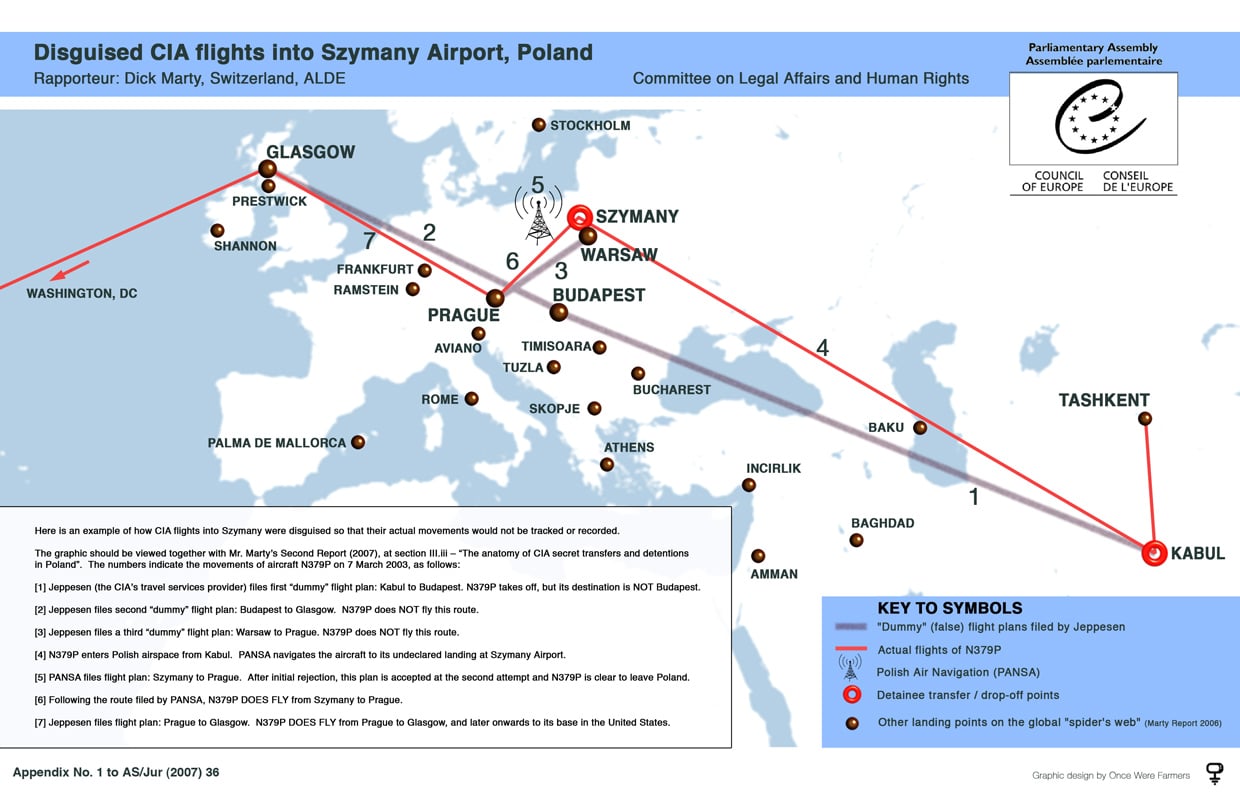
• Flights to Poland – including one that may have carried Khalid Sheikh Mohammed from Kabul to Szymany on 7 March 2003 – were deliberately disguised through the filing of “dummy” flight plans and the complicity of Polish air traffic controllers (see graphic 1)


• Mistaken terror suspect Khaled El-Masri was “homeward rendered” by the CIA from Kabul to the Bezat-Kuçova Aerodrome in Albania on 28 May 2004 (see graphic 3)


The committee said that only Bosnia and Herzegovina and Canada, a Council of Europe observer state, had fully acknowledged their responsibilities with regard to the unlawful transfers of detainees.


The parliamentarians said information as well as evidence concerning the liability of the state’s representatives for serious violations of human rights “must not be considered as worthy of protection as state secrets”.


The disclosure of the truth, they said, “is the the best way of restoring the vital co-operation between secret services for the prevention and suppression of terrorism”.

Adopted draft resolution and recommendation

Mr Marty’s explanatory memorandum (PDF)

Appendix 1 – graphic

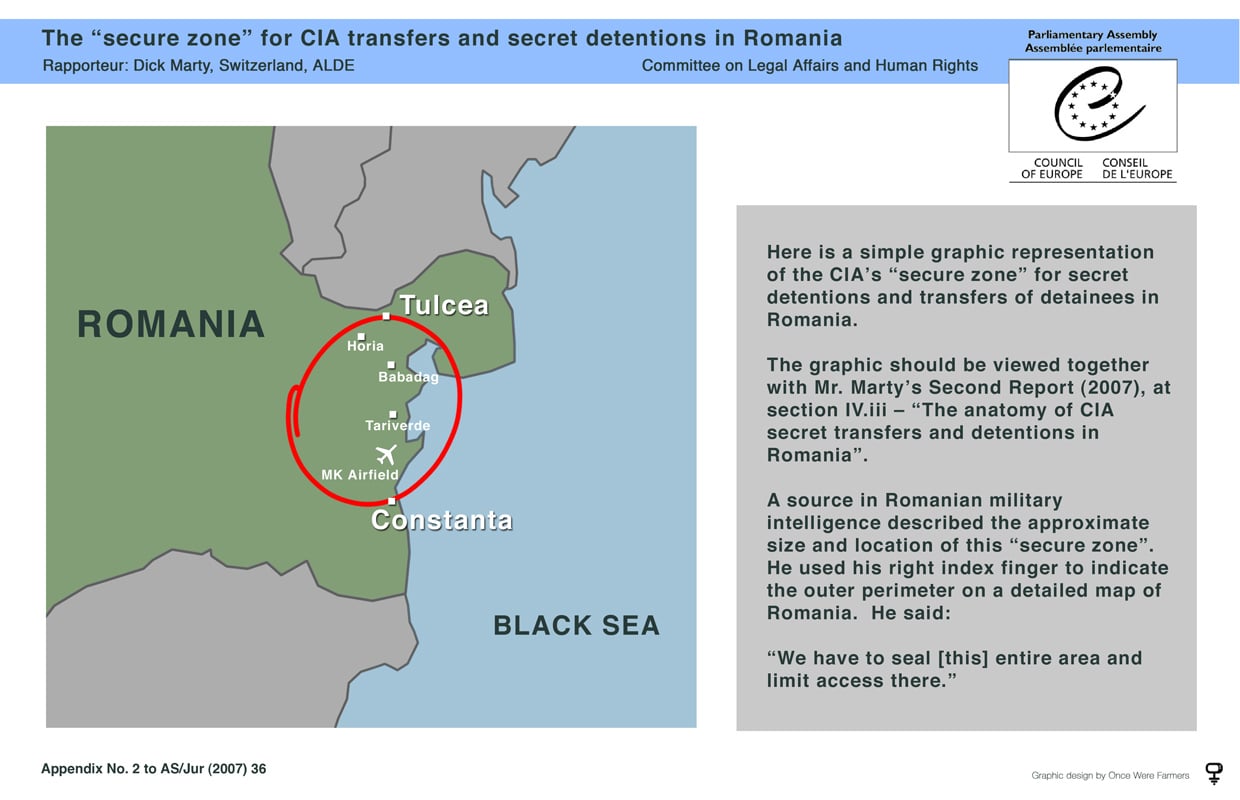
Appendix 2 – graphic

Appendix 3 – graphic (PDF)

Background: chronology and other documents

Washington and Israel discuss possible war against Syria

June 10, 2007

Washington and Israel discuss possible war against Syria

Global Research, June 9, 2007

World Socialist Web Site

Email this article to a friend

Print this article


The Bush administration has used discussions between Israeli Transportation Minister and former Defense Minister Shaul Mofaz, US Secretary of State Condoleezza Rice and Under Secretary of State Nicholas Burns to insist that there should be no talks between Israel and Syria.

State Department spokesman Sean McCormack told reporters Wednesday June 6, “We’re not going to manage Israeli foreign policy. But let’s take a look at Syria’s behavior over the recent past, and I don’t think you’re going to find many indications of Syria showing the rest of the world that they are interested in playing a constructive, positive role in trying to bring about a more peaceful, secure region.”

McCormack accused Syria of continuing to support terrorist groups in Lebanon and in the Palestinian territories and cited its links to Iran.

The possibility of opening a dialogue with the regime of Bashar al-Assad in Damascus had earlier been mooted at a special security cabinet meeting that same day in Israel by President Ehud Olmert. The meeting was called to discuss the growing threat of war with Syria.

Olmert took the occasion to stress that Israel wanted peace with Syria and must be wary of miscalculations that could lead to war. He also stated that he did not rule out direct dialogue with Syria, without any preconditions. The newspaper Yedioth Ahronoth reported that Olmert had also relayed a secret message to Damascus saying Israel would return Golan to Syria in exchange for a comprehensive peace. This included the insistence that Syria severed all ties to Iran, the Lebanese Shia Islamist movement Hezbollah and “the Palestinian terror organisations and stop funding and promoting terror.”

The framing of Olmert’s demands is deliberately provocative and strongly suggests that his pose is largely motivated by an attempt to shore up his crisis-ridden coalition government with Labour.

Olmert has no functioning defence minister, after Labour’s Amir Peretz was knocked out in the first round of the party’s leadership contest. Peretz will be replaced as party leader next week by either former Prime Minister Ehud Barak or retired admiral and former Shin Bet internal security chief Ami Ayalon, both of whom have called for Olmert to resign over the debacle suffered by Israel in the war against Lebanon last summer. Ayalon has even threatened to take Labour out of the coalition, which would force a general election.

At the security cabinet meeting Olmert claimed—without providing any evidence—that Syria had refused his call for peace talks. However, last week Syria’s Foreign Minister Walid Muallem had told the Guardian newspaper that Damascus was “ready to resume peace talks with Israel based on the principle of land for peace. Unfortunately we received many signals from Israeli public opinion but we have seen no official readiness.”

Whatever his real intentions—or indeed his own eventual fate—Olmert is responding to a very real possibility of war.

His remarks are at least in part meant to placate a section of the Israeli ruling elite that has been arguing for a concerted effort to engage with Syria, utilizing military and diplomatic threats as a stick and the Golan Heights as a carrot to drive a wedge between Damascus and what many consider to be the main enemy, Iran. These elements also seek to isolate Hezbollah prior to a possible military offensive by Lebanon’s pro-Western government of Fouad Siniora and to weaken Hamas in Gaza, where Israel is supporting President Mahmoud Abbas and Fateh in the factional warfare that has broken out.

Within the ruling coalition Peretz, who remains a significant player within Labour, has argued, “A diplomatic process with Syria could immediately and dramatically change the balance on three fronts [i.e., Syria, Lebanon and the Palestinian front], so picking up the gauntlet, or exploring any chance for sincere negotiations with Syria is, in my opinion, an option that absolutely must not be neglected.” Several other ministers, including Meir Sheetrit of Kadima and Labour’s Benjamin Ben-Eliezer, have also called for a renewal of peace talks.

On the other side of the foreign policy dispute in Israel are those opposed to any talk of concessions to Syria, who insist that Damascus must continue to be bracketed alongside Tehran and stress the need for Israel to prepare for open military conflict.

The leader of the opposition Likud, Benjamin Netanyahu, this week used the occasion of the fortieth anniversary of the 1967 Six Day war to insist that withdrawal from “Judea and Samaria” would expose Israel to the threat of annihilation. Victory had transformed Israel from a “feeble and fragile country whose existence was questionable, into a state which cannot be defeated,” he said.

On the Golan Heights, which Israel first captured in 1967 and annexed in 1981, he added, “As we are on these mountains, we are unbeatable.” At a debate organized by Peace Now, he declared, “What is a peace agreement with Syria worth? A piece of paper!”

Within the coalition Avigdor Lieberman of the right-wing Yisrael Beiteinu is vehemently against even a partial withdrawal from the Golan Heights and talks are also opposed by Shas ministers Eli Yishai and Yitzhak Cohen.

Differences of emphasis notwithstanding, both positions have developed within the framework of advanced military and political preparations for a possible war against Syria, which many sources predict could take place by the summer.

One Israeli intelligence report has suggested that Syria, Iran and Hezbollah are coordinating to form a joint front in preparation for war over the summer. Security sources also allege a Syrian arms build-up, including sophisticated Russian anti-aircraft systems and long-range missiles, and military preparations on its northern borders, including an underground missile command center capable of striking any part of Israel.

The day before the security cabinet meeting and the discussions in Washington, Israel staged a large-scale exercise involving infantry units, tank divisions and the air force in the southern Negev simulating the invasion of Syria. Peretz told the media that the Israeli Defence Force was indeed preparing for the possibility of war with Syria.

Commenting on the exercise in the Jerusalem Post, Yaakov Katz described it as an expression of the IDF’s “shift from the Palestinian and Hizbullah threat to Syria.” He noted, “For the first time in years, the annual exercise simulated the conquest of a Syrian village by infantry armor and airborne units, and not a Palestinian one, as had been tradition since the second intifada. ‘The IDF is preparing for an escalation on both the Palestinian and the northern fronts,’ Chief of General Staff Lt.-Gen. Gabi Ashkenazi said, as he watched the tanks cross over makeshift bridges to invade a ‘Syrian village.’ ‘The display seen here today is quite impressive. Only one element is lacking—an enemy.’”

The day the security cabinet met, Israel’s Channel 2 news reported that Syria has set August as the month it will finalise preparations for war and “planned to complete training of its military forces within eight months.” Channel 2 showed pictures of Israeli military tanks “ready for any possible Syrian attack” and quoted Mofaz claiming that Syria possesses long range missiles “which can hit Jerusalem in case war erupted.”

The security cabinet established an 11-member ministerial committee on Syria, which will receive regular briefings and details of the army’s preparations. Senior IDF commanders had presented to the cabinet the army’s preparations for a possible conflict on Israel’s northern border. Military Intelligence chief Major General Amos Yadlin had stressed the possibility of a war breaking out due to a “miscalculation.” He stated that the Syrian Army was capable of redeploying from its defensive formation and attacking Israel with relative speed, but he did not believe Damascus wanted to do so. His principal concern was that Syria might react wrongly to an Israeli move and encourage an attack by Hezbollah from Lebanon.

Olmert appealed for cabinet members not to discuss the possibility of war with Syria, but Lieberman actually left the cabinet meeting at one point to give a radio interview in which he claimed that Syria was arming itself at an unprecedented pace.

“Managing Israeli foreign policy” is in fact precisely what Washington is doing. The political divisions in Israel over how to deal with Syria echo those within the Bush administration, with Rice reportedly favouring diplomatic efforts to drive a wedge between Damascus and Tehran and Vice President Dick Cheney opposed. Cheney was reportedly in favour of Israel directly engaging with Syria during last summer’s attack on Lebanon and led Republican denunciations of the visit to Syria in April by House Speaker Nancy Pelosi, a Democrat.

Rice herself met with Syria’s foreign minister for a “business-like” 30 minutes on May 3 at a conference on how to stabilize Iraq at Sharm el Sheik, Egypt—and also tried unsuccessfully to meet with her Iranian counterpart. But afterwards she again assumed a hard line, insisting that Damascus had to close its Iraq border to foreign fighters and crack down on Palestinian “extremists” if it wanted to restore relations with Washington.

After his meeting with Rice and Under Secretary of State Nicholas Burns, Mofaz, who had also earlier raised the possibility of talks with Syria, stressed that Israel wanted to give greater priority to building peace with the Palestinians. When asked whether peace efforts would be revived with Syria, he replied several times, “Our first priority should be Palestinian discussions.”

He also insisted that “Hezbollah will never leave southern Lebanon. It is arming with missiles that could hit central and even southern Israel.” And he urged that a deadline of the end of this year be placed on Iranian compliance with US demands for the suspension of its nuclear programme.

The next day, Mofaz responded to reports of a seizure of armaments by the Lebanese army by insisting that the weapons had come from Iran via Syria.

En route to Berlin for a meeting of Middle East Quartet, Rice denied Washington was blocking Israeli efforts to engage in peace talks with Syria.

“No one is opposed to Israel pursuing other tracks, including a Syria track,” she said, “But my understanding is that it’s the view of the Israelis and certainly our view that the Syrians are engaged in behavior right now that is destabilizing to the region.”

Such a track could be pursued at a future date, she added.

For its part, Syria has indicated its belief that Israel will initiate military hostilities. Muhammad Habash, a member of parliament, told Al-Jazeera on May 5 that it was no secret that Syria was “actively” preparing for a military encounter with Israel, which wanted war in order to survive politically.

Chris Marsden is a frequent contributor to Global Research. Global Research Articles by Chris Marsden

What Happens in CIA Jails in Europe

June 10, 2007

Source: The New York Times

Rights Group Offers Grim View of C.I.A. Jails


Published: June 9, 2007

PARIS, June 8 — In a report on Friday, the lead investigator for the Council of Europe gave a bleak description of secret prisons run by the Central Intelligence Agency in Eastern Europe, with information he said was gleaned from anonymous intelligence agents.

Prisoners guarded by silent men in black masks and dark visors were held naked in cramped cells and shackled to walls, according to the report, which was prepared by Dick Marty, a Swiss senator investigating C.I.A. operations for the Council of Europe, a 46-nation rights group.

Ventilation holes in the cells released bursts of hot or freezing air, with temperature used as a form of extreme pressure to wear down prisoners, the investigators found. Prisoners were also subjected to water-boarding, a form of simulated drowning, and relentless blasts of music and sound, from rap to cackling laughter and screams, the report says.

The report, which runs more than 100 pages, says the prisons were operated exclusively by Americans in Poland and Romania from 2003 to 2006. It relies heavily on testimony from C.I.A. agents.

Critics in Poland and Romania attacked Mr. Marty’s use of anonymous sources and issued categorical denials, as they have done repeatedly. Denis MacShane, a British member of Parliament and longtime critic of Mr. Marty, complained that the investigator “makes grave allegations to two European Union member states, Poland and Romania, without any proof at all.”

Tomasz Szeratics, a spokesman for the Polish Ministry of Foreign Affairs, said: “We shall not make any comments on Dick Marty’s latest report until we receive it officially and analyze the evidence presented. The Polish position remains unchanged and it is very clear: There were no secret C.I.A. detention centers on the territory of the Republic of Poland.”

But Mr. Marty said at a news conference in Paris that anonymous testimony was backed by thousands of flight records showing prisoner transfers, including private planes linked to the C.I.A. that made 10 flights from Afghanistan and Dubai to the Szczytno-Szymany International Airport in Poland between 2002 and 2005.

That was the closest airport to a Soviet-era military compound where about a dozen high-level terror suspects were jailed, the report charges. The local authorities formed secure buffer zones around the jails, which were operated exclusively by Americans, Mr. Marty reported.

Lower-level prisoners from Afghanistan and Iraq were held at a military base near the Black Sea in Romania, the report says. The Romanians were restricted to the buffer zone.

“Our Romanian officers do not know what happened inside those areas because we sealed them off and we had control,” the report cites a senior military agent as saying.

The details of prison life were given by retired and current American intelligence agents who had been promised confidentiality, the report says.

Their motives were varied, Mr. Marty said. “For 15 years, I have interviewed people as an investigating magistrate and I have always noticed that at a certain point, people with secrets need to talk,” he said.

Others justified the grim treatment, the reports said, saying, in one instance: “Here’s my question. Was the guy a terrorist? ’Cause if he’s a terrorist, then I figure he got what was coming to him.”

According to the report, suspects were often held for months with no contact except with masked, silent guards who would push meals of cheese, potatoes and bread through hatches.

When prisoners resisted, the report says, one investigator considered it a welcome sign. “You know they are starting to crack,” he said, “So you hold out. You push them over the edge.”

Secret C.I.A. Prisons in Europe

June 10, 2007

Source: The New York Times


Published: June 8, 2007

LONDON, June 7 — Investigators have confirmed the existence of clandestine C.I.A. prisons in Romania and Poland housing leading members of Al Qaeda, contends a new report from the Council of Europe, the European human rights monitoring agency.

Dick Marty, the Swiss senator leading the inquiry, said in a recent interview that his conclusions were based on information from intelligence agents on both sides of the Atlantic, including members of the C.I.A. counterterrorism center. The report is to be released on Friday.

The report says the jails operated from 2003 to 2005. “Large numbers of people have been abducted from various locations across the world and transferred to countries where they have been persecuted and where it is known that torture is common practice,” it says.

These suspects included Khalid Shaikh Mohammed, the confessed master planner for the Sept. 11 attacks; Ramzi bin al-Shibh, a member of the Hamburg, Germany, cell that organized the conspiracy; and Abu Zubaida, believed to have been a senior figure in Al Qaeda.

The report says that some of the information comes from trusted intelligence agents, who reported directly to former President Aleksander Kwasniewski of Poland and to two former Romanian leaders, Ion Iliescu and Traian Basescu.

The governments of Poland and Romania have denied the existence of such prisons, and officials could not be reached for comment on Thursday. Poland has criticized Mr. Marty and his investigators in the past for not traveling there to investigate the compound that the report describes as a prison.

The current president, Lech Kaczynski, has said that since he came to power in December 2005 “there has been no secret prison — I am 100 percent sure of it,” adding, “I am assured there never were any in the past either.”

Romania has repeatedly denied the presence of a secret prison there.

But last year, President Bush acknowledged for the first time that terrorism suspects had been held in C.I.A.-run prisons overseas, without specifying where.

Paul Gimigliano, a C.I.A. spokesman, said Thursday that, “While I’ve yet to see the report, Europe has been the source of grossly inaccurate allegations about the C.I.A. and counterterrorism,” and he added, “People should remember that Europeans have benefited from the agency’s bold, lawful work to disrupt terrorist plots.”

The report contends, “What was previously just a set of allegations is now proven.” An advance copy of the report was obtained by the British Channel 4 program “Dispatches” and provided to The New York Times.

Apart from the statements of what his report describes as former and serving intelligence agents, Mr. Marty quotes aviation records that he suggests provide detailed evidence of clandestine visits by C.I.A. planes to Szymany, in Poland; as well as the text of confidential military agreements signed between the United States and Romania that, he suggests, allowed the establishment of a C.I.A. base in the country.

Mr. Marty said the C.I.A.’s partners in establishing the secret prisons were the military intelligence agencies of both countries, which reported only to their presidents and defense ministers. Neither the countries’ prime ministers nor the two Parliaments’ intelligence committees were consulted or informed.

Prisoners in the secret jails were subjected to sleep deprivation and water-boarding, or simulated drowning, said Mr. Marty, who also said that the two jails had been divided into two categories.

The main C.I.A. jail was centered in a Soviet-era military compound at Stare Kjekuty, in northeastern Poland, where about a dozen high-level terrorism suspects were jailed, the report concludes. Lower-level prisoners from Afghanistan and Iraq were held in a military base near the Black Sea in Romania, the report contends.

Jails were staffed entirely by the C.I.A., and local guards secured the perimeters, the report says. “The local authorities were not supposed to be aware of the exact number or the identities of the prisoners who passed through the facilities — this was information that they did not ‘need to know,’ ” the report said.

Mr. Marty said last month in an interview with the Swiss newspaper La Liberté that the report relied on information from disaffected C.I.A. agents and other intelligence officials on the other side of the Atlantic. Many of the agents said they were surprised that the prisons remained a secret for so many years. “They spoke to me because they found what was happening to be disgusting,” he was quoted as saying.

The report includes more specific conclusions than a study issued in June last year that contended that at least 14 European countries had accepted secret transfers of terrorism suspects by the United States. That report listed a web of landing points around the world that it said had been used by American authorities for its air network.

The new report contends that the C.I.A. took extraordinary measures to cover its activities. When C.I.A. jets flew to the Szymany airport in Poland, they used flight plans with “fictitious routes,” it says, giving no indication that the airport was the destination. Polish air traffic controllers — working with military intelligence — completed the cover-up, the report says.

Although the report singled out Poland and Romania, it said that it could not rule out the possibility that other European countries permitted these jails to operate.

Among its accusations, this report said NATO agreements, under the guise of waging a “war on terror,” provided the framework that the C.I.A. used to expand its European operations after Sept. 11.

The Marty report says it would be pointless for researchers to visit the Polish compound because “we have no doubts about the capability of those who would have removed any traces of the prisoner’s presence.”

Mark Mazzetti contributed reporting from Washington.

Dr Nasir Khan: The End of State-Socialism and the Future of Marxism

June 9, 2007

Sources:

https://sudhan.wordpress.com/wp-admin/post.php?action=edit&post=59

http://www.socialistviewpoint.org/mayjun_07/0507001.htmlThe rapid course of events that had started unfolding in the second half of 1989 in Eastern Europe eventually culminated in the disintegration of the Soviet Union by the end of 1991. These colossal changes in the former Eastern bloc countries undoubtedly constitute one of the major turning points in the history of the twentieth century. In view of the epochal changes that had taken place, political observers asked questions, such as: What will be the final outcome of these developments? What sort of new global order will emerge to replace the former balance of power between the East and the West? How is the United States as the sole superpower going to behave in relation to those countries that choose to follow their independent socio-economic developments, stand for their national interests or refuse to bow to the U.S. domination and pressure? As it turned out, no one had to wait long for the answers. The events during the last fourteen years are before us. They have revealed clearly the shape of international developments.

Let us take a quick glance at some of the events. We have seen how during the course of the last sixteen years the U.S. has virtually monopolized the United Nations and started to use it to dictate its decrees in the international organization. In the first place, this ploy succeeds because it gives the appearance of legalistic formality to the American conduct before the silent majority in the international community who in any case has little or no effective influence on the major decisions, which are taken in the Security Council. Secondly, this practice has been closely associated with asserting the full weight of the U.S., the only superpower in the international arena. The foundation of this role is to protect and increase the sphere of the U.S. interests. These, in any case, are not confined to any fixed area or location; they extend to the whole world in general, and in particular, the oil-rich countries of the Middles East. At the same time, only the U.S. can define and proclaim its national interests in any manner it chooses to do so. This assertion of supra-national interests is backed by the most destructive military arsenal and prowess in the human history as well as by using the policy of terror and intimidation against those countries that dare to defy the United States diktat.

continued…

Draft Resistance Is A Human Right

June 9, 2007

Selective Service Draft Registration Freeze Initiative Resolution Committee

Aska Draft Registration Freeze
scott@draftresistance.org

This site is a crime against the Military Selective Service Act. It advocates. We are specifically encouraging resistance to the registration laws of the United States, seeing registration as the necessary step toward conscription (the draft). We are what the Selective Service calls ‘anti-war intellectuals.’ We see the direct link between registration, the draft, and aggressive war. Remember, non- registration is the strategy to beat the draft. If enough of us refuse, there is nothing they can do!
Scott A Kohlhaas

7 reasons to refuse selective service
How to UN-Register

Defining patriotism

EDITORIAL – Ron Paul before the U.S. House of Representatives, May 22, 2007

Read more…

Posted on May 24, 07 | 9:24 pm

The truth is getting him fired VA says the rules will cost agency a valued worker

VA says the rules will cost agency a valued worker

Read more…

Posted on May 11, 07 | 7:44 pm

The Draft and Dirigibles

A highly-qualified Veteran’s Administration employee is being fired for failure to register with the Selective Service.

Read more…

Posted on May 11, 07 | 7:42 pm

Amman opts to resume military conscription

Jordan has decided to resume limited military conscription for men and women.

Read more…

Posted on Mar 08, 07 | 3:44 pm

AFP Conscripts prepare to boost Eritrea’s defences on tense border

For Eritrea, a nation that has spent most of the past half-century in bloody battles against arch-foe and large neighbour Ethiopia, war worries are never far from people’s minds.

Read more…

Posted on Mar 01, 07 | 3:33 pm

SELECTIVE SERVICE STUDIED RAPID-FIRE DRAFT PLAN

The Selective Service System last year studied whether it should revert to a Cold War-era plan of being able to draft people within 13 days of a crisis, compared to its current goal of carrying it out within six months.

Read more…

Posted on Feb 25, 07 | 7:43 pm

Regiment is in ‘parlous state’, MP tells House of Commons

A British MP has launched a stinging attack on the Bermuda Regiment in the House of Commons.
Anti-conscription campaigner Andrew MacKinlay – a member of the ruling Labour Party – said the Regiment was in a “parlous state”.

Read more…

Posted on Feb 18, 07 | 11:15 pm

Why Did Bush Invade Iraq?

June 8, 2007

Source: CounterPunch.org

Why Did Bush Invade Iraq?


The Secret War

BY PAUL CRAIG ROBERTS

American soldiers have been fighting and dying in Iraq since 2003, and Americans do not know why.

All the reasons President Bush gave us for his war are false. Bush said he invaded Iraq “to disarm Iraq of weapons of mass destruction, to end Saddam Hussein’s support for terrorism, and to free the Iraqi people.”

We now know that these were false claims. Disinformation about Iraq was produced by a special unit within the Pentagon run by Rumsfeld, Wolfowitz and Feith. The unit operated outside the normal intelligence channels of the CIA and DIA. Its purpose was to create false intelligence to enable Bush to initiate war with Iraq.

Did President Bush know that the claims put into his speeches by his speechwriters was false?

Who instructed Bush’s speechwriters to incorporate known lies into the President’s speeches?

Why did Vice President Cheney, the Secretary of State, the National Security Advisor, and the Secretary of Defense all lie to the American people and to the entire world?

What is the real agenda?

Millions of Americans have come to their own conclusions about the reasons for Bush’s invasion: (1) Oil: the US government wants to hold on to power by expanding its control over oil, and Bush and Cheney want to reward their oil company cronies. (2) Military-security complex: Police agencies favor war as a means of expanding their power, and military industries favor war as a means of expanding their profits. (3) Neoconservative ideology: Neocons’ believe in “American exceptionalism” and claim that America’s virtue gives the US government the right and the obligation to impose US hegemony on the rest of the world, especially in the Middle East where independent Muslim states object to Israel’s theft of Palestine. (4) Karl Rove: Rove used the “war president” role to rescue Bush from attack by Democrats as an illegitimate president elected by one vote of the US Supreme Court. (5) American self-righteousness over 9/11 and lust for revenge.

All of these reasons came together to make a cruel war on an innocent people.

There may be other reasons about which we know not.

As it is now recognized that every reason for the war is false or illegitimate, the question is: why does Bush insist on persisting with a costly war, the express reasons for which are now known to be mistakes? There were no weapons of mass destruction, no connections to al Qaeda, and Bush has installed a puppet Iraqi government that cannot venture outside the heavily fortified and US protected “green zone.” The Iraqi government governs nothing.

War without cause is murder, not war.

That Bush persists with a war for which he can provide no legitimate reason indicates that there is a secret agenda that has not been shared with the American people. Are we experiencing the privatization of the US government by police agencies, the military-security complex, and the Israel Lobby?

That the American people and their elected representatives continue to tolerate a war that has killed and maimed thousands of their own soldiers, destroyed the infrastructure of a country,

killed hundreds of thousands of Iraqi civilians and created 4 million refugees for no known reason raises serious questions about the morals of the American people.

Is the impotence of the peace movement due to the power of the Israel Lobby or have Americans become morally degenerate as commentators increasingly assert?

One indication would be the response of presidential candidates to the gratuitous and failed war. What we saw at the Republican presidential candidates’ debate on June 5 is inconsistent with the self-esteem of the American people. All of the leading Republican presidential candidates openly and nonchalantly endorsed using nuclear weapons against Iran unless Iran abandons its right to enrich uranium under the non-proliferation treaty, to which Iran is a signatory (unlike nuclear-armed Israel, India, and US puppet Pakistan).

What is moral degeneracy if it is not using nuclear weapons to murder masses of innocent civilians and spread deadly radioactivity over vast areas merely in order to force a country to do as we order? If this isn’t barbarism, what is barbarism?

Do the American people realize that the frontrunners for the Republican presidential nomination are monsters who want to murder people who have done us no harm?

After five years of war that has achieved no noble purpose, no valid aim, indeed, no aim at all except perhaps Osama bin Laden’s aim of stirring up uncontrollable strife in the Middle East, how can Republicans cheer for candidates who preach a wider war and the use of nuclear weapons against defenseless people?

Is the approval lavished on Republican presidential candidates, who are willing to use nuclear weapons as means of terrorizing Muslim peoples, an indication that the American people have morphed into inhuman monsters?

If not, what does it indicate? Ignorant fanaticism? Paranoia? Blind hatred? The belief that no one is of any value but Americans?

For six and one-half years the Bush Regime has relied on coercion, intimidation, war, and threats of war. Diplomacy and good will have been shunned. The regime’s blatant warmongering has resurrected the nuclear arms race. China and Russia regard America’s drive for world hegemony with great alarm. China has put nuclear ICBMs on mobile platforms to increase their survivability in event of an American attack. Russia has developed new multi-warhead ICBMs, which can penetrate any known missile defense, and new cruise missiles that Putin says will be targeted on Europe if the US persists in its aggressive military encirclement of Russia.

An administration that resurrects the threat of nuclear Armageddon so that its cronies in the military-security complex can become still richer is evil beyond compare.

Paul Craig Roberts was Assistant Secretary of the Treasury in the Reagan administration. He was Associate Editor of the Wall Street Journal editorial page and Contributing Editor of National Review. He is co-author of The Tyranny of Good Intentions. He can be reached at: PaulCraigRoberts@yahoo.com