The Bush administration’s approval of the abuse of detainees is a toxic legacy for the next US president
-

- Philippe Sands The Guardian, Saturday October 18 2008
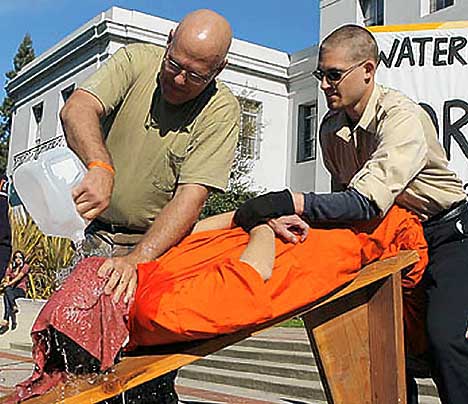
As the US presidential election reaches a climax against the background of the financial crisis, another silent, dark, time bomb of an issue hangs over the two candidates: torture. For now, there seems to be a shared desire not to delve too deeply into the circumstances in which the Bush administration allowed the US military and the CIA to embrace abusive techniques of interrogation – including waterboarding, in the case of the CIA – which violate the Geneva conventions and the 1984 UN torture convention.
The torture issue’s cancerous consequences go deep, and will cause headaches for the next president. New evidence has emerged in Congressional inquiries that throw more light on the extent to which early knowledge and approval of the abuse went to the highest levels. What does a country do when compelling evidence shows its leaders have authorised international crimes?
For three years I have followed a trail which leads unambiguously to the conclusion that the real bad eggs were not Lyndie England or others on the ground in Abu Ghraib, but the most senior officials in the White House, the Pentagon and the department of justice. Over recent months, Congress has been looking into the role of senior officials involved in the development of interrogation rules. These have attracted relatively scant attention; little by little, however, senators and congressmen have uncovered the outlines of a potentially far-reaching criminal conspiracy.
The first hearings were convened before the judiciary committee of the House of Representatives, at the instance of its chairman, Congressman John Conyers, apparently off the back of my book Torture Team. Parallel hearings have been held before the Senate armed services committee.
The evidence that has emerged is potentially devastating. It confirms, for instance, that the search for new interrogation techniques for use at Guantánamo began not with the local military but in the offices of Donald Rumsfeld and his chief lawyer, Jim Haynes. It shows that when the career military expressed objections on legal grounds, Haynes intervened to stop the normal process of review. And it shows a previously unknown interplay between the department of defence and the CIA: a visit to Guantánamo in September 2002 by the administration’s most senior lawyers was followed days later by a senior CIA lawyer, to brief on the new techniques. “If someone dies while aggressive techniques are being used,” he explained, “the backlash of attention would be severely detrimental.”
Last month the Senate armed services committee received new material from Condoleezza Rice, the first cabinet-level official to confirm high-level involvement in discussions on interrogation techniques. “I participated in a number of meetings in 2002 and 2003 … at which issues relating to detainees in US custody, including interrogation issues, were discussed,” she said. Those present at such meetings included Rumsfeld, attorney general John Ashcroft, Colin Powell, Paul Wolfowitz and CIA director George Tenet. The meetings, which concerned the CIA programme, “occurred inside the White House”. Rice confirmed she was aware of the existence of, but did not read, the justice department legal advice of August 1 2002 that abandoned the international definition of torture and replaced it with a definition drawn from a US Medicare statute.
Buried away in this testimony lies the most dangerous material of all: evidence which may establish that abuses on detainees in Iraq in September 2003, in the period perhaps including the events at Abu Ghraib, were the result of decisions taken at the highest levels of the administration. The administration has long proclaimed it did not allow aggressive interrogations in Iraq, since the Geneva conventions applied. Last month we learned this was false: not everyone had protection under Geneva. If you were considered to be a terrorist, you had no protection at all. A senior US intelligence officer visited Iraq in September 2003. He witnessed abusive interrogation techniques that violated Geneva and complained. The response? He was told the techniques “were pre-approved by DoD GC or higher”. DoD GC is the general counsel at the department of defence, Jim Haynes. Who could be higher? His boss: Rumsfeld.
I have testified before Congress on these issues, and have been asked if there should be criminal investigations and prosecutions. At the very least, the next US president must ensure the full facts are established. It will then be for others to decide what follows. But if the US doesn’t get its own house in order and restore its reputation for the rule of law, others will surely step in.
• Philippe Sands QC is professor of law at UCL, a barrister at Matrix Chambers and author of Torture Team p.sands@ucl.ac.uk


 Peace and Justice Post
Moderation in the Pursuit of Justice Is No Virtue
November 20, 2008Joseph L. Galloway | McClatchy Newspapers, Nov 18, 2008
With two months still to go before his inauguration as the 44th President of the United States, Barack Obama and his transition team are already getting off on the wrong foot, signaling that they have no intention of investigating anyone in the Bush administration for possible war crimes.
What we’re talking about here is the torture of detained terrorist suspects in American custody in a grotesque violation of both our treaty obligations under the Geneva Conventions and our historic principles as a democratic nation.
By their own machinations and attempts to redefine and pervert both treaties and our own laws, President Bush, Vice President Dick Cheney, former Defense Secretary Donald H. Rumsfeld, Attorneys General John Ashcroft and Alberto Gonzales, Cheney’s chief of staff David Addington and any number of lesser suspects sought to shield themselves from, or put themselves above, justice.
They did so knowing full well that what they were doing — clearing the way for interrogators at Guantanamo and in the Central Intelligence Agency’s secret dungeons around the world to do anything it took, short of murder, to extract information from terror suspects.
The “harsh interrogation methods” included water-boarding, stripping and humiliating prisoners, subjecting them to extremes of temperature, putting them into stressful physical positions for hours, the use of psychotropic drugs and doubtless other equally uncivilized practices.
Water boarding has always been treated as a criminal act in this country. Military officers were court-martialed at the turn of the last century for water boarding Filipino guerrillas. More recently, an East Texas sheriff was sentenced to 10 years in federal prison for water boarding a suspect and extracting a confession from him.
Moderation in the pursuit of justice is no virtue, and its no way to begin an administration that was elected on promises of change. What it says is that if you’re one of the elite and powerful, your violations of the law will be overlooked, no matter how much damage you did to our country’s standing in the world.
What signal does it send to Mr. Bush’s gang of unindicted co-conspirators, who’ve unwrapped a Pandora’s boxful of other offenses — from perverting the administration of justice, to illegally eavesdropping on the phone conversations and e-mails of ordinary Americans, to salting the stream of intelligence with bogus material, to inviting their cronies to loot the Treasury with no-bid military contracts, to lying under oath to congressional oversight committees, to applying political litmus tests to the hiring of civil service employees to the wholesale destruction of White House e-mails and records? Etcetera. Etcetera.
This nation was founded on the principle of equal justice under the law. No one — no one — ought to be able to skate or hold a get-out-of-jail-free card by virtue of having been the most powerful felon in the land, or of working for him.
This signal on torture investigations says that Sen. Obama wants to start his administration as a uniter, not a divider, trying to untangle the unholy mess that the Decider and Co. are leaving behind them in the economy, in our military, in virtually every walk of our national life. It speaks to his desire to reach across the aisle to the defeated Republicans and try to bring them back into the fold as Americans.
That’s all well and good, but not if it comes at the cost of lifting the blindfold off Justice’s eyes and letting her pick and choose who’ll pay for criminal acts and who won’t. That’s no way to begin, and no way to continue.
Out in West Texas, crusty old ranchers plagued by coyotes killing their calves and baby sheep shoot the offending beasts and hang their carcasses on the nearest barbed wire fence as an object lesson to the rest of the pack.
Unless the newly empowered Democrats in the White House and on Capitol Hill hang a few coyotes on some fences in Washington, D.C., they’re making a huge mistake that will come back to haunt them, and all the rest of us, too.
Unless the truth, the whole truth, is unearthed, justice is done and the Republican closet is emptied of festering transgressions, the next pack will do it again, secure in the knowledge that their positions will protect them from the penalties that more ordinary citizens must pay for the same crimes.
The people of this nation have spoken loudly. They voted to throw the rascals out. They voted for a different way of governing, a different way of law making. They voted for equal rights under the law.
If their desires aren’t satisfied — if the new broom sweeps no cleaner than the old one — the next time around they may move things up a notch and throw all the bastards out — and they’d be fully justified in doing so.
Share this:
Tags:American violations of international law and the Genev, Bush administration, President-elect Obama, torture, War Criminals, waterboarding
Posted in Commentary, Human rights, USA, War Criminals | Leave a Comment »