Posts Tagged ‘US military’

Killings of Afghan civilians sharply up, U.N. says

September 17, 2008

By Stephanie Nebehay

GENEVA, Sept 16 (Reuters) – Nearly 1,500 Afghan civilians were killed in the first eight months of this year, many in attacks on schools, medical clinics, bazaars and other crowded areas, the United Nations said on Tuesday.

The death toll, up 39 percent from the same period in 2007, includes 800 killings blamed on Taliban and other militants as well as 577 caused by Afghan forces and their U.S.-led coalition allies. Responsibility for another 68 deaths was not clear.

The U.N. human rights office said the spike in fatalities had coincided with “a systematic campaign of intimidation and violence” by Taliban forces targeting doctors, teachers, students, tribal elders, civil servants, former police and military personnel and public construction workers.

“The number of killings by the Taliban and other anti-government forces almost doubled by comparison with the first eight months of 2007, with the numbers killed by government and international military forces also increasing substantially,” it said in a report.

There were 330 civilians killed in Afghanistan in August alone, spokesman Rupert Colville said.

“That’s the highest number of civilian deaths to occur in a single month since the end of major hostilities and the ousting of the Taliban regime at the end of 2001,” he told a news briefing in Geneva, where the U.N.’s human rights work is based.

Air strikes by international forces caused nearly 400 civilian deaths in the year through August, the U.N. office said, calling for accountability and greater transparency about those attacks.

The Taliban carried out 142 summary executions and also used suicide attacks and improvised explosive devices, according to the report drawn up by human rights officers attached to the U.N. Assistance Mission in Afghanistan.

COMMUNITIES FEARFUL

In a statement, U.N. High Commissioner for Human Rights Navanetham Pillay said there was “substantial evidence” that the Taliban was seeking to intimidate aand attack Afghan civilians thought to support the Afghan government, the international community and military forces.

While most Taliban attacks focused on military and government targets, “such operations were frequently undertaken in crowded civilian areas such as bazaars or busy roads,” the U.N. report found.

“Such attacks terrorise communities and make them fearful of supporting or even associating with the government,” it said. “Schools and medical services, in particular, have become prime targets for attack by anti-government elements”.

It singled out a suicide bombing during a dog fight in Kandahar province last February which killed 67 spectators, and a bomb in July at the Indian embassy in Kabul which killed 50.

An air strike on a wedding party in Nangahar province last July killed 47 civilians, including 30 children, and a strike in Azizabad village in western Herat’s Shindand district on Aug. 22 caused 92 civilian deaths, including 62 children, it said.

The U.S. military, which initially said 30 to 35 militants were killed in Azizabad, plans to reopen the investigation into the incident after a cellphone video emerged showing bodies of people said to have been killed in the strike.

Pillay, a former International Criminal Court judge who took up as the top U.N. rights official this month, said civilians must to be shielded from the ongoing fighting in Afghanistan.

“It is also imperative that there is greater transparency in accountability procedures for international forces involved in incidents that cause civilian casualties,” she said. (editing by Laura MacInnis and Robert Hart)

AlertNet news is provided by

http://lite.alertnet.org/images/reuterslog.gif

US air power triples deaths of Afghan civilians, says report

September 8, 2008
Afghan boy injured in US air strike

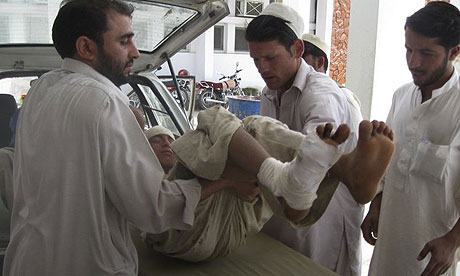
An injured Afghan boy is put on a stretcher at a hospital in Jalalabad city, Afghanistan. Photograph: Nesar Ahmad

Civilian deaths in Afghanistan from US and Nato air strikes have nearly tripled over the past year, with the onslaught continuing in 2008 and fuelling a public backlash, a leading human rights group says today.

The report by Human Rights Watch Human Rights Watch says that despite changes in the rules of engagement which had reduced the rate of civilian casualties since a spike in July last year, air strikes killed at least 321 civilians in 2007, compared with at least 116 in 2006. In the first seven months of this year at least 540 Afghan civilians were killed in fighting related to the armed conflict, with at least 119 killed by US or Nato air strikes, such as this July’s attack on a wedding party which killed 47, says Human Rights Watch.

“There has been a massive and unprecedented surge in the use of air power in Afghanistan in 2008,” the report says. It found that few civilians casualties were the result of planned air strikes on suspected Taliban targets. Instead, most were from air strikes during rapid response missions mostly carried out in support of “troops in contact” – ground troops under insurgent attack. Such strikes included situations where American special forces – normally small in number and lightly armed – came under insurgent attack.

“In response to increased insurgent activity, twice as many tons of bombs were dropped in 2007 than in 2006,” the report says. “In 2008, the pace has increased: in the months of June and July alone the US dropped approximately as much as it did in all of 2006. Without improvements in planning, intelligence, targeting, and identifying civilian populations, the massive use of air power in Afghanistan will continue to lead to unacceptably high civilian casualties.”

“Mistakes by the US and Nato have dramatically decreased public support for the Afghan government and the presence of international forces providing security to Afghans,” said Brad Adams, Asia director at Human Rights Watch. The report criticises the response given by US officials when civilian deaths occur. Before conducting investigations, US officials often immediately deny responsibility for civilian deaths or place all blame on the Taliban, the report says.

US investigations have been “unilateral, ponderous, and lacking in transparency, undercutting rather than improving relations with local populations and the Afghan government”.

Last night the US military announced it would reopen its investigation of an air strike last month in which the Afghan government says 90 civilians, mainly women and children, were killed. An initial US inquiry found that up to 35 suspected insurgents and seven civilians died in the attack on Azizabad in Herat province, but General David McKiernan, the senior US officer in Afghanistan, announced a review in the light of “new information”. Afghan and western officials say that videos of the bombing’s aftermath shows dozens of dead civilians.

US military trained Georgian commandos

September 7, 2008

By Charles Clover in Moscow and Demetri Sevastopulo in Washington | Financial Times, September 5 2008

The US military provided combat training to 80 Georgian special forces commandos only months prior to Georgia’s army assault in South Ossetia in August.

The revelation, based on recruitment documents and interviews with US military trainers obtained by the Financial Times, could add fuel to accusations by Vlad­imir Putin, Russian prime minister, last month that the US had “orchestrated” the war in the Georgian enclave.

The training was provided by senior US soldiers and two military contractors. There is no evidence that the contractors or the Pentagon, which hired them, knew that the commandos they were training were likely be used in the assault on South Ossetia.

A US army spokesman said the goal of the programme was to train the commandos for duty in Afghanistan as part of Nato-led International Security Assist­ance Force. The programme, however, highlights the often unintended consequences of US “train and equip” programmes in foreign countries.

The contractors – MPRI and American Systems, both based in Virginia – recruited a 15-man team of former special forces soldiers to train the Georgians at the Vashlijvari special forces base on the outskirts of Tbilisi, part of a programme run by the US defence department.

MPRI was hired by the Pentagon in 1995 to train the Croatian military prior to their invasion of the ethnically-Serbian Krajina region, which led to the displacement of 200,000 refugees and was one of the worst incidents of ethnic cleansing in the Balkan wars. MPRI denies any wrongdoing.

US training of the Georgian army is a big flashpoint between Washington and Moscow. Mr Putin said on CNN on August 29: “It is not just that the American side could not restrain the Georgian leadership from this criminal act [of intervening in South Ossetia]. The American side in effect armed and trained the Georgian army.”

The first phase of the special forces training was held between January and April this year, concentrating on “basic special forces skills” said an American Systems employee interviewed by phone from the US army’s Fort Bragg.

The US military official familiar with the programme said the Pentagon hired the military contracting firms to help supplement its own trainers because of a lack of manpower.

The second 70-day phase was set to begin on August 11, a few days after war broke out in South Ossetia. The trainers arrived on August 3, four days before the conflict flared on August 7. “They would have only seen the inside of a hotel room,” quipped one former contractor. Neither MPRI nor American Systems would speak at length to the FT about the programme.

American Systems di­rected questions to the US army’s Security Assistance Training Management Organisation (Satmo) at Fort Bragg, part of the US Army’s Special Warfare Center School. Satmo sends trainers, mainly special forces but also contractors, to countries such as Yemen, Colombia and the Philippines. Satmo trainers generally work with forces involved in counter-insurgencies, counter-terrorism or civil wars. A Satmo spokesman declined to comment.

One US military official familiar with the programme said it emerged from a Georgian offer to the US in December 2006 to send commandos to Afghanistan to work alongside American special operations forces.

According to this person, the US told Georgia that the offer should be made through Nato, which welcomed the offer but informed Georgia that its forces would need additional training to meet the military alliance’s standards.

While the programme is not classified, there is a lack of transparency surrounding it, though US military officials said the lack of publicity was not part of an effort to keep the programme secret. Other US military training programmes in Georgia have their own websites and photo galleries.

A US European Command spokesman confirmed the existence of the programme only after reviewing an e-mail sent by MPRI recruiters that was obtained by the FT. According to the e-mail, which did not mention Nato operations, former US special operations forces would receive $2,000 ($1,150, €1,400) a week plus costs as trainers. “We can confirm the pro­gramme exists, but due to its nature and training ob­jectives we do not discuss specifics to ensure the integrity of the programme and force protection of the trainers and participants,” he said.

James Appathurai, Nato’s spokesman in Brussels, said: “Georgia has made an offer to provide forces to Isaf in the last two years. But until now these Georgian forces have not joined the Isaf mission.” An official at a senior Nato member state said it was understood that the forces had been trained by the US, but that the forces had not passed a certification process under which all potential members of the Isaf mission are vetted.

Additional reporting James Blitz in London

Conflict in the Caucasus

The conflict between Russia and Georgia began on the night of August 7, when Georgian forces, including commando units, tanks and artillery, assaulted the South Ossetian capital of Tskhinvali.

Russia says that at least 133 civilians died in the attack, as well as 59 of its own peacekeepers, according to figures released this week.

In response Russia launched a mass invasion and aerial bombardment of Georgia, in which 215 Georgians have died, including 146 soldiers and 69 civilians.

Torture’s Political Invisibility

August 20, 2008

Bangor Daily News (Maine), August 19, 2008

by John Buell

That U.S. military personnel — and their superiors — supported the torture of enemy combatants elicits disturbingly little outrage among most voters. Human beings seldom torture those they regard as like themselves. Humans need and crave community, but throughout history narrow definitions of community and exaggerated claims on its behalf have occasioned grave injustices.

The most widely accepted defense of torture is a limited one: a nation possesses a sovereign right to torture a terrorist who purportedly knows the whereabouts of a ticking time bomb. If authorities had solid reason to know that an individual possessed such knowledge, it would present a serious moral dilemma.

Torture, however, has been employed well beyond those extreme parameters. Jane Mayer argues in her new book “The Dark Side” that after 9-11 the government emphasized “interrogation over due process to pre-empt future attacks” even before any ticking bombs were even being made.

In Portland Phoenix articles, Lance Tapley points out that about 35,000 U.S. citizens are held in solitary confinement at “Supermaxes” (including Maine’s). Many are subjected to torture in the form of beating, sleep deprivation and mental abuse that rival practices at Guantanamo, according to Tapley.

Torture’s political invisibility is remarkable given its counterproductive consequences. Tapley points out that the torture of Supermax prisoners, most of whom are mentally ill, leads to high rates of recidivism and poses great public risk.

Frank Rich, commenting on Mayer, suggests: “torture may well be enabling future attacks… false confessions and [an] avalanche of misinformation since 9-11… compromised prosecutions, allowed other culprits to escape and sent the American military on wild-goose chases.”

Some Americans do oppose torture, but even many who are opposed won’t acknowledge that “we” torture individuals not privy to secret bomb information. For example, prison authorities, major media and political leaders have not challenged Tapley’s specific factual assertions. Nonetheless, none have acted on his findings. Many national leaders even engage in tortuous redefinitions of torture.

These responses may have deep origins. Our world now presents shrinking employment options, rapid changes in neighborhoods and complex interdependence. Social turmoil leads many Americans, steeped in traditional notions of the U.S. as “a city upon a hill” in possession of unique truth, to embrace a problematic conviction: individuals whose differences in religion, lifestyle or ethnicity pose no direct threat really are dangerous.

The world is seen as irrevocably divided between a virtuous “us” and a dangerous “them.” We would never torture or would do so only for overwhelming reasons. When victims of our torture attack or murder us, their actions merely confirm our conviction that they are “basically evil.”

Greater equality and adequate security might blunt xenophobic responses to economic crisis. Nonetheless, especially in a world becoming ever more multicultural, achieving progressive reforms is unlikely without also challenging some prevalent forms of fundamentalism. These dogmatic and exclusionary creeds blind us to the limits of our own intelligence, deny opportunities for full self-development, and preclude social justice movements across racial and religious lines.

For the sake of others and ourselves, we need dialogues to explore sympathetically the deeper — and inherently contestable — assertions about God, truth and morality that underlie major religious, national and ethnic communities. Nations also must acknowledge that they can no longer manage all that goes on even within their own borders. “Multinational” corporations constrain national governments.

Nations should acknowledge the contributions that transnational labor and environmental activists can make by adding labor and environmental standards to the corporate protections in trade agreements. Our willingness to articulate, collectively revise and live by international civil liberties standards would also lead more of the world’s people to disclose terrorist criminal conspiracies.

What if, as James Der Derian, director of the Global Security Program at Brown University, has argued, “border guards, concrete barriers and earthen levees not only prove inadequate but act as force multipliers, producing automated bungling that transform isolated events and singular attacks into global disasters.” We must, he argues, “ask if such mega-catastrophes are no longer an exception but part of densely networked systems that defy national management.”

Our support of torture and our desperate efforts to deny its prevalence — like defenses of slavery — bespeak an arrogant disregard of humans who may be different but are no less worthy. They also emanate from and intensify a false sense of security that poses increased risks to us all.

John Buell is a political economist who lives in Southwest Harbor. Readers may contact him at jbuell@acadia.net.

© 2008 The Bangor Daily News

The Military-Industrial Complex

July 29, 2008


It’s Much Later Than You Think

By Chalmers Johnson | TomDispatch.com, July 27, 2008

Most Americans have a rough idea what the term “military-industrial complex” means when they come across it in a newspaper or hear a politician mention it. President Dwight D. Eisenhower introduced the idea to the public in his farewell address of January 17, 1961. “Our military organization today bears little relation to that known by any of my predecessors in peacetime,” he said, “or indeed by the fighting men of World War II and Korea… We have been compelled to create a permanent armaments industry of vast proportions… We must not fail to comprehend its grave implications… We must guard against the acquisition of unwarranted influence, whether sought or unsought, by the military-industrial complex.”

Although Eisenhower’s reference to the military-industrial complex is, by now, well-known, his warning against its “unwarranted influence” has, I believe, largely been ignored. Since 1961, there has been too little serious study of, or discussion of, the origins of the military-industrial complex, how it has changed over time, how governmental secrecy has hidden it from oversight by members of Congress or attentive citizens, and how it degrades our Constitutional structure of checks and balances.

From its origins in the early 1940s, when President Franklin Delano Roosevelt was building up his “arsenal of democracy,” down to the present moment, public opinion has usually assumed that it involved more or less equitable relations — often termed a “partnership” — between the high command and civilian overlords of the United States military and privately-owned, for-profit manufacturing and service enterprises. Unfortunately, the truth of the matter is that, from the time they first emerged, these relations were never equitable.

In the formative years of the military-industrial complex, the public still deeply distrusted privately owned industrial firms because of the way they had contributed to the Great Depression. Thus, the leading role in the newly emerging relationship was played by the official governmental sector. A deeply popular, charismatic president, FDR sponsored these public-private relationships. They gained further legitimacy because their purpose was to rearm the country, as well as allied nations around the world, against the gathering forces of fascism. The private sector was eager to go along with this largely as a way to regain public trust and disguise its wartime profit-making.

In the late 1930s and early 1940s, Roosevelt’s use of public-private “partnerships” to build up the munitions industry, and thereby finally overcome the Great Depression, did not go entirely unchallenged. Although he was himself an implacable enemy of fascism, a few people thought that the president nonetheless was coming close to copying some of its key institutions. The leading Italian philosopher of fascism, the neo-Hegelian Giovanni Gentile, once argued that it should more appropriately be called “corporatism” because it was a merger of state and corporate power. (See Eugene Jarecki’s The American Way of War, p. 69.)

Some critics were alarmed early on by the growing symbiotic relationship between government and corporate officials because each simultaneously sheltered and empowered the other, while greatly confusing the separation of powers. Since the activities of a corporation are less amenable to public or congressional scrutiny than those of a public institution, public-private collaborative relationships afford the private sector an added measure of security from such scrutiny. These concerns were ultimately swamped by enthusiasm for the war effort and the postwar era of prosperity that the war produced.

Continued . . .