Analysis by Zoltán Dujisin
PRAGUE, Aug 11 (IPS) – As war breaks out in Georgia, the geopolitical struggle between the U.S. and Russia becomes more violent and closer to Russia’s border than ever.
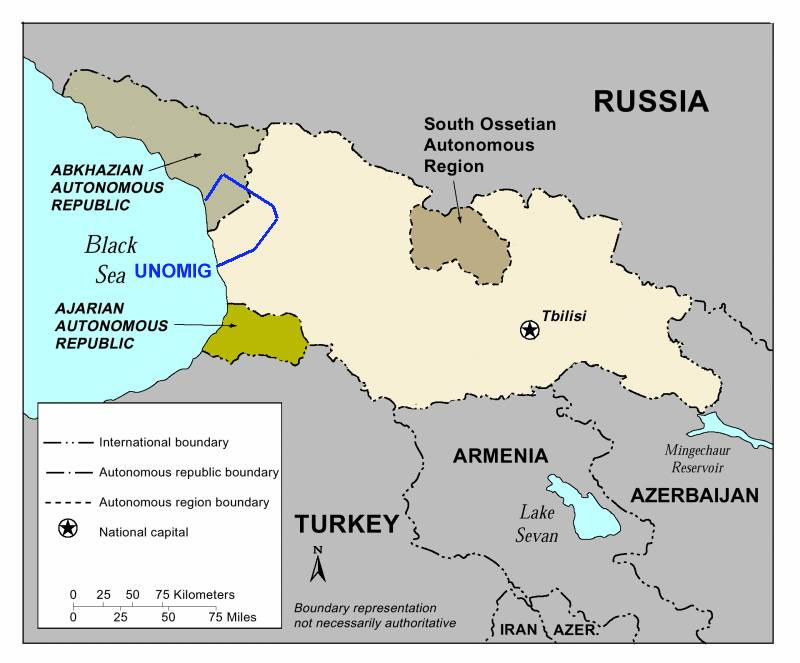
The conflict started after Georgian troops tried to take control of the Georgian breakaway region of South Ossetia, which had been de facto independent and protected by Russian peacekeeping forces since 1992.
Russia has responded by launching an extensive military operation in South Ossetia, repelling Georgian forces from regional capital Tskhinvali, 100 km northwest of the Georgian capital Tbilisi, and advancing into Georgian territory.
Mikheil Saakashvili, President of the 4.6 million Caucasus country, claims the Russian “invasion” was premeditated.
Abkhazia, another breakaway region in Western Georgia that proclaimed independence in the same year, has also become entangled in the conflict by taking Russia’s side.
Sporadic clashes between Georgian and separatist soldiers were not rare, but hostilities never reached the current extent.
The Georgian move apparently took Western leaders, who had warned against attempting a military solution, by surprise.
Ivan Sukhov, a journalist specialised in the region told Radio Free Europe on Friday that Saakashvili had taken “a position that is awkward for the West, since Georgia has consistently positioned itself as a principled opponent of military action. Even if the Georgian actions were provoked by the South Ossetians, this is a serious political mistake.”
Georgia seemed determined to expose Russia’s involvement in Abkhazia and South Ossetia and present the conflict as one between Western democracy and Eastern authoritarianism, possibly hoping to obtain a more decisive Western intervention in the conflict.
The attempt to revive cold war rhetoric was palpable in Saakashvili’s parallels of Georgia’s situation with the 1956 Hungarian and 1968 Czechoslovak interventions by the Soviet Union.
One possible goal of the Georgian leadership’s military intervention was to internationalise the conflict so as to change the format of the present Russian-dominated peacekeeping mission, and facilitate the regions’ peaceful or forcible reintegration.
Many have seen in Georgia’s rash decision the first consequence of Kosovo’s unilateral independence from Serbia last February.
The move has encouraged the separatist claims of the South Ossetian and Abkhaz leaderships, and Georgia’s renewed determination to fully regain its territorial sovereignty.
The leaders of the separatist regions trust that after Kosovo’s independence, the consent of the sovereign state is no longer necessary if a greater power can guarantee its security.
Moreover they have deployed similar arguments to those applied in Kosovo: a past of ethnic-driven war which left thousands of civilians dead and countless displaced on both sides.
Unhappy with the U.S.-promoted Kosovo independence, Moscow had promised an adequate response to the latest violation in international law, and its first step came with the institutionalisation of ties with Georgia’s two breakaway regions in March.
Unlike the West in Kosovo, Russia can claim the conflict in its southern regions directly affects its own security, and above all, that of a population of which 80 percent hold Russian passports.
Russian claims of arbitrary killings of up to 1,600 civilians by Georgian forces have not been independently verified, although a few Western journalists have started to take interest in testimonies by Ossetian refugees allegedly witness to human rights abuses by Georgian troops.
If the claims were to be at least partially verified and Russia was to show self-restraint and restore order, its ambition of a role as a legitimate world power and a regional pacifier could gain credibility.
Besides Kosovo, Russia was irritated by Washington’s enthusiastic promotion of North Atlantic Treaty Organisation (NATO) membership for two of Russia’s neighbours, Ukraine and Georgia, as well as U.S. plans to build a missile defence system in Eastern Europe which it claims will alter the balance of forces in Europe.
Georgia’s NATO bid was presented by the U.S. and Georgia’s former communist Eastern European allies as a chance to expand the area of freedom and democracy and to limit the expansion of Moscow’s authoritarian tendencies in Russia’s near abroad.
Many elites in the post-communist countries tend to believe that Russia is inherently inclined towards authoritarianism and expansionism and that the Soviet Union was just another expression of this impulse.
But the Western European member states, aware that Georgia’s commitment to liberal democracy was dubious and territorial tensions on the rise, decided to postpone the discussion on Georgia’s membership of NATO.
Many have noted an increase in Saakashvili’s authoritarian tendencies over the last year, with the arrest of opposition activists and the abuse of state resources by merely citing the “Russian threat”.
The U.S. has also been openly providing military support and training to the Georgian army while often encouraging Georgia to see itself as a crusader for democracy in the midst of authoritarianism. But as a member of NATO, a young and nationalistic state like Georgia could have drawn the entire alliance into a direct military confrontation with Russia.



 Peace and Justice Post
Russia Georgia War – Washington Risks Nuclear War by Miscalculation
August 12, 2008By F William Engdahl | The Market Oracle, August 11, 2008
The dramatic military attack by the military of the Republic of Georgia on South Ossetia in the last days has brought the world one major step closer to the ultimate horror of the Cold War era—a thermonuclear war between Russia and the United States—by miscalculation. What is playing out in the Caucasus is being reported in US media in an alarmingly misleading light, making Moscow appear the lone aggressor. The question is whether George W. Bush and Dick Cheney are encouraging the unstable Georgian President, Mikhail Saakashvili in order to force the next US President to back the NATO military agenda of the Bush Doctrine. This time Washington may have badly misjudged the possibilities, as it did in Iraq , but this time with possible nuclear consequences.
The underlying issue, as I stressed in my July 11 piece in this space, Georgien, Washington, Moskau: Atomarer geopolitischer Machtpoker , is the fact that since the dissolution of the Warsaw Pact in 1991 one after another former member as well as former states of the USSR have been coaxed and in many cases bribed with false promises by Washington into joining the counter organization, NATO.
Rather than initiate discussions after the 1991 dissolution of the Warsaw Pact about a systematic dissolution of NATO, Washington has systematically converted NATO into what can only be called the military vehicle of an American global imperial rule, linked by a network of military bases from Kosovo to Poland to Turkey to Iraq and Afghanistan . In 1999, former Warsaw Pact members Hungary , Poland and the Czech Republic joined NATO. Bulgaria , Estonia , Latvia , Lithuania , Romania , and Slovakia followed suit in March 2004. Now Washington is putting immense pressure on the EU members of NATO, especially Germany and France , that they vote in December to admit Georgia and Ukraine .
The roots of the conflict
The specific conflict between Georgia and South Ossetia and Abkhazia has its roots in the following. First, the Southern Ossetes , who until 1990 formed an autonomous region of the Georgian Soviet republic, seek to unite in one state with their co-ethnics in North Ossetia , an autonomous republic of the Russian Soviet republic and now the Russian Federation . There is an historically grounded Ossete fear of violent Georgian nationalism and the experience of Georgian hatred of ethnic minorities under then Georgian leader Zviad Gamsakhurdia, which the Ossetes see again under Georgian President, Mikhel Saakashvili. Saakashvili was brought to power with US financing and US covert regime change activities in December 2003 in what was called the Rose Revolution. Now the thorns of that rose are causing blood to spill.
Abkhazia and South Ossetia—the first a traditional Black Sea resort area, the second an impoverished, sparsely populated region that borders Russia to the north—each has its own language, culture, history. When the Soviet Union collapsed, both regions sought to separate themselves from Georgia in bloody conflicts – South Ossetia in 1990-1, Abkhazia in 1992-4.
In December 1990 Georgia under Gamsakhurdia sent troops into South Ossetia after the region declared its own sovereignty. This Georgian move was defeated by Soviet Interior Ministry troops. Then Georgia declared abolition of the South Ossete autonomous region and its incorporation into Georgia proper. Both wars ended with cease-fires that were negotiated by Russia and policed by peacekeeping forces under the aegis of the recently established Commonwealth of Independent States. The situation hardened into “frozen conflicts,” like that over Cyprus . By late 2005, Georgia signed an agreement that it would not use force, and the Abkhaz would allow the gradual return of 200,000-plus ethnic Georgians who had fled the violence. But the agreement collapsed in early 2006, when Saakashvili sent troops to retake the Kodori Valley in Abkhazia. Since then Saakashvili has been escalating preparations for military action.
Critical is Russia ‘s support for the Southern Ossetes . Russia is unwilling to see Georgia join NATO. In addition, the Ossetes are the oldest Russian allies in the Caucasus who have provided troops to the Russian army in many wars. Russia does not wish to abandon them and the Abkhaz, and fuel yet more ethnic unrest among their compatriots in the Russian North Caucasus . In a November 2006 referendum, 99 percent of South Ossetians voted for independence from Georgia , at a time when most of them had long held Russian passports. This enabled Russian President Medvedev to justify his military’s counter-attack of Georgia on Friday as an effort to “protect the lives and dignity of Russian citizens, wherever they may be.”
For Russia , Ossetia has been an important strategic base near the Turkish and Iranian frontiers since the days of the czars. Georgia is also an important transit country for oil being pumped from the Caspian Sea to the Turkish port of Ceyhan and a potential base for Washington efforts to encircle Tehran .
As far as the Georgians are concerned, South Ossetia and Abkhazia are simply part of their national territory, to be recovered at all costs. Promises by NATO leaders to bring Georgia into the alliance, and ostentatious declarations of support from Washington , have emboldened Saakashvili to launch his military offensive against the two provinces, South Ossetia and Abkhazia. Saakashvili and likely, Dick Cheney’s office in Washington appear to have miscalculated very badly. Russia has made it clear that it has no intention of ceding its support for South Ossetia or Abkhazia.
Continued . . .
Share this:
Tags:Abkhazia, American global imperial rule, Bush and Cheney, danger of nuclear war, Debkhafile, Georgia, Kosovo, NATO, President Saakashvile, proxy war, Russian-Georgian relations, South Ossetia, the Pentagon policy, US media
Posted in Commentary | 1 Comment »