CIA Tactics Endorsed In Secret Memos
Joby Warrick
Washington Post Staff Writer
Wednesday, October 15, 2008; Page A01
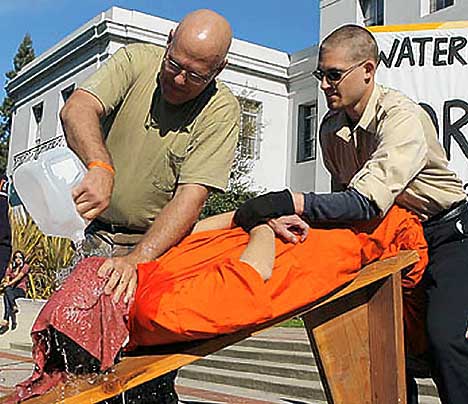
The Bush administration issued a pair of secret memos to the CIA in 2003 and 2004 that explicitly endorsed the agency’s use of interrogation techniques such as waterboarding against al-Qaeda suspects — documents prompted by worries among intelligence officials about a possible backlash if details of the program became public.
The classified memos, which have not been previously disclosed, were requested by then-CIA Director George J. Tenet more than a year after the start of the secret interrogations, according to four administration and intelligence officials familiar with the documents. Although Justice Department lawyers, beginning in 2002, had signed off on the agency’s interrogation methods, senior CIA officials were troubled that White House policymakers had never endorsed the program in writing.
The memos were the first — and, for years, the only — tangible expressions of the administration’s consent for the CIA’s use of harsh measures to extract information from captured al-Qaeda leaders, the sources said. As early as the spring of 2002, several White House officials, including then-national security adviser Condoleezza Rice and Vice President Cheney, were given individual briefings by Tenet and his deputies, the officials said. Rice, in a statement to congressional investigators last month, confirmed the briefings and acknowledged that the CIA director had pressed the White House for “policy approval.”
The repeated requests for a paper trail reflected growing worries within the CIA that the administration might later distance itself from key decisions about the handling of captured al-Qaeda leaders, former intelligence officials said. The concerns grew more pronounced after the revelations of mistreatment of detainees at the Abu Ghraib prison in Iraq, and further still as tensions grew between the administration and its intelligence advisers over the conduct of the Iraq war.

 Peace and Justice Post
The trail of torture
October 17, 2008That the White House authorised ‘waterboarding’ is disturbing. But that no one in mainstream US politics seems to care is worse
The revelation, in yesterday’s Washington Post, that the Bush administration “issued a pair of secret memos to the CIA in 2003 and 2004 that explicitly endorsed the agency’s use of interrogation techniques such as waterboarding against al-Qaida suspects” will increase calls for the administration to be held to account for its actions.
It is unlikely, though, that this revelation will lead to significant activity, beyond adding more voices to grassroots impeachment campaigns in the United States – although it may lead to a strengthening of plans in various European countries to indict senior officials for war crimes. As law professor Scott Horton explained in June, the best that opponents of the regime can hope for is that the “Bush administration officials who pushed torture will need to be careful about their travel plans.”
The problem for all parties concerned is that the administration itself still refuses to concede that it has engaged in torture, and is being allowed to get away with it in the two places where opposition could really count: the Senate and the House of Representatives. Rather than pursuing senior officials, house Democrat leader Nancy Pelosi declared that impeachment was “off the table” after the Democrats gained a majority in the House of Representatives two years ago. A month earlier, politicians had endorsed the executive’s attempts to shield itself and its employees from any liability for their actions by passing the Military Commissions Act, parts of which were clearly intended to exempt US officials from being prosecuted for war crimes.
Freed from direct challenges, the administration has, instead, attempted to stifle all mention of torture in its dealings with prisoners seized in the “war on terror”.
A case in point is the British resident Binyam Mohamed. According to his lawyers at the legal action charity Reprieve, Mr Mohamed, who was seized in Pakistan in April 2002, was sent to Morocco by the CIA (before the agency brought torture “in-house”), where proxy torturers extracted a number of false confessions from him. As a result, he was accused of plotting to detonate a radioactive “dirty bomb” in a US city, and was put forward for trial by military commission at Guantánamo.
However, just last week, when a judge in Washington, DC finally had the opportunity to review his case, the US justice department chose to drop the charges relating to the “bomb plot” rather than pursue them, presumably because senior officials were aware that the entire trail of decision-making as to why Mr Mohamed was rendered to Morocco led to the highest levels of government, and to the kinds of discussions between the CIA and senior officials – including Vice President Dick Cheney and defence secretary Donald Rumsfeld – that were discussed in yesterday’s article in the Washington Post.
Even so, Mr Mohamed may still face the same charges in a trial by military commission, because the defence department, safe from judicial scrutiny, still believes that it can pursue prosecutions in a system that is so rigged that, when one of the prosecutors, Lt Col Darrel Vandeveld, resigned two weeks ago, he expressed his profound doubts that the system was “capable of delivering justice”.
The fact that some of these cases – like that of Mr Mohamed – involve the alleged use of extraordinary rendition and torture by or on behalf of the CIA only serves to confirm that even confirmed critics and opponents of the administration’s detention and interrogation policies in the “war on terror” are a long way from holding senior officials to account. Perhaps the greatest shame, however, is that out on the campaign trail, where these issues ought to count for something, they are not being mentioned at all.
Share this:
Tags:Binyam Mohamed, Bush administration, CIA, impeachment campaigns, Nancy Pelsoi, secret memos to CIA, torure, Washington Post
Posted in Commentary, Human rights, imperialism, US policy | Leave a Comment »