|
by Prof. Rodrigue Tremblay
|
|||||
 |
|||||
|
|
|||||
|
[PART I]
Whoever is elected president in the coming November 4 American election will inherit a most miserable situation on nearly all fronts. This is because George W. Bush has been one of the worst presidents the U.S. has ever had, if not the worst. It is widely recognized that he was a below average politician who led his country on the wrong track, both domestically and internationally. Today, only a meager 9 percent of Americans dare to say that their country is moving in the right direction. As a matter of fact, a very large majority of Americans— both Democrats and Republicans, men and women, residents of cities and of rural areas, high school graduates and college-educated— all say that the United States has been headed in the wrong direction under George W. Bush’s stewardship. Bush’s approval rating reflects the lack of confidence that Americans have in him and his administration. In fact, George W. Bush has recorded the lowest approval rating of any president in the 70-year history of the Gallup Poll. And, around the world, the United States has never had a leader who commands so little respect and confidence. Most people in the U.S. and abroad will find satisfaction in seeing his term come to an end.
This is a terrible indictment of the Bush Administration that has presided over America’s destinies for the last eight years. What is more disconcerting, this all came after George W. Bush won the presidential election in 2000, with fewer popular votes than Democratic candidate Al Gore, after a one-judge-majority decision of the Supreme Court, in effect, gave him the presidency. Therefore, this is an administration that had no widespread democratic mandate to do what it has done. And it has done a lot of things wrong. In fact, many people think this has been a morally bankrupt administration. International disaster: An Illegal and Immoral War of Aggression At the center of this fiasco, is the fact that the Bush-Cheney administration and its neocon cohort rushed to exploit the 9/11 terrorist attacks and used this as a pretext to implement a preconceived pro-Israel and pro-oil plan in the Middle East. This led them to adopt a simplistic response to Islamist terrorism, barging into complex Middle East societies on elephant feet. But in the process, they have only succeeded in making matters worse and in encouraging more hatred against the U.S. and more terrorism. Indeed, George W. Bush will be remembered above all as the man who launched an illegal and immoral war of aggression against another sovereign nation, on false pretenses and forged documents, destroying in so doing the entire country of Iraq, and damaging perhaps irreparably the U.S. reputation in the world. As Scott McClellan, Bush’s former Press Secretary during seven long years, stated, Bush and his advisers [in launching the Iraq War] “confused the propaganda campaign with the high level of candour and honesty so fundamentally needed to build and then sustain public support during a time of war”. Bush’s deception and lies about Iraq in order to initiate a war of aggression, an aggression that is a war crime under the Nuremberg standard established by the U.S., are well documented. Thus, historians will have no difficulty in establishing the fact that the United States, under Bush, acted as a lawless international aggressor. In initiating a war of aggression, Bush did violate the United Nations Charter, which “prohibits the use of military force” against any nation without the specific approval of the United Nations Security Council. The Security Council never approved the American-led military invasion of Iraq. Therefore, Bush and his crew had no international legal basis to invade Iraq. And they cannot pretend that Congress gave them such an authorization, since it is well known in law that no domestic law can override a signed international treaty in good standing. In a domestic parallel, George W. Bush and his administration have set up what is probably the most widespread war profiteering system in modern history, through which billions and billions of dollars were misappropriated and wasted. At the same time as they were adopting a permanent war posture abroad, they were irresponsibly calling at home for a 674 billion dollar tax cut for their rich supporters and pushing up the deficits, of which a large proportion was financed by borrowing abroad. Illegality and Immorality On the legal front, this is an administration that has shamed the United States with its illegal actions, with its deliberate and dishonest lies, with its war crimes, its disregard for international treaties, and with its overt disregard of constitutional government. On the question of lawlessness, the list of missteps the Bush-Cheney administration took outside of the law is too long for a short article as this one. But there are numerous documents to be consulted and it is possible to attempt a short summary. From the very beginning, the Bush-Cheney administration has dismissed international law and disregarded domestic law. They began by either repudiating or refusing to honor the United States’ international commitments and obligations, thus showing indifference, if not outright hostility, toward international law. They opted out of five important international treaties and commitments: the Kyoto Protocol on Climate Change, the Anti-Ballistic Missile Treaty, the Biological and Toxin Weapons Convention, the Non-Proliferation of Nuclear Weapons Treaty and the International Criminal Court. In so doing, the United States, under the Bush-Cheney administration, has betrayed its international commitments and has moved away from being a moral state, and more and more toward the status of an international rogue state. This was all confirmed when the Bush-Cheney administration adopted, in September 2002, the Bush Doctrine of preventive war, an internationally illegal and immoral program. Indeed, under existing international law, no country may attack another under false pretenses, nor use military force unilaterally. This was followed by the even more dangerous and hairy Cheney Doctrine (or the One Percent Doctrine) which is anti-human rights, anti-rule of law and anti-Constitution, because it posits that if there is even a 1% chance American interests are in jeopardy somewhere in the world, unilateral American military interventions are justified, and this without conclusive evidence or extensive analysis. Such hubristic and shoot-from-the-hip foreign policies are a true recipe for international anarchy and thus render a great disservice to humanity. Domestically, President George W. Bush has introduced the unconstitutional practice of adding signing statements to new laws, stating that he has the right, as President, to violate any section of a law, should he deem it in the national interest to do so. For example, on January 28, 2008, Bush signed into law the repeal of the “Insurrection Act Rider” in the 2006 defense appropriations bill. That rider had given the President sweeping power to use military troops in ways contrary to the Insurrection Act and Posse Comitatus Act and authorized the president to have troops patrol American streets in response to disasters, epidemics, and any “condition” he might cite. But in signing this repeal, Bush attached a signing statement that he did not feel bound by the repeal, thus opening the possibility he could ignore the law any time he saw fit to do so. Disrespect for Liberty and the U.S. Constitution As if this were not enough, there was the attempt by the Bush-Cheney regime to suspend and even permanently abolish the more than eight centuries old right of Habeas Corpus. And when the Supreme Court, in a far-reaching decision on June 12, 2008, rebuked the B-C administration’s argument that it had a right to establish concentration camps on U.S.-run properties around the world and hold prisoners indefinitely with no legal recourse, especially at the Guantánamo Bay detention center, President George W. Bush had the gall to criticize the Supreme Court’s decision while on a trip to Europe. Then Bush embarked upon a program of domestic spying on Americans never before seen in a democracy. He, indeed, removed most of the safeguards that had been erected to protect citizens from illegal and warrantless spying activities by government, thus making a mockery of the U.S. Constitution. In particular, the Bush-Cheney administration did not respect key parts of the U.S. Constitution, especially the Fourth Amendment, which protects against unreasonable searches and seizures. It must said, however, that some Bush Democrats, such as House Speaker Nancy Pelosi (D-CA) and Democratic House Majority Leader Steny H. Hoyer (D – MD) have also willfully and enthusiastically collaborated with George W. Bush in enlarging the government’s spying powers over citizens. On his own, however, George W. Bush did his utmost to make permanent the President’s War Powers, thus making sure that the United States could remain on a permanent war path and be in a position to suspend at will basic constitutional rights. On top of everything, George W. Bush will be remembered as a politician who authorized torture and indefinite detention of prisoners. Indeed, after Bush willfully suspended the rights accorded prisoners of war by the Geneva Conventions, he was, in fact, officially turning the United States into an immoral nation that openly and unashamedly resorts to torture, thus violating basic rules of morality, international law and a host of international treaties adhered to by the United States. In fact, the Geneva Conventions in its article 3 does not only prohibit torture, but also any cruel, inhuman, degrading, and humiliating treatment of a detainee “in all circumstances.” However, it is not only on the issue of torture that the United States under Bush has become an international pariah. The Bush-Cheney administration has also operated concentration camps in many countries, holding captive tens of thousands of detainees and hiding them from the Red Cross, the body empowered to monitor compliance with the Geneva Conventions. The Bush-Cheney administration has placed itself outside the civilized world and was nearly alone, last May (2008), in trying to undermine a treaty banning cluster bombs, a type of bombs which have killed so many civilians, when 111 countries signed a treaty outlawing these inhuman weapons. On this occasion, the United States, under Bush-Cheney, sided with a handful of weapons makers and users, none of them known as great defenders of human rights and democracy: Russia, China, Israel, India and Pakistan. The Bush-Cheney administration has truly been a shamelessly immoral administration. (PART II on Global Research next week) Rodrigue Tremblay is professor emeritus of economics at the University of Montreal and can be reached at: rodrigue.tremblay@ yahoo.com. He is the author of the book ‘The New American Empire’. Visit his blog site at www.thenewamericanempire.com/blog. Author’s Website: www.thenewamericanempire.com/ Check Dr. Tremblay’s coming book “The Code for Global Ethics” at: www.TheCodeForGlobalEthics.com/ |
|||||
Archive for the ‘US policy’ Category
 Email this article to a friend
 Print this article
Tens of Thousands of Iraqis Mass for Anti-SOFA Protest
October 18, 2008At least 50,000 Iraqis joined a protest in the streets of Baghdad today, organized by followers of Shi’ite cleric Moqtada al-Sadr, chanting anti-US and anti-occupation slogans and waving banners opposing the controversial Status of Forces Agreement (SOFA) which would keep US troops in Iraq through 2011.
Though Sadr was not personally present at the rally, he did address the crowd in a message directed at Iraqi lawmakers, read by Sheik Abdul-Hadi al-Mohammadawi. In the statement he urged Iraq’s parliament to “champion the will of the people over that of the occupier” and oppose the pact. He also cautioned that passing the deal “will stigmatize Iraq and its government for years to come.”
Sadr is just one of many influential religious leaders, both Sunni and Shi’ite, speaking out against the SOFA. The high attendance for the rally underscores a growing popular hostility for the deal, which faces a long battle for approval in the Iraqi government.
Though it is unclear at this point whether the terms of the deal are finalized, officials reported this was the case earlier in the week though White House Press Secretary Dana Perino denied it yesterday, Iraqi Foreign Minister Hoshyar Zebari says it would be “difficult to reopen the text” and that it was time for parliament to either ratify or reject the deal. He added that “the next few days are very crucial for Iraqi leaders to decide.”
Popular and religious opposition to the deal as well as a splintering coalition government will make it extremely difficult for Iraq’s parliament to pass the deal. And even though a simple majority is all that is required for passage, Prime Minister Nouri al-Maliki reportedly intends to submit it for consideration only if he is confident it will receive a two-thirds majority, fearing criticism if the vote is close.
Related Stories
U.S., Iraqi Officials Question Terms of Draft Security Deal
October 18, 2008At Issue: Legal Authority Over Troops
By Mary Beth Sheridan and Karen DeYoung
Washington Post Staff Writers, Saturday, October 18, 2008
BAGHDAD, Oct. 17 — A number of senior Iraqi and U.S. politicians expressed strong reservations Friday about the terms of a draft agreement that gives Iraq the “primary right” — subject to U.S. acquiescence — to try American soldiers accused of serious crimes committed during off-duty hours outside U.S. military bases here.
Some political leaders in Baghdad, who got their first look at the controversial agreement to extend the U.S. military presence in Iraq beyond 2008, said it did not go far enough in guaranteeing Iraqi sovereignty. The bilateral accord was presented Friday to the Political Council for National Security, an advisory body including political, legislative and judicial leaders, whose support is necessary before it can be submitted to Prime Minister Nouri al-Maliki‘s cabinet and then to parliament for final approval. After an initial review, the council said it would continue discussions next week.
In Washington, congressional Democrats questioned ceding any authority over U.S. troops to Iraq. “I am very concerned about reports that U.S. service personnel may not have full immunity under Iraqi law,” said Rep. Ike Skelton (D-Mo.), the House Armed Services Committee chairman. The Bush administration allowed a small group of senior congressional aides to read the document at a White House briefing this morning but did not allow copies to be made.
A provision in the draft would give the United States “primary” jurisdiction over military personnel and Defense Department employees who are on bases or engaged in authorized military operations.
Iraq, it says, would have the “primary right to exercise judicial jurisdiction” over “premeditated and gross felonies . . . committed outside the agreed facilities and areas and when not on a mission.” Foreign Minister Hoshyar Zebari said Friday that any disagreement would be resolved by a joint committee. “If the crime is very grave or serious, the U.S. may waive its jurisdiction,” he said.
U.S. Defense Secretary Robert M. Gates told reporters at a Pentagon briefing that “there is not a reason to be concerned.” He said top U.S. military officials “are all satisfied that our men and women in uniform serving in Iraq are well protected.” U.S. officials have emphasized that off-duty American troops in Iraq rarely, if ever, venture outside their bases, and said that they consider language in the document vague enough to ensure absolute U.S. control in all circumstances.
Administration officials also said they are confident that withdrawal dates in the document — June 30, 2009, for U.S. forces in Iraqi cities and Dec. 31, 2011, from all of Iraq — contain sufficient caveats to address any future downturn in the security situation. Before the final deadline, the draft says, “on the basis of Iraq’s assessment of conditions on the ground,” the Iraqi government could ask for U.S. troops to remain for “training purposes” or to “support Iraqi security forces.”
The accord also would prohibit U.S. forces from detaining any Iraqi citizen without an Iraqi warrant, and says any detainee would have to be handed over to government custody within 24 hours. All Iraqis in U.S. custody as of Jan. 1 — when the agreement would go into effect upon expiration of the current U.N. mandate authorizing foreign troops here — would have to be turned over to the Iraqi government. Home and property searches also would require an Iraqi warrant, except during certain combat situations.
U.S. and Iraqi officials confirmed the wording of the document, portions of which were widely circulated in both capitals Friday.
The sensitivity of the draft agreement, which has been under negotiation since March, was illustrated when Maliki lashed out at the top American commander here for saying that U.S. intelligence indicated Iran was trying to bribe Iraqi lawmakers to reject the pact.
“The American commander has risked his position when he spoke in this tone and has complicated relations in a deplorable way,” Maliki told a group of Kuwaiti journalists in an interview broadcast by Iraqi state television Friday. Maliki expressed astonishment at the remarks from U.S. Gen. Ray Odierno, whom he described as a “kind and good man.” Iraqi members of parliament, he said, had not accepted any bribes.
Maliki was reacting to a Monday article in The Washington Post in which Odierno said Iran was conducting a “full-court press” with its Iraqi contacts to sabotage the pact, including “coming in to pay off people to vote against it.” A U.S. military spokesman later said there was no confirmation that bribes had been accepted by lawmakers.
A number of Iraq’s leading political leaders spent years in exile in Iran during the presidency of Saddam Hussein and maintain warm relations with the Tehran government. Several expressed sharp offense at Odierno’s comments.
Jalal al-Deen al-Saghir, a top lawmaker from the Islamic Supreme Council of Iraq, Maliki’s main political partner, said in an interview that he saw “serious problems” in the proposed accord, “especially after Odierno’s statements.”
Pentagon spokesman Geoff Morrell said Friday that there was a misunderstanding about Odierno’s comments. “I don’t think General Odierno was implying that there are crooked Iraqi politicians, but rather that there are Iranian agents who, in their attempt to derail the [agreement], are trying to bribe Iraqi politicians,” he said.
In Najaf, the religious capital of Iraq’s Shiite majority, a leading cleric blasted the idea of giving U.S. forces any immunity from Iraqi law. “We consider this a basic point because it represents sovereignty,” Sadir Addin al-Qobanchi said in a sermon at the city’s grand mosque. “If someone commits a hostile act against your house and family, and you say it is fine and don’t hold him responsible, it means that you don’t have dignity or sovereignty.”
U.S. military and political officials have expressed concern that the agreement may not make it through Iraq’s slow-moving political process by year’s end. An extension of the U.N. mandate, the most likely option if a final agreement is not reached, poses political and legal complications for both sides.
Mahmoud Othman, a Kurdish lawmaker, said the agreement could gain the approval of the political council and the cabinet. But in parliament, supporters of the agreement “will face opposition,” he said. The accord, which must win a majority in the 275-seat parliament, is strongly supported by the Kurdish bloc, the second-biggest with 54 seats. Various Sunni and independent parties representing scores of seats have also indicated their approval.
But Othman said the backing of some politicians was not solid.
“They tell the Americans, ‘We are okay, we’ll sign it.’ Then they tell their people in parliament not to vote for it,” he said.
The U.S. Congress does not have similar veto power over the agreement, which requires only a presidential signature. But senior Democrats, and a number of Republicans, have questioned its terms. Senate Armed Services Committee Chairman Carl M. Levin (D-Mich.) said in a statement Friday that complete American jurisdiction over U.S. service members was “critical” and that they could not be “subject to criminal prosecution in an Iraqi judicial system that does not meet due process standards.” Levin said he would “reserve judgment” on the draft until he was given an opportunity for a “complete review” of its terms.
DeYoung reported from Washington. Staff writer Ann Scott Tyson in Washington and special correspondent Qais Mizher in Baghdad contributed to this report.
The torture time bomb
October 18, 2008The Bush administration’s approval of the abuse of detainees is a toxic legacy for the next US president
-

- Philippe Sands The Guardian, Saturday October 18 2008
As the US presidential election reaches a climax against the background of the financial crisis, another silent, dark, time bomb of an issue hangs over the two candidates: torture. For now, there seems to be a shared desire not to delve too deeply into the circumstances in which the Bush administration allowed the US military and the CIA to embrace abusive techniques of interrogation – including waterboarding, in the case of the CIA – which violate the Geneva conventions and the 1984 UN torture convention.
The torture issue’s cancerous consequences go deep, and will cause headaches for the next president. New evidence has emerged in Congressional inquiries that throw more light on the extent to which early knowledge and approval of the abuse went to the highest levels. What does a country do when compelling evidence shows its leaders have authorised international crimes?
For three years I have followed a trail which leads unambiguously to the conclusion that the real bad eggs were not Lyndie England or others on the ground in Abu Ghraib, but the most senior officials in the White House, the Pentagon and the department of justice. Over recent months, Congress has been looking into the role of senior officials involved in the development of interrogation rules. These have attracted relatively scant attention; little by little, however, senators and congressmen have uncovered the outlines of a potentially far-reaching criminal conspiracy.
The first hearings were convened before the judiciary committee of the House of Representatives, at the instance of its chairman, Congressman John Conyers, apparently off the back of my book Torture Team. Parallel hearings have been held before the Senate armed services committee.
The evidence that has emerged is potentially devastating. It confirms, for instance, that the search for new interrogation techniques for use at Guantánamo began not with the local military but in the offices of Donald Rumsfeld and his chief lawyer, Jim Haynes. It shows that when the career military expressed objections on legal grounds, Haynes intervened to stop the normal process of review. And it shows a previously unknown interplay between the department of defence and the CIA: a visit to Guantánamo in September 2002 by the administration’s most senior lawyers was followed days later by a senior CIA lawyer, to brief on the new techniques. “If someone dies while aggressive techniques are being used,” he explained, “the backlash of attention would be severely detrimental.”
Last month the Senate armed services committee received new material from Condoleezza Rice, the first cabinet-level official to confirm high-level involvement in discussions on interrogation techniques. “I participated in a number of meetings in 2002 and 2003 … at which issues relating to detainees in US custody, including interrogation issues, were discussed,” she said. Those present at such meetings included Rumsfeld, attorney general John Ashcroft, Colin Powell, Paul Wolfowitz and CIA director George Tenet. The meetings, which concerned the CIA programme, “occurred inside the White House”. Rice confirmed she was aware of the existence of, but did not read, the justice department legal advice of August 1 2002 that abandoned the international definition of torture and replaced it with a definition drawn from a US Medicare statute.
Buried away in this testimony lies the most dangerous material of all: evidence which may establish that abuses on detainees in Iraq in September 2003, in the period perhaps including the events at Abu Ghraib, were the result of decisions taken at the highest levels of the administration. The administration has long proclaimed it did not allow aggressive interrogations in Iraq, since the Geneva conventions applied. Last month we learned this was false: not everyone had protection under Geneva. If you were considered to be a terrorist, you had no protection at all. A senior US intelligence officer visited Iraq in September 2003. He witnessed abusive interrogation techniques that violated Geneva and complained. The response? He was told the techniques “were pre-approved by DoD GC or higher”. DoD GC is the general counsel at the department of defence, Jim Haynes. Who could be higher? His boss: Rumsfeld.
I have testified before Congress on these issues, and have been asked if there should be criminal investigations and prosecutions. At the very least, the next US president must ensure the full facts are established. It will then be for others to decide what follows. But if the US doesn’t get its own house in order and restore its reputation for the rule of law, others will surely step in.
• Philippe Sands QC is professor of law at UCL, a barrister at Matrix Chambers and author of Torture Team p.sands@ucl.ac.uk
The trail of torture
October 17, 2008That the White House authorised ‘waterboarding’ is disturbing. But that no one in mainstream US politics seems to care is worse
-

- Andy Worthington | guardian.co.uk, Thursday October 16 2008
The revelation, in yesterday’s Washington Post, that the Bush administration “issued a pair of secret memos to the CIA in 2003 and 2004 that explicitly endorsed the agency’s use of interrogation techniques such as waterboarding against al-Qaida suspects” will increase calls for the administration to be held to account for its actions.
It is unlikely, though, that this revelation will lead to significant activity, beyond adding more voices to grassroots impeachment campaigns in the United States – although it may lead to a strengthening of plans in various European countries to indict senior officials for war crimes. As law professor Scott Horton explained in June, the best that opponents of the regime can hope for is that the “Bush administration officials who pushed torture will need to be careful about their travel plans.”
The problem for all parties concerned is that the administration itself still refuses to concede that it has engaged in torture, and is being allowed to get away with it in the two places where opposition could really count: the Senate and the House of Representatives. Rather than pursuing senior officials, house Democrat leader Nancy Pelosi declared that impeachment was “off the table” after the Democrats gained a majority in the House of Representatives two years ago. A month earlier, politicians had endorsed the executive’s attempts to shield itself and its employees from any liability for their actions by passing the Military Commissions Act, parts of which were clearly intended to exempt US officials from being prosecuted for war crimes.
Freed from direct challenges, the administration has, instead, attempted to stifle all mention of torture in its dealings with prisoners seized in the “war on terror”.
A case in point is the British resident Binyam Mohamed. According to his lawyers at the legal action charity Reprieve, Mr Mohamed, who was seized in Pakistan in April 2002, was sent to Morocco by the CIA (before the agency brought torture “in-house”), where proxy torturers extracted a number of false confessions from him. As a result, he was accused of plotting to detonate a radioactive “dirty bomb” in a US city, and was put forward for trial by military commission at Guantánamo.
However, just last week, when a judge in Washington, DC finally had the opportunity to review his case, the US justice department chose to drop the charges relating to the “bomb plot” rather than pursue them, presumably because senior officials were aware that the entire trail of decision-making as to why Mr Mohamed was rendered to Morocco led to the highest levels of government, and to the kinds of discussions between the CIA and senior officials – including Vice President Dick Cheney and defence secretary Donald Rumsfeld – that were discussed in yesterday’s article in the Washington Post.
Even so, Mr Mohamed may still face the same charges in a trial by military commission, because the defence department, safe from judicial scrutiny, still believes that it can pursue prosecutions in a system that is so rigged that, when one of the prosecutors, Lt Col Darrel Vandeveld, resigned two weeks ago, he expressed his profound doubts that the system was “capable of delivering justice”.
The fact that some of these cases – like that of Mr Mohamed – involve the alleged use of extraordinary rendition and torture by or on behalf of the CIA only serves to confirm that even confirmed critics and opponents of the administration’s detention and interrogation policies in the “war on terror” are a long way from holding senior officials to account. Perhaps the greatest shame, however, is that out on the campaign trail, where these issues ought to count for something, they are not being mentioned at all.
The reality of war in Afghanistan
October 16, 2008Despite their differences over how to pursue the US war in Iraq, Senators John McCain and Barack Obama both want to send more American troops to Afghanistan. Both are wrong. History cries out to them, but they are not listening.
Both candidates would do well to gaze for a moment on a painting by the British artist Elizabeth Butler called “Remnants of an Army.” It depicts the lone survivor of a 15,000-strong British column that sought to march through 150 kilometers of hostile Afghan territory in 1842. His gaunt, defeated figure is a timeless reminder of what happens to foreign armies that try to subdue Afghanistan.
The McCain-Obama approach to Afghanistan, like much of US policy toward the Middle East and Central Asia, is based on emotion rather than realism. Emotion leads many Americans to want to punish perpetrators of the Sept. 11, 2001 attacks. They see war against the Taliban as a way to do it. Suggesting that victory over the Taliban is impossible, and that the United States can only hope for peace in Afghanistan through compromise with Taliban leaders, has been taken as near-treason.
This knee-jerk response ignores the pattern of fluid loyalties that has been part of Afghan tribal life for centuries. Alliances shift as interests change. Warlords who support the Taliban are not necessarily enemies of the United States. If they are today, they need not be tomorrow.
In recent weeks, this elemental truth has begun to reshape debate over Western policy toward Afghanistan. Warlords on both sides met quietly in Saudi Arabia. The Afghan defense minister called for a “political settlement with the Taliban.” Secretary of Defense Robert Gates would not go that far, but said he might ultimately be open to “reconciliation as part of the political outcome.”
Gates, however, struck a delusionary note of “can-do” cheeriness by repeating the McCain-Obama mantra: More US troops can pacify Afghanistan. Speaking days after a National Intelligence Estimate concluded that the United States was caught in a “downward spiral” there, Gates asserted that there is “no reason to be defeatist or underestimate the opportunity to be successful in the long run.”
In fact, long-run success in Afghanistan – defined as an acceptable level of violence and assurance that Afghan territory will not be used for attacks against other countries – will only be possible with fewer foreign troops on the ground, not more.
A relentless series of US attacks in Afghanistan has produced “collateral damage” in the form of hundreds of civilian deaths, which alienate the very Afghans the West needs. As long as the campaign continues, recruits will pour into Taliban ranks. It is no accident that the Taliban has mushroomed since the current bombing campaign began. It allows the Taliban to claim the mantle of resistance to a foreign occupier. In Afghanistan, there is none more sacred.
The US war in Afghanistan also serves as a recruiting tool for Al Qaeda. It is attracting a new stream of foreign fighters into the region. A few years ago, these jihadists went to Iraq to fight the Great Satan. Now they see the United States escalating its war in Afghanistan and neighboring regions of Pakistan, and are flocking there instead.
Even if the United States de-escalates its war in Afghanistan, the country will not be stable as long as the poppy trade provides huge sums of money for violent militants. Eradicating poppies is like eradicating the Taliban: a great idea but not achievable. Instead of waging endless spray-and-burn campaigns that alienate ordinary Afghans, the United States should allow planting to proceed unmolested, and then buy the entire crop. Some could be turned into morphine for medical use, and the rest destroyed. The Afghan poppy crop is worth an estimated $4 billion per year. That sum would be better spent putting cash into the pockets of Afghan peasants than firing missiles into their villages.
Deploying more US troops in Afghanistan will intensify this highly dangerous conflict, not calm it. Compromise with Al Qaeda would be both unimaginable and morally repugnant, but the Taliban is a different force. Skillful negotiation among clan leaders, based on a genuine willingness to compromise, holds the best hope for Afghanistan. It is an approach based on reality, not emotion.
Waterboarding Got White House Nod
October 15, 2008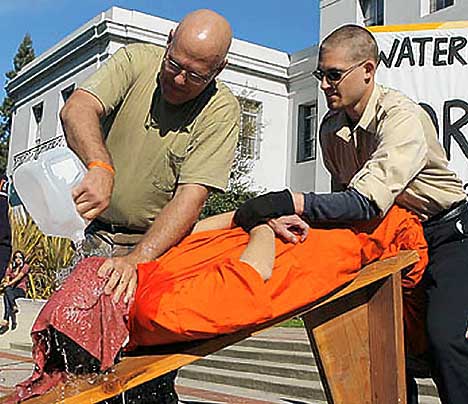
CIA Tactics Endorsed In Secret Memos
Joby Warrick
Washington Post Staff Writer
Wednesday, October 15, 2008; Page A01
The Bush administration issued a pair of secret memos to the CIA in 2003 and 2004 that explicitly endorsed the agency’s use of interrogation techniques such as waterboarding against al-Qaeda suspects — documents prompted by worries among intelligence officials about a possible backlash if details of the program became public.
The classified memos, which have not been previously disclosed, were requested by then-CIA Director George J. Tenet more than a year after the start of the secret interrogations, according to four administration and intelligence officials familiar with the documents. Although Justice Department lawyers, beginning in 2002, had signed off on the agency’s interrogation methods, senior CIA officials were troubled that White House policymakers had never endorsed the program in writing.
The memos were the first — and, for years, the only — tangible expressions of the administration’s consent for the CIA’s use of harsh measures to extract information from captured al-Qaeda leaders, the sources said. As early as the spring of 2002, several White House officials, including then-national security adviser Condoleezza Rice and Vice President Cheney, were given individual briefings by Tenet and his deputies, the officials said. Rice, in a statement to congressional investigators last month, confirmed the briefings and acknowledged that the CIA director had pressed the White House for “policy approval.”
The repeated requests for a paper trail reflected growing worries within the CIA that the administration might later distance itself from key decisions about the handling of captured al-Qaeda leaders, former intelligence officials said. The concerns grew more pronounced after the revelations of mistreatment of detainees at the Abu Ghraib prison in Iraq, and further still as tensions grew between the administration and its intelligence advisers over the conduct of the Iraq war.
Pentagon Challenge: Ask Iraqis How Many Have Died
October 15, 2008This provides an excellent opportunity to revisit an important question:
How many Iraqis have died since the U.S. invasion?
The $15 million-a-year initiative will supplement the military’s $100 million-a-year strategic communications operation, which aims to produce content for Iraqi media that will “engage and inspire” the population, Pincus notes.
The size and scope of the program “will provide an extraordinary amount of data,” said a former government official. Another former official noted that $15 million is far more than the State Department allocates annually for its polling activities worldwide.
Pincus notes that the larger Pentagon project of which this polling is a part has been controversial in Congress. In particular, Senator Webb has asked for suspension of the new Army contracts to produce print, radio and television news stories as well as entertainment programs in Iraq.
While I support Senator Webb’s very reasonable proposal, I would also like to suggest a different approach to the proposed polling project.
Use it.
In particular, I think Congress should require the Pentagon to ask Iraqis the following questions:
“How many members of your household have died since March, 2003? How many members of your household have died since March, 2003 due to violence?”
Inclusion of these questions would allow the U.S. government to estimate how many Iraqis have been killed since the U.S. invasion.
Not only should Congress require the Pentagon to ask these questions, but Congress should require the Pentagon to use the data so gathered to create estimates of Iraqi deaths since 2003, and of how many of those deaths were due to violence. And Congress should require that those numbers be reported to Congress.
When the “Lancet study” (that is, the Johns Hopkins study) estimated two years ago that 600,000 Iraqis had died, President Bush dismissed the study as “not credible,” without offering his own estimate, or explaining why that estimate was “not credible.”
Much ink has been spilled since then in the dispute over estimates of Iraqi casualties (relatively little, however, of that ink has been spilled in our corporate media in the United States.)
Just Foreign Policy publishes an extrapolation of the Lancet study, using the trend which can be inferred from the Iraq Body Count tally. If the Lancet study estimate was roughly correct, and if Iraq Body Count gives a roughly accurate trend, that would suggest more than a million deaths due to violence in Iraq since March 2003, over and above what would have occurred had there been no U.S. invasion.
Now, the Bush Administration has the opportunity to set the record straight. The Pentagon is, apparently, going to be polling Iraqis anyway, so there would be no additional cost. And if the Pentagon is going to be polling Iraqis on a regular basis, then the question could be repeated, so as to arrive at a more accurate estimate.
I double dare the Pentagon to ask Iraqis this question. If the Pentagon is brave, it will agree.
Of course, it could well be that, facing the prospect of being required to come up with its own estimate of Iraqi deaths, the Pentagon would lose interest in polling Iraqis. So be it. But if the Pentagon is going to poll Iraqis, then this simple question should be among the questions that they ask.


The Forgotten U.S. War on the Iraqi People
October 21, 2008By Ghali Hassan | Axis of Logic, Oct 16, 2008, 19:42
On October 3, 2008, the Washington Post reported that the Pentagon is paying $300 million to U.S. contractors to produce pro-U.S. propaganda for Iraqi audiences “in an effort to ‘engage and inspire’ the local population to support U.S. objectives and the puppet government”. The aim of this psychological warfare is to normalise the murderous Occupation and cover-up the slaughter of innocent Iraqi civilians.
As Iraqis continue to suffer, the war on has receded from mainstream media headlines in order to remove people’s historical memory and to provide the Republican Party with a fictitious victory and improves John McCain’s chances of winning the presidency. In the same way the decade-long genocidal sanctions that killed 2 million innocent Iraqi civilians were normalised, journalists and media outlets in the U.S. and in occupied Iraq are promoted and paid to write “good news” stories about the ongoing Occupation.
As a result, few Americans are against the war, and most of the US population still find it acceptable to perpetuate barbarism against defenceless population. The justification and rationalisations for the application of barbaric violence have been based on U.S. euphemistic doctrines with disregard to international law and civilised norms. Despite the enormity of the atrocity in Iraq, Americans have re-elected George Bush in 2004 and continue paying $12 billion per month to propel a criminal war which is destroying an entire society.
Indeed, since World War II, the U.S. has committed unimaginable war crimes against defenceless civilian population, more than any other nation on earth. It is astonishing that a large segment of US society is proud of these horrendous war crimes, and violence continues to play an important role in the US psyche. Just take a look at how the bigoted John McCain is portrayed by the media as a “maverick” and a war “hero” (not a war criminal) and even allowed to (deceptively) distance himself from George Bush and his own Republican Party’s ideology. His incompetence in foreign policy, the economy, and his erratic character and criminal record in Vietnam and Iraq have largely been ignored in the media.
It is certain, if the Republicans are re-elected and John McCain become president, the U.S. will declare a police state and will embark on a war agenda reminiscent of Hitler’s war agenda. The Republican ideology is a Nazis’-like ideology seeking to dominate the world through violence, racism and propaganda. With thousands of U.S. troops have been deployed on U.S. streets to control the population, the people of the United States do not need more serious warnings.
The world ignores U.S. war crimes
Why is the world ignoring the U.S.-perpetuated war crimes and crimes against humanity in Iraq? The primary reasons are: Western media complicity in U.S. war crimes through disinformation and distortion of the situation on ground; and most importantly, Islamophobia. The U.S.-Zionist media play an important role in spreading anti-Muslims propaganda throughout the world, demonising Muslims and distorting Islam in order to manipulate public opinion and justify war crimes against Muslims at home and abroad. Additionally, a deep-seated and inherently widespread dehumanisation of Arabs and Muslims by Western media, the Western ruling classes and opportunist politicians encourages silence and moral bankruptcy.
Recall how in 2003 the US people and a large segment of Western population were manipulated and deceived to support an illegal war of aggression against an entirely defenceless Iraqi population. Deep silence prevailed despite it was well-known that Iraq had neither weapons of mass destruction nor any link to “terrorism”, and that the pretexts were outright lies fabricated in Washington and London. The aggression against Iraq was and still is a crime against humanity and those who supported the crimes have blood on their hands.
Pretexts used to justify the illegal war and occupation
Immediately after the pretexts to justify the invasion were exposed, the U.S. began to engineer and used countless pretexts to justify the ongoing Occupation, including the incitement of massive outbreak of violence. For instance, the U.S.-drafted “Iraqi Constitution” defines Iraqis according to their ethnicities and religious sects. It was designed to divide Iraqis and sow the seeds of hatred and division that defined Iraq today. Hence, the Occupation-generated violence is a deliberate strategy to justify the presence of U.S. troops in Iraq. It is the Bush regime’s strategy to “stay the course”. It has achieved what the U.S. regime has planned before the aggression; the destruction of Iraq’s unity and the establishment of a U.S. military foothold in Iraq.
More than five years of murderous Occupation, George Bush and his criminal accomplices remain unindicted. Moreover, the Bush regime is refusing to withdraw U.S. troops from Iraq and restore the Iraqi freedom and independence. Instead, the Bush regime is bribing and coercing members of the criminal puppet government – whose survival depends on the Occupation – to sign a deal to permanently station U.S. troops in Iraq against the will of the Iraqi people. It is now clear to everyone that the motives for the premeditated aggression and subsequent Occupation are:
The “surge” and ethnic cleansing in Iraq
Meanwhile, the propaganda for a new “victory” in Iraq is in full swing. The so-called “reduction” in violence against Iraqi civilians has much to do with the mass killing and widespread ethnic cleansing that have left less people to kill not the “surge” in troops number as the Bush’s regime alleges. According to the Pentagon Quarterly Report, Iraq has become a nation of ethnically cleansed neighbourhoods, separated by concrete walls dividing communities and preventing free movement. This so-called “neighbourhood homogenisation” has been achieved only through a U.S.-controlled reign of terror and mass murder of Iraqi civilians. Today, a large part of Baghdad’s neighbourhoods have been emptied of their original population. At least 5 million Iraqis are either internally displaced or refugees in neighbouring countries.
Other studies have also pointed out to the ethnic cleansing perpetuated by U.S. forces and U.S.-controlled death squads and militias in reducing some of the violence against Iraqi civilians and have rejected the Bush’s regime propaganda that the “surge” is responsible for the “reduction” in violence. One of these studies is the UCLA Study. While the Study found that “the surge has no observable effect”, it is also deliberately misleading. The Study suggestion that the “surge” designed “to improve the materials condition of life and create a breathing space for political compromise between major factions” in Baghdad is a falsehood. The “surge” is part of the Republicans propaganda campaign which is designed to mislead the American public and provides John McCain with something to say about a murderous Occupation. The reality is that the Occupation remains the root causes of violence and destruction in Iraq.
Furthermore, Iraqi sources reveal that conditions are worsening in the Baghdad once again ‘despite the heavy presence of Iraqi security forces and a surge in number of checkpoints’. U.S. officials say the “surge” is “success”, but they also called the situation “fragile” and “reversible”, means the Occupation will continue.
Another factor that has contributed to the “reduction” in violence is that the U.S. began paying militias, including the Kurdish militia and collaborators to collaborate and stop carrying out killings (executions) anti-Occupation civilians. Additionally, Iran role in restraining Iranian criminals and Iranian-controlled militias and encouraged them to collaborate with the Occupation must be acknowledged.
At the timing of this writing, U.S. troops killed 11 people from one family while conducting a dawn raid on a house in the Seventeen Tammuz neighbourhoods, west of Mosul. It is an established fact that the ongoing violence is controlled by U.S. forces and their collaborators. This has been the norm since 2003. Of course, every time U.S. forces perpetuated a massacre of Iraqi civilians, they cover-up their war crimes by alleging that they have killed “al-Qaeda” fighters. The phantom, which the U.S. created to justify terrorism, keeps growing wherever U.S. forces invade a foreign nation.
The unprovoked criminal invasion and subsequent Occupation of Iraq have resulted in deliberate mass killing and physical destruction of Iraq in whole or in part. Every major population centre has been targeted by a campaign of terror and indiscriminate aerial bombings using all kinds of legally banned weapons of mass destruction. At least 1.3 million innocent Iraqi civilians, mostly women and children, have been killed since 2003. While this figure is a conservative figure, it is still much higher than the Rwandan genocide.
Only the U.S. and Israel (and their allies) could get away with such unimaginable war crimes against innocent civilians and terrorism. In every country the U.S. and its allies have invaded, they brought chaos and insecurity rather than “freedom” and “democracy”, they destroyed rather than build, they brought poverty rather than prosperity, and they sowed the seeds of violence rather than seeds of peace. The ongoing atrocities in Iraq and Afghanistan are just the current examples.
According to the UN Convention on Genocide, there is an ongoing genocide in Iraq. Genocide means any of the following acts committed with intent to destroy, in whole or in part, a national, ethnical, racial, or religious group such as:
Hence, there is overwhelming evidence to charge George Bush and his willing allies and accomplices with war crimes and genocide. An indictment of Western leaders with war crimes and crimes against humanity could pave the way for a peaceful and just world and reduce the eventuality of premeditated and unprovoked war of aggression.
Finally, the Pentagon-funded propaganda campaign is a psychological warfare designed to whitewash a murderous Occupation. The only way to end the colonial Occupation of Iraq and stop the mass slaughter of innocent Iraqi civilians is the immediate withdrawal of all U.S. troops and mercenaries from Iraq.
© Copyright 2008 by AxisofLogic.com
This material is available for republication as long as reprints include verbatim copy of the article its entirety, respecting its integrity. Reprints must cite the author and Axis of Logic as the original source including a “live link” to the article. Thank you!
Share this:
Tags:George W. Bush, Iraqi people, John McCain, jutifying illegal occupation, Pentagon, pro-US propaganda, UCLA study, US crimes against humanity in Iraq, US war crimes in Iraq, US-Zionist media, war crimes, Washington Post
Posted in Commentary, Human rights, Iraq, US policy, War Criminals | Leave a Comment »